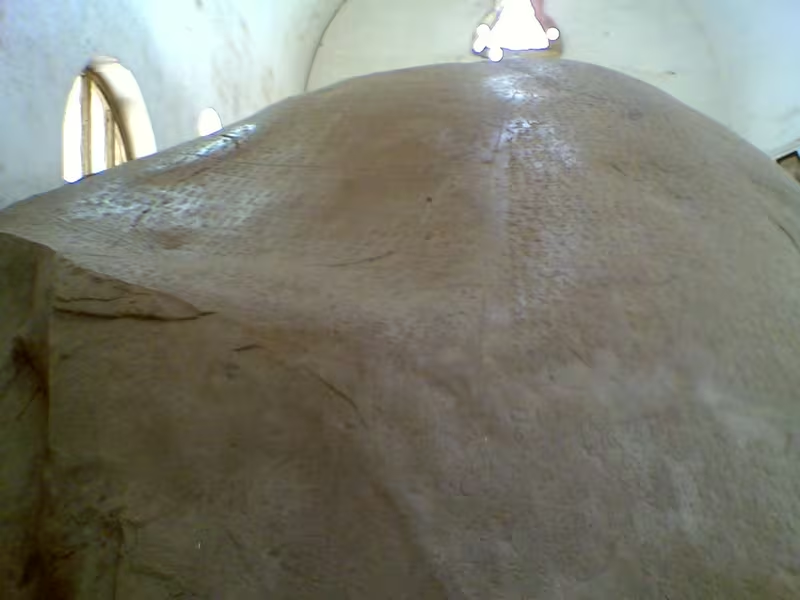
Junagadh Rock Inscription of Rudradaman: Water, Kingship, and Sanskrit on Stone
Carved into a major rock near the base of Girnar hill, the Junagadh rock inscription of Rudradaman preserves a record of water management, royal achievement, and the changing language of public commemoration in ancient India. The inscription is located east of the town of Junagadh in Gujarat and is dated to shortly after 150 CE. It is the second of three significant inscriptions on the rock: an earlier version of one of Ashoka’s Major Rock Edicts, the inscription of Rudradaman I, and a later inscription of Skandagupta of the Gupta Empire. Written entirely in Sanskrit prose, it contains twenty lines spread across an area about 5.5 feet high and 11 feet wide. Its first section records the history of Sudarshana Lake and its irrigation conduits from the reign of Chandragupta Maurya onward. Its concluding twelve lines praise Rudradaman, making the monument both a historical record and a royal eulogy.
Discovery and Provenance
Discovery
The circumstances of the inscription’s initial discovery are not recorded in the historical account. Its modern scholarly study began when James Prinsep, known for his work with the Brahmi script, first edited and translated it in April 1838. The inscription subsequently attracted visits, revisions, and publications by Lassen, Wilson, Fleet, Bhagvanlal Indraji, Bhau Daji, Eggeling, Burgess, and Kielhorn.
Journey Through History
The inscription remains on the major rock near Junagadh, where it forms part of a sequence of records created over several centuries. The oldest inscription on the rock is associated with Ashoka. Rudradaman’s text was added later, shortly after 150 CE, and the inscription of Skandagupta represents the final major addition described in the historical record.
Current Home
The inscription remains at the rock east of Junagadh, near Girnar mountain in Gujarat. It is not identified with a museum collection or accession number.
Physical Description
Materials and Construction
The text is carved into a natural rock surface. The inscription has twenty lines of varying lengths. The characters are about seven-eighths of an inch high. Kielhorn identified the alphabet as an earlier form of the “decidedly southern alphabet” seen in later Gupta-period inscriptions and in the record of Skandagupta.
Dimensions and Form
The inscribed area measures about 5.5 feet in height and 11 feet in width. The lines are arranged across the rock face, with the opening sixteen lines differing in length and suffering extensive damage.
Condition
The first sixteen lines are incomplete in places. About 15 percent of the text has been lost, with evidence of both deliberate damage and natural peeling of the rock. The final four lines remain complete and are in good condition.
Artistic Details
The inscription is not described as a sculptural or decorative work. Its principal formal feature is the transition from a historical account of water infrastructure to a praise poem in prose dedicated to Rudradaman I.
Historical Context
The Era
The inscription was created during the rule of Rudradaman I of the Western Satraps, shortly after 150 CE. It refers back to earlier Mauryan activity at Sudarshana Lake and records later work undertaken during the reign of Ashoka. It also preserves the ancient names of the regional landscape: Junagadh was known as Girinagara, while Girnar mountain was called Urjayat.
Purpose and Function
The inscription served two connected purposes. Its first eight lines documented the construction and maintenance of a reservoir and its irrigation conduits. Its final twelve lines praised Rudradaman I, whose name is explained as meaning “garland of Rudra.”
Commissioning and Creation
The inscription was created under Rudradaman I. The names of the individual stonecutter or scribe are not given. The record states that Sudarshana Lake was constructed during the reign of Chandragupta Maurya by the Vaishya Pushyagupta. During the reign of Ashoka, a Yavana king named Tushaspha built conduits associated with the lake.
Significance and Symbolism
Historical Importance
The Junagadh inscription is significant as a record of public works in ancient India. It preserves information about water management nearly five hundred years before the inscription itself was created. Its references to Pushyagupta and Tushaspha also suggest a tradition of maintaining historical records about public projects and their administrators.
Artistic Significance
The inscription is the first long surviving record written entirely in more or less standard Sanskrit. Salomon describes it as a turning point in the history of epigraphic Sanskrit and as the prototype of the later poetic prasastis associated with the Gupta era.
Religious/Cultural Meaning
The inscription’s eulogy presents Rudradaman through formal royal praise. Its cultural significance also lies in its use of Sanskrit prose for an extensive public inscription, even though the language does not follow every rule of strict classical Sanskrit.
Inscriptions and Text
The language is Sanskrit, written in an earlier form of the alphabet later associated with southern and Gupta-period inscriptions. The opening section recounts the history of Sudarshana Lake from the Mauryan period to the second century CE. The final twelve lines praise Rudradaman I.
The Sanskrit is generally of a good classical standard but includes non-standard features. Kielhorn noted that sandhi rules are disregarded at least ten times, while the text also has relatively few verbal forms. Its orthography varies in the treatment of anusvara, visarga, double consonants, and the retroflex ḷ. These features may reflect epic-vernacular and local dialect influences, although the inscription approaches classical Sanskrit norms.
Scholarly Study
Key Research
James Prinsep produced the first edited translation in 1838. Later work included contributions by Lassen, Wilson, Fleet, Bhagvanlal Indraji, Bhau Daji, Eggeling, and Burgess. Kielhorn’s translation was published in Epigraphia Indica, Volume VIII, and formed the basis for the translation described in the historical record.
Debates and Controversies
Scholarly discussion has focused on the inscription’s language, orthography, and damaged passages. The missing sections appear to result from both deliberate damage and natural peeling. Researchers have also examined whether departures from strict classical Sanskrit reflect clerical errors, local speech, or an early prose style.
Legacy and Influence
Impact on Art History
The inscription established an early model for the Sanskrit prasasti, or royal eulogy. Although Rudradaman’s Western Satrap successors preferred a less formal hybrid Sanskrit, the literary style of this record anticipated later Gupta-period inscriptions.
Modern Recognition
The inscription remains notable for combining a record of ancient irrigation works with one of the earliest long surviving Sanskrit compositions in epigraphic form. Its study has also helped preserve the ancient names of Junagadh and Girnar.
Viewing Today
The inscription is located on the Junagadh rock east of Junagadh, near the base of Girnar mountain in Gujarat, India. The same rock contains inscriptions associated with Ashoka and Skandagupta.
Conclusion
The Junagadh rock inscription of Rudradaman brings together infrastructure, political memory, regional geography, and Sanskrit literary expression. Its account of Sudarshana Lake reaches back to the reign of Chandragupta Maurya, mentions work undertaken during Ashoka’s reign, and culminates in a praise of Rudradaman I around 150 CE. Its damaged upper section and well-preserved final lines reveal both the vulnerability and durability of writing on stone. More broadly, the inscription marks a decisive stage in the history of epigraphic Sanskrit: it is the first long surviving inscription composed entirely in more or less standard Sanskrit and an early prototype for the poetic royal records of the Gupta era.