Overview
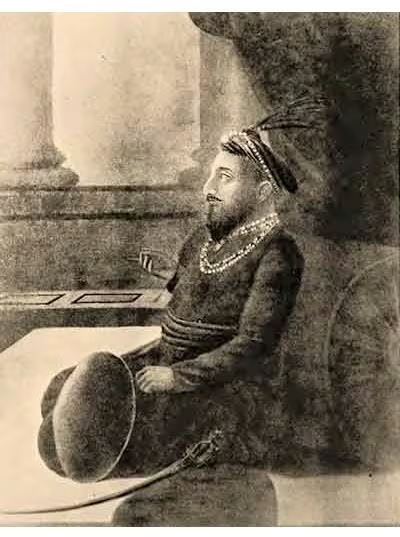
In 1717, Mughal emperor Farrukhsiyar recognised Murshid Quli Khan as the hereditary Nawab Nazim of Bengal. That decision formalised a political transformation already under way: Bengal's provincial premier had become the effective ruler of Bengal, Bihar and Orissa. The nawab continued to acknowledge the Mughal emperor and to issue coins in his name, but the government in Murshidabad exercised practical independence.
The nawabs ruled from Murshidabad, a centrally placed city within their extensive territory. Their authority stretched from the border of Oudh in the west to the border of Arakan in the east. The province remained formally connected to the Mughal Empire, yet the weakening of imperial power allowed its governors to consolidate their own administration, revenue systems and military forces.
The Nawabs of Bengal presided over a wealthy and commercially active region. Dhaka and Sonargaon were associated with the muslin trade, Murshidabad became a major silk centre, Chittagong supported shipbuilding, and Patna was known for metalworking and military production. Bengal, Bihar and Orissa also supplied gunpowder and saltpetre to overseas markets. European companies established trading posts throughout the region, while Indian bankers such as the Jagat Seth family financed both the nawabs and foreign merchants.
This prosperity did not guarantee political security. Afghan revolts, Maratha raids, strained relations with zamindars and succession disputes weakened the state. The British East India Company eventually exploited these pressures. The Battle of Plassey in 1757 ended the independence of the nawabs in practice, and the Battle of Buxar in 1764 opened the way for the Company's expansion across northern India.
Rise to Power
The Mughal conquest of Bengal in the sixteenth century placed the region within a provincial system known as the Bengal Subah. Two branches of government were especially important. The nizamat, headed by the subahdar or viceroy, dealt with executive and military authority. The diwani, led by the diwan or provincial premier, was responsible for revenue and legal affairs.
In theory, the subahdar occupied the higher position. In practice, the growing distance between Bengal and the imperial court, combined with rivalries within the provincial administration, allowed the diwan to accumulate power. The Mughal court relied heavily on Bengal's revenue, which made control of its finances especially important.
Azim-us-Shan, the Mughal viceroy of Bengal, entered into a bitter power struggle with his prime minister, Murshid Quli Khan. In 1703, Emperor Aurangzeb transferred Azim-us-Shan out of Bengal to Bihar. With the viceroy removed, Murshid Quli Khan emerged as the effective ruler of Bengal. His administrative coup brought the offices of diwan and subedar together under his authority.
In 1716, Murshid Quli Khan moved the provincial capital from Dhaka to a new city named after him: Murshidabad. The following year, Farrukhsiyar recognised him as hereditary Nawab Nazim. His jurisdiction included Bengal, Bihar and Orissa, making the new office much more than a local governorship.
The shift to Murshidabad reflected both geography and political strategy. The city was centrally located within the three provinces and became the seat of the court, revenue administration and military authority. Dhaka retained considerable importance as the former provincial capital and as the centre of eastern Bengal. Its deputy, the Naib Nazim of Dhaka, controlled much of the east and possessed considerable wealth.
The nawab's power was supported by a network of officials and local elites. Important authorities were stationed in Dhaka, Patna, Cuttack and Chittagong. The zamindars of Bengal formed the aristocracy, although their relationship with the nawab was frequently unstable. Financial support came from the Jagat Seth family of bankers and money lenders, who controlled the flow of Bengali revenue to the Mughal treasury in Delhi and financed European companies operating in the region.
Golden Age
The Bengal Subah reached its peak during the reign of Nawab Shuja-ud-Din Muhammad Khan. His rule brought a period of economic and political consolidation. The wealth of the province rested on both agricultural revenue and an extensive production and trading system that connected Bengal and Bihar with markets across Eurasia.
Shuja-ud-Din invested in the development of Murshidabad. His royal complex, Farrabagh—meaning “Garden of Joy”—included a palace, military base, city gates, revenue office, public audience hall and mosques. Canals, fountains, flowers and fruit trees formed part of the compound. The complex embodied the political importance of the new capital and the courtly culture of the nawabs.
The period's prosperity was visible in the diversity of production. Dhaka and Sonargaon were major centres of cotton muslin, a fabric whose worldwide demand generated substantial revenue. Murshidabad was associated with silk production. Chittagong's shipbuilding served Ottoman and European demand, while Patna developed metalworking and a military-industrial sector. Bengal and Bihar were also major exporters of gunpowder and saltpetre.
The region's commercial life attracted merchants from across Eurasia. Traders were accommodated in caravanserais such as the Katra Masjid in Murshidabad and the Bara Katra and Choto Katra in Dhaka. Dutch activity included the port of Pipeli in Orissa, a settlement in Rajshahi and trading centres at Cossimbazar and Hugli. The Danes established posts at Bankipur and on islands in the Bay of Bengal. Balasore in Orissa became a prominent Austrian trading post.
These settlements were not isolated European enclaves. Bengali cities brought together brokers, workers, peons, naibs, wakils and ordinary traders. The European companies depended on local commercial networks, artisans, financiers and officials. The nawab's court regulated this environment while benefiting from its revenue.
Administration and Governance
The nawabs maintained the forms of Mughal sovereignty while exercising increasingly independent authority. Their continued use of the Mughal emperor's name on coins expressed formal allegiance, and Bengal continued to send a large share of its funds to the imperial treasury in Delhi. Yet the nawabs governed as independent monarchs in nearly every practical respect.
The merging of the diwani and subedari under Murshid Quli Khan concentrated revenue collection and executive authority in one office. This arrangement allowed the court to monitor the province's financial resources more closely. It also helped Murshid Quli Khan establish Murshidabad as the political centre of Bengal.
The administrative structure depended on both appointed officials and local elites. The Naib Nazim of Dhaka served as the nawab's chief deputy and governed much of eastern Bengal. Officials in Patna, Cuttack and Chittagong extended the reach of the provincial government. Zamindars collected revenue in their territories, but their loyalty could not be assumed.
Bihar presented a particular challenge. Its zamindars maintained a tenuous relationship with the nawabs and frequently withheld revenue or rebelled. Records described the chiefs as “continually in arms.” Although Bihar possessed the potential to provide substantial income, the nawabs were unable to extract significant sums from its chiefs until 1748, and even afterward the amount remained low.
Revenue pressure could be severe. Murshid Quli Khan became notorious for coercive tax collection, including the use of torture against those who failed to pay. His reputation therefore combines administrative effectiveness with harsh fiscal practices. He was also remembered as Shuja ul-Mulk, or “hero of the country,” particularly for repelling Maratha invasions of Bengal.
The financial system extended beyond the provincial court. The Jagat Seth family served as bankers to the nawabs, the Mughal court and European companies. Their role reveals how political authority depended on private finance. Control of revenue flows could shape military decisions, succession disputes and relations with foreign trading companies.
Military Campaigns
The nawabs inherited a militarised frontier and a province exposed to threats from several directions. Bengal maintained fortifications including Idrakpur Fort, Sonakanda Fort, Hajiganj Fort, Lalbagh Fort and Jangalbari Fort. Its forces possessed notable artillery, and the region was known for naval activity and shipbuilding. The Mughal authorities had previously expelled Arakanese and Portuguese pirates from the northeastern coast of the Bay of Bengal.
The most sustained military challenge came from the Maratha Empire. Maratha raids began in 1741 and continued for roughly a decade. The campaigns included the First and Second Battles of Katwa, the Battle of Burdwan, the Battle of Rani Sarai, the Battle of Birbhum and the First and Second Battles of Midnapur.
Nawab Alivardi Khan fought repeatedly against the Marathas and succeeded in repelling their attacks in several engagements. The raids nevertheless caused extensive devastation. Contemporary accounts described the killing of civilians, including textile weavers, silk workers and mulberry cultivators, as well as the flight of people from western Bengal to eastern Bengal. The accounts also record mutilation and sexual violence. These descriptions should be read as evidence of the severe human cost of the conflict rather than only as a record of military movements.
The Maratha expeditions were led by Raghuji Bhonsle of Nagpur. They established de facto Maratha control over Orissa, which was formally incorporated into the Maratha Empire in 1752. Alivardi Khan, fearing further destruction, agreed to pay an annual chauth of 1.2 million rupees for Bengal and Bihar. In return, the Marathas agreed not to invade Bengal again.
Bengal also faced four Afghan insurrections between 1745 and 1750. These revolts were led by ambitious Afghan figures including Mustafa Khan, Sardar Khan and Shamshir Khan, who sought to establish their own Afghan state in Bengal. The nawab's government ultimately suppressed the insurrections.
The decisive military crisis came from the British East India Company. Siraj-ud-Daulah, successor to Alivardi Khan, was increasingly suspicious of the Company's presence. He also feared attacks by the Durrani Empire from the north and the Marathas from the west. On 20 June 1756, he besieged Calcutta and captured the British base at Fort William.
The Company responded by sending a fleet under Robert Clive. By January 1757, British forces had retaken Fort William. The confrontation continued, intensified by Siraj-ud-Daulah's cooperation with the French East India Company during the wider Seven Years' War.
On 23 June 1757, the Battle of Plassey transformed the political order of Bengal. Siraj-ud-Daulah and his French allies were caught off guard when Mir Jafar, the nawab's commander-in-chief, defected to the British. The British victory gave the East India Company enormous influence over Bengal. Siraj-ud-Daulah was later arrested by former officers and killed in revenge for his treatment of courtiers.
Mir Jafar was installed as nawab under British influence. When he entered into a secret treaty with the Dutch East India Company, the British replaced him with his son-in-law, Mir Qasim, in October 1760. Mir Qasim ceded Chittagong, Burdwan and Midnapore to the Company. He initially appeared to be an effective and popular ruler, but his independent policies soon brought him into conflict with the British.
Mir Qasim moved his capital to Munger and raised an independent army. He attacked British positions at Patna, overran Company offices and killed its resident. He also attacked the British-allied Gorkha Kingdom. Mir Qasim then joined forces with Shuja-ud-Daula of Awadh and Mughal emperor Shah Alam II.
Their defeat at the Battle of Buxar in 1764 was more consequential than the earlier reversal at Plassey. The defeat of Mir Qasim, Shuja-ud-Daula and Shah Alam II removed the last major opportunity to prevent British expansion across the northern Indian subcontinent.
Cultural Contributions
The nawabs were patrons of the arts and supported a courtly culture centred on Murshidabad. The city developed its own style of Mughal painting, known as the Murshidabad style. Court patronage also supported Hindustani classical music, the Baul tradition and local craftsmanship.
Architecture expressed both administrative power and cultural ambition. Farrabagh, developed during Shuja-ud-Din Muhammad Khan's reign, combined residential, military, financial, ceremonial and religious functions. Its canals, fountains, flowers and fruit trees gave the political centre the character of a carefully designed garden complex.
The commercial cities of the nawab's territories also fostered craftsmanship. Muslin weaving in Dhaka and Sonargaon, silk production in Murshidabad, metalworking in Patna and shipbuilding in Chittagong linked technical skill to long-distance trade. These industries were not merely courtly luxuries; they formed part of the fiscal and commercial base of the state.
After British control expanded, the descendants of Mir Jafar continued to live in Murshidabad. Hazarduari Palace was built in the 1830s as a residence for the nawabs and was also used by British colonial officials. Its later history reflects the transformation of Murshidabad from an independent court into a centre of aristocratic memory under colonial rule.
Economy and Trade
The wealth of Bengal rested on a broad production zone linking Bengal, Bihar and Orissa. The region manufactured cotton muslin, silk cloth, ships, gunpowder, saltpetre and metal goods. The variety of production gave the nawab's government access to both domestic revenue and international commercial networks.
Muslin production was concentrated around Dhaka and Sonargaon. The worldwide demand for this fine cotton cloth enriched merchants and generated income for the nawab. Murshidabad's silk industry gave the capital an economic importance that complemented its political role. Chittagong's shipbuilding responded to Ottoman and European demand, while Patna's metalworking supported military production.
European companies established factories and trading posts in many of the region's cities and ports. The British, French, Danish, Austrian and Dutch companies all operated in the Bengal-Bihar-Orissa commercial sphere. Their presence created opportunities for export but also introduced powerful organisations with their own armed forces, diplomatic aims and financial resources.
Murshidabad, Dhaka, Patna, Sonargaon, Chittagong, Rajshahi, Cossimbazar, Balasore, Pipeli and Hugli were among the centres associated with production or trade. The commercial system depended on many occupations: brokers arranged transactions, workers produced goods, peons and officials carried out administrative tasks, naibs and wakils represented interests, and ordinary traders moved goods through towns and ports.
The nawabs were financially connected to the Mughal imperial system even as their political autonomy grew. Bengal continued to provide the largest share of funds to the treasury in Delhi. At the same time, bankers such as the Jagat Seths financed the provincial government and European companies. This made Bengal a financial backbone of the Mughal court and a prize for any power seeking control of northern India's resources.
Decline and Fall
The decline of the nawabs resulted from several pressures rather than a single failure. The weakening of Mughal authority made provincial independence possible, but it also deprived Bengal of a powerful imperial framework. Internal succession conflicts, Afghan insurrections, Maratha raids and resistance from Bihar's zamindars all placed demands on the state.
The rise of the European companies created a new problem. These organisations were commercial bodies with military forces and international alliances. The British East India Company increasingly rivalled the authority of the nawab. Siraj-ud-Daulah's attempt to remove the British from Calcutta in 1756 led directly to the Company's counterattack and the Battle of Plassey.
After Plassey, the nawab's office survived but lost its independence. Mir Jafar and Mir Qasim showed that the British could determine succession, demand territorial concessions and intervene in provincial politics. Mir Qasim's effort to restore autonomy ended at Buxar.
In 1765, Robert Clive, acting for the East India Company, received the Diwani of Bengal from Mughal emperor Shah Alam II. A system of dual government followed: the nawab retained responsibility for the nizamat, while the Company controlled the diwani and therefore the revenue administration. This arrangement left the nawab with authority in form but deprived him of the financial foundation required for independent rule.
In 1772, Governor-General Warren Hastings moved administrative and judicial offices from Murshidabad to Calcutta, the capital of the newly formed Bengal Presidency and the de facto capital of British India. The nawabs had already lost independent authority since 1757; the relocation made the change in political geography unmistakable.
In 1793, the Mughal emperor ceded the nizamat of Bengal to the Company as well. The Nawab of Bengal was reduced to a titular position and became a Company pensioner. The British government abolished the symbolic authority of the Mughal court in 1858 after the end of Company rule and the beginning of Crown rule in India.
Nawab Mansur Ali Khan was the last titular Nawab Nazim of Bengal. His administration at Murshidabad became heavily indebted. He left the city in February 1869 and began living in England. After returning to Bombay in October 1880 and failing to resolve his dispute with the government, he renounced his styles and titles on 1 November 1880 in favour of his eldest son. The title of Nawab of Bengal was abolished.
The Nawabs of Murshidabad succeeded the Nawab Nazims. Their members remained wealthy and continued to produce bureaucrats and army officers, but they were reduced to the status of zamindars and exercised no significant political power.
Legacy
The history of the Nawabs of Bengal connects the weakening of Mughal authority with the rise of the East India Company. The nawabs were not simply passive figures between empire and colonial rule. They built a powerful provincial administration, managed a wealthy production system, fought major wars and maintained a court that supported painting, music, craftsmanship and architecture.
Their period also shows the costs of political and economic wealth. Bengal's textile and industrial production attracted European companies, while its revenue attracted financiers and military powers. The same commercial prosperity that made the province important made it a target for intervention.
Murshidabad remains central to the memory of the nawabs. Farrabagh represented the ambitions of an independent provincial court, while Hazarduari Palace reflects the later world of aristocratic survival under British rule. The transition from Murshidabad to Calcutta marked more than a change of capital: it signalled the transfer of administrative and financial power from the nawab's court to the Company.
Plassey and Buxar became turning points in the making of British power in India. Plassey installed a British-backed nawab and gave the Company decisive influence in Bengal. Buxar defeated the combined forces of the nawab of Bengal, the nawab of Awadh and the Mughal emperor, making wider British expansion possible. Through these events, the history of Bengal became a central part of the political transformation of the subcontinent.