Overview
From bases in western Odisha, the Somavamshi or Keshari dynasty expanded toward the coast and reshaped the political and religious landscape of medieval Odisha. Their rule is generally placed between the ninth and early twelfth centuries, with the earliest securely known ruler, Mahashivagupta I—also called Janamejaya I—reigning approximately from 882 to 922. The dynasty’s capitals included Vinitapura, identified with modern Binka, and Abhinava-Yayatinagara, identified with modern Jajpur.
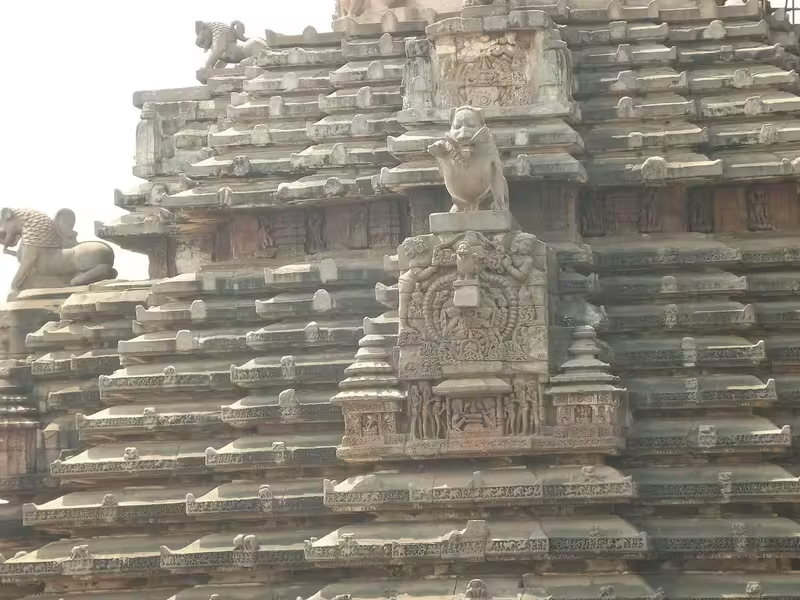
The Somavamshis are associated with the decline of Buddhist prominence and the strengthening of Brahmanical religious institutions, especially Shaivism. Their reign also saw the emergence of a new architectural language in Odisha. Temples connected with this period include the Brahmeswara, Lingaraja, Mukteshvara and Rajarani temples, although the inscriptional evidence does not attribute all of them directly to Somavamshi rulers.
The dynasty’s origins remain uncertain. Several features connect it with the Panduvamshis of Dakshina Kosala: both claimed lunar descent, some rulers used names ending in -gupta, and both traditions employed related royal titles. The early Somavamshis ruled in western Odisha, an area that had once formed the eastern part of Dakshina Kosala. Yet a direct dynastic relationship has not been conclusively established.
Rise to Power
One influential theory holds that the Panduvamshis were displaced from Dakshina Kosala by the Kalachuris and migrated eastward. They may then have established themselves at Vinitapura on the Mahanadi River. The rulers whose authority was initially limited to the area around Vinitapura are commonly described as the “early” Somavamshis. Later rulers, whose power extended across a much larger portion of Odisha, are called the “later” Somavamshis.
The evidence behind this reconstruction includes royal titles, scripts and grants. The earliest known Somavamshi king, Mahashivagupta I or Janamejaya I, was called Kosalendra, meaning “lord of Kosala,” in the Chaudwar inscription. Several Somavamshi records mention grants to people from Kosala, villages located in Kosala, and officers associated specifically with that region. These connections suggest that Kosala remained central to the dynasty’s political identity even as its rulers moved toward eastern Odisha.
Janamejaya I appears to have consolidated his authority through a combination of military action, marriage alliances and the movement of the royal court. His daughter married the Bhauma-Kara king Shubhakara IV. After Shubhakara’s death, the Bhauma-Kara kingdom was ruled by his brother Shivakara III. Around 894, Janamejaya’s daughter came to the throne as Tribhuvana-Devi II, apparently with her father’s support.
The exact circumstances of this succession are debated. An inscription at the Brahmeswara Temple states that the king of the Odra country was killed by Janamejaya’s spear. Historian Krishna Chandra Panigrahi identified this ruler with Shivakara III and proposed that Janamejaya installed his daughter after killing him. Other historians interpret “Odra” more narrowly, as a district centred on the modern Dhenkanal area, and identify the defeated ruler as a rebellious Bhanja vassal rather than the Bhauma-Kara king. The inscription confirms military intervention, but it does not settle the larger political question.
Janamejaya’s long reign is documented by numerous copper-plate grants issued from different “victorious camps.” Such records suggest that the king travelled through his kingdom while consolidating authority. In his thirty-first regnal year, he issued three grants from Kataka, identified with Chaudwar near modern Cuttack. This indicates that Somavamshi influence had reached eastern Odisha by the end of his reign.
Golden Age
Janamejaya I was succeeded by his son Yayati I, who ruled approximately from 922 to 955. Yayati continued the expansion and consolidation of the kingdom. His inscriptions record extensive village grants in Dakshina Kosala, the dynasty’s traditional heartland, but they also document authority over territories that had previously belonged to other political formations.
Yayati’s records were issued at Yayatinagara, probably the earlier Somavamshi capital Vinitapura renamed after the king. The capital was later shifted to Guheshvarapataka, the former Bhauma-Kara capital at modern Jajpur. It was renamed Abhinava-Yayatinagara, meaning “the new city of Yayati.” The changing names of these cities reflect both political expansion and the dynasty’s effort to associate conquered or inherited centres with its own royal identity.
The extent of Somavamshi control over Odisha during Yayati I’s reign cannot be fixed with complete certainty. It may have been achieved by his time, or consolidated gradually under later rulers. His inscriptions nevertheless show that the dynasty had moved beyond its western base. Chandagrama, identified with Changan south-east of Cuttack, had earlier belonged to the Bhauma-Kara sphere. Gandatapati, identified with modern Gandharadi, had been located in Bhanja territory. Their appearance in Somavamshi grants indicates that the dynasty had extended its reach into areas previously governed by rival powers.
Yayati I is also traditionally credited with rebuilding a temple at Puri and reinstalling the image of Purushottama, identified with Jagannatha. According to the historical tradition surrounding the region, an image of Jagannatha had been removed during a Rashtrakuta invasion around 800. The account of Yayati’s role is important to the religious history of Odisha, though the broader temple tradition combines historical memory with later narrative development.
The Somavamshi period marked a turning point in Odisha’s architectural history. Temples began to display forms, ornamentation and iconography not previously seen in the region. This style may reflect the dynasty’s connections with central India. The transition was not simply a matter of royal building activity; it was also tied to changing religious institutions, patronage networks and the increasing prominence of Brahmanical worship.
Administration and Governance
The surviving records reveal a monarchy that exercised authority through land grants, royal camps, regional officers and relationships with local chiefs. Copper-plate inscriptions record grants of villages, often to religious beneficiaries. These documents are especially valuable because they identify places, officials, political titles and administrative connections that are otherwise difficult to reconstruct.
Janamejaya’s grants from different victorious camps suggest that the court was not permanently confined to a single capital. Movement allowed the ruler to display authority across newly consolidated territories. It also connected the central monarchy with local administrative structures. The frequent appearance of Kosala-related officers and beneficiaries shows that the older regional organisation remained important within the expanding kingdom.
The inscriptions are written in Sanskrit. Somavamshi stone inscriptions use the Nagari script, as do stone inscriptions beginning with the reign of the Panduvamshi ruler Balarjuna. Earlier Panduvamshi copper plates used “box-headed” characters, while Somavamshi copper plates share features with records of the Śarabhapuriyas and Panduvamshis and generally consist of three plates.
The available evidence does not provide a detailed account of taxation, currency or a uniform bureaucratic system. It does, however, show a political order in which royal grants, local territorial units and recognised officers helped connect the monarchy with villages and religious institutions.
Military Campaigns
The dynasty’s rise involved both direct warfare and political alliances. Janamejaya I made inroads into the Bhauma-Kara kingdom, while his daughter’s marriage and subsequent accession created a close relationship between the two royal houses. Whether Janamejaya personally killed a Bhauma-Kara ruler remains disputed, but his reign clearly involved military intervention in eastern Odisha.
The Somavamshis also expanded into territories linked with the Bhanjas. Their growing authority over Utkala and the coastal region appears to have been achieved over more than one reign. During the reigns of Janamejaya I and Yayati I, inscriptions record grants in places formerly outside the dynasty’s core territory.
The kingdom later suffered serious reversals. The most notable invasion was the Chola attack on Yayatinagara in 1021. There is also evidence for invasions by the Paramaras of Malwa and the Kalachuris of Tripuri. The records do not preserve a full narrative of these campaigns, but the attacks exposed the vulnerability of the Somavamshi kingdom and contributed to the loss of territory.
Yayati II, also known as Chandihara, led a revival after the troubled reigns of Bhimaratha, Dharmaratha and Nahusha. He was a younger cousin of Nahusha and descended from Janamejaya I through Vichitravirya and Abhimanyu. According to the Brahmeswara Temple inscription, ministers appointed Yayati II and he restored order to the kingdom. He re-established authority over Kosala and Utkala, which had been lost to rival chiefs.
Somavamshi records describe Yayati II as lord of Kalinga, Kosala and Utkala. They also claim victories in distant Gurjara and Lata. These wider conquests are generally regarded as poetic exaggerations because independent historical evidence does not support them.
Cultural Contributions
The Somavamshi kings were Shaivite Hindus. The Pashupata and Mattamayura schools of Shaivism appear to have been influential during their period. At the same time, the dynasty ruled during a broader transition from Buddhism toward Brahmanism, a process that had begun under the Bhauma-Karas and accelerated under Somavamshi rule.
Uddyotakeshari, the successor of Yayati II, is associated with temple and water-work restoration. His mother, Kolavati Devi, dedicated the Brahmeswara Temple at modern Bhubaneswar in the eighteenth year of his reign. The construction of the Lingaraja Temple probably began toward the end of Uddyotakeshari’s reign and was completed under his successor, Janamejaya II. Uddyotakeshari also patronised the Jains of Udayagiri, showing that the religious landscape was not exclusively Shaivite.
Several major temples in Bhubaneswar are dated to the Somavamshi period, including the Mukteshvara, Lingaraja and Rajarani temples. Traditional accounts credit the dynasty with extensive temple construction, and the Madala Panji attributes many Bhubaneswar temples to Yayati Keshari. That figure appears to combine the historical rulers Yayati I and Yayati II. Of these monuments, the Brahmeswara Temple is the only one explicitly attributed to the Somavamshis by an inscription.
A later legend states that Yayati Keshari brought 10,000 Brahmins from Kanyakubja for an ashvamedha, or horse sacrifice. This story reflects the dynasty’s remembered role in promoting Brahmanical institutions, but it should be distinguished from the more securely documented evidence of inscriptions and surviving buildings.
Economy and Trade
The inscriptions provide more information about landholding and religious grants than about commerce. Royal copper plates record the donation of villages and agricultural resources, linking the court to local communities and religious beneficiaries. Grants in Kosala, Utkala and former Bhauma-Kara or Bhanja territories also reveal the administrative and economic integration of expanding regions.
The use of multiple royal camps and capitals indicates the importance of controlling territory along the Mahanadi and across the routes connecting western Odisha with the coast. However, the surviving evidence does not permit a detailed reconstruction of trade networks, taxation rates or monetary circulation. It is safest to view the economy through the documented system of villages, land grants, officers and temple patronage rather than through assumptions about commercial institutions.
Decline and Fall
After Uddyotakeshari, Somavamshi power declined gradually. The Kalachuris of Ratnapura conquered parts of the western kingdom and reached their height during this period. The dynasty also lost territory in the north-west to the Nagas and in the south to the Gangas.
The kingdom’s shrinking boundaries reveal the cumulative nature of its decline. External invasions, the rise of regional powers and the loss of earlier conquered territories weakened the central monarchy. By the reign of Karnadeva, the last Somavamshi ruler, the kingdom had been reduced to a coastal tract between the present-day Balasore and Puri districts.
In 1114, the Eastern Ganga ruler Anantavarman Chodaganga captured the remaining Somavamshi territories. This marked the end of Somavamshi rule as an independent political power in Odisha and opened the way for Ganga expansion.
Legacy
The Somavamshi dynasty’s most lasting legacy lies in the political and cultural foundations it helped establish in medieval Odisha. Its rulers connected western Odisha with the coastal regions, strengthened the position of Kosala and Utkala within a larger kingdom, and patronised religious institutions associated particularly with Shaivism and Brahmanism.
Their period is also central to the development of Odisha’s temple architecture. The Brahmeswara Temple provides the clearest inscriptional link to the dynasty, while the Lingaraja, Mukteshvara and Rajarani temples represent the wider architectural environment of the age. The dynasty’s inscriptions remain essential for understanding royal authority, land grants, regional administration and the changing relationship between political power and religious patronage.