Overview
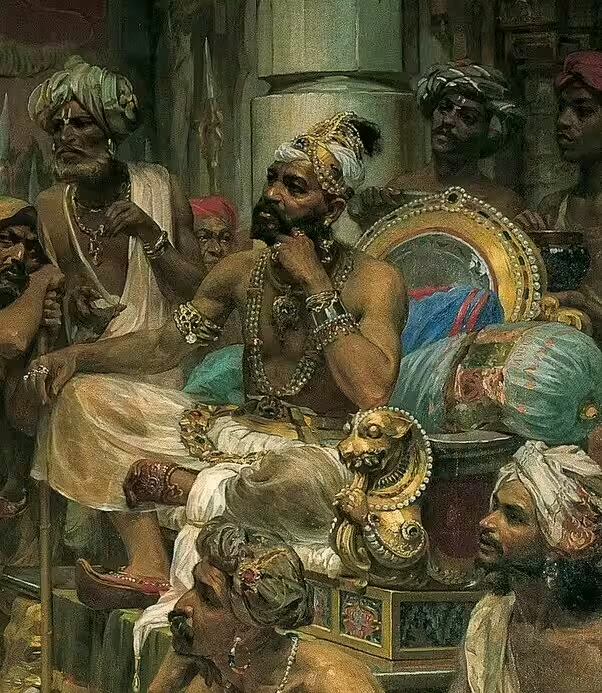
In the late fifteenth century, ships seeking pepper and other Asian commodities gathered at Calicut and Panthalayini Kollam on the Malabar coast. Calicut was not merely a royal residence: it was a port city where Arab, Persian, Chinese, Jewish, Gujarati, Tamil, and Kerala merchants met, exchanged goods, and negotiated with the court. The ruler who presided over this commercial world was known in Malayalam as the Samoothiri and in European languages as the Zamorin.
The Samoothiris emerged from the Eradi ruling house of Eranad. Their earlier seat was at Nediyiruppu, inland from the coast, but their political future was tied to Calicut. By developing the port, extending authority over neighbouring chiefdoms, and protecting the movement of merchants and ships, the Eradis transformed a regional power into the leading political force in much of South Malabar. Their authority was rarely uniform. Some areas were governed directly, while others remained under hereditary chiefs who acknowledged the Zamorin's supremacy, paid dues, and supplied troops.
The dynasty's history extends from the period of the later Kodungallur Cheras to the age of the East India Company. It includes the expansion of Calicut over Polanadu and Valluvanadu, diplomatic contact with the Timurid court at Herat and the Ming court in China, the arrival of Vasco da Gama in 1498, prolonged naval conflict with Portugal, and the eventual conquest of Malabar by Mysore and the British. By 1806, the Zamorin had been reduced from a regional monarch to a pensioned landlord. The royal family, however, retained ritual and institutional importance in northern Kerala.
The title itself has appeared in several forms. Ibn Battuta used a form of the title in 1342. Duarte Barbosa, writing around 1516, recorded forms such as çamidre and zomodri, while Zainuddin Makhdoom II used Sāmuri in the sixteenth century. The English form “Zamorin” is therefore the result of transmission through Arabic, Portuguese, and other languages rather than the original Malayalam pronunciation.
The title was once explained as a Sanskrit-derived expression meaning “lord of the sea.” K. V. Krishna Iyer instead connected it to svami and sri, with tiri representing the combined form, and interpreted the complete title as Svami Tiri Tirumulapad, or “august emperor.” In inscriptions, palace records, and official agreements, the rulers used the title Punturakkon or Punthurakon. Later literary works also used Kunnalakkon, “Lord of Hills and Waves,” and its Sanskrit form Shailabdhishvara. No surviving record securely identifies the personal name of every ruler.
Rise to Power
Eranad and the later Cheras
The origins of the Samoothiri dynasty are connected with Eranad, a region that formed part of the Kodungallur Chera political sphere. The Chera kingdom was not a tightly centralised state in the later imperial sense. It consisted of a collection of chiefdoms and local authorities governed by hereditary rulers. The chief of Eranad is referred to in early records by titles including Eralanadu Utaiyar.
The earliest reference to the ruler and chiefdom of Eranad occurs in the Cochin Jewish copper plate, dated around 1000. Old Malayalam inscriptions later mention titles such as Manvepala Manaviyata, associated with the eleventh century, and Manavikrama, associated with the twelfth. In later periods, Manavikrama, Manaveda, and Viraraya were names used for male members of the royal house, while the ruler himself was consistently known by the title Manavikrama.
The military strength of the Eranad chief was described as a “Six Hundred,” referring to the organisation of warriors under his authority. Other Kerala chiefdoms had comparable formations: Venad, Valluvanad, Ramavalanadu, and Kizhmalanadu are associated with forces of similar size, while Kurumpuranadu is described as having a “Seven Hundred.” These designations reveal a political landscape in which military capacity was organised through local communities and hereditary chiefs rather than through a single permanent state army.
The exact circumstances in which the Eradis acquired Calicut remain uncertain. A widely repeated tradition links their rise to the partition of the Chera kingdom. The Keralolpathi and the Calicut Granthavari preserve versions of this account, but the story is also shaped by Brahmanic legend and cannot be treated as a straightforward contemporary record.
The tradition of the two Eradi brothers
According to the traditional narrative, two brothers of the Eradi ruling family, Manichan and Vikraman, served as trusted warriors of the Kodungallur Chera king. They distinguished themselves in battles against foreign forces. When the Chera kingdom was divided, the Eradi house was initially excluded from the distribution of territory. The king later attempted to compensate the family by granting the younger brother, Vikraman, a marshy tract called Kozhikode.
The king is said to have given Vikraman a broken sword and a broken prayer conch, telling him to conquer as much land as he could. The Eradis then expanded through military campaigns. Their emblem—two crossed swords, a broken conch, and a lighted lamp—was understood as a reminder of their connection with the Chera ruler and of the broken objects that had been presented to them.
This account should be read alongside, rather than in place of, inscriptional evidence. One interpretation holds that the Eradi prince was a favoured member of the inner circle of the last Kodungallur Chera ruler, Rama Kulasekhara, who reigned approximately from 1089 to 1122. An inscription dated 1102 at the Rameshwaram temple in Kollam records a royal council in which Punthurakkon Manavikrama, the chief of Eranad, was present. The assembly included the king, Arya Brahmins, four Brahmin ministers, the leader of a thousand Nairs, the leader of the Six Hundred Nairs of Venad, and other feudatories.
The inscription records an act of penance by the king after an offence against Arya Brahmins. Cereals were donated for the daily feeding of Brahmins, and a revenue-bearing settlement was leased to the Venad chief for that purpose. The presence of Punthurakkon Manavikrama in this council supports the view that the Eranad chief was closely connected to the Chera court. It does not, however, establish every detail of the later conquest narratives.
One historical reconstruction proposes that the Eradi prince led Chera forces against Chola-Pandya attacks in southern Kerala and was rewarded with a coastal tract near Calicut in addition to his hereditary lands. The Eradis then moved from inland Eranad toward the coast and established Calicut as their principal seat. This interpretation explains why the dynasty's political centre shifted from Nediyiruppu to a port whose importance grew rapidly after the thirteenth century.
The capture of Polanadu
Calicut and its immediate surroundings were initially part of Polanadu, ruled by the Polarthiri. According to the Keralolpathi, the Eradi ruler marched with his Nair forces to Panniyankara and besieged the Polarthiri. The conflict is said to have continued for forty-eight years, a duration that may reflect the tradition's tendency to present the struggle as a long dynastic contest rather than a precisely dated war.
Military pressure alone did not secure victory. The Eradi ruler is said to have sought the favour of Bhagavati, won over the followers of Polarthiri through gifts, and gained the support of the ruler's consort. When Polarthiri learned of this internal defection, he fled from Kozhikode. The Eradi ruler then shifted his seat from Nediyiruppu to Calicut, also called Thrivikramapuram, and built a fort known as Koyil Kotta at Velapuram.
The story combines warfare, ritual patronage, diplomacy, and political defection. These elements are important because the Samoothiri state did not expand through battlefield victories alone. Control of temples, alliances with local chiefs, relationships with merchant groups, and the ability to provide protection at the port all contributed to the consolidation of Calicut.
Golden Age
The making of a port kingdom
The rise of Calicut as a political power followed the rise of its port. Calicut's location was not naturally the most convenient harbour on the Malabar coast, yet the economic policies of the Zamorins helped it outcompete other centres. The decline of Kodungallur as a major port around 1341, the growing importance of Chinese and Middle Eastern trade, and the ambitions of new regional rulers all strengthened Calicut.
By the late fifteenth century, the principal ports under Zamorin control or influence included Calicut and Panthalayini Kollam. Smaller ports included Puthuppattanam or Kottakkal, Parappanangadi, Tanur, Ponnani, Chetuva, and Kodungallur. Beypore served as a shipbuilding centre. The kingdom's revenue depended heavily on taxing the movement and sale of spices, and the court therefore had a direct interest in keeping merchants, shipping, and port facilities active.
Calicut acquired several names in the records of visitors. Middle Eastern travellers used forms such as Kalikooth. Tamil speakers called it Kallikkottai, while Chinese visitors recorded forms including Kalifo and Quli. In the medieval period, the city was described as the “City of Spices” because it had become the principal trading point for Asian spices.
Calicut was not simply a market where local products were exchanged. It was a redistribution centre. Pepper, ginger, cardamom, coconut products, and textiles moved through the port. Gold, copper, silver, horses, silk, aromatics, and other goods entered the kingdom. Some commodities were carried across the Arabian Sea, while others circulated along the Indian coast or through the Gulf of Mannar.
Panthalayini Kollam
Panthalayini Kollam, known to Ibn Battuta as Fandarina and to the Chinese writer Wang Ta-yuan as Shaojunan, was another important port in the Zamorin sphere. It lay north of Calicut near a bay whose geographical setting was well suited to the wintering of ships during the annual monsoon rains.
The port attracted Chetti, Arab, Jewish, and other merchants. Its position within the monsoon trading system gave it value beyond the movement of local commodities. Ships needed secure places to wait during seasonal changes in wind and weather, and the ability to shelter vessels was an important part of the commercial geography of the Malabar coast.
Ponnani
Ponnani became one of the most important secondary centres of the Calicut kingdom. It was both a port and a strategic base. The Zamorin built a fort at Ponnani in 1498, the same year Vasco da Gama reached the Malabar coast. Ponnani later became closely associated with the Muslim scholarly and maritime communities that supported Calicut's resistance to Portugal.
The port also served as a refuge during periods of political crisis. Members of the Zamorin's family were sent to Ponnani when Mysorean forces approached Calicut in 1766. The town's position connected inland Malabar with the coast, making it useful for military transport, trade, and communication.
The territorial expansion of Calicut
The Zamorin's expansion proceeded in stages. Smaller chiefdoms south of Calicut—Beypore, Chaliyam, Parappanadu, and Tanur—submitted and became feudatories. The rulers of Payyormala and Kurumbranadu, along with other Nair chiefs around Calicut, acknowledged the supremacy of the Zamorin.
Payyanadu, a coastal area formerly associated with Kurumbranadu, became a point of dispute. Calicut defeated the Kurumbranadu forces and secured Valisseri after Kurumbranadu sued for peace. These campaigns extended the Zamorin's influence beyond the immediate port and into the network of agrarian and coastal communities that supplied the kingdom.
The next major objective was the Perar valley and the sacred settlement of Thirunavaya, then under the influence of Valluvakkonathiri, the hereditary ruler of Valluvanadu. Calicut's involvement was connected with a conflict among Nambudiri settlements known as the kurmatsaram. The ruler of Thirumanasseri Nadu sought Zamorin assistance against neighbouring enemies and offered Ponnani as the price of protection.
Calicut accepted. Forces advanced by land and sea. The Zamorin led the main force toward Thripangodu, while the Eralppadu—the second-ranking prince in the succession system—commanded a fleet across the sea to Ponnani. The Muslim naval force under the Koya of Calicut supported the campaign, while local subordinate chiefs supplied additional troops and provisions.
The campaign eventually brought Thirunavaya under Calicut control. Two Valluvanadu princes were killed, and the settlement was abandoned by its defenders. Control of Thirunavaya did not end the conflict with Valluvanadu. Further campaigns brought Malappuram, Nilambur, Vallappanattukara, and Manjeri under Calicut authority or influence. Some regions resisted for years, especially along Valluvanadu's western borders.
The struggle included both conventional warfare and political betrayal. A Valluvanadu chief minister assassinated a Calicut minister during a visit to Venkatakkotta, provoking a conflict that lasted almost a decade. The Valluvanadu minister was eventually captured and executed at Padapparambu. The province of Ten Kalams, including Kottakkal and Panthalur, was occupied, and the Kizhakke Kovilakam Munalappadu received half of the newly conquered area as a reward.
Expansion toward Kochi
Calicut's first major attempt to conquer the Perumpadappu kingdom, the polity associated with Kochi, ended in defeat. Perumpadappu and Valluvanadu combined their forces, and after a fierce three-day battle the Calicut army retreated.
The balance later shifted. Calicut occupied Nedunganadu, located between Valluvanadu and Palakkad, without a major battle. Smaller settlements around Thirunavaya also fell under Calicut control. The Calicut prince advanced near Karimpuzha, where Cherumas and Panans associated with Kotta resisted. Gifts and political accommodation won their support.
Calicut then secured the submission of chiefs under Palakkad at Vengotri, Nellayi, and Kakkathodu. Talappilli and Chengazhinadu also submitted without resistance. Ponnani taluk was taken from Valluvanadu, while Vannerinadu was captured from Perumpadappu. The Perumpadappu ruler shifted the royal base southward to Thiruvanchikkulam, and later to Kochi after Thrikkanamathilakam came under Calicut control.
The Zamorin exploited a succession dispute between the elder and younger branches of the Kochi ruling family. Several local rulers, including the chiefs of Kodungallur, Idappalli, Airur, Sarkkara, Patinjattedam, and Chittur, supported or joined the Calicut forces. Kochi was defeated at Thrissur and its palace occupied. The ruler escaped south, but Calicut forces pursued him and occupied Kochi. The prince of the elder branch was installed as ruler under Calicut suzerainty.
Calicut later expanded toward Naduvattom, Palakkad, and Kollengode. Yet the conquest of Kochi did not result in the permanent elimination of Valluvanadu. Even after losing Kochi as an ally, Valluvanadu continued to resist Calicut, particularly in its eastern hinterland.
Kolathunadu and the northern coast
Calicut also extended its influence northward toward Kolathunadu, the polity associated with Kannur. The occupation of Panthalayini Kollam served as an advance toward Kolathunadu. The Kolathiri ruler then sent ambassadors and accepted terms that transferred areas already occupied by Calicut and certain temple rights.
Traditions concerning the origin of the Kadathanadu ruling family connect it with the rivalry between Calicut and Polanadu. A Polarthiri princess who had been exiled from Calicut was welcomed at Kolathunadu. Her marriage to a Kolathu prince is said to have produced the Kadathanadu line. The name Kadathanadu referred to the passage between Kolathunadu and Calicut.
These relationships demonstrate that political authority in Kerala was not based only on direct annexation. Marriage, exile, temple privileges, the settlement of disputes, and the recognition of hereditary status all shaped the map of power.
Administration and Governance
The matrilineal royal house
The Samoothiris belonged to the Eradi subcaste of the Samantan section of Kerala's Nair aristocracy. Samantas claimed a status higher than ordinary Nairs and developed a distinct social identity. Their birth, marriage, and death customs remained similar to those of other Nair communities, while their political claims were shaped by the wider Hindu idea that rulers should possess Kshatriya status.
The royal house followed matrilineal inheritance. The next ruler was not normally the king's own son but the son of his sister. The Zamorin's direct sisters were married to Nambudiri Brahmins, so the royal lineage was described as half Zamorin and half Nambudiri Brahmin. Royal women entered sambandham relationships with Nambudiri Brahmins or Kshatriyas, while the Zamorin's consort held the title Naittiyar.
Women could not rule Calicut as Zamorin. The senior male member of the royal house became the next ruler. This system linked royal authority to the seniority of males across the matrilineal branches of the dynasty rather than to a simple father-to-son succession.
The royal family was known as the Nediyiruppu Swaroopam. Its members were organised into three thavazhis, or matrilineal branches:
- Kizhakke Kovilakam, the Eastern Branch
- Padinhare Kovilakam, the Western Branch
- Puthiya Kovilakam, the New Branch
The succession system was expressed through five sthanams, or ranked positions. Each had separate property and was occupied in sequence by senior members of the royal family.
The first sthanam was the Zamorin of Calicut. The second was the Eranadu Ilamkur Nambiyathiri Thirumulpadu, known as the Eralppadu. His seat was at Karimpuzha in the northeastern part of present-day Palakkad district. The Eralppadu represented the second position in the line of succession and governed territory annexed from Valluvanadu.
The third was the Eranadu Moonnamkur Nambiyathiri Thirumulpad, or Munalppadu. The fourth was the Edattaranadu Nambiyathiri Thirumulpadu, or Etatralpadu, associated with the “Three Hundred” Nairs in the Manjeri Pulapatta inscription. The Etatralpadu resided at Edattara near Manjeri.
The fifth was the Nediyiruppu Mootta Eradi Thirumulpadu, or Naduralpadu. This position recalled the earlier head of the house, the Eranad chief under the Cheras.
The senior female member of the family, the Valiya Thamburatti, also held a sthanam and possessed property associated with Ambadi Kovilakam. Although the royal women played important roles in the matrilineal order, the ruling position remained with the senior male member traced through the royal branches.
Local authority and tributary rule
At its greatest extent, the Zamorin's authority ran from areas near Kollam to Panthalayini Kollam, although the level of control varied greatly. Hereditary local chiefs retained power in their own territories but acknowledged the Zamorin's overlordship. They provided warriors during campaigns and expected Calicut to protect their domains when rivals threatened them.
Some local chiefs had investiture ceremonies resembling that of the Zamorin. Several claimed Kshatriya status and some used the title Raja. The local political order included chiefs such as the Vettam Udaya Mootha Kovil, Thirumanassheri Namboothiri, the Thalappilli Punnathoor and Kakkattu Nambadis, Vannilassheri Padinjare Nambadi, Parappur chiefs, Chittoor Namboothirippadu, Manakkulathil Mooppil, Venginnadu Nambadi, and Kurumburanadu Madampu Unithiri.
Calicut did not usually replace every conquered ruler with a centrally appointed governor. A former ruler might continue as a vassal or feudatory. In other areas, authority was given to a Calicut official, a general, a minister, or an Eradi prince. This arrangement allowed the Zamorin to extend political influence without maintaining a uniform bureaucracy across every district.
By the late eighteenth century, the kingdom's directly held territories were more restricted. They included Payyanadu, Polanadu, Ponnani, Cheranadu, Venkattakkotta, Malappuram, Kappul, Mannarkkad, Karimpuzha, and Nedunganadu. The Zamorin still claimed varying degrees of paramount authority over Payyormala, Pulavayi, Beypore, Parappanadu, Tanur, Talappilli, Chavakkad, and Kavalappara. More immediate control was exercised over Kollengode-Venginnadu, Koduvayur, and Mankara.
Ministers and palace officials
The Zamorin was assisted by four hereditary chief ministers known as the Sarvadhi Karyakkar. The officials named in the historical record include:
- Mangattachan, the prime minister
- Tinayancheri Elayatu
- Dharmothu Panikkar, the instructor in arms and commander of Calicut's forces
- Varakkal Paranambi, responsible for treasury and accounts
- Ramachan Nedungadi
Other Karyakkar could be appointed or removed by the Zamorin. Adhikaris, Thalachennavars, Achanmar, and temple functionaries also formed part of the administrative structure. The royal establishment included Hindu priests, astrologers, physicians, weavers, and other occupational groups.
This arrangement combined political, ritual, military, and economic functions. The palace was not only the residence of the monarch. It was also the centre of ceremonies, taxation, military mobilisation, temple patronage, and the maintenance of the royal household.
The Shahbandar Koya
The Shahbandar Koya was among the most influential officials in Calicut. A Muslim merchant and port commissioner, he supervised customs on behalf of the ruler, fixed commodity prices, collected the royal share of port revenue, and exercised rights associated with brokerage and poll taxes.
The Shahbandar was particularly important because the Zamorin did not operate a fully mercantilist state in which the crown directly controlled all trade. Merchants from Kerala and the Middle East continued to conduct commerce. The state instead taxed the port, regulated transactions, and protected the commercial environment.
Tradition attributes the conquest of Valluvanadu partly to the encouragement of a merchant from Muscat. This merchant was later appointed Shahbandar and was granted the privileges and dignities of a Nair chief. He also received jurisdiction over Muslims in Calicut's bazaar and ceremonial rights connected to honours conferred by the Zamorin.
The position illustrates the practical pluralism of the Calicut court. A Muslim merchant could receive a high administrative office and ritual privileges within a Hindu-ruled kingdom because commercial and political interests overlapped.
Military Campaigns
Forces and commanders
Calicut's army was based mainly on feudal levies. Vassal rulers and local chiefs supplied troops according to their political obligations. The forces were organised into commanders of Five Thousand, One Thousand, Five Hundred, Three Hundred, and One Hundred.
Strategic forces were stationed at Calicut, Ponnani, Chavakkad, Chunganadu, and other locations. Dharmothu Panikkar served as instructor in arms and commander of the Calicut forces. Cherayi Panicker was another important military head. The nominal cavalry was associated with the Kuthiravattattu Nair, while the Nair militia generally fought on foot and was slower than cavalry.
Firearms and artillery were known before the arrival of the Portuguese. Mappilas formed the principal corps of musketeers, led by Thinayancheri Elayathu. The use of Muslim military and maritime specialists was a significant feature of Calicut's forces, especially because the kingdom's greatest external challenge came through the sea.
The conquest of Valluvanadu
The campaigns against Valluvanadu were among the most important military struggles in the expansion of Calicut. The capture of Thirunavaya secured a sacred and strategic settlement on the Perar and weakened Valluvanadu's position. Calicut then advanced into Malappuram, Nilambur, Vallappanattukara, Manjeri, and other areas.
These campaigns combined attacks by land, river, and sea. Muslim merchants and commanders at Ponnani supplied food, transport, and provisions. The Koya of Calicut led a column against Thirunavaya, while the Eralppadu operated from the south. The military movement was therefore supported by a broader logistical network based on the port.
Valluvanadu resisted for a long period. Some of its western provinces could be taken only after prolonged conflict. The execution of its chief minister at Padapparambu and the occupation of Ten Kalams marked a major setback for the Valluvanadu polity. Yet Calicut never entirely transformed the former Valluvanadu hinterland into a uniformly administered province.
Conflict with Kochi
Calicut's relationship with Kochi alternated between military rivalry and political intervention. After its initial defeat against combined Perumpadappu and Valluvanadu forces, Calicut benefited from internal divisions within the Kochi ruling house.
The Zamorin's forces occupied Thrissur and later penetrated into Kochi. The defeated ruler escaped south, and an elder-branch prince was installed as a vassal. Calicut's influence also spread through the submission or cooperation of neighbouring chiefs.
This intervention brought Calicut to the height of its political reach in central Kerala. However, it also created long-term hostility. Kochi later became an important ally of the Portuguese, who used the rivalry between Calicut and Kochi to establish a base on the Malabar coast.
Vijayanagara supremacy
In the fifteenth century, the Vijayanagara ruler Deva Raya II conquered much of present-day Kerala. He defeated the rulers of Venad and Calicut in 1443. According to the account of Fernão Nunes, the Zamorin and even rulers in Burma paid tribute to Vijayanagara.
Calicut and Venad later appear to have rebelled as Vijayanagara power weakened. Deva Raya II suppressed the rebellion, but the declining authority of Vijayanagara eventually enabled the Zamorin to recover influence. Calicut built a fort at Ponnani in 1498, signalling the kingdom's renewed strength shortly before the arrival of the Portuguese.
The Kunjali Marakkars and naval warfare
The Kunjali Marakkars served as admirals of the Calicut fleet and became the most famous figures in the kingdom's resistance to Portugal. Their forces relied on small, lightly armed, mobile vessels suited to coastal and guerrilla warfare. These ships posed a serious threat to Portuguese shipping along the western coast.
The Marakkar fleets operated in the Arabian Sea, along the Malabar coast, in southern Tamil regions, and around western Sri Lanka. They attempted to move spices through Portuguese blockades and attacked ships connected with the Portuguese Estado da Índia. Their vessels were not designed for large-scale fleet battles, and their artillery was inferior to that of the Portuguese, but their mobility and knowledge of coastal waters allowed them to challenge Portuguese control.
The first Marakkars may have been merchants and suppliers rather than military commanders. Some supplied rice from the Konkan and Coromandel coasts and delivered food to Portuguese settlements. Commercial competition eventually became open conflict, particularly as Portuguese private traders in Kochi sought to control the spice trade.
The four principal Kunjali Marakkars are identified as:
- Kutti Ahmed Ali, Marakkar I
- Kutti Pokker Ali, Marakkar II
- Pattu Kunjali Marakkar, Marakkar III
- Ponnani Muhammed Kunjali, Marakkar IV
The fourth Kunjali Marakkar was defeated and executed around 1600 through the combined actions of the Zamorin and the Portuguese state. The alliance between Calicut and Portugal against its own admiral remains one of the most complex episodes in the kingdom's maritime history. Portuguese pressure and the conflict with the Marakkars weakened Calicut's ability to control the spice routes, but the title Kunjali Marakkar continued to exist for nearly another century.
Cultural Contributions
The court and royal tradition
The Samoothiri court reflected Kerala's layered social and religious order. The royal household combined matrilineal succession, Nambudiri relationships, Samanta identity, Nair military service, temple patronage, and the administrative participation of Muslim merchants.
The royal title Punturakkon appears in inscriptions, palace records called Granthavaris, and treaties with the English and Dutch. Later literary works used the title Kunnalakkon, “Lord of Hills and Waves,” as well as the Sanskrit form Shailabdhishvara. These titles linked the ruler to both territorial sovereignty and the maritime landscape.
Royal ceremonial objects included the Cheraman sword. Duarte Barbosa noted that the sword was among the royal emblems taken out in procession, together with other swords and insignia. The Zamorins worshipped it daily in a private temple and especially during coronation ceremonies.
The original sword was burned during a Dutch surprise attack at Kodungallur in 1670 while the Zamorin was staying with Velutha Nambiyar. A replacement was made in 1672 from fragments of the old sword. These fragments were placed in a sealed copper sheath and continued to be worshipped at the Bhagavati temple attached to the Zamorin palace at Thiruvachira.
Temples and ritual authority
The Zamorin's political position was closely tied to temple rights. The expansion of Calicut brought not only land and military authority but also claims over temples and ceremonial privileges. In negotiations with neighbouring rulers, the transfer of temple rights could form part of a political settlement.
The 147th Samoothiri Raja, Sree Manavedan Raja, was the last ruler in the dynasty's 682-year history to hold power over Guruvayur Temple. The Zamorin family later retained a permanent seat on the managing committee of the Guruvayur Sree Krishna Temple.
The family's present-day trusteeship extends to forty-six Hindu temples under the Malabar Devaswom Board, including five special-grade temples. These continuing roles preserve a connection between the royal house and the temple-centred political culture of northern Kerala, even though the dynasty no longer exercises sovereign authority.
Historical writing and memory
Several important accounts of Calicut emerged from different intellectual and cultural settings. The Keralolpathi preserves Brahmanic traditions about the formation of Kerala's political order and the rise of the Eradis. The Calicut Granthavari contains palace records. Zainuddin Makhdoom II's Tuhfat Ul Mujahideen, written in Arabic in the sixteenth century, presents an account of the Portuguese struggle and the resistance organised by the Kunjali Marakkars and the Zamorin.
The work is especially important because it is identified as the first known book fully based on Kerala history to have been authored by a Keralite. It describes the period from the arrival of the Portuguese in 1498 to approximately 1583. Its Arabic composition also reflects the cosmopolitan setting of Malabar's Muslim scholarly and commercial communities.
European travellers and officials produced additional accounts. Ibn Battuta wrote about Calicut in the fourteenth century. Abdur Razzaq described the port and its customs in the fifteenth century. Chinese visitors and envoys left records of the city's trade, while Portuguese chroniclers attempted to reconstruct the succession of Zamorins and the politics of the Malabar coast.
Economy and Trade
The spice economy
The Zamorin's principal revenue came from taxation of the spice trade. Pepper was especially important, while ginger and cardamom were also carried through the ports. Coconut products, textiles, coir, cinnamon, and rice circulated through coastal trade networks.
Goods transported across the Arabian Sea included spices, textiles, and coconut products. Imports included gold, copper, silver, horses, silk, aromatics, and other commodities. Horses were particularly associated with Kannur, while food grains could be brought from Canara and the Coromandel coast.
The spice trade was not exclusively foreign. Mappilas and Marakkars from Malabar, Arab merchants from the Middle East, Jews, Chettis from the Coromandel coast, and Vanias from Gujarat all participated. Foreign merchants played a leading role in the lucrative long-distance trade, while local communities supplied and consumed goods and handled coastal distribution.
Trade through the Gulf of Mannar included high-volume, lower-value foodstuffs. Rice was a major import into Calicut. The combination of bulk food trade and high-value spices made the port economically resilient and connected it to both local markets and distant commercial systems.
Customs and port regulation
Port trade was supervised by the Shahbandar Koya. The office covered customs administration, price setting, collection of the royal share, brokerage, and certain taxes. This was a system of regulation and revenue extraction rather than a complete royal monopoly.
The relatively low customs recorded by Abdur Razzaq attracted attention. He stated that duties at Calicut were assessed at one-fortieth, and only on sales, making them lower than those at Hormuz. A favourable customs regime helped the Zamorin draw merchants and shipping to a port that lacked the natural advantages of some competing harbours.
The commercial role of Calicut explains why its political history cannot be separated from the history of the Indian Ocean. The city prospered when it could provide safe access, predictable customs, and protection from rivals. It weakened when the Portuguese introduced armed maritime enforcement and attempted to redirect trade through their own network of fortified ports.
Coinage
Coins minted in Calicut included the gold Panam, the silver Taram, and the copper Kasu. The officer responsible for the mint was called the Goldsmith of Manavikraman. The royal mint was destroyed in 1766 during the Mysorean conquest.
The following relationships are recorded:
- 16 Kasu equalled 1 Taram
- 1 Taram was approximately equal to 1 Portuguese real
- 16 Taram equalled 1 Panam
Other tables provide differing valuations for coins in circulation. Ma Huan's 1409 table gives 1 Kochi Panam as equal to 15 Taram. A table associated with Holzschuher in 1503 records 19 Calicut, Kannur, or Kochi Panams to 1 Portuguese cruzado or European ducat, while 12 Kollam Panams equalled the same unit.
Coins used in and around Calicut included gold Pagodas or Pratapas, silver Tangas from Gujarat, Bijapur, and Vijayanagara, Larines from Persia, Xerafins from Cairo, and Venetian and Genoan ducats. Other forms included the Riyal, Dirham, Rupee, Rasi, and Venadu Chakram.
The Rasi later gave way to the Kaliyuga Rayan Panam. One variety of that coin, originally issued by Kannur, was imitated by the Zamorin as the Virarayan Putiya Panam, distinguishing it from the Kannur Pazhaya Panam. Four Pazhaya Panams equalled a rupee, while three and a half Putiya Panams equalled a rupee.
Calico and the name of Calicut
The fine cotton cloth known as calico is thought to derive its name from Calicut. The association reflects the port's role in the distribution of textiles as well as spices. Calicut's commercial importance rested on a broad range of goods, and its name travelled with the commodities that passed through its market.
Relations with China and the wider Indian Ocean
Early Chinese connections
Chinese ships visited Kerala ports frequently during the Tang period, particularly in the ninth and tenth centuries, to obtain spices. Some historians identify the Nanpiraj mentioned in the Ling daida with Calicut.
From the thirteenth century, Calicut became a major meeting point for Middle Eastern and Chinese sailors. Marco Polo, who visited around 1293–1294, recorded Chinese dominance in parts of Kerala's trade. Ibn Battuta described brisk Chinese commerce at Calicut. Wang Ta-yuan wrote about the pepper trade in his Tao-i-Chih.
Chinese trade left traces in and around the modern city: Silk Street, Chinese Fort or Chinakotta, the Chinese settlement known as Chinachery at Kappad, and the Chinese Mosque or Chinapalli at Panthalayini Kollam.
The Ming expeditions
Calicut was a central destination of the Ming maritime expeditions led by Zheng He. The first expedition, from 1405 to 1407, focused partly on the kingdom of Calicut. The fleet probably remained at Calicut from December 1406 to April 1407. Ambassadors from Calicut returned with the fleet to Nanjing in 1407, bringing tribute goods.
Zheng He visited Calicut again during the second expedition of 1408–1409. The Chinese envoys formally invested the Zamorin, recorded as Mana Piehchialaman, and presented brocades, gauzes, and other gifts to the ruler and his retinue. A memorial inscription was erected at Calicut to commemorate the investiture.
The third expedition, from 1409 to 1411, also visited Calicut before continuing to Sri Lanka. The fourth, fifth, sixth, and seventh fleets followed the route to Calicut in the early fifteenth century. Calicut rulers sent tribute delegations to Nanjing and Beijing in 1421, 1423, 1433, and other years. Their gifts included horses and black pepper.
Ma Huan visited Calicut several times and described its trade. Fei-Hsin also recorded the port's commercial activity. These accounts place Calicut within a maritime world extending from the Persian Gulf and Red Sea to Southeast Asia and China.
Herat and Vijayanagara
The Zamorin also established diplomatic contact with the Timurid court. Officials connected with Mirza Shahrukh at Herat had previously been stranded at Calicut while returning from Bengal. Impressed by their description of Timurid power, the Zamorin sent an embassy to Herat.
Abdur Razzaq, an official of Shahrukh, reached Calicut in November 1442 and remained until April 1443. He carried gifts including a horse, pelisse, headgear, and ceremonial robes. His observation that Calicut's customs were lower than those of Hormuz provides valuable information about the port's commercial policy.
While in Calicut, Abdur Razzaq was invited by Deva Raya II of Vijayanagara to visit the imperial court. The Vijayanagara envoy asked the Zamorin to forward the Timurid ambassador. Razzaq stated that the king of Vijayanagara did not possess jurisdiction over Calicut, but that the Zamorin remained in considerable awe of him. The episode reveals the careful diplomacy required of a coastal ruler balancing regional imperial power with overseas connections.
Relations with the Portuguese
Vasco da Gama and the opening of the sea route
Vasco da Gama's arrival at the Malabar coast in 1498 is often treated as the beginning of a new phase in Asian history. His voyage created a direct sailing connection between Europe and South Asia, allowing Portuguese merchants and officials to challenge the established trade of Arab and other Muslim merchants.
Da Gama visited Quilandy, or Koyilandy, near Calicut. The Zamorin welcomed the Portuguese and allowed them to obtain spices. In Portugal, the goods carried by da Gama were calculated to have been worth sixty times the cost of the expedition.
The initial welcome did not produce a stable alliance. The Portuguese wanted more than access to Calicut's market. They sought to control the spice trade through naval force, fortified settlements, and a system of passes and patrols. This conflicted with the interests of the Zamorin, the Muslim merchants established at Calicut, and the rulers of ports that depended on open commerce.
Conflict with Calicut and the Muslim merchants
The Estado da Índia repeatedly fought the Zamorin's forces and the Middle Eastern merchants in Calicut. Portuguese squadrons patrolled the Malabar ports and attacked departing fleets. Mappila and Marakkar traders responded by working with the rulers of Malabar and Ceylon to oppose Portuguese expansion.
The Portuguese also fought leading Mappila families, including merchants associated with Kannur and the Marakkars of the Pearl Fishery Coast. Naval battles took place from the Konkan and Malabar coasts to southern Tamil regions and western Sri Lanka.
Francisco de Almeida and Afonso de Albuquerque helped establish the Portuguese imperial system in Asia. By the middle of the sixteenth century, Portuguese operations had curtailed the traditional trade between Calicut and the Middle East. Kochi became the dominant seaport in Kerala, surpassing both Kannur and Calicut.
The Portuguese effort was part of a wider attempt to break the commercial advantages long enjoyed by Venetian and Egyptian interests in the Asian trade. Internal divisions between Egyptian and Ottoman powers helped the Portuguese establish themselves. Yet their control was never uncontested, and the Calicut-Mappila resistance continued for decades.
The fall of Kunjali Marakkar IV
Ponnani Muhammed Kunjali, the fourth Kunjali Marakkar, became the most prominent naval opponent of Portugal. His vessels challenged Portuguese blockades and attacked shipping. The Portuguese eventually sought Zamorin cooperation against him.
The combined action of the Portuguese state and the Kingdom of Calicut brought about the defeat and execution of Kunjali Marakkar IV around 1600. The event weakened one of the most effective organised forms of maritime resistance on the Malabar coast. It also showed the conflicting pressures faced by the Zamorin: the Marakkars were valuable allies against Portugal, but they could also become autonomous military powers whose interests did not always align with the court.
Relations with the Dutch and English
The Dutch treaty
In 1602, the Zamorin sent messages to Aceh offering the Dutch a fort at Calicut if they would assist in expelling the Portuguese. Two Dutch agents were sent onward from Aceh but were captured by the chief of Tanur and handed over to the Portuguese. They were later executed in Goa.
A Dutch fleet under Admiral Steven van der Hagen reached Calicut in November 1604. On 11 November, the Dutch concluded a treaty with the Zamorin. It was the first treaty made by the Dutch East India Company with an Indian ruler.
The agreement created a mutual alliance against the Portuguese. In return, the Dutch East India Company received facilities for trade at Calicut and Ponnani, including spacious warehouses. The treaty reflected the Zamorin's attempt to use European rivalries to recover his position against Portugal.
The Dutch, however, did not provide the sustained military assistance the Zamorin expected. About fifteen years after he had first requested their help, the Zamorin turned toward the English.
The English factory
The English presence in Kerala began in 1615, when Captain William Keeling arrived at Kozhikode with three ships. Sir Thomas Roe travelled on one of these ships on his way to the court of Jahangir, the Mughal emperor.
An English treaty of trade was concluded in 1616. Among its provisions was an English promise to help Calicut expel the Portuguese from Fort Kochi and Fort Cranganore. The English established a factory at Calicut, and George Woolman was sent as factor with a stock of presents.
The Zamorin soon found the English as unreliable as the Dutch in military matters. The factory closed in March 1617. The episode illustrates how European companies used treaties to secure commercial access while being reluctant to commit themselves fully to the Zamorin's wars.
The Dutch and Kochi
In 1661, Calicut joined a Dutch-led coalition against the Portuguese and Kochi. The coalition conducted several successful campaigns. The struggle weakened Portuguese power in Kerala, but it did not restore Calicut's earlier dominance over the spice trade.
The Dutch later lost their position to the British. Under the Kew Letters, Dutch settlements on the Malabar coast were surrendered to the British in 1795 to prevent their capture by the French. The Anglo-Dutch Treaty of 1814 confirmed the transfer by exchanging the colony for Bangka Island.
Decline and Fall
Mysorean intervention
Mysore first intervened in Kerala in 1732 at the invitation of the chief of Palakkad. Mysorean forces appeared again in 1735 and raided Zamorin frontier posts in 1737. In 1745, Mysore and Calicut fought three battles. In 1756, Mysore invaded Calicut for the fifth time.
The chief of Palakkad had accepted Mysorean protection and agreed to pay an annual tribute of 12,000 fanams. Hyder Ali sent an expedition under Mukhdam Sahib, consisting of 2,000 cavalry, 5,000 infantry, and five guns. The Zamorin attempted to avoid defeat by agreeing not to molest Palakkad and promising 12 lakh rupees for the expedition's expenses. He could not pay the amount.
In 1766, Hyder Ali marched into Malabar from Mangalore with 12,000 troops. His advance was assisted by Muslim forces in Malabar, including Ali Raja of Kannur. Calicut's army included Thiyyar troops, for whom the Zamorin appointed the Cherayi Panicker as military head.
The Mysorean army defeated Calicut forces at Perinkolam Ferry on the Kotta River and moved toward the city. The Zamorin sent members of his family to Ponnani and then to Travancore. To avoid surrender and the humiliation of capture, he set fire to his palace at Mananchira and died by self-immolation on 27 April.
This was the most dramatic moment in the fall of the independent Calicut kingdom. It did not immediately end the royal family's political role. Mysorean occupation provoked Nair rebellions, and members of the Zamorin's family, including the Eralppadu Krishna Varma and his nephew Ravi Varma, organised resistance with British assistance.
Restoration and renewed Mysorean control
In 1768, a Zamorin prince was restored at Calicut after agreeing to pay annual tribute to Mysore. For several years, little was heard of Hyder Ali in the region. In 1774, however, Mysorean forces under Srinivasa Rao occupied Calicut again, and the prince retired to Travancore.
Ravi Varma then took over the resistance. He assisted the East India Company in occupying Calicut in 1782. The Treaty of Mangalore in 1784 restored Malabar to Mysore. In 1785, oppression by revenue officials led to a rebellion by Mappilas of Manjeri. Tipu Sultan rewarded Ravi Varma for helping suppress the rebellion, granting him a pension and a jaghir in 1786.
Peace soon broke down again. Tipu sent troops under Mon. Lally to Kerala. The continuing instability weakened both Mysorean authority and the remaining political position of the Zamorin.
Travancore and the changing balance in Kerala
Travancore became the most powerful state in Kerala after defeating the Zamorin at Purakkad in 1755. This defeat demonstrated that Calicut's regional dominance had been broken before the final Mysorean conquest.
Calicut's difficulties were therefore not caused by European intervention alone. Rival Kerala states, shifting alliances, the loss of tributary territories, and the growing power of Mysore all contributed to the decline. European companies then entered this fragmented political landscape and used local rivalries to build their own influence.
Company rule
During the Third Anglo-Mysore War of 1790–1792, Lord Cornwallis invited the Kerala chiefs to join the British and promised future independence from Mysore under Company protection. Ravi Varma met General Meadows at Trichinopoly and negotiated Calicut's cooperation.
The Treaty of Seringapatam placed Malabar under Company control. In the settlement negotiations, the Zamorin resisted the Company's demands. To pressure him, the Company leased portions of his former territory—including Payyanadu, Payyormala, Kizhakkumpuram, Vadakkampuram, and Pulavayi—to the ruler of Kurumburanadu.
After prolonged negotiations, the Zamorin's hereditary territory, mint, and sea customs were leased back to him. He was temporarily given jurisdiction over minor rulers. The revenue from Beypore, Parappanadu, and Vettattunadu was to be paid through him as a recognition of his exceptional position in Malabar.
These arrangements did not restore sovereignty. The Zamorin was eventually reduced to a pensioned landlord receiving malikhana. On 1 July 1800, Malabar was transferred to the Madras Presidency. On 15 November 1806, an agreement formalised the future political relationship between the Zamorin and the English.
The final Zamorin's personal name is not securely preserved in the historical record summarised here. The dynasty's last ruler is instead remembered through the tragic account of his death: after hearing that Hyder Ali had captured the neighbouring country of Chirakkal, he set fire to his palace and burned himself alive inside it.
Legacy
A maritime kingdom remembered through its port
The Samoothiri kingdom's most enduring legacy is the historical identity of Calicut as a major Indian Ocean port. The city's prosperity was not an accidental result of geography. It depended on policies that attracted merchants, kept customs comparatively favourable, supported port infrastructure, and linked the ruler to local and foreign commercial communities.
Calicut's history also shows that maritime power in premodern India did not belong only to large empires. A regional kingdom could influence trade across the Arabian Sea through alliances with merchant groups, protection of ports, control of customs, and the use of mobile naval forces.
The Zamorin's court occupied an intermediate position between inland agrarian power and oceanic commerce. Its revenues came from spices and port taxation, but its armies were drawn from local chiefs and social communities. Its officials included Nair commanders, Brahmin ministers, temple functionaries, and Muslim port administrators.
The Kunjali Marakkar tradition
The Kunjali Marakkars remain central to the memory of resistance against Portuguese expansion. Their campaigns demonstrated the effectiveness of small, fast vessels operating close to shore. Although they could not match Portuguese artillery or permanently break the Portuguese system of maritime control, they made the Malabar coast difficult to dominate.
The complicated end of Kunjali Marakkar IV also remains historically important. The Zamorin's cooperation with Portugal against an admiral who had previously served Calicut reveals the pressures created by the growth of autonomous military and commercial interests. The episode cannot be reduced to a simple division between local resistance and European conquest.
The royal family after sovereignty
The Zamorin family returned to Calicut from Travancore by 1800. During British rule, Malabar's principal commercial importance lay in pepper production. The Company maintained the family as a pensioned landlord and paid an annual allowance known as malikhana. After Indian independence in 1947, these payments were taken over by the Government of India.
The Kerala government decided in 2013 to provide a monthly pension to members of the royal family. The family has also continued to hold ritual and educational roles. It serves as trustee for temples under the Malabar Devaswom Board, retains a permanent seat on the Guruvayur Temple managing committee, and manages the Zamorin's Guruvayurappan College. Zamorin's High School, overlooking the Tali Temple, was established in 1877.
The family's private collection includes palm-leaf manuscripts, swords, shields, and other valuables. Proposals have been made to preserve these materials and to place temples managed by hereditary trustees under the Malabar Devaswom Board.
Historical interpretation
The Samoothiri past is preserved through several kinds of evidence: inscriptions, palace records, Arabic historical writing, Chinese accounts, European travel narratives, diplomatic reports, and later dynastic histories. These materials do not always agree. The Chera partition story, the precise sequence of early rulers, and some details of territorial conquest remain difficult to establish with certainty.
The absence of consistent personal names is especially notable. The rulers were generally known by titles such as Manavikrama rather than by individual names recorded in a continuous chronological list. Later historians attempted to construct a succession of Zamorins, but the available evidence leaves ambiguities.
This uncertainty does not diminish the historical importance of the dynasty. It instead highlights the need to distinguish between dynastic tradition, inscriptional evidence, court records, and later historical reconstruction. Together, they reveal a kingdom that was politically flexible, commercially outward-looking, militarily active, and deeply embedded in Kerala's regional society.