Overview
On 18 July 1947, the British Parliament gave Royal Assent to the Indian Independence Act. The statute provided the legal framework for the end of British rule in the Indian subcontinent and established two new independent Dominions: India and Pakistan. Its appointed date was 15 August 1947, when the constitutional arrangements created by the Act took effect.
The Act did more than announce independence. It divided the provinces of Bengal and Punjab, established a Governor-General for each Dominion, transferred full legislative authority to the two Constituent Assemblies, and ended British suzerainty over the princely states. It also laid down temporary arrangements for government, public services, armed forces, property, liabilities, and the adaptation of existing law.
The legislation followed the 3 June Plan, also known as the Mountbatten Plan. This plan had been agreed by representatives of the Indian National Congress, the Muslim League, and the Sikh community in consultation with Lord Mountbatten, then Viceroy and Governor-General of India. Independence therefore arrived through a constitutional act in Britain, but its implementation transformed political authority, territory, and citizenship across South Asia.
Background
The immediate political setting was defined by the British Government’s decision to transfer power. On 20 February 1947, Clement Attlee, the British prime minister, announced that full self-government would be granted to British India by 3 June 1947 at the latest. He also stated that the future of the princely states would be decided after the date of the final transfer had been fixed.
The announcement established a short timetable. It also left major questions unresolved. British India included directly administered provinces as well as numerous princely states. The constitutional future of these territories, the division of provincial institutions, and the distribution of administrative and military resources all had to be addressed before the transfer of power.
The plan announced on 3 June accepted the partition of British India. The successor governments were to receive Dominion status and enjoy autonomy and sovereignty. Each would be able to make its own constitution. The arrangement therefore contemplated not merely a change of ministers or an alteration in colonial administration, but the creation of two new political authorities.
The princely states occupied a distinct place in this settlement. The plan gave them the right to join either India or Pakistan, with geographical contiguity and the wishes of the people identified as the two major considerations. The arrangements did not provide an option for remaining independent within the framework of the plan.
Prelude
Lord Mountbatten played a central role in the negotiations and in the transition that followed. As Viceroy and Governor-General of India, he worked with representatives of the Indian National Congress, the Muslim League, and the Sikh community. Their agreement became known as the 3 June Plan or Mountbatten Plan.
The British Parliament then converted this political agreement into law. The House of Commons voted for the bill on 15 July 1947. The House of Lords gave its consent on the following day. Royal Assent was granted on 18 July.
The interval between the Act’s approval and the appointed date was extremely short. Administrators had to prepare for the establishment of two Dominions, determine new provincial arrangements, and divide shared institutions and resources. The legislation anticipated these difficulties by authorising arrangements for the division of joint property and by providing for the division of the armed forces.
A Partition Committee was formed on 7 June 1947. It had two representatives from each side, with the Viceroy as chair, and was charged with deciding the future division of the Indian armed forces. Once partition began, it was to be replaced by a Partition Council with a similar structure.
The Event
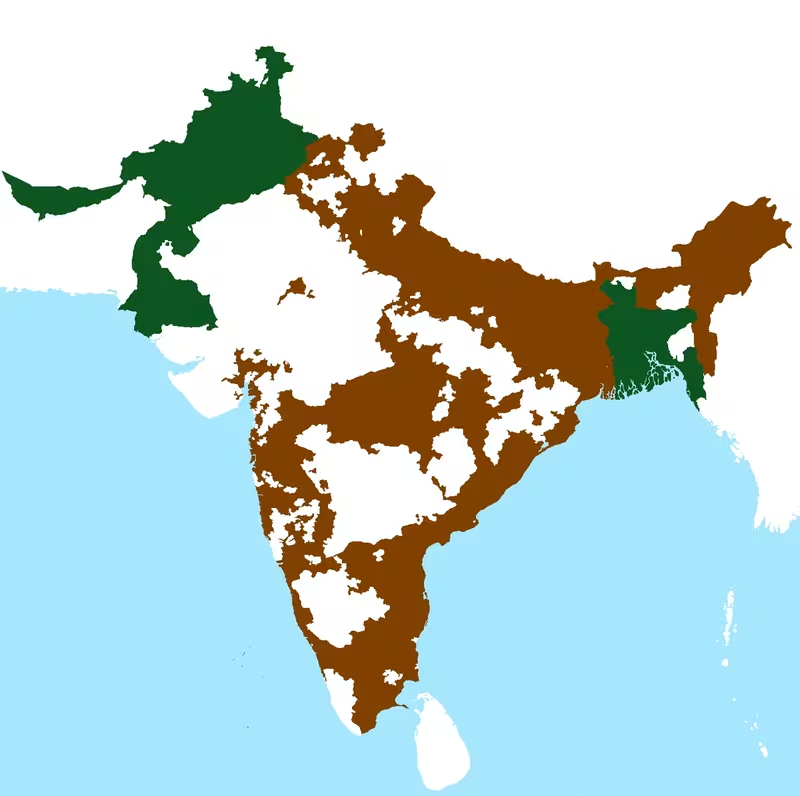
The Indian Independence Act divided British India into the Dominion of India and the Dominion of Pakistan with effect from 15 August 1947. The Act identified Pakistan’s territories as East Bengal, West Punjab, Sindh, and the Chief Commissioner’s Province of Baluchistan. The future of the North-West Frontier Province was to be determined by referendum.
The province of Bengal, as constituted under the Government of India Act 1935, ceased to exist. In its place, the Act provided for East Bengal and West Bengal. The fate of Sylhet district in Assam was also to be determined by referendum.
Punjab was treated in the same way. The province constituted under the 1935 Act ceased to exist, and two new provinces—West Punjab and East Punjab—were to be created. Their boundaries were to be determined by a boundary commission appointed by the Governor-General. The boundary award could be made either before or after the appointed date.
Key Phases
1. Political agreement
The first phase was the acceptance of partition as the basis for the transfer of power. The British Government, the Congress, the Muslim League, and Sikh representatives participated in the political process associated with the 3 June Plan.
2. Parliamentary enactment
The second phase was the passage of the bill through the British Parliament. The House of Commons approved it on 15 July, the House of Lords consented on 16 July, and the King granted Royal Assent on 18 July.
3. Creation of the Dominions
The third phase began on 15 August. India and Pakistan became independent Dominions. Each was to have a Governor-General representing the Crown. Lord Mountbatten continued as the first Governor-General of India. Muhammad Ali Jinnah became Governor-General of Pakistan.
4. Temporary constitutional government
Until new constitutions were made, the Dominions and their provinces were to be governed under the Government of India Act 1935, subject to the changes authorised by the Independence Act. The existing legislative arrangements were allowed to continue both as constitution-making bodies and as legislatures.
Turning Points
The decisive constitutional turning point was the transfer of legislative authority. The Constituent Assembly of each Dominion received full power to make laws for that Dominion, including laws with extraterritorial operation. Laws enacted by the new legislatures could not be declared invalid merely because they conflicted with English law.
Another major turning point was the termination of British responsibility. After independence, His Majesty’s Government no longer held responsibility for the new Dominions. The British Crown’s suzerainty over the Indian states lapsed, and treaties and agreements with those states and with the tribal areas also lapsed.
The Act also abolished the use of the title “Emperor of India” by the British monarch. King George VI subsequently carried this out by royal proclamation on 22 June 1948.
Participants
The British Government and Parliament
Clement Attlee’s announcement of February 1947 established the timetable for self-government. Parliament then enacted the legislation that gave legal form to the transfer. The statute was an Act of the Parliament of the United Kingdom, although its consequences were felt across the territories of British India.
The legislation also ended the office of the Secretary of State for India. Provisions of the Government of India Act 1935 concerning appointments to civil services or civil posts under the Crown by the Secretary of State ceased to operate.
Lord Mountbatten and the Viceroy’s administration
Lord Mountbatten served as Viceroy and Governor-General during the transition. The Act gave the Governor-General extensive powers during the interim period. These included bringing the Act into force, supervising the division of territories, powers, duties, rights, assets, and liabilities, and adapting the Government of India Act 1935.
The power to introduce changes in this way continued until 31 March 1948. After that date, the Constituent Assemblies could modify or adopt the constitutional arrangements. The Governor-General also possessed full authority to give assent to legislation.
India
Jawaharlal Nehru became the first prime minister of independent India, while Vallabhbhai Patel became home minister. Lord Mountbatten continued as India’s first Governor-General.
More than 550 princely states, almost all those contiguous with Indian territory, acceded to India by 15 August. Junagadh, Hyderabad, and Jammu and Kashmir were notable exceptions at that stage.
Jammu and Kashmir was contiguous to both India and Pakistan. Its population was described as 77 percent Muslim, and Pakistan was expected to be its destination. Maharaja Hari Singh hesitated, however. Pakistan launched a tribal invasion, but the Maharaja chose to accede to India. The state remained disputed between India and Pakistan.
Junagadh initially acceded to Pakistan, despite a revolt among its Hindu population. India rejected the accession as inconsistent with geographical contiguity, while Pakistan argued that the state was connected to Pakistan by sea. After a breakdown of law and order, Junagadh’s Dewan asked India to take over the administration on 8 November 1947. India held a referendum on 20 February 1948, in which the people voted overwhelmingly to join India.
Hyderabad had a Hindu majority and a Muslim ruler. The Nizam sought Dominion status and attempted to maintain independence. The state faced both the pro-communist Telangana Rebellion and opposition from Indian nationalists. India launched Operation Polo on 13 September 1948. After five days of fighting, the Hyderabadi military was defeated and the Nizam signed the Instrument of Accession. The formal integration of Hyderabad into India took place later, on 25 January 1950.
Pakistan
Muhammad Ali Jinnah became Pakistan’s first Governor-General, and Liaquat Ali Khan became its prime minister.
Several Muslim-majority princely states acceded to Pakistan between October 1947 and March 1948. They included Amb, Bahawalpur, Chitral, Dir, Kalat, Khairpur, Kharan, Las Bela, Makran, and Swat. The Khanate of Kalat initially chose to resume its independence, but its ruler acceded to Pakistan on 27 March 1948.
Aftermath
The legal establishment of the two Dominions was accompanied by the division of territory and institutions. The Act provided for the separation of Bengal and Punjab and for the appointment of boundary commissions. It also addressed the division of joint property and the armed forces.
Government servants appointed on or before 15 August 1947 were permitted to continue in service under the Governments of the new Dominions, with their benefits protected. The transitional provisions were intended to prevent the complete collapse of administration while the two new states formed their own constitutional and governmental systems.
The human consequences were severe. Partition was accompanied by extensive violence. Many Muslims living in areas that became part of India fled to Pakistan, while Hindus and Sikhs in areas that became part of Pakistan fled to India. Large numbers of people left behind homes, possessions, and property in order to escape violence and reach the state they regarded as their new country.
The end of British suzerainty transformed the position of the princely states. On 25 July 1947, Mountbatten addressed a special full meeting of the Chamber of Princes. He described the states as numbering something like 565 and urged them to accede to the appropriate Dominion. He acknowledged that they would technically and legally become independent when British suzerainty lapsed, but argued that geographical realities made accession the practical course.
The proposed accession arrangement covered defence, external affairs, and communications while preserving internal autonomy in other matters. Mountbatten argued that most states could not effectively manage these functions alone. Although complete independence was not legally impossible in the abstract, he presented it as impractical within the new political circumstances.
Historical Significance
The Indian Independence Act marked the constitutional end of British rule over British India. It created two new Dominions and gave them the authority to make their own laws and constitutions. The Act therefore transferred sovereignty from the British imperial government to the institutions of India and Pakistan.
Its significance also lay in the way it combined independence with territorial partition. The legislation did not simply create a single self-governing Indian state. It divided Bengal and Punjab, specified the initial territories of Pakistan, and established procedures for referendums and boundary-making.
The Act shaped the constitutional transition but did not settle every political question. The status of the princely states required subsequent accessions and, in some cases, conflict or political intervention. Jammu and Kashmir remained disputed. Junagadh and Hyderabad followed different paths before their integration into India.
The legislation also illustrates the difference between legal independence and the practical work of state formation. The new Dominions inherited administrative structures based on the Government of India Act 1935, but these had to be adapted. They needed governments, legislatures, public services, armed forces, communications, and systems for dividing assets and liabilities.
Legacy
The Act was later replaced in the constitutional systems of the new countries. Article 395 of the Constitution of India repealed it in India. Article 221 of Pakistan’s Constitution of 1956 did the same in Pakistan. Both constitutions were intended to establish greater independence for the new states.
In the United Kingdom, however, the Act was not entirely repealed at that time. Sections 2–5, parts of sections 6, 8–12, parts of sections 14 and 15, section 16, parts of sections 18 and 19, and Schedules 1 and 2 were repealed by the Statute Law (Repeals) Act 1976. That repeal came into force on 27 May 1976.
The Indian Independence Act is therefore remembered both as an independence measure and as the legal instrument of Partition. Its language concerns Dominions, Governors-General, legislatures, services, armed forces, boundaries, and princely states. Its historical meaning extends beyond those legal categories because the arrangements it created shaped the movement of millions of people and the political map of South Asia.
Historiography
The history of the Act can be approached from two connected perspectives. Constitutionally, it was the British statute that created India and Pakistan as independent Dominions and transferred authority to their own legislatures. Politically, it was the legal culmination of the 3 June Plan, negotiated by the main representative communities and accepted by the British Government.
The Act’s provisions also reveal the unsettled nature of the transition. It established clear dates and institutions, but left boundary awards, provincial referendums, the accession of princely states, and the division of armed forces to be managed during a compressed period. The contrast between the precision of the legal text and the violence and displacement that accompanied implementation is central to understanding its place in history.
Its legacy is consequently both institutional and human. It created the constitutional starting points of India and Pakistan, while also setting in motion the territorial and political processes associated with Partition.
Timeline
Attlee Announces the Transfer Timetable
On 20 February, Clement Attlee announced that full self-government would be granted to British India by 3 June 1947 at the latest.
The 3 June Plan
The British Government announced the Mountbatten Plan, accepting partition and proposing two independent Dominions.
Partition Committee Formed
On 7 June, a committee with representatives from both sides and the Viceroy as chair began planning the division of the armed forces.
House of Commons Approves the Bill
The House of Commons voted for the Indian Independence Bill on 15 July.
Royal Assent
The House of Lords consented on 16 July, and Royal Assent was granted on 18 July.
India and Pakistan Become Dominions
On 15 August, the appointed date under the Act, India and Pakistan became independent Dominions.
Junagadh Administration Transferred
On 8 November, Junagadh’s Dewan requested that India take over the administration.
Junagadh Referendum
On 20 February, a referendum recorded an overwhelming vote for Junagadh to join India.
Hyderabad Accedes to India
After Operation Polo in September, the Nizam signed the Instrument of Accession; formal integration followed on 25 January 1950.
Partial Repeal in the United Kingdom
Specified provisions of the Act were repealed under the Statute Law (Repeals) Act 1976, effective from 27 May.