Overview
On 30 June 1855, at a time when the East India Company’s authority extended through revenue collectors, courts, police and zamindars, Sidhu and Kanhu Murmu gathered roughly 10,000 Santals and announced a radically different political order. They claimed that Thakur Bonga, the great spirit, had instructed them to remove outsiders—including mahajans, zamindars and the British—and establish Santhal rule. The declaration marked the beginning of the Santhal Rebellion, or Santhal Hool, in the Damin-i-koh region and adjoining parts of the Bengal Presidency.
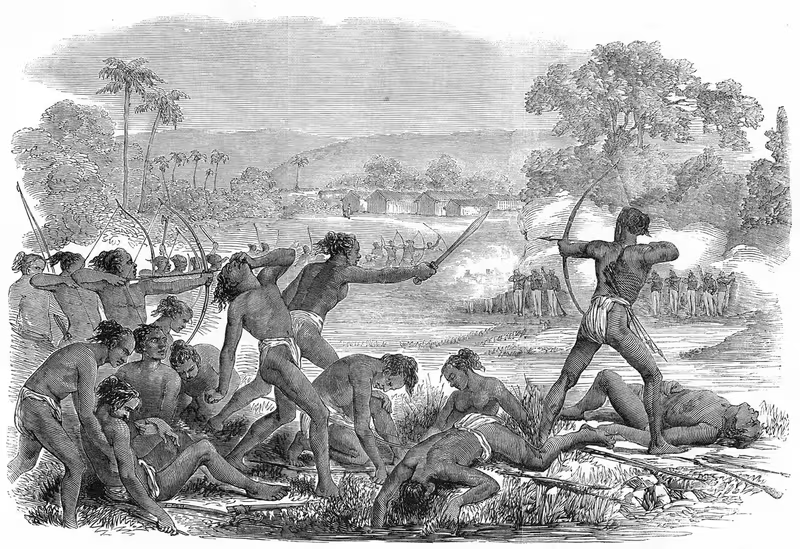
The rebellion was not a single battle. It was an extended uprising involving attacks on moneylenders, zamindars and Company officials, the disruption of roads and railway connections, the burning of settlements and repeated confrontations with Company troops. At its greatest extent, roughly 60,000 Santals were mobilised in groups that commonly numbered between 1,500 and 2,000 people. Other local communities, including Gowalas and Lohars, supported the rebels by providing information and weapons; accounts also describe participation by groups such as Kamars, Bagdis and Bagals.
The East India Company eventually defeated the rebellion through expanding military operations, the use of local rangers, blocked passes, informers and martial law. More than 15,000 people were killed, villages were destroyed and many people were displaced. Yet the uprising forced the colonial administration to respond to the conditions that had produced it. The Sonthal Parganas Act of 1855 created a separate Santal Parganas district, and the Santhal Parganas Tenancy Act of 1876 later sought to prevent tribal land from being transferred to non-tribals.
Background
Migration into Damin-i-koh
The Santals lived across a broad territory stretching from Hazaribagh to Medinipur and along the Subarnarekha River, alongside other Munda ethnolinguistic communities. Agriculture was central to their livelihood. The 1770 Bengal famine severely affected the region, creating pressure for access to fertile and uncultivated land.
In 1832, the East India Company demarcated Damin-i-koh, a forested region in present-day Jharkhand. The Company first encouraged the Paharia people of the Rajmahal hills to clear forests and practise agriculture. When the Paharias declined the offer, the administration invited Santals from surrounding areas, including Dhalbhum, Manbhum, Hazaribagh and Midnapore. The Company promised land and economic advantages, and substantial migration followed.
The transformation was rapid. The Santal population in the area reportedly increased from 3,000 in 1838 to 82,790 in 1851. A report published in The Illustrated London News on 23 February 1856 estimated that approximately 120,000 Santals had settled in the region by the time of the rebellion. The agricultural expansion also brought an enormous increase in Company revenue: income from the area grew 22-fold.
This growth benefited the colonial revenue system, but it also intensified the pressure placed on the cultivators. The people who cleared forests and made the land productive increasingly encountered intermediaries who controlled taxation, credit and local administration.
Revenue, debt and the zamindari system
The Permanent Settlement of 1793 strengthened the position of zamindars and allowed mahajans and other intermediaries to become important parts of the colonial economy. They acted as moneylenders, tax collectors and links between the Company administration and rural society. In practice, this gave them power over land, debts and access to officials.
Many Santals borrowed money at highly inflated rates. When they could not repay, their land could be seized and they could be forced into bonded labour. The formal legal structure did not provide an effective remedy. Police and courts were associated with the same system that enforced revenue demands, while petitions from Santal leaders against moneylenders and other intermediaries were largely ignored.
The resulting conflict was therefore both economic and political. It was not only a dispute over individual debts. The Santals confronted a system in which the people who lent money, collected revenue and represented authority could reinforce one another. The terms of the new order were imposed through zamindars, police, courts and Company officials, while the people most affected had limited power to challenge it.
Rumour, prophecy and preparation
The years before the rebellion also saw the spread of stories about dacoits, secret leaders and supernatural signs. One Santal named Bir Singh Manjhi led a gang of robbers and claimed that a god had whispered a secret mantra to him. Other leaders combined resistance to the state with millenarian expectations, encouraging the belief that a dramatic transformation was approaching.
A chieftain known as Margo Raja cultivated a network of secret disciples throughout Damin-i-koh. His aim was to unite the Santals into a single body. At the same time, rumours circulated about calamities and portents. These included the appearance of Lag Lagin snakes, women with equal numbers of children exchanging vows of friendship, buffalo calves resting before houses before the inhabitants died, and a golden boat sinking in the Ganges after a Dom touched it.
Other stories carried a more directly political message. A child born to an unmarried girl was said to be a suba, a title associated with an official leader. People were reportedly told that others were coming to kill the dikkus, or non-tribals, and that Santals should identify themselves by hanging a buffalo hide and a pair of flutes at the end of their village street. Such accounts circulated from village to village. They intensified fear, but they also made communities attentive to anyone who promised protection and a new order.
Prelude
The immediate prelude to the rebellion combined long-standing grievances with efforts to build a unified movement. Santal leaders had already complained about moneylenders and administrative abuses. When their petitions failed to produce relief, mobilisation increasingly appeared to be the only remaining means of confronting the intermediaries.
On 30 June 1855, Sidhu and Kanhu Murmu assembled about 10,000 Santals. They said that Thakur Bonga had instructed them to expel outsiders and establish Santhal authority. Their brothers Chand and Bhairav also assumed positions as suba, or leaders. Their sisters Phoolo and Jhano participated in the cause and were later killed.
The declaration gave political form to a movement that had previously existed through scattered complaints, rumours, local acts of resistance and networks of leaders. The new claim was not simply that particular officials or lenders should be punished. It was that Company rule itself should be displaced and replaced with Santhal self-government.
The rebellion spread quickly. Sidhu and Kanhu sent letters to zamindars, attempting either to persuade them to join or to intimidate them into supporting the uprising. Some rebels attacked local zamindars, moneylenders and Company officials. Sidhu established a Santal government intended to collect taxes and enforce its own laws. The rebels also sought to present their rule as fairer to cultivators, charging lower rents to Bhumij and Bengali peasants than those associated with Company administration.
The Event
Initial mobilisation
Company officials were surprised by the scale and speed of the uprising. On 9 July, the District Magistrate of Bhagalpur reported that 1,000 Santals were ready to act and that another 4,000 to 5,000 were waiting for orders. A report from the District Magistrate of Aurangabad, A. Eden, stated that 9,000 Santals had gathered at Murdapur and were planning attacks on Pakur Raj and Samserganj before returning towards Rajmahal and Bhagalpur after ritually bathing in the Ganges.
By 10 July, an estimated 10,000 to 12,000 Santals were said to be assembling near Jangipur. Reports from Birbhum described another 13,000 rebels burning railway bungalows and threatening Pakur. Rumours suggested that Santals from Bankura and Singhbhum were joining the rebellion. Mal Paharias and other non-Santal groups also participated in parts of the conflict.
The precise number under Sidhu and Kanhu was uncertain. One witness estimated 7,000 men on 9 July, while a later report claimed that the two leaders commanded 30,000 rebels. That account divided the force between 12,000 intended for an attack on Rajmahal and others moving along the railway towards Jangipur and Murshidabad. By 11 July, reports reaching Bhagalpur claimed that 20,000 armed Santals were marching westward.
Rebel groups advanced in units of approximately 1,000. They reached Colgong, now Kahalgaon, by 11 July and severed road and rail connections to Bhagalpur by 17 July. In areas under their control, they declared Company rule over and proclaimed the authority of the subas.
Narayanpur and the growth of confidence
On 15 July, the Company issued a proclamation urging the Santals to surrender and promising to examine their grievances. The rebels ignored it. Their confidence increased after they defeated a Company force at Narayanpur. They first routed a Company-aligned Paharia Rangers unit and then inflicted a humiliating defeat on East India Company troops, killing several Indian officers and 25 sepoys.
The battle acquired an important symbolic dimension. Company firearms failed because their gun caps had become wet. The malfunction was interpreted by some as evidence that Sidhu and Kanhu possessed divine protection. The leaders had reportedly claimed earlier that Company guns would turn to water. Company authorities attempted to prevent panic among their soldiers by insisting that the failure was mechanical rather than supernatural.
The victory encouraged further action. By 21 July, Santals were looting and burning villages along the road between Rajmahal and Palassour. Many zamindars fled to Rajmahal, where the defenders included only a small police force, 12 Europeans and 160 sepoys. Approximately 12,000 Santals were moving towards the city. The Bhagalpur Commissioner was ordered to redistribute troops, leaving Rajmahal vulnerable.
Other rebel forces moved towards Pakur, Maheshpur and Samserganj. Their numbers were reported to have risen to 20,000 by the middle of July. Rampurhat and Pulsa were captured and burned. Sidhu and Kanhu attempted to create a more structured administration, granting titles such as suba thakur and nazir to followers.
Company response and the battle of Maheshpur
The Company appointed A. C. Bidwell as Special Commissioner for the Suppression of the Sonthal Insurrection. Bidwell was responsible for coordinating civil affairs in the affected districts, while individual districts retained the power to request military assistance.
The Governor’s Council authorised full-scale military action. Troops were moved from Barrackpore towards Raniganj, and key railway stations and sections of the Grand Trunk Road were reinforced. The broad plan was to secure positions near the Ganges, prevent the Santals from moving north of the road and block their retreat into the hills.
On 10 July, Major Burroughs led 160 men from Bhagalpur. Other troops were sent to protect villages around Samserganj. The Company also sought assistance from local zamindars. The Nawab of Murshidabad supplied 30 elephants. A recommendation from the Burdwan Divisional Commissioner to send 1,500 troops was rejected by the Lieutenant Governor, who considered the uprising a local insurrection that did not yet require such extensive reinforcements.
A major confrontation took place on 24 July near Maheshpur. Commissioner Toogood commanded 50 Company troops, supported by 200 soldiers supplied by the Nawab of Murshidabad and 30 elephants. They encountered approximately 5,000 Santals. The battle lasted around ten minutes. About 100 Santals were killed, and the remainder fled, leaving their belongings behind. Sidhu and Kanhu were both reportedly wounded.
Despite the result, the Company force did not immediately advance towards Bhagnadi. Its officers feared that between 20,000 and 30,000 Santals were concentrated in the area. At Barhait, Kanhu personally led an attack. Company troops fired, but their shots failed to hit the rebels. A rumour that Kanhu had been killed then spread, prompting Sidhu, Chand and Bhairav to withdraw into the hills with looted property.
Fighting in Birbhum
The conflict remained fluid in Birbhum. Company troops won direct engagements, but they struggled to prevent the Santals from regrouping. On 17 July, about 8,000 Santals tried to cross the Mor River to attack Suri. High water delayed the movement.
On 22 July, Lieutenant Toulmain and 106 troops were ambushed by approximately 8,000 Santals. Toulmain was killed, along with 13 British soldiers. The Santals suffered around 300 casualties in the engagement. In another battle at Nangolia, Company troops pushed the rebels back across the river, causing approximately 200 further Santal casualties.
The fighting demonstrated the difficulty of controlling the countryside. Even when Company units defeated rebel forces in open encounters, they could not easily hold the territory they had retaken. Civilians accompanying Company troops sometimes burned Santal villages in retaliation, further widening the destruction and displacement caused by the conflict.
Key Phases
Organised uprising
During the first phase, the Santals operated in large groups and attacked the institutions that represented the colonial order: zamindars, moneylenders, officials, roads and railway facilities. Sidhu’s attempt to collect taxes and enforce laws showed that the rebellion sought to build an alternative authority rather than merely resist individual acts of exploitation.
Military containment
The Company then concentrated on protecting strategic roads, railway stations and settlements. Troops were redistributed, allied forces were mobilised and commanders attempted to prevent the rebels from reaching the plains or retreating into the hills.
Guerrilla warfare
By late July and August, the rebels increasingly adopted hit-and-run attacks. Company troops moved through the hills and split Santal forces, while thousands of Santals found routes into the plains blocked. The District Magistrate of Munger armed ghatwals and discharged sepoys to guard the passes. Around 4,000 Santals who had hoped to move into the Munger plains were forced to turn south.
Whether the guerrilla attacks were directed by a central leadership or were organised independently by local thakurs remains unclear. The shift nevertheless enabled resistance to continue after the large formations had been defeated.
Martial law and final suppression
The legal and military response became increasingly severe. On 23 August, the Bhagalpur Commissioner issued an Urdu proclamation permitting the killing of Santals found in armed groups while prohibiting harm to women and children. Some officials, including the magistrate at Rajmahal, went further and advocated exterminating the Santal population. Bidwell argued that capturing prisoners and preventing the plunder of insurgents was impractical, and urged permission for executions and the burning of villages.
The Company initially hesitated to impose martial law. The Lieutenant Governor eventually pressed the Governor-General to do so, arguing that civil law was insufficient to suppress the uprising. Martial law was declared on 8 November 1855 and applied from Bhagalpur to Murshidabad. It permitted the immediate execution of armed Santals, although the government advised officials to minimise bloodshed. The extract also records 10 November as the date on which martial law was proclaimed; both dates belong to the same phase of the emergency administration.
The Company had offered large rewards for the capture of Sidhu and Kanhu, though these were later revoked. In August, commanders were urged to pardon insurgents who surrendered, except for the principal leaders. As the rebellion weakened, surrendered rebels were promised rent annulments and grace periods if they gave up their weapons and abandoned the rebel leaders. In practice, field commanders often failed to maintain this distinction and punished civilians along with fighters.
Surrendering villages were forced to identify insurgents. Sidhu was captured in August or early October by Santals working with a Bengali informer. Kanhu, Chand and Bhairav initially remained concealed in the hills. Reports in November still described thousands of armed followers south of the Mor River. By early December, however, the three were captured by Paharia rangers while disguised as peasants. Their capture effectively ended the main rebellion.
Participants
Santhal rebels
Sidhu, Kanhu, Chand and Bhairav Murmu were the principal leaders. Each assumed the title of suba, giving the uprising a collective leadership rooted in the Murmu family. Sidhu also attempted to operate a Santal government, collect taxes and establish laws. Kanhu directed forces in the field and personally led the attack at Barhait.
Phoolo and Jhano, the sisters of the four principal leaders, also took part in the cause and were killed. Their presence demonstrates that the rebellion involved more than male military leadership, although the surviving account provides few details about their specific activities.
Ram Manjhi, a subordinate near Birbhum, became an important leader after Sidhu’s retreat from Bhagnadi. Other suba thakurs also directed forces during the later period of dispersed warfare.
The rebels’ support extended beyond the Santals. Gowalas and Lohars supplied information and weapons. Ranabir Samaddar is described as arguing that Kamars, Bagdis, Bagals and other aboriginal inhabitants also participated.
East India Company and allied forces
A. C. Bidwell coordinated the early civil and military response. Major General G. W. A. Lloyd later took command as the Company prepared a larger campaign. His force included five regiments of local infantry, Hill Rangers, European troops and cavalry, as well as soldiers supplied by zamindars.
Company forces also relied on Paharia Rangers, armed ghatwals, discharged sepoys and the troops and elephants supplied by the Nawab of Murshidabad. Zamindars were important allies because the rebellion directly threatened their position as landlords and intermediaries.
The Company’s strength lay in its ability to draw on an expanding military and administrative network. Its weakness was the difficulty of applying that power across hills, forests, villages and river crossings while distinguishing insurgents from civilians.
Aftermath
Martial law was suspended on 3 January 1856, and military operations ended the following month. The rebellion had caused enormous loss of life. More than 15,000 people were killed, numerous villages were destroyed and many inhabitants were displaced. The fighting and the punitive actions that followed affected civilians as well as combatants.
The administration attempted to combine repression with limited concessions. Surrendering rebels were offered rent annulments and grace periods, but only if they surrendered weapons and abandoned the leaders. These measures did not erase the violence of the campaign, particularly where field commanders punished villages or burned settlements suspected of supporting the rebellion.
The rebellion also exposed a serious administrative problem. The Company had opened Damin-i-koh to Santal settlement, benefited from its agricultural expansion and increased its revenue, but had failed to create institutions capable of protecting settlers from debt, land seizure and official coercion. The result was not simply disorder in a remote region. It was a crisis produced by the very structures through which colonial rule extracted revenue.
Historical Significance
The Santhal Rebellion revealed the tensions created when colonial expansion transformed land, labour and authority. Santals had been encouraged to settle and cultivate Damin-i-koh, but the growth of agriculture brought them under the power of zamindars, mahajans, police and courts. The prosperity recorded in Company revenue figures concealed the insecurity of the cultivators who generated that income.
The rebellion also showed that tribal resistance could develop into an alternative political project. Sidhu’s administration collected taxes and enforced laws. The rebel leadership assigned titles and attempted to create a land system with lower rents for Bhumij and Bengali peasants. These efforts suggest that the movement was not only a protest against isolated abuses. It sought to replace an exploitative order with a form of self-government.
The immediate administrative response was the Sonthal Parganas Act, Act 37 of 1855. It created the Santal Parganas district as a separate non-regulation district under the jurisdiction of Bhagalpur. The district was administered by a Deputy Commissioner at Dumka, assisted by other officials. Its administrative model was based on the South-West Frontier Agency of Chota Nagpur.
The new district covered approximately 5,470 square miles, or 14,200 square kilometres. It was bordered by Bhagalpur, Purnea, Malda, Murshidabad, Birbhum, Bardwan, Manbhum, Hazaribagh and Monghyr. Its purpose was double-edged: it acknowledged the distinct grievances and circumstances of the Santal region, while also strengthening British control over it.
Further recognition of the land question came with the Santhal Parganas Tenancy Act of 1876. The legislation sought to safeguard tribal land rights and prevent land alienation to non-tribals. These measures did not make the rebellion a victory in military terms, but they show that the uprising compelled the colonial state to modify its administration.
Legacy
The rebellion remains associated with the courage and sacrifice of Sidhu, Kanhu, Chand, Bhairav, Phoolo and Jhano. In Jharkhand, 30 June is commemorated as Hul Diwas, marking the beginning of the uprising led by Sidhu and Kanhu.
The event also entered wider literary and political memory. Charles Dickens, writing in Household Words, contrasted the reported conduct of the Santals with that of Russia’s armies, praising the idea that they used poisoned arrows for hunting but not against enemies. His passage reflects a contemporary attempt to portray the rebels through the moral language of warfare, even while the colonial conflict itself was marked by severe violence.
Mrinal Sen’s 1976 film Mrigayaa is set during the Santhal Rebellion. Karl Marx described the uprising in Notes on Indian History as India’s first organised “mass revolution.” These later references helped place the rebellion within broader interpretations of colonial resistance and popular mobilisation.
Historiography
Interpretations of the Santhal Rebellion have emphasised several connected dimensions. One approach views it as an agrarian uprising against moneylenders, zamindars and the revenue system. This interpretation draws attention to debt, land seizure, bonded labour and the failure of courts and officials to address petitions.
Another approach stresses the rebellion’s political and anti-colonial character. The declaration of Santhal rule, Sidhu’s tax-collecting government and the effort to drive out British officials indicate that the movement challenged the authority of the East India Company itself.
A third perspective focuses on religious expectation and millenarian belief. Claims of divine instruction from Thakur Bonga, stories of portents and the belief that Company weapons would fail helped unite people and explain the extraordinary events taking place around them. These elements should not be treated as separate from material grievances. Spiritual authority, political organisation and resistance to economic exploitation worked together in the mobilisation.
The scale of participation also complicates any account that treats the conflict as an isolated Santal episode. Gowalas, Lohars, Mal Paharias and other communities were involved in different ways. Ranabir Samaddar’s interpretation, as recorded in the historical account, includes Kamars, Bagdis, Bagals and others among the participants. At the same time, the exact number of fighters and the degree of central direction remain uncertain. Reports varied from several thousand to 30,000 in particular operations, while the total mobilisation over the course of the rebellion is estimated at roughly 60,000.
The Company’s own records also require careful reading. They describe military movements, intelligence from zamindars and informers, and the need to distinguish armed rebels from civilians. Yet those same records reveal disagreement among officials over whether to pardon, prosecute, execute or punish entire villages. The debate over martial law exposes the tension between formal claims of ordered governance and the coercive practices used to restore colonial authority.
Timeline
Damin-i-koh demarcated
The East India Company demarcates Damin-i-koh and invites Santals to settle and cultivate the region.
Early population recorded
The Santal population in the area is recorded as approximately 3,000.
Rapid settlement
The Santal population is reported to have risen to 82,790, alongside a 22-fold increase in Company revenue.
The Hul begins
Sidhu and Kanhu Murmu gather about 10,000 Santals and declare their intention to expel outsiders and establish Santhal rule.
Company proclamation
The East India Company urges the Santals to surrender and promises to examine their grievances.
Rebellion expands
Santals burn and loot villages along the Rajmahal–Palassour road while large forces move towards Rajmahal and adjoining areas.
Battle of Maheshpur
Company and allied forces confront approximately 5,000 Santals; around 100 Santals are killed and Sidhu and Kanhu are reportedly wounded.
Guerrilla phase
After the large confrontations, Santals increasingly use hit-and-run attacks while Company forces block routes and passes.
Martial law declared
Martial law is applied from Bhagalpur to Murshidabad, permitting the immediate execution of armed Santals.
Sidhu captured
Sidhu is captured in August or early October by Santals working with a Bengali informer.
Principal leaders captured
Kanhu, Chand and Bhairav are captured by Paharia rangers while disguised as peasants.
Martial law suspended
Martial law is suspended as the rebellion enters its final stage.
Military operations end
The remaining military operations conclude after the main rebellion has been suppressed.