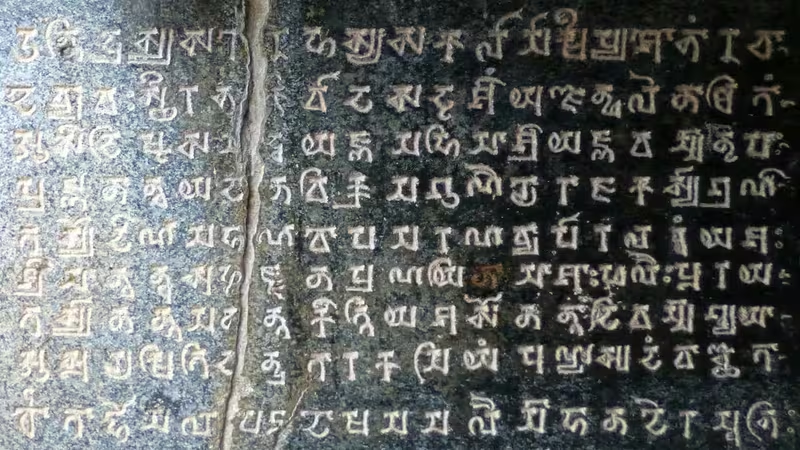
Gupta Script: A Link Between Brahmi and Later Indic Writing
The Gupta script was used to write Sanskrit during the period associated with the Gupta Empire, an era of material prosperity and major religious and scientific developments in the Indian subcontinent. Also called Gupta Brahmi or Late Brahmi, it descended from the Ashokan Brahmi script and became a crucial link between Brahmi and most later Brahmic writing systems.
The script was not uniform across the Gupta Empire. During the fourth century, its letters increasingly took more cursive and symmetric forms, reflecting a desire to write more quickly and aesthetically. Regional differences also became more visible. Because a single inscription could contain different forms of the same symbol, scholars have classified the script in three, four, or five broad categories, but no definitive classification exists.
Gupta writing survives mainly on iron and stone pillars and on gold coins issued by Gupta rulers. One of its most important records is the Prayagraj Prasasti, composed by Harisena, court poet and minister of Samudragupta. Inscribed on the Allahabad pillar of Ashoka, it describes Samudragupta’s reign, from his accession as the second Gupta king through his conquests of other rulers.
Origins and Classification
Linguistic Family
The Gupta script is a writing system rather than a spoken language. It was primarily used for Sanskrit. In structural terms, it belongs to the Brahmic family of alphasyllabaries, also called abugidas.
Origins
The script descended from Ashokan Brahmi. It preserved the basic operating method of its predecessor and later successors, while changing the shapes and forms of its graphemes and diacritics. The term “Gupta script” can refer broadly to scripts derived from the Gupta period, despite their lack of complete uniformity.
Name Etymology
The name “Gupta script” reflects its association with the Gupta Empire. The alternative names “Gupta Brahmi” and “Late Brahmi” emphasize its relationship to Brahmi and its position in the development of Indic scripts.
Historical Development
Gupta-Period Development (Fourth Century CE)
Through the fourth century, Gupta letters became more cursive and symmetric. This development was connected with faster and more aesthetically shaped writing. The script also became more regionally differentiated across the Gupta Empire.
Regional Variation
The surviving evidence does not support a single definitive classification. Individual symbols could be written in different ways even within one inscription. Consequently, “Gupta script” is best understood as a broad designation for writing forms associated with, or derived from, the Gupta period.
Scripts and Writing Systems
Gupta Script
The Gupta script functioned as an abugida. Consonantal phonemes had distinct symbols, while vowels were represented through diacritics. When no diacritic was present, the consonant carried the implied vowel /a/.
The alphabet contained 37 letters: 32 consonants with the inherent ending “a” and five independent vowels. Diacritics attached to consonants could change the final vowel from the inherent “a” to sounds such as i, u, e, o, and au. Consonants could also combine into conjuncts. For example, sa and ya could be joined vertically to form sya.
Inscriptions and Coins
Inscriptions are found mainly on iron or stone pillars. Gupta gold coins also carry legends and records of historical events. Coin writing differed from pillar writing because coins had to remain conservative as currency, limiting the appearance of regional variation. Space was especially restricted on silver coins, so symbols were sometimes truncated or shortened. The forms for ta and na, for example, were often reduced to vertical strokes.
Script Evolution
The Gupta script gave rise to the Sharada and Siddham scripts. These, in turn, contributed to the development of several important Indic scripts, including Devanagari, Gurmukhi, Odia, Bengali-Assamese, and Tibetan. The Unicode Standard does not explicitly define Gupta script as a stylistic variation of Brahmi, although Brahmi encoding is one possible approach.
Geographic Distribution
Historical Spread
The script was used across the Gupta Empire and the wider Indian subcontinent. Its regional forms varied, and surviving examples come from pillars, other stone and iron inscriptions, and Gupta coinage.
Centers of Learning
The source material identifies the Gupta imperial context and the Prayagraj Prasasti but does not establish a separate list of educational centers associated with the script.
Literary and Historical Heritage
Inscriptions
The Prayagraj Prasasti is the most prominent named inscription associated with the Gupta script. Harisena composed it to describe Samudragupta’s reign, accession, and conquests.
Numismatic Records
Gupta coins preserve legends and references to historic events. Almost every Gupta king issued coins, beginning with Chandragupta I. The discovery of a gold-coin hoard in 1783 began the study of Gupta numismatics. The Bayana hoard, discovered in 1946 in Rajasthan’s Bharatpur district, contained more than 2,000 gold coins issued by Gupta kings.
Grammar and Phonology
Key Features
The script encoded consonants with an inherent /a/. Vowel changes were indicated by attached diacritics, and consonants could be combined into conjunct forms.
Sound System
The surviving description concerns writing rather than a separate Gupta sound system. It identifies the inherent /a/ and vowel values represented by diacritics, including i, u, e, o, and au.
Influence and Legacy
The Gupta script’s most significant legacy is its position between Ashokan Brahmi and later Brahmic scripts. Through Sharada and Siddham, it contributed to the history of Devanagari, Gurmukhi, Odia, Bengali-Assamese, and Tibetan writing.
Royal and Religious Patronage
Gupta Empire
The Gupta Empire provided the historical setting in which the script was used. Gupta rulers issued gold and silver coins bearing inscriptions, while imperial records such as the Prayagraj Prasasti documented royal power and conquest.
Modern Status
Gupta script is no longer a living writing system. It remains important for the study of Gupta inscriptions, Sanskrit writing, Indian scripts, and Gupta coinage.
Learning and Study
Academic Study
The script is studied through surviving pillar inscriptions, stone and iron records, gold coins, and numismatic hoards. The Unicode Standard’s treatment of Brahmi provides one possible encoding approach, although it does not explicitly classify Gupta as a stylistic variation of Brahmi.
Conclusion
Gupta script records a formative stage in the history of Indian writing. Descended from Ashokan Brahmi, it retained the abugida structure in which consonants carried an inherent /a/ and other vowels were marked with diacritics. Its fourth-century forms became more cursive and symmetric, while regional variation prevented the emergence of a single uniform alphabet. Inscriptions such as the Prayagraj Prasasti reveal its role in recording Gupta political history, and coins show how writing adapted to restricted surfaces and the demands of currency. Most importantly, Gupta script connected Brahmi with later scripts, including Devanagari, Gurmukhi, Odia, Bengali-Assamese, and Tibetan.