Maithili Language: Literature, Tirhuta Script, and the Mithila Region
In the fourteenth century, Jyotirishwar Thakur composed the Varṇa Ratnākara in Mithilakshar, the script historically associated with Maithili. This work occupies a remarkable place in the history of Indian writing: it is described as the earliest known prose text in Maithili and the first prose work not only in Maithili but in any modern Indian language. Its appearance reflects the consolidation of a literary tradition in Mithila after earlier centuries of mystical verse, courtly patronage, and oral culture.
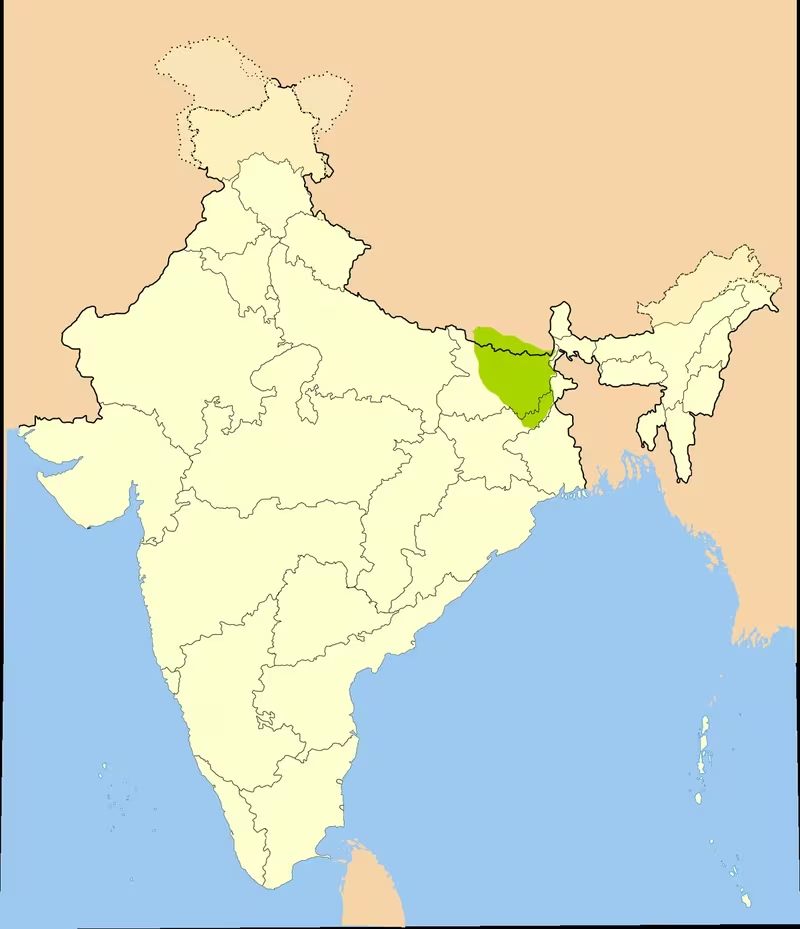
Maithili is an Indo-Aryan language native to the Mithila region, a cultural and linguistic area extending across parts of Bihar and Jharkhand in India and Nepal's Koshi and Madhesh Provinces. More than 75 million people speak it. Today, Devanagari is the predominant script, while Tirhuta—also called Mithilakshar or Maithili—remains the historical and original script of the language. Tirhuta has retained particular uses in religious texts, genealogical records, letters, and signage, and has experienced renewed interest in the twenty-first century.
The language has a varied dialect landscape, a substantial tradition of folk songs and devotional poetry, and a history that reaches from the Charyapadas to modern constitutional and educational recognition. It is one of India's 22 Scheduled Languages and has official administrative status in Nepal's Koshi and Madhesh Provinces.
Origins and Classification
Linguistic Family
Maithili belongs to the Indo-Aryan branch of the Indo-European language family. Its classification was debated by European and Indian scholars during the nineteenth century. In the 1870s, Beames considered it a dialect of Bengali. Hoernlé initially treated it as a dialect of Eastern Hindi, but comparison with the Gaudian languages led him to recognise that Maithili showed more similarities with Bengali than with Hindi.
George Grierson recognised Maithili as a distinct language. He grouped it under “Bihari” and published its first grammar in 1881. Chatterji grouped Maithili with Magadhi Prakrit. The language's early historical development is also associated with ancient Maithili or proto-Maithili forms found in the Charyapadas.
These differing classifications illustrate the complexity of tracing language boundaries in eastern South Asia. Maithili has long existed alongside Bengali, Hindi, and other regional languages, and its dialects occupy a broad geographical area on both sides of the India–Nepal border.
Origins
The beginnings of Maithili language and literature are traced to the Charyapadas, Buddhist mystical verses composed between approximately 700 and 1300 CE. The verses were written in Sandhya bhasa by Siddhas associated with Vajrayana Buddhism. These figures were distributed across Assam, Bengal, Bihar, and Odisha, and several—including Kanhapa and Sarhapa—came from the Mithila region.
Scholars Rahul Sankrityayan, Subhadra Jha, and Jayakant Mishra identified traces of ancient Maithili or proto-Maithili in the language of the Charyapadas. The verses therefore represent an important early stage in the history of Maithili, although they belong to a multilingual and geographically dispersed literary environment.
Alongside written and mystical compositions, Mithila preserved a rich oral culture. Folk songs, folk traditions, and popular performances circulated among ordinary people in the region. This oral heritage continued to develop alongside courtly, religious, and literary forms.
Name Etymology
The name Maithili derives from Mithila, the ancient kingdom traditionally associated with King Janaka in the Ramayana. Maithili is also one of the names of Sita, described as the wife of King Rama and daughter of King Janaka. The language's name thus connects it with the geography of Mithila and with a major cultural tradition associated with that region.
Historical Development
Charyapada and Early Maithili Traces (c. 700–1300 CE)
The Charyapadas provide the earliest literary evidence associated with the history of Maithili. Their authors were Siddhas of Vajrayana Buddhism, and their verses were composed in Sandhya bhasa. Because these poets and religious figures were active across a wide area, the Charyapadas cannot be separated from the broader linguistic environment of eastern India.
Their importance lies in the linguistic traces that scholars have identified. Ancient Maithili or proto-Maithili features appear within the verses, particularly in compositions connected with Siddhas from Mithila. These materials provide a point of departure for the history of Maithili literature.
The period also demonstrates that Maithili developed through more than one channel. Written mystical verse existed alongside popular songs and oral traditions. The latter were especially important in the Mithila region, where folk culture remained a central vehicle for the transmission of language.
Karnata Patronage and the Rise of Prose (1226–1340 CE)
After the fall of the Pala Empire, Buddhism declined in the region, and the Karnat dynasty became established. Maithili received patronage under Harisimhadeva, who ruled from 1226 to 1324. This period helped create conditions for the development of a distinct Maithili literary culture.
Jyotirishwar Thakur, who lived from approximately 1280 to 1340, wrote Varṇa Ratnākara. The work is identified as the earliest known prose text in Maithili. It was written in Mithilakshar script and is also described as the first prose work not only in Maithili but in any modern Indian language.
The importance of Varṇa Ratnākara extends beyond its language. It demonstrates that Maithili prose had acquired a literary form at a time when courtly and scholarly writing in South Asia often used Sanskrit or other established literary languages. Its composition marks a significant moment in the history of Maithili writing and in the broader history of modern Indian literatures.
The Tughluq Invasion and Vidyapati (1324–1450 CE)
In 1324, Ghyasuddin Tughluq, the emperor of Delhi, invaded Mithila and defeated Harisimhadeva. Mithila was entrusted to Kameshvar Jha, a Maithil Brahmin, family priest, and military scholar. The disturbed political era that followed did not produce Maithili literature until the emergence of Vidyapati Thakur.
Vidyapati lived from approximately 1360 to 1450 and became an epoch-making poet under the patronage of Shiva Simha Singh and his queen, Lakhimadevi. He composed more than 1,000 songs in Maithili. Their subjects included the love of Radha and Krishna, the domestic life of Shiva and Parvati, and the suffering of migrant labourers from Morang and their families. Vidyapati also wrote several treatises in Sanskrit.
His songs spread rapidly and attracted saints, poets, and younger audiences. Chaitanya Mahaprabhu interpreted the songs through a devotional understanding of love, and they became themes of Vaishnavism in Bengal. Vidyapati's influence extended to the religious literature of Assam, Bengal, and the Utkala Kingdom.
His poetic influence also reached Rabindranath Tagore. As a young man, Tagore composed poems in imitation of Vidyapati's songs under the pseudonym Bhanusimha. The later blending of languages gave rise to artificial literary dialects such as Brajabuli in Bengal and Brajavali in Assam.
Early European Descriptions and Devotional Drama (1575–1771)
The earliest reference to Maithili or Tirhutiya is identified in Amaduzzi's preface to Beligatti's Alphabetum Brammhanicum, published in 1771. The preface included a list of Indian languages, among them “Tourutiana.” Colebrooke's essay on Sanskrit and Prakrit, written in 1801, was the first to describe Maithili as a distinct dialect.
Maithili devotional and dramatic traditions continued to develop during the early modern period. Vaisnava saints wrote many devotional songs. Mapati Upadhyaya composed the drama Pārijātaharaṇa in Maithili. Professional troupes, many of them from Dalit communities and known as Kirtanias, performed the drama in public gatherings and in the courts of nobles. The term Kirtania refers to singers of bhajan, or devotional songs.
Lochana, who lived approximately from 1575 to 1660, wrote Rāgatarangni, an important treatise on music. It describes the ragas, talas, and lyrics prevalent in Mithila. This work shows that Maithili literary culture included not only poetry and drama but also systematic writing about musical forms.
Maithili in Nepal under the Malla Dynasty (16th–17th Centuries)
During the rule of the Malla dynasty, Maithili spread widely throughout Nepal. At least seventy Maithili dramas were produced during this period. The drama Harishchandranrityam by Siddhinarayanadeva, who lived from 1620 to 1657, illustrates the multilingual character of theatrical culture. Different characters speak colloquial Maithili, Bengali, Sanskrit, or Prakrit.
Bhupatindra Malla was a notable Malla king who patronised Maithili. He composed 26 plays in the language during his lifetime. The Malla period therefore represents an important stage in Maithili's geographical expansion and theatrical history.
Colonial and Institutional Revival (1860–1917)
After the death of Maheshwar Singh, ruler of Darbhanga Raj, in 1860, the estate was taken over by the British Raj as regent. It returned to his successor, Maharaj Lakshmishvar Singh, in 1898. The Zamindari Raj initially had a lackadaisical approach toward Maithili, but individual efforts helped revive the language's public and literary use.
MM Parameshvar Mishra, Chanda Jha, Munshi Raghunandan Das, and others contributed to this revival. Periodicals including Maithil Hita Sadhana in 1905, Mithila Moda in 1906, and Mithila Mihir in 1908 encouraged writers and readers.
The first social organisation devoted to the development of Mithila and Maithili, the Maithil Mahasabha, was established in 1910. It campaigned for recognition of Maithili as a regional language. Its membership, however, was restricted to Maithil Brahmins and Karna Kayasthas and excluded people from outside those communities.
Calcutta University recognised Maithili in 1917, and other universities followed. Babu Bhola Lal Das wrote Maithili Grammar, edited Gadya Kusumanjali, and edited a journal called Maithili. These activities strengthened the language's presence in education and print culture.
Constitutional Recognition and the Contemporary Period
Maithili was officially accepted by the Sahitya Akademi in 1965. It was recognised in the Eighth Schedule of the Indian Constitution in 2002, and the constitutional recognition is also described as taking effect in 2003. Maithili is now one of India's 22 Scheduled Languages, allowing it to be used in education, government, and other official contexts.
In March 2018, Maithili received second official language status in Jharkhand. In Nepal, the Nepalese Languages Commission made it an official language for administration in Koshi Province and Madhesh Province. Maithili is constitutionally registered as one of Nepal's provincial official languages and is the country's second most commonly spoken native language with constitutional registration.
On 26 November 2024, Constitution Day, the Maithili version of the Indian Constitution was launched by President Droupadi Murmu. The language has also been included in the CBSE curriculum, although the Tirhuta script was not included in that curriculum.
Scripts and Writing Systems
Tirhuta and Mithilakshar
From the fourteenth century, Maithili was written in the Tirhuta script. Tirhuta is also known as Mithilakshar or Maithili. It is the historical and original script of the language and is related to the Bengali-Assamese script.
Jyotirishwar Thakur's Varṇa Ratnākara was written in Mithilakshar. The script was therefore associated with some of the earliest known prose in Maithili. Although Devanagari is now dominant, Tirhuta remains visible in religious texts, genealogical records, letters, and signage in north Bihar.
The Tirhuta and Kaithi scripts are both included in Unicode. The Indian government has undertaken efforts to bring Tirhuta to major digital platforms, including Google Keyboard and Android and iOS operating systems. Linguists and language activists have welcomed these efforts, which respond to the script's continuing cultural importance and its renewed use in the twenty-first century.
Kaithi and Devanagari
In Nepal, the Newar script was used to write Maithili. By the early twentieth century, Tirhuta was strongly associated with Mithila Brahmans, while many others used Kaithi. Devanagari spread under the influence of scholars at Banaras, and its use gradually increased.
During the course of the twentieth century, Devanagari eventually replaced Tirhuta and Kaithi as the dominant script for Maithili. It remains the principal script today. This shift changed the visual form through which many speakers encountered the language, but it did not eliminate Tirhuta from religious, genealogical, epistolary, and regional contexts.
Script Evolution
The history of Maithili writing reflects changes in social use, education, and institutional influence. Tirhuta served as the traditional script from the fourteenth century onward. Kaithi also had an important role, particularly among communities that did not primarily use Tirhuta. Newar was used in Nepal, while Devanagari expanded through educational and scholarly networks.
The present situation is therefore one of dominance and revival rather than simple disappearance. Devanagari is predominant, but Tirhuta continues to be used and is receiving support for digital implementation. The language's original script has also become an important focus for cultural preservation and language activism.
Geographic Distribution
Historical Spread
Maithili is native to Mithila, a region encompassing parts of eastern India and southern Nepal. In India, it is mainly spoken in the Darbhanga, Tirhut, Kosi, Purnia, Bhagalpur, and Munger divisions of Bihar, as well as in the Santhal Pargana division of Jharkhand.
In Nepal, Maithili is spoken in Madhesh Province and Koshi Province. Its spread through Nepal was especially notable during the Malla dynasty, when Maithili drama became an important part of courtly and theatrical culture.
Centers of Learning and Culture
Darbhanga, Madhubani, and Janakpur are important cultural and linguistic centres of Maithili. Darbhanga and Madhubani lie in Bihar, while Janakpur is in Nepal. Together, these centres represent the cross-border cultural geography of Mithila.
The region's literary culture has included court poetry, prose, devotional songs, drama, musicological writing, folk traditions, periodicals, grammar writing, and social organisations. The history of Maithili cannot therefore be reduced to a single court or city. Its development involved religious communities, royal patrons, professional performers, scholars, writers, and ordinary speakers.
Modern Distribution
Contemporary Maithili is spoken across northern and eastern Bihar, parts of Jharkhand, and Nepal's Madhesh and Koshi Provinces. It is spoken by more than 75 million people. Its official and educational presence has expanded through constitutional recognition in India, provincial recognition in Nepal, inclusion in the CBSE curriculum, and the publication of a Maithili version of the Indian Constitution.
Literary Heritage
Early and Classical Literature
The Charyapadas form the earliest literary layer associated with Maithili. Their Buddhist mystical verses preserve traces of ancient Maithili or proto-Maithili and connect the language's early history with the wider religious and linguistic world of eastern India.
The Varṇa Ratnākara represents a decisive development in Maithili prose. Jyotirishwar Thakur wrote it in Mithilakshar, and it is described as the earliest known Maithili prose text. Its status as the first prose work in any modern Indian language gives it significance beyond the history of Maithili itself.
Vidyapati's songs form another central part of the literary heritage. His work includes devotional and love poetry, depictions of domestic life, and songs about the suffering of migrant labourers and their families. His compositions influenced religious literature well beyond Mithila.
Religious and Devotional Texts
The Charyapadas were Buddhist mystical verses composed by Siddhas associated with Vajrayana Buddhism. They provide evidence of the religious setting in which early Maithili or proto-Maithili features appeared.
Later Maithili devotional literature included songs by Vaisnava saints and Vidyapati's compositions on Radha and Krishna, Shiva and Parvati, and spiritual love. Chaitanya Mahaprabhu helped spread the devotional interpretation of Vidyapati's songs, especially in Bengal.
Religious performance also played an important role. Kirtania troupes performed devotional songs and dramas before public audiences and at noble courts. Maithili thus circulated through both written texts and sung or staged forms.
Poetry and Drama
Vidyapati is the best-known poet associated with the medieval Maithili tradition described here. His more than 1,000 songs established themes and forms that travelled across eastern South Asia. Their influence was strong enough to inspire Tagore's Bhanusimha poems.
Drama became particularly prominent in Nepal during the Malla period. At least seventy Maithili dramas were produced, and Harishchandranrityam shows how Maithili theatre could combine several languages within a single work. Bhupatindra Malla's 26 Maithili plays represent one of the most substantial examples of royal literary patronage in the language.
Musicological and Scholarly Works
Lochana's Rāgatarangni is a significant treatise on the science of music. It describes the ragas, talas, and lyrics prevalent in Mithila. Its subject demonstrates that Maithili's literary culture included technical discussion of artistic practice.
Modern scholarly writing included Babu Bhola Lal Das's Maithili Grammar. The publication of periodicals and the organisation of literary activity through the Maithil Mahasabha also helped develop a modern public sphere for Maithili.
Grammar and Phonology
Morphology
The distinction between adjectives and nouns is described as very slight in Maithili, although the language has marked adjectives. Maithili pronouns are declined similarly to nominals, but the genitive case has a different form in most pronouns. Accusative and postpositional forms are also identified, while plural forms are formed periphrastically.
The language's morphology therefore includes case-related variation in nouns and pronouns, as well as distinctions between forms used with accusative and postpositional functions. The available description indicates that pronoun declension is an important part of the grammatical system.
Vowels
Maithili vowels have nasal counterparts. Nasality is represented by a tilde in the International Phonetic Alphabet and by the candrabindu sign in Devanagari, as in the representation of a nasal long vowel. All vowel sounds are realised as nasal when they occur before or after a nasal consonant.
The sounds /eː/ and /oː/ are often replaced by the diphthongs /əɪ̯/ and /əʊ̯/. The vowel /ɔ/ is replaced by /ə/ in northern dialects and by /o/ in southernmost dialects.
Grierson described three short vowels that modern grammarians do not count as independent vowels. They may instead be understood as syllable breaks. Maithili also includes diphthongs such as /aːi̯/, /aːu̯/, /aːe̯/, /aːo̯/, /iu̯/, /ie̯/, /io̯/, /ui̯/, and /ue̯/. Four non-syllabic vowels—/i̯/, /u̯/, /e̯/, and /o̯/—are represented in Devanagari with forms related to y and v.
A recent phonetic change involves epenthesis, described as the backward transposition of final /i/ and /u/ in many words. Examples include the colloquial pronunciation of अछि as अइछ, रवि as रइब, मधु as मउध, and बालु as बाउल.
Consonants
Maithili has four classes of stops, one affricate class generally treated as a stop series, related nasals, fricatives, and approximants. The stop system includes bilabial, coronal, retroflex, and velar series, together with affricates.
The stop contrasts include tenuis, voiced, aspirated, and murmured or aspirated voiced sounds. The retroflex series behaves differently in some positions. The retroflex voiced stops /ɖ/ and /ɖʱ/ show their main phonological contrast word-initially and have restricted distribution elsewhere.
The most common fricatives are /s/ and /ɦ/, which have a full phonological opposition. Sounds such as [ɕ], [ʂ], [x], and [f] occur in particular lexical environments, including tatsama and Perso-Arabic words. Some borrowed sounds are replaced by more common Maithili pronunciations.
The nasals /m/ and /n/ occur in all phonological positions. Other nasals have more restricted distributions, often occurring before homorganic stops. In most styles of pronunciation, the retroflex flap [ɽ] occurs only marginally and is commonly pronounced as the alveolar tap [ɾ] or interchanged with /r/.
Dialects
Maithili varies greatly across dialects. Central Maithili, also called Sotipura, is spoken in districts including Darbhanga, Madhubani, Supaul, Madhepura, Purnia, Samastipur, Araria, and Saharsa in India. In Nepal, it is spoken in Dhanusha, Mahottari, Siraha, Saptari, Sarlahi, Sunsari, and Morang.
Bajjika, or Western Maithili, is spoken mainly in Sitamarhi, Muzaffarpur, Vaishali, and Sheohar in Bihar, and in Rautahat and Sarlahi in Nepal. It is listed as a distinct language in Nepal and overlaps by approximately 76–86 percent with Maithili dialects spoken in Dhanusa, Morang, Saptari, and Sarlahi.
Thēthi is spoken mainly in the Munger division and Samastipur in Bihar, as well as in adjoining districts of Nepal. Angika, also called Southern Maithili, is spoken around Bhagalpur, Banka, and Munger in Bihar and in Godda, Sahebganj, Dumka, and other districts of Jharkhand.
Eastern Maithili, or Purbi Maithili, is spoken primarily in the Kosi and Purnia divisions of the Mithila region. Mondarika Maithili is spoken in the Mandar Hill area, including Banka, Godda, Sahebganj, and Pakur. Deogharia Maithili is widely spoken in Deoghar and Dumka.
Kochila Tharu is spoken by Tharu communities in Saptari and Siraha and adjoining areas. Some linguists have described it as a variety of Maithili. Other dialects include Dehati, Deshi, Kisan, Bantar, Barmeli, Musar, Tati, and Jolaha. These dialects are described as intelligible to native Maithili speakers.
Influence and Legacy
Languages and Literatures Influenced
Vidyapati's songs influenced religious literature in Assam, Bengal, and Utkala. Their circulation also contributed to the development of artificial literary dialects, including Brajabuli in Bengal and Brajavali in Assam.
Maithili's literary influence was not limited to written texts. Songs, dramas, and performances enabled the language to cross regional and social boundaries. The Malla courts of Nepal, Bengali devotional communities, Assamese religious circles, and public Kirtania performances all formed part of this wider cultural movement.
Contact with Other Languages
Maithili's historical classification was discussed in relation to Bengali, Eastern Hindi, the Gaudian languages, and Magadhi Prakrit. Its phonology also reflects contact with Sanskrit and Perso-Arabic vocabulary. Sounds such as [x] and [f] occur in Perso-Arabic loanwords, while several other sounds occur in Sanskrit-derived words.
The language's literary history similarly shows multilingual interaction. In Harishchandranrityam, different characters speak Maithili, Bengali, Sanskrit, or Prakrit. Such evidence shows that Maithili literary culture developed in a multilingual environment rather than in isolation.
Cultural Impact
Maithili is closely associated with Mithila's cultural identity. Its folk songs, devotional traditions, genealogical records, drama, music, and poetry have all contributed to that identity. The language's association with Sita and the ancient kingdom of Mithila gives it a strong place in regional cultural memory.
The continuing use and revival of Tirhuta also links modern language activism with older literary practice. Digital support for the script, the inclusion of Maithili in education, and official recognition in India and Nepal have extended this cultural legacy into contemporary institutions.
Royal and Religious Patronage
The Karnata Dynasty
Harisimhadeva of the Karnata dynasty provided patronage for Maithili during the period after the fall of the Pala Empire. His reign is associated with the development of a literary environment in which Maithili prose could flourish. Jyotirishwar Thakur's Varṇa Ratnākara belongs to this period.
The Malla Dynasty
The Malla dynasty played a major role in the spread of Maithili through Nepal. At least seventy Maithili dramas were produced during Malla rule, and Bhupatindra Malla composed 26 Maithili plays. The multilingual character of Malla theatre shows how Maithili operated within a wider courtly and religious environment.
Religious Performers and Communities
Vajrayana Siddhas, Vaisnava saints, and Kirtania performers all contributed to the history of Maithili. The Charyapadas connect early linguistic evidence with Buddhist mystical practice. Later devotional singers and performers carried Maithili poetry to public gatherings, courts, and religious communities.
Modern Status
Current Speakers
Maithili is spoken by more than 75 million people. It remains a living language with major speech communities in Bihar, Jharkhand, Madhesh Province, and Koshi Province.
Official Recognition
In India, Maithili was included in the Eighth Schedule of the Constitution in 2002, with recognition described as taking effect in 2003. This status permits its use in education, government, and other official contexts. It is one of India's 22 Scheduled Languages.
In Jharkhand, Maithili received second official language status in March 2018. In Nepal, the Nepalese Languages Commission made it an official language for administration in Koshi Province and Madhesh Province.
Maithili also has a growing institutional presence. It was accepted by the Sahitya Akademi in 1965, is included in the CBSE curriculum, and received a Maithili version of the Indian Constitution in 2024. The CBSE curriculum, however, does not include the Tirhuta script.
Preservation Efforts
Preservation efforts focus especially on Tirhuta, the historic script of Maithili. The Indian government has worked to bring Tirhuta to Google Keyboard and to Android and iOS operating systems. The script's inclusion in Unicode provides a technical foundation for digital use.
Tirhuta remains used in religious texts, genealogical records, letters, and signage in north Bihar. Its renewed visibility reflects efforts by linguists and language activists to connect contemporary digital communication with the traditional writing system of Maithili.
Learning and Study
Academic Study
Maithili has been studied through grammar, literary history, historical comparison, and phonological description. Grierson published its first grammar in 1881, while Babu Bhola Lal Das later wrote Maithili Grammar. Scholars including Rahul Sankrityayan, Subhadra Jha, and Jayakant Mishra examined the relationship between the Charyapadas and ancient or proto-Maithili.
Universities began recognising Maithili in the early twentieth century, beginning with Calcutta University in 1917. The language's later recognition by the Sahitya Akademi and its constitutional status further established it as a subject of literary and academic study.
Resources
Modern resources include Maithili books in Devanagari and Tirhuta, grammars, literary journals, digital script initiatives, and language materials. The publishing of Maithili books in Mithilakshar was started by Acharya Ramlochan Saran.
The language is also represented through literary periodicals and online materials, including the Maithili journal Videha. Digital support for Tirhuta, along with the Unicode encoding of Tirhuta and Kaithi, provides additional resources for readers and researchers interested in the language's written heritage.
Conclusion
Maithili combines a broad modern speech community with a literary history extending back to the Charyapadas and the early prose of Jyotirishwar Thakur. Its poets, dramatists, devotional singers, musicologists, and scholars developed a tradition rooted in Mithila but influential across Bengal, Assam, Utkala, Nepal, and the wider cultural world of eastern South Asia.
The language's history also demonstrates the importance of scripts. Tirhuta, or Mithilakshar, was the traditional vehicle of Maithili writing, while Devanagari became dominant during the twentieth century. Today, both the language's official recognition and the digital revival of Tirhuta are shaping its future. Spoken across India and Nepal by more than 75 million people, Maithili remains a major living language whose literary and cultural identity continues to develop.