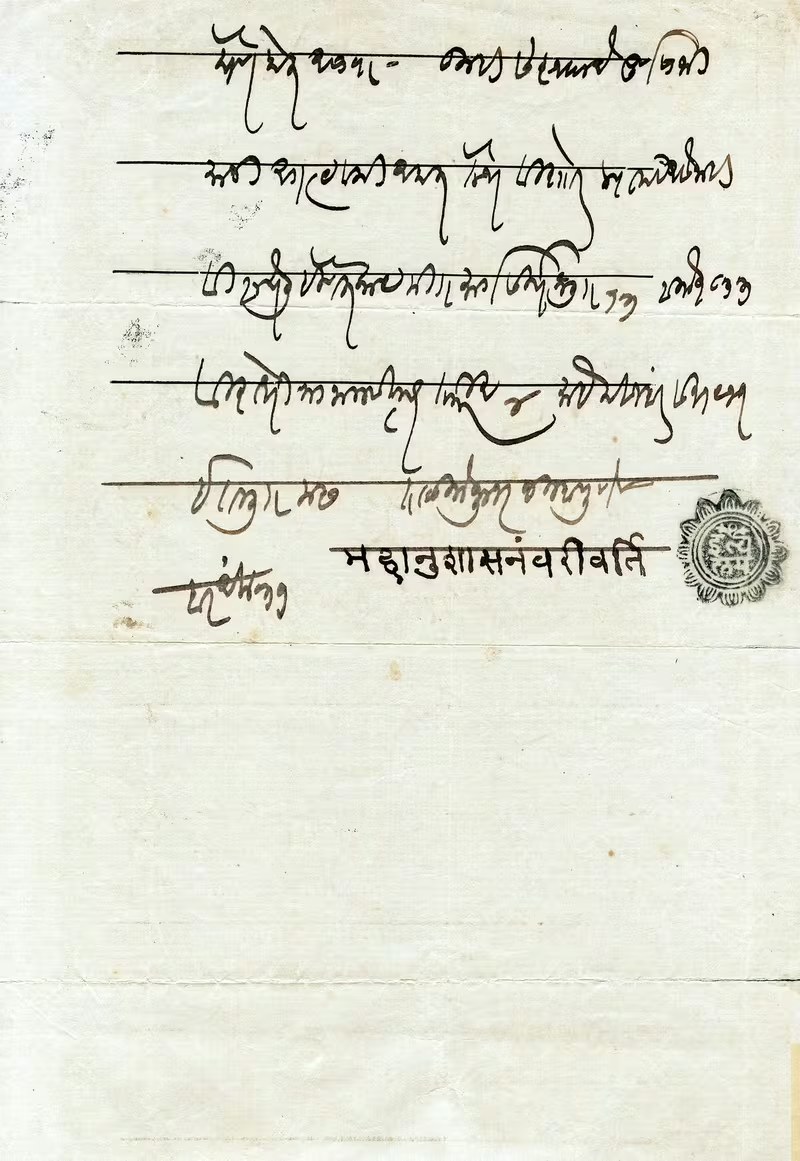
Modi Script: The Cursive Hand of Marathi Administration
In Pune, the oldest known document written in the Modi script dates from 1389, offering a direct connection to a writing tradition that shaped Marathi records for centuries. Modi was used to write Marathi, the primary language of Maharashtra, alongside the Balbodh style of Devanagari. Its importance came not only from the language it represented but also from the speed and continuity of its handwriting. Modi was designed to reduce the need to lift a pen while writing, an advantage for scribes producing business papers, administrative records, accounts, and correspondence. Its rounded and sometimes “broken” letter forms made it a cursive modification of Devanagari, while its conventions for vowels, consonants, conjuncts, and abbreviations gave it a distinctive visual identity.
The script passed through several historical styles, from Proto-Modi in the twelfth century to forms associated with the Yādava, Bahamanī, Shivaji, and Peshwa eras. During the Peshwa period, Chitnisi, Bilavalkari, Mahadevapanti, and Ranadi styles were used, with Chitnisi becoming the most prominent. Although Modi's everyday use declined after Indian independence, Unicode encoding, new fonts, keyboard tools, and teaching initiatives have supported its revival.
Origins and Classification
Linguistic Family
Modi is a script rather than a separate spoken language. It was used for Marathi and derives from the Nāgari family of scripts. More specifically, it is described as a modification of the Balbodh style of Devanagari intended for continuous writing. Modi and Devanagari therefore share some shapes, but they differ considerably in letter forms, rendering behaviour, and orthography.
The script has 46 distinctive letters: 36 consonants and 10 vowels. Its relationship with Devanagari is especially visible in the treatment of consonant-vowel combinations and conjunct consonants, although the forms and behaviours of these elements are often different.
Origins
The earliest historical style of Modi, Proto-Modi or ādyakālīna, appeared in the twelfth century. The available historical account presents several theories about the script's origin.
One theory connects Modi with Hemāḍpant, a minister during the reign of Mahadeva and the early years of Rāmachandra of the Yadava Dynasty. Within this broader theory are several possibilities. The creation subtheory holds that Hemāḍpant created Modi. The refinement subtheory proposes that Modi already existed in the thirteenth century and that Hemāḍpant refined it and introduced it as an official script for Marathi. A further Sri Lanka subtheory states that Hemāḍpant brought the script to India from Sri Lanka.
Another theory associates the origin of Modi with Bāḷājī Avajī Chitnis, who served as secretary of state to Shivaji Maharaj. The historical account does not resolve these competing origin theories.
Name Etymology
The name “Modi” may derive from the Marathi verb moḍaṇe, meaning “to bend or break.” The idea that Modi developed from broken Devanagari characters supports this interpretation. Several Modi characters are indeed described as “broken” versions of their Devanagari counterparts, although the name's origin remains a matter of theory.
Historical Development
Proto-Modi (12th Century)
Proto-Modi, called ādyakālīna in Marathi, appeared in the twelfth century. It represents the earliest style identified in the historical development of the script. Later changes produced forms associated with particular political and administrative eras.
Yādava Era (13th Century)
The Yādava Era style, or yādavakālīna, emerged as a distinct form in the thirteenth century during the Yādava Dynasty. This period is also important in theories connecting Modi's refinement or official introduction with Hemāḍpant.
Bahamanī Era (14th–16th Centuries)
The Bahamanī Era style, known as bahamanīkālīna, appeared between the fourteenth and sixteenth centuries during the years of the Bahmani Sultanate. The existence of era-specific forms demonstrates that Modi was not a completely fixed system: many changes occurred within each period.
Chatrapati Shivaji Era (17th Century)
During the rule of Shivaji, the seventeenth-century shivakālīna style developed. The Chitnisi style of Modi emerged in this period. Chitnisi later became especially prominent during the Peshwa Era.
Peshwa Era (Until 1818)
The Peshwa Era, or peshvekālīna, lasted until 1818. Various Modi styles proliferated during this period of the Maratha Empire. The named styles were Chitnisi, Bilavalkari, Mahadevapanti, and Ranadi. All were popular, but Chitnisi was the most prominent and frequently used style for Modi writing.
Modern Period
Modi use diminished after the independence of India. Balbodh Devanagari became the primary script used to write Marathi. In the twenty-first century, however, the script has gained new support through digital encoding, fonts, keyboard development, and educational initiatives.
Scripts and Writing Systems
Modi Script
Modi was created for swift, continuous writing. Its cursive features minimise the need to lift the pen from paper to dip it in ink or move from one character to the next. Many characters are more circular than their Devanagari counterparts, and some are broken forms of Devanagari letters. These properties also made it easier for scribes to produce multiple copies of a document.
The consonants can be grouped into three broad categories. Some retain their isolated forms and attach dependent vowels in a manner common to many Indic scripts. Others take contextual forms when followed immediately by a dependent vowel; the vowel signs then attach to the contextual consonant form. A third group forms ligatures when followed by vowels. The shape of the consonant and the presence of a loop on the right generally determine these ligatures.
Modi also contains special treatments for conjuncts. As in Devanagari, ksha and tra have special conjunct forms. Other consonants generally use half forms or contextual forms. The letter ra is particularly distinctive: as the first consonant in a conjunct cluster, it can occupy different visual positions depending on whether it is palatalized. As the second consonant, it functions in a way that is almost identical to its Devanagari use.
Alternative forms of ra appear in multisyllabic clusters. In forms such as kara, tara, and sara, it may appear as a subjoined element at the bottom right of a letter. At the end of other syllables, it may appear with a curved head. After dependent vowel signs such as -aa and punctuation marks such as dandas, ra can join underneath, with additional vowel marks written directly above the subjoined form.
An empty circle is used to indicate abbreviations. This feature may also have been borrowed by Goykanadi, a script used for writing Konkani, which is closely related to Marathi.
Devanagari and Balbodh
Modi was used alongside Devanagari to write Marathi until the twentieth century. Balbodh, the style of Devanagari promoted as the standard writing system for Marathi, eventually replaced Modi in primary use. The two scripts share some consonant, vowel, and vowel-sign shapes, but their writing behaviours and orthographic conventions differ.
Head Stroke and Page Layout
The Modi head stroke differs notably from the Devanagari head stroke. In Modi, it was typically written before the letters. This produced a ruled page for writing lines of text. Because the stroke did not break between words, word boundaries could not be visibly distinguished from the head stroke itself.
Geographic Distribution
Historical Spread
Modi was principally associated with Marathi and Maharashtra. Its historical use extended through administrative, commercial, and documentary settings. Most documents in the script are handwritten, and the majority of documents and correspondence from before the time of Shivaji Raje Bhonsle are written in Modi.
Centers of Documentation
Pune is an important centre for Modi preservation and revival. The oldest known Modi document, dating from 1389, is preserved at the Bhārat Itihās Sanshodhan Mandal in Pune. Linguists in Pune also spearheaded the modern Modi revival movement in 2014.
Modern Distribution
Modi is no longer the primary script for Marathi. Balbodh Devanagari now holds that position. Nevertheless, Modi remains present in historical documents, digital typography, specialist study, and educational programmes.
Literary and Documentary Heritage
Prose and Poetry
Before printing in Marathi was possible, Modi was used for prose while Balbodh was used for poetry. This distinction reflects the practical strengths of the two writing systems in the period before modern printing.
A sample associated with the script preserves verses attributed to Dnyaneshwar. The same text is presented in Modi, Balbodh Devanagari, and Roman transcription, illustrating the relationship between the historical script and Marathi's later standard writing system.
Administrative and Commercial Records
Modi was frequently used as a shorthand script for swift writing in business and administration. Administrative officials and businessmen used it for keeping accounts and writing Hundis, or credit notes. Its cursive forms allowed rapid writing and helped scribes make multiple copies of documents.
The script could also be used to encrypt messages because not everyone was familiar with reading it. In this setting, limited literacy in Modi gave the script a practical level of privacy.
Handwritten Documents
Most Modi documents are handwritten. The oldest known document dates from 1389, and the historical record includes substantial documentation from periods before Shivaji. These manuscripts and correspondences form an important part of the script's surviving documentary heritage.
Printing and Digital Technology
Printing
The arrival of Marathi printing created a choice between Modi and Balbodh. William Carey published the first book on Marathi grammar in 1805 using Balbodh because printing in Modi was not available to him in Serampore, Bengal. At the time, Marathi books were generally written in Balbodh.
Later editions of Carey's grammar, beginning in 1810, were written in Modi. Offset printing machines, previously including lithography, were used in the history of Modi printing.
Unicode and Typing
Modi was included in Unicode for the first time in version 7.0, released in June 2014. Its Unicode alphabet occupies the range U+11600–U+1165F. This encoding enabled the development of Unicode fonts such as MarathiCursive and Noto Sans Modi.
A Unicode keyboard layout named “Modi (KaGaPa Phonetic)” was also added to the XKB keyboard stack, used mainly in Linux-based operating systems. Its character mapping is similar to the Marathi KaGaPa Phonetic layout, but it uses Modi's dedicated Unicode block.
Modern Status
Current Use
Modi's everyday use has diminished, and Balbodh Devanagari is now the primary script for Marathi. The surviving handwritten documents, historical correspondence, printed works, Unicode characters, and digital tools continue to support its study.
Preservation Efforts
Linguists in Pune spearheaded a Modi revival movement in 2014. By 2025, more than 400 students had been trained to understand the script. A primary school has also begun teaching Modi to the next generation.
These initiatives connect historical manuscript study with practical learning. Unicode fonts and keyboard layouts further extend the script's use beyond archives and into digital environments.
Learning and Study
Academic Study
Modi can be studied through its historical styles, including Proto-Modi, Yādava Era, Bahamanī Era, Shivaji Era, and Peshwa Era forms. Learners must also attend to its contextual consonants, ligatures, conjuncts, forms of ra, dependent vowel signs, abbreviations, and head stroke.
The script's historical use in accounts, credit notes, administration, and correspondence makes documentary reading central to its study.
Resources
Unicode fonts such as MarathiCursive and Noto Sans Modi support digital display. The Modi KaGaPa Phonetic keyboard layout supports typing on systems using the XKB keyboard stack. Historical handwritten documents preserved in Pune and revival classes provide additional opportunities for learning.
Conclusion
Modi preserves the history of Marathi writing through a form shaped by speed, continuity, and administrative practice. Its rounded and sometimes broken letter forms, contextual consonants, ligatures, special treatments of ra, abbreviation mark, and continuous head stroke distinguish it from Balbodh Devanagari. From its earliest Proto-Modi form in the twelfth century through the Yādava, Bahamanī, Shivaji, and Peshwa eras, the script changed with the institutions that used it.
Its role extended beyond ordinary writing. Modi served officials, merchants, accountants, and scribes, carrying administrative correspondence, accounts, and Hundis. Although its use declined after independence, its oldest documents, printed history, Unicode encoding, digital fonts, keyboard layouts, and new teaching initiatives keep it connected to the present. The training of hundreds of students and the introduction of Modi instruction in a primary school show that this historic Marathi script remains a living subject of preservation and renewal.