Overview
Mandore lies 9 km north of Jodhpur in Rajasthan's Jodhpur district. Long before Jodhpur became the dominant center of Marwar, Mandore was an ancient political seat associated with the Pratiharas of Mandavyapura in the 6th century CE.
Its importance continued under the Rathores. Mandore Fort became the capital of the Rathore family before Rao Jodha founded Jodhpur and moved the capital there in 1459. Today, the ruined fort, Mandore Gardens, royal cenotaphs, museums, temples, and memorials preserve several layers of Marwar's history.
Etymology and Names
Mandore is associated in the historical record with Mandavyapura, the seat of the Pratiharas who ruled the region in the 6th century CE. The surviving account does not establish how the name changed from Mandavyapura to Mandore or provide a definitive explanation of its meaning.
Geography and Location
Mandore is located in the north-western Indian state of Rajasthan, around 9 km north of modern Jodhpur. Its position made it a practical center for ruling the surrounding Marwar region. The town's fortifications and elevated rock terraces remain visible features of its historic landscape.
Historical Timeline
The Pratiharas of Mandavyapura ruled the region in the 6th century. Even after the wider Gurjara-Pratihara empire disintegrated, a Pratihara family continued to govern at Mandore.
In the late 14th and early 15th centuries, this family allied with Rao Chunda, a Rathore chief. Rao Chunda married a Pratihara princess and received Mandore Fort in dowry. The fort then served as the Rathore family's capital.
Rathore Struggles for Mandore
Rao Ranmal Rathore secured Mandore's throne in 1427. He also became administrator of Mewar, assisting Maharana Mokal and later Rana Kumbha. After Mokal's assassination in 1433, Ranmal continued in that role. In 1438, Rana Kumbha ended the power-sharing arrangement, had Ranmal assassinated in Chittor, and captured Mandore.
Ranmal's son, Rao Jodha, escaped toward Marwar with approximately 700 horsemen. After fighting near Chittor and suffering losses at Someshwar Pass, he reached Mandore with only seven companions. He abandoned the town, continued toward Jangalu, and eventually found safety at Kahuni near present-day Bikaner.
For fifteen years, Jodha tried to recover Mandore. His opportunity came in 1453, when Rana Kumbha faced attacks from the sultans of Malwa and Gujarat. Jodha launched a surprise attack and captured Mandore. The two rulers later settled their differences to confront their common enemies.
Political Significance
Mandore was the capital of the princely state of Marwar, also known as Jodhpur State, until Rao Jodha moved the capital to Jodhpur in 1459. The new city became associated with Mehrangarh, while Mandore retained its importance as a dynastic and ceremonial site.
Religious and Cultural Importance
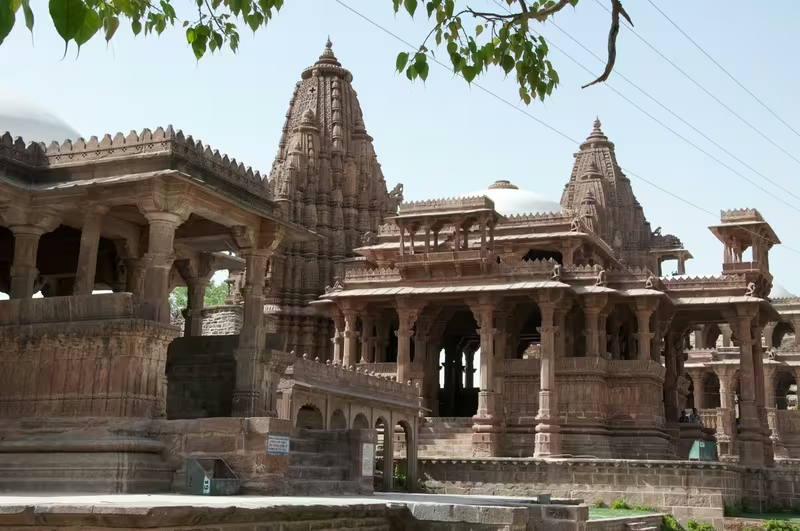
Mandore Gardens contain temples, memorials, and the cenotaphs of several rulers of Jodhpur State. The chhatri of Maharaja Ajit Singh, built in 1793, is among the prominent memorials.
A Ravan temple is another attraction. Local tradition identifies Mandore as the native place of Mandodari, Ravan's wife, and some local Brahmins treat Ravan as a son-in-law.
Monuments and Architecture
Mandore Fort is now ruined, but its thick walls and substantial scale indicate its former importance. A large ruined temple within the fort is notable for carved botanical forms, birds, animals, and planets on its outer wall.
The gardens also contain a government museum established in 1968 to conserve and display the architectural and zoological heritage of Marwar. The Hall of Heroes commemorates popular regional folk heroes and contains sixteen figures carved from a single rock.
Mandore remained the royal cremation ground for Marwar's kings until Maharaja Takht Singh. From Maharaja Jaswant Singh II onward, Jaswant Thada became the royal cremation ground.
Modern City
Mandore is now a historical suburb of Jodhpur and a heritage destination. Its attractions include the fort ruins, gardens, cenotaphs, museum, Hall of Heroes, temples, and the Hindu temple dedicated to the 33 crore gods. Its preservation is supported in part through the adoption of Mandore Fort by the Mehrangarh Museum Trust under the Indian government's “adopt a heritage” scheme.