Overview
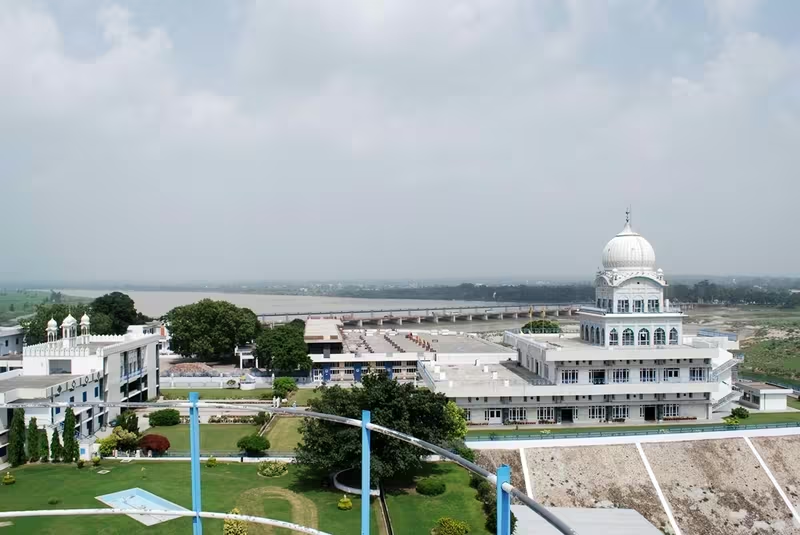
On the bank of the Sutlej, at an elevation of about 260 metres, Rupnagar preserves two different kinds of historical evidence: an archaeological site associated with the Indus Valley Civilization and a modern wetland shaped by river engineering. Formerly known as Ropar or Rupar, the city lies in Punjab, close to the Shivalik hills and about 47 kilometres northwest of Chandigarh.
Rupnagar is especially important because excavations here revealed a continuous cultural sequence from the Harappan period to medieval times. The city’s Archaeological Museum, opened to the public in 1998, displays objects recovered from the excavated site, including Harappan antiquities, copper and bronze implements, and gold coins attributed to Chandragupta Maurya.
Etymology and Names
The city is commonly identified today as Rupnagar, while Ropar and Rupar remain important historical names. Local tradition connects the name Rupnagar with a ruler called Raja Rokeshar, said to have ruled during the 11th century. According to this account, he named the town after his son, Rup Sen.
The surviving account presents this as a tradition rather than a firmly dated foundation record. It does not establish the precise moment when the settlement began, but the archaeological evidence shows that the area formed part of a much older cultural landscape.
Geography and Location
Rupnagar stands beside the Sutlej River, with the Shivalik hill range spread along the opposite bank. The city is bordered by Himachal Pradesh to the north and Shahid Bhagat Singh Nagar district to the west. Its location places it between the plains of Punjab and the foothills of the Lower Himalayas.
The climate is generally dry outside the southwest monsoon season. Winters are cold, summers are hot, and temperatures may range from about 1°C in winter to 47°C in summer. Most of the annual rainfall arrives between June and September, with approximately 78 percent recorded during these months.
This setting has shaped both the city’s environmental history and its modern connections. The Sutlej supports the Rupnagar Wetland, while the nearby hills and plains form a distinctive geographical boundary around the city.
Ancient History
Rupnagar is one of the important sites associated with the Indus Valley Civilization and is located along the beds of the Ghaggar-Hakra river system identified in accounts of the region. It is also notable as the first Harappan site excavated in India after independence.
Excavations have produced evidence of successive cultural phases rather than a single isolated settlement. The sequence extends from the Harappan period through later phases and into medieval times. This continuity makes Rupnagar valuable for studying how communities, material traditions, and settlement patterns changed across a long span of northern Indian history.
The museum’s collections include Harappan objects, copper and bronze implements, and gold coins attributed to Chandragupta Maurya. These finds connect the site not only with prehistoric and protohistoric archaeology but also with the wider historical development of the Punjab region.
Historical Timeline
Harappan Period
The earliest major phase represented at Rupnagar belongs to the Harappan cultural horizon. The excavated remains establish the city’s place among the archaeological sites associated with the Indus Valley Civilization.
Later Cultural Phases
The site was not abandoned as a historical subject after the Harappan period. Excavations indicate a continuous cultural sequence extending through later periods and into medieval times. The available record does not identify every ruling dynasty or provide dates for each phase.
Modern Period
Rupnagar became an important district center in modern Punjab. The Archaeological Museum opened to the public in 1998, making discoveries from the site accessible beyond scholarly excavation reports. In 2002, the Rupnagar Wetland was declared a Ramsar site.
Political Significance
Rupnagar is the headquarters of Rupnagar district and has become one of Punjab’s divisional headquarters, alongside Mohali and adjoining districts. Its administrative importance is part of the city’s modern identity, even though the strongest evidence for its ancient significance comes from archaeology rather than political records.
The city’s position also gives it regional importance. It is connected with Chandigarh, Himachal Pradesh, the Punjab plains, and routes leading toward Delhi. These links reinforce Rupnagar’s role as an urban center serving surrounding villages and towns.
Religious and Cultural Importance
Rupnagar contains several important Sikh religious sites, including Gurdwara Bhatha Sahib, Gurdwara Bhubour Sahib, Gurdwara Solkhian, and Gurdwara Tibbi Sahib. Together, these places form part of the city’s religious landscape.
Its cultural importance also rests on the Archaeological Museum. By preserving artefacts from the excavated site, the museum provides a tangible record of the region’s long history. Rupnagar therefore brings together living religious institutions, archaeological remains, and an environmental heritage site.
Economic Role
Rupnagar is connected by railway to Chandigarh and to Amritsar through Jalandhar, Ludhiana, Morinda, Una, and Nangal Dam. Its road network links it with Una, Baddi, Shimla, Solan, Ludhiana, Jalandhar, Chandigarh, and Delhi.
National Highway routes connect Rupnagar with Kharar, Chandigarh, Kurali, Kiratpur Sahib, Bilaspur, and Shimla. Other routes link it with Hoshiarpur, Phagwara, Jalandhar, Nawanshahr, Balachaur, and Banga. The city is also near the Baddi-Barotiwala-Nalagarh industrial corridor.
Monuments and Architecture
The Archaeological Museum is Rupnagar’s principal heritage institution. Its displays include material recovered through excavations, particularly Harappan antiquities and metal objects. The city’s listed religious landmarks include the four gurdwaras associated with Bhatha Sahib, Bhubour Sahib, Solkhian, and Tibbi Sahib.
Modern City
According to the 2011 census, Rupnagar had a population of 56,038. Its literacy rate was 82.19 percent, above the national average recorded in the same account. The city has schools affiliated with the CBSE, Punjab School Education Board, and ICSE systems.
Higher education is represented by the Indian Institute of Technology Ropar, spread across 525 acres beside the Sutlej, as well as the Institute of Engineering and Technology at Bhaddal and Government College, Ropar. These institutions serve students from Rupnagar and nearby districts.
The Rupnagar Wetland adds another dimension to the modern city. Created in 1952 after a head regulator was built on the Sutlej, this 1,365-hectare man-made freshwater wetland supports numerous species, including at least 154 bird, 35 fish, and 9 mammal species. Surrounded by Shivalik hills to the northwest and plains to the south and southeast, it remains one of Punjab’s important ecological zones.
Timeline
Rupnagar Wetland created
A head regulator on the Sutlej created the man-made freshwater wetland.
Archaeological Museum opened
The museum opened to the public with artefacts from the excavated site.
Ramsar designation
Rupnagar Wetland was declared a Ramsar site.
Census population recorded
Rupnagar recorded a population of 56,038.