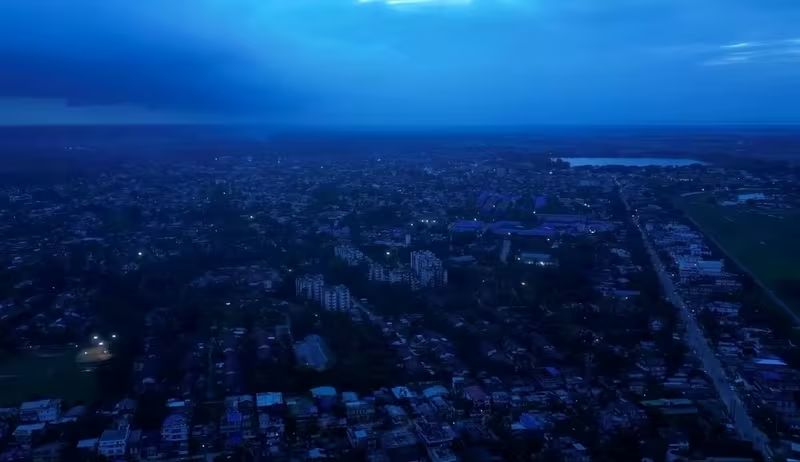
Overview
Sivasagar’s historic identity took shape in 1733, when Ahom queen Ambika Devi dug a tank covering about 257 acres at the kingdom’s capital, Rangpur. Beside it stood Siva Dol, and the place gradually came to be known as Sivpore, Sivpur, and eventually Sibsagar or Sivasagar.
Formerly Rangpur, Sivasagar was the capital of the Ahom Kingdom from 1699 to 1788. The Ahoms ruled Assam for approximately six centuries, making the city a major political centre in the history of the region. Today, Sivasagar is known for its Ahom palaces and monuments, while also functioning as a centre for tea, oil, education, and district administration.
Etymology and Names
A local tradition connects the earliest name, Kalansupar, with Kalansu Gohain, who is said to have lived in a village occupying the area where the Sivasagar tank now lies. In 1733, Ambika Devi created the large tank at Rangpur. Its association with the great Siva temple on the bank led to the name Sivpore or Sivpur. Over time, this developed into Sibsagar and then Sivasagar.
The name Rangpur is particularly important historically because it identifies the city during its period as the Ahom capital. The different names therefore reflect both an earlier local tradition and the later religious and political landscape created under Ahom rule.
Geography and Location
Sivasagar lies in Upper Assam at 26.9889° north and 94.639° east, at an average elevation of 86.6 metres above sea level. The city is the headquarters of Sivasagar district. Its location places it within the historic region where the Ahom kingdom exercised power for centuries.
The large historic tank remains the defining geographical feature associated with the old capital. The city is connected by road to other important centres of Assam. Sibsagar Town railway station serves the city, while Simaluguri Junction lies 16 kilometres away on the Lumding–Dibrugarh railway section. Jorhat Airport is about 75 kilometres away and Dibrugarh Airport about 95 kilometres away.
Ancient History
The available historical account of Sivasagar begins with traditions surrounding Kalansupar and the later Ahom capital of Rangpur. It does not provide evidence for an ancient settlement predating the Ahom period, nor does it identify archaeological remains from earlier dynasties. Sivasagar’s documented importance rests principally on its role in the Ahom kingdom and on the monuments associated with that era.
Historical Timeline
Ahom Period
The Ahom Kingdom made Rangpur its capital in 1699. From then until 1788, the city served as a seat of political authority. The period saw the creation of major architectural and water-management features, including the tank dug by Ambika Devi in 1733 and Siva Dol on its bank.
During the reign of Gaurinath Singha, who ruled from 1780 to 1795, a battle was fought near the Sivasagar tank against the Moamoria rebels. This episode reflects the internal challenges faced by the Ahom state in its later period.
The Ahoms continued to rule Assam until the kingdom fell to the Burmese Konbaung dynasty in 1819. The Ahom ruling class was then almost entirely wiped out. These events marked a decisive break in the political history of Sivasagar and Assam.
Colonial and Modern Era
The British conquered the province in 1825 and completely annexed it in 1826. For administrative purposes, the province was divided into three sub-divisions. Sivasagar later developed as a district and judicial centre. A separate civil district was declared in 1984, and the district judiciary was established in 1985.
The city remains the headquarters of Sivasagar district. Its modern economy includes tea and oil industries, while its educational institutions serve Upper Assam.
Political Significance
Sivasagar’s greatest historical importance comes from its time as the capital of the Ahom Kingdom. As Rangpur, it was a seat of royal authority and a centre from which the kingdom was administered. The monuments and tank associated with the city preserve the physical memory of that capital.
In the present day, Sivasagar is an administrative centre. The district has its own courts, and Charaideo’s judicial courts separated from Sivasagar district in 2021.
Religious and Cultural Importance
Siva Dol is the most prominent religious landmark named in the historical account of the city. Its position beside the tank helped shape the name Sivasagar. The tank and temple together form a major cultural landscape associated with the Ahom capital.
Sivasagar also has a strong Assamese cultural identity. At the 2011 census, Assamese was the first language of 90.24% of the population in the district. The district also includes speakers of Mishing, Hindi, Bengali, and Sadri, as well as communities such as the Khamyang and Turung Buddhist tribes.
Economic Role
Sivasagar is an important modern centre for the tea and oil industries. It is also an educational hub in Upper Assam, with institutions including Sivasagar College, Sivasagar Girls’ College, Demow College, Nazira College, and Sivasagar University. Government programmes such as Sarva Shiksha Abhiyan and Rashtriya Madhyamik Shiksha Abhiyan have aimed to improve educational infrastructure, teacher training, and student outcomes.
Monuments and Architecture
The Sivasagar tank, covering approximately 257 acres, is the city’s defining historic water feature. Siva Dol was built on its bank and gave the settlement its later name. The city is also well known for Ahom palaces and monuments, although the available account does not provide individual construction dates or architectural descriptions for each structure.
Together, these remains make Sivasagar an important place for understanding the material culture of the Ahom capital.
Famous Personalities
People associated with Sivasagar and its district include Assamese singer Dipali Barthakur, film director Jahnu Barua, athlete and coach Bhogeswar Baruah, poet Parvati Prasad Baruva, writers Maheswar Neog, Dimbeswar Neog, Imran Shah, and Benudhar Sharma, and freedom fighter Maniram Dewan. The list also includes politicians such as Bimala Prasad Chaliha and Hiteswar Saikia, actor Devoleena Bhattacharjee, musician Manas Robin, and historian Lila Gogoi.
Decline and Revival
Sivasagar’s political centrality declined after the Ahom capital period ended in 1788. The Moamoria rebellion, the fall of the Ahom kingdom to the Burmese in 1819, and British annexation in 1825–1826 transformed the region’s political order.
The city later revived in a different role—as a district headquarters, judicial centre, transport-connected town, educational hub, and heritage destination. Its historic monuments remain central to its identity.
Modern City
According to the 2011 census figures given for the district, Sivasagar had a population of 1,151,050, with a literacy rate of 81.36% and a sex ratio of 954 females for every 1,000 males. The city and surrounding district retain an overwhelming Assamese majority, alongside several other linguistic and cultural communities.
Sivasagar is accessible by rail and road, with regular buses to Guwahati, Dibrugarh, and Jorhat. Its historic tank, Siva Dol, and Ahom monuments continue to connect the modern city with its past as Rangpur, the capital of the Ahom kingdom.