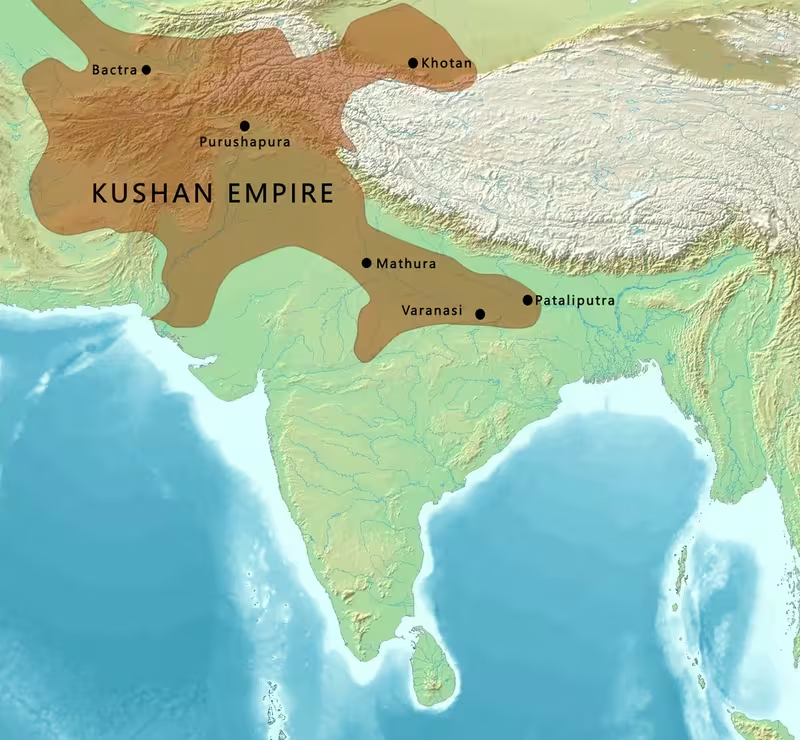
Overview
Around the first centuries of the Common Era, a dynasty rooted in Bactria governed a realm that connected the Hindu Kush, the Indus Valley, northern India and the roads of Central Asia. This was the Kushan Empire, a state formed by the Kushans, probably one of the five branches of the Yuezhi confederation. From its Central Asian beginnings, it expanded into a political and commercial power whose territories brought together Iranian, Greek, Indian and Buddhist traditions.
The empire is generally dated to approximately 30–375 CE, although its political history was not a single uninterrupted period of centralized rule. Its strongest phase came under the rulers traditionally called the Great Kushans, especially Kujula Kadphises, Vima Kadphises, Kanishka I, Huvishka and Vasudeva I. After Vasudeva I, Kushan authority divided into western and eastern spheres. Western lands fell under Sasanian control and became associated with the Kushano-Sasanian Kingdom, while eastern territories survived through smaller Kushan rulers in the Punjab before the final remnants were overwhelmed by the Kidarites.
The Kushan achievement lay not only in conquest. Their territory occupied a strategic position between the Roman world, Sasanian Iran, the Han empire of China and the societies of the Indian subcontinent. Their rulers used several languages and scripts, issued coins displaying a remarkably diverse range of gods, supported Buddhist institutions and presided over the development of Gandharan and Mathura art. Their reign helped create the conditions in which Buddhist texts, teachers and images moved from the Indian subcontinent through Central Asia toward China.
Much of Kushan history must be reconstructed from inscriptions, coins, archaeological remains and accounts written in other languages. No continuous Kushan historical narrative has survived. As a result, the identities and dates of some rulers remain uncertain, and the relationship between the early Kushans and the wider Yuezhi confederation continues to be debated. Even so, the surviving evidence reveals a dynasty that was deeply connected to several cultural worlds rather than belonging exclusively to one of them.
Rise to Power
The Yuezhi migration
The earliest background to the Kushan Empire lies in the movement of the Yuezhi from northwestern China toward Central Asia. Chinese historical works describe the Yuezhi as living in the grasslands of eastern Xinjiang and northwestern Gansu. They were eventually forced to migrate after conflict with the Xiongnu. Chinese accounts place this major movement in the period 176–160 BCE, after the Yuezhi king was defeated and beheaded by the Xiongnu.
The Yuezhi were not initially a unified Kushan kingdom. They were a confederation made up of five aristocratic tribes or divisions. Chinese sources name these as Xiūmì, Guìshuāng, Shuāngmǐ, Xìdùn and Dūmì. The Guìshuāng, or Kushan, group later became dominant among them. The Chinese continued to use the broader name Yuezhi, while the name Guishuang was adapted in western usage into “Kushan.”
The identity of the Yuezhi has been discussed from linguistic, historical and archaeological perspectives. Many scholars have regarded them as an Indo-European people. A specifically Tocharian origin has been proposed, while other interpretations have suggested an Iranian or Saka connection. Genetic research has also raised questions about whether the Yuezhi and the Tocharians shared the same origin. The relationship remains unresolved, and the evidence does not support treating the Kushans simply as a later Turkish or Mongol people. Their Central Asian origin is clear, but their precise ethnic and linguistic background is more complicated.
By approximately 135 BCE, the Yuezhi had reached the region of the Hellenic kingdom of Greco-Bactria in northern Afghanistan and Uzbekistan. Their movement contributed to the displacement of Greek dynasties toward the southeast. Saka groups, themselves pushed by earlier movements, also moved into regions farther south. These population shifts transformed the political landscape around Bactria, the Hindu Kush and the Indus basin.
The Yuezhi settlement in Bactria brought them into contact with the surviving traditions of the Hellenistic world. The Kushans later used Greek-derived artistic forms, Greek-style coinage and the Greek alphabet adapted to the Bactrian language. Their culture was therefore shaped by migration and conquest, but also by their incorporation of institutions and visual languages that already existed in the lands they occupied.
Early Kushan presence in Bactria
Archaeological remains from Bactria and Sogdiana provide evidence for Kushan presence during the second and first centuries BCE. Sites such as Takht-i Sangin, Surkh Kotal and Khalchayan preserve structures or sculptures associated with this period. At the same time, Kushan fortresses were built over or near earlier Hellenistic settlements, showing that the new rulers inherited and adapted older political and architectural landscapes.
Khalchayan is especially important for understanding the early Kushans. Sculptures and reliefs from the site show aristocratic and military figures, including horse-riding archers. A Kushan prince is represented with an artificially deformed skull, a practice well attested among nomadic populations of Central Asia. Some scenes are interpreted as depicting Kushan conflict with the Sakas. In these representations, the groups are distinguished through dress, facial treatment and physical presentation, although the precise historical events represented remain uncertain.
The earliest Kushan rulers did not immediately control the enormous region later associated with Kanishka. Their power grew through the consolidation of the Guishuang branch and the submission or absorption of other Yuezhi groups. The Chinese Book of Later Han presents Kujula Kadphises as the leader who united the other Yuezhi clans and founded the Kushan imperial power. The account describes his conquest of territories associated with Indo-Parthia, Kabul, Paktiya, Kapisa and Gandhara.
The historical relationship between Heraios and Kujula Kadphises is not completely settled. Heraios is the earliest ruler known to have called himself Kushan on his coins. He used Greek legends and styles and described himself as a “tyrant” in Greek. His coins also show the practice of artificial skull deformation. Heraios may have been the same person as Kujula Kadphises, or he may have been an earlier ruler or ally. The evidence permits more than one interpretation.
Kujula Kadphises and the formation of the empire
Kujula Kadphises is conventionally regarded as the founder of the Kushan dynasty. His rise probably occurred during the first century CE, when the Guishuang branch of the Yuezhi became dominant over the other groups. Through military and political consolidation, the Kushans formed a more tightly organized confederation and began to expand southward.
The Chinese account of Kujula describes a ruler who was more than eighty years old at his death. It attributes to him the conquest of the Gaofu region, generally associated with Kabul, and the defeat of Puda, or Paktiya, and Jibin, associated with Kapisa and Gandhara. These identifications are not completely straightforward, but the overall picture is clear: the Kushans moved from their Bactrian base through the Hindu Kush and into the political world of northwestern South Asia.
Kujula’s coins are particularly significant. He issued an extensive series, drawing upon Greek and Indo-Greek models while asserting a new Kushan identity. His coinage reveals how the dynasty used money not merely for exchange but also to communicate authority. The ruler’s name, titles, imagery and religious associations appeared across a wide area, allowing the currency to serve as a portable statement of sovereignty.
Kujula followed Iranian and Greek cultural ideas and iconography inherited from the Greco-Bactrian tradition. He was also associated with Shaivism, as were later rulers Vima Kadphises and Vasudeva II. This early religious affiliation did not prevent the Kushans from supporting Buddhism or incorporating other traditions. From the beginning, Kushan political culture was characterized by adaptation rather than strict religious uniformity.
The dynasty’s southward expansion brought it into Gandhara, a region centered on the valleys around Peshawar and Taxila. The Kushans established major centers at Kapisa, near modern Bagram, and Pushkalavati, later associated with Charsadda. These bases gave them access to routes through the Hindu Kush, the Indus region and the northwestern subcontinent.
Golden Age
Vima Takto and Vima Kadphises
Kujula Kadphises was followed by rulers whose exact family relationships and dates are reconstructed through inscriptions, coins and Chinese accounts. Vima Takto, also known in older scholarship as Soter Megas or “Great Saviour,” is mentioned in the Rabatak inscription. The Chinese name Yangaozhen in the Book of Later Han has been identified with Vima Takto, although the identification is not absolutely certain and the text may refer instead to Sadaṣkaṇa, a son or relative of Kujula.
Vima Takto expanded the Kushan presence into the northwest of South Asia. Chinese records say that the ruler who followed Kujula defeated Tianzhu, a term used for northern or northwestern India, and installed generals to supervise the conquered area. The same account remarks that the Yuezhi became extremely wealthy. This description connects military expansion with control of productive territories and long-distance commercial routes.
Vima Kadphises, generally placed after Vima Takto, further strengthened Kushan authority. He is identified in the Rabatak inscription as the son or descendant of the earlier Kushan line and as the father of Kanishka. His reign is usually dated to approximately 113–127 CE, though the chronology of the early Kushan rulers is not entirely fixed.
Vima Kadphises issued extensive coinage and inscriptions. His coins are especially associated with Shaivite imagery, contributing to the evidence that some Kushan rulers actively identified with forms of Hindu religious practice. At the same time, the state remained connected to Buddhist institutions and continued to employ the religiously varied imagery that became a defining feature of Kushan monetary culture.
The expansion under these rulers laid the foundation for Kanishka’s empire. By the early second century, the Kushans possessed the military capacity and political networks needed to control territories on both sides of the Hindu Kush. They also occupied a position from which they could participate in trade between Central Asia, India and the wider Eurasian world.
Kanishka I
Kanishka I, traditionally called Kanishka the Great, was the most celebrated Kushan ruler. His reign is generally placed from about 127 to approximately 151 CE, although the dating of the Kushan era has been debated. Research associated with Harry Falk has supported the beginning of Kanishka’s era in 127 CE.
The Rabatak inscription presents Kanishka as a ruler whose authority extended across a broad section of northern India. It names cities and regions including Kundina, Ujjain, Saketa, Kausambi, Pataliputra and possibly Champa. The wording indicates that rulers and important persons in these areas had submitted to his will. Because the inscription is royal propaganda, it should be read as a statement of imperial claim rather than as a complete administrative register. Nevertheless, it confirms the scale of Kushan ambition and the dynasty’s reach beyond the northwest.
Kanishka’s principal centers included Purushapura, modern Peshawar, and Mathura in northern India. Kapisa, near modern Bagram, served as a summer capital. The division of royal activity among these centers reflected the geographical breadth of the empire. Purushapura was closely connected with Gandhara and routes toward Central Asia, while Mathura linked the dynasty to the northern Indian plains. Kapisa occupied a strategic position near the Hindu Kush.
The famous Begram Treasure was found near Kapisa. It contains objects ranging in origin and style from Greece to China, including imported works of art and luxury goods. The collection illustrates the international connections of the Kushan court and the movement of objects through Central Asian trade routes. It also demonstrates that the empire was not culturally isolated: its elites participated in a world in which artistic and commercial goods crossed political boundaries.
Kanishka is strongly associated with Buddhism. Buddhist tradition credits him with convening a major Buddhist council in Kashmir. The historical details of this council are preserved in later Buddhist accounts and should therefore be treated with care, but the broader evidence for Kanishka’s patronage of Buddhism is substantial. His reign coincided with the expansion of Buddhist institutions and the movement of Buddhist teachers and texts across Central Asia.
Kanishka’s religious identity was not exclusively Buddhist. His coins display Iranian, Greek and Indian deities, as well as Buddha and Buddhist figures. The appearance of such varied imagery suggests that Kushan kingship operated through a broad religious vocabulary. The empire could support Buddhist institutions while also presenting the ruler within Iranian, Indian and Hellenistic traditions.
Huvishka
Huvishka succeeded Kanishka and ruled for approximately thirty years, conventionally from about 151 to 190 CE. His reign is often characterized as a period of consolidation and retrenchment rather than the dramatic expansion associated with Kanishka. Huvishka devoted particular attention to strengthening Kushan control over Mathura early in his reign.
Mathura was an important political, commercial and artistic center. Its location connected the Kushan realm with routes across the Gangetic plain and with regions farther south. Inscriptions, coins and sculptures from the area show that Kushan rule was not limited to military occupation. It was expressed through patronage, local administration, religious donations and the circulation of official coinage.
The reign of Huvishka also provides important evidence for the development of Buddhist devotion. A statue found at Govindo-Nagar near Mathura is dedicated to Amitabha Buddha and dates to the twenty-eighth year of Huvishka’s reign. The dedication was made by a family of merchants. This inscription is regarded as the earliest known epigraphic evidence of Amitabha. A manuscript fragment also describes Huvishka as a supporter of the Mahayana.
These references connect the Kushan period to the growth of devotional and Mahayana Buddhist traditions. The evidence does not mean that the entire empire followed one uniform form of Buddhism. Rather, it shows that different forms of Buddhist practice, patronage and textual transmission were active within Kushan territories.
Vasudeva I
Vasudeva I was the last of the rulers commonly called the Great Kushans. His reign is generally placed between approximately 190 and 230 CE, although inscriptions dated from year 64 to year 98 of the Kanishka era suggest a reign extending at least from about 191 to 225 CE.
Vasudeva’s name is notable because it is strongly associated with the Indian cultural sphere. His coinage and titulature nevertheless continued the broader Kushan political tradition. The empire still connected the Punjab, Gandhara, northern India and Central Asian routes, but pressures on its western and northern frontiers were increasing.
The end of Vasudeva’s rule coincided with Sasanian expansion toward the northwest of the Indian subcontinent. The Sasanians established control over territories that had been associated with western Kushan power, including areas in modern Afghanistan, Pakistan and northwestern India. This did not immediately eliminate every Kushan ruler, but it marked the beginning of the political fragmentation that ended the empire’s earlier unity.
Administration and Governance
A multilingual imperial culture
The Kushan Empire governed a region that contained many languages, scripts, religious communities and older political traditions. The dynasty’s administrative culture changed over time. Greek was initially used for administrative purposes, reflecting the Hellenistic heritage of Bactria and the models available to early Kushan rulers. The Kushans later adopted Eastern Iranian Bactrian for official use.
Bactrian was written in an adapted Greek script. This combination illustrates the practical flexibility of Kushan administration: an inherited alphabet was modified to represent a different language. Kushan coin legends also reveal this transition. During the early period, rulers used Greek legends alongside Prakrit written in Kharosthi. After the middle of Kanishka’s reign, Bactrian legends written in Greek script became prominent, while Greek and Prakrit forms continued to appear in different contexts.
In the Indian territories, inscriptions were written in Brahmi and Kharosthi. Sanskrit and Prakrit were both important in the inscriptional record. The Mathura region provides evidence for the use of Brahmi, while Gandhara and the northwest are associated especially with Kharosthi. This linguistic diversity was not merely a cultural feature; it was part of how the dynasty communicated with different populations and administrative traditions.
Satraps and great satraps
The Kushans introduced or expanded a form of governance using Kshatrapas and Mahakshatrapas, usually translated as satraps and great satraps. These officials or regional rulers helped administer a territory too large and varied to be managed directly from a single court.
The use of satrapal authority reflects the Kushans’ inheritance of earlier Iranian and Hellenistic political practices. Regional administration allowed the imperial center to maintain influence without replacing every local institution. It also created a structure in which authority could become more decentralized over time. When central power weakened after Vasudeva I, semi-independent rulers and local Kushan branches were able to survive in different parts of the former empire.
The available evidence does not provide a complete description of taxation, courts or bureaucratic offices. It does, however, show that Kushan government depended on a combination of royal authority, regional officials, military command and local political relationships. Inscriptions naming great satraps and royal benefactors reveal the presence of an organized political hierarchy, while the wide circulation of coinage indicates an effective system of monetary authority.
Coinage as administration and propaganda
Kushan coins are among the most important surviving records of the dynasty. They were abundant, circulated across a broad region and carried images and legends that identified individual rulers. The coinage included gold, silver and copper issues. The Kushans also used gold ingots, as shown by a treasure discovered at Dalverzin Tepe.
The circular gold ingots from the treasure could be cut progressively according to the amount required for a transaction. Parallelepiped ingots were used to store wealth in a form that was not meant to be divided. Some carried Kharosthi inscriptions recording their weight and invoking Mitra, associated with the protection of contractual relationships.
The Kushan monetary system influenced other political powers. Kushano-Sasanian rulers copied aspects of Kushan coinage in the west, while the state of Samatata in Bengal issued coins imitating Kanishka’s types. Gupta coinage was initially derived in part from Kushan coinage, adopting its weight standard, techniques and designs after Gupta expansion into the northwest.
The source of the gold used in Kushan coins remains uncertain. Roman coins and Roman trade goods circulated in the region, and older explanations proposed that Roman gold was imported, melted and struck into Kushan currency. Archaeometallurgical analysis, however, found high levels of platinum and palladium in Kushan gold, which do not support a Roman provenance. The origin of the gold remains unresolved.
Military Campaigns
Expansion through the Hindu Kush
The early Kushan military state grew through control of the routes and valleys leading from Bactria into the Hindu Kush and Gandhara. Kujula Kadphises is credited in Chinese accounts with defeating or absorbing territories associated with Kabul, Paktiya, Kapisa and Gandhara. These conquests gave the dynasty access to the Indus basin and the northwestern Indian political world.
The Kushans built or occupied fortresses in Bactria and elsewhere. Many were constructed over earlier Hellenistic defenses, showing that the dynasty adapted existing military infrastructure. Kushan fortresses are often characterized by arrow-shaped loopholes for archers. Such structures helped defend strategic routes, settlements and administrative centers.
The military forces of the Kushans included mounted archers, a tradition visible in early sculpture and consistent with their Central Asian background. Their expansion also depended on controlling passes and maintaining communication between their northern and southern territories. The Hindu Kush was therefore not simply a barrier but a zone through which the empire organized movement.
Northern India
Under Vima Takto and Vima Kadphises, Kushan authority expanded into the northwest of South Asia. Under Kanishka, the empire claimed a much wider zone. The Rabatak inscription names Ujjain, Kundina, Saketa, Kausambi, Pataliputra and possibly Champa. Kushan territory in India extended at least as far as Saketa and Sarnath near Varanasi, where inscriptions connected with the era of Kanishka have been found.
The precise nature of Kushan control varied from place to place. A city named in a royal inscription might have been directly administered, subordinated through a local ruler or included in a broader sphere of authority. The inscription’s language of submission expresses imperial power but does not by itself explain the daily mechanisms of governance. Archaeological and numismatic evidence therefore remains important for evaluating the extent of direct Kushan rule.
Evidence from Pauni, south of the Narmada River, includes an inscription by a great satrap named Rupiamma. It may indicate Kushan control extending that far south, although an alternative interpretation connects the area with the Western Satraps. This uncertainty illustrates the difficulty of drawing a precise political map of the empire.
Kushan influence also reached eastern India. Decorated coins of Huvishka were dedicated at Bodh Gaya along with gold offerings beneath the Enlightenment Throne of the Buddha. Their presence suggests direct Kushan influence or patronage in the area during the third century. Coins in Bengal and Odisha copied Kushan designs, though such imitations may reflect commercial influence rather than political conquest.
The Tarim Basin and China
The Kushans also turned north toward the Tarim Basin. During the first century CE, Kujula Kadphises sent an army to support the city-state of Kucha against Chinese expansion. The army withdrew after limited encounters. In the second century, Kanishka conducted further campaigns or military forays in the Tarim Basin.
Kushan influence in Kashgar, Yarkand and Khotan is visible in coinage. These regions occupied important positions on the routes between China, Central Asia and the Indian subcontinent. Control of them offered access to trade and created opportunities for Buddhist transmission.
Chinese accounts preserve a dramatic episode in which the Kushans requested a Han princess after sending gifts to the Chinese court. When the request was refused, the Kushans allegedly marched against the Chinese general Ban Chao with a force of 70,000. The smaller Chinese force defeated them, after which the Yuezhi retreated and paid tribute to the Han emperor.
The scale of the forces reported in ancient accounts may be rhetorical, but the episode reflects genuine rivalry between the Kushan and Han spheres. Later, the Kushans sent forces to install Chenpan, who had been held as a hostage among them, as king of Kashgar. These interactions were military, diplomatic and cultural at the same time.
The Kushans also had contacts with Chinese generals in campaigns against Central Asian opponents. Their political position near the Tarim Basin allowed them to cooperate with China in some circumstances and compete with it in others. This combination of alliance, tribute, conflict and commerce characterized relations between the two powers.
Cultural Contributions
Religious pluralism
Kushan religious culture was notably diverse. The empire’s rulers supported Buddhism, but they also patronized or represented Iranian, Greek, Hellenistic and Indian religious traditions. The coinage provides the clearest evidence. More than thirty different deities or divine figures appear on Kushan coins in gold, silver and copper.
Iranian figures included Ardoxsho, associated with prosperity; Mithra; Nana; Ahura Mazda; Verethragna; Atar, the royal fire; Vayu and several other figures. Greek and Hellenistic figures included Zeus, Helios, Hephaistos, Nike, Selene, Anemos, Heracles and Sarapis. Indian figures included Buddha, Shakyamuni Buddha, Maitreya, Mahasena, Skanda-Kumara, Vishakha, Uma and Oesho.
The identification of some figures remains debated. Oesho was long interpreted as Shiva, but has also been understood as the Avestan Vayu combined with Shiva. Two copper coins of Huvishka carry a legend associated with Ganesha but depict an archer with a bow and arrow. The image is generally interpreted as Rudra or Shiva rather than as the familiar elephant-headed Ganesha.
This religious imagery should not be reduced to a simple list of separate gods. Kushan visual culture often combined or adapted traditions. A deity could be represented through a form recognizable in more than one religious environment. The use of several pantheons allowed the king to present himself as a legitimate ruler across culturally different regions.
The Kushans’ religious policy was therefore one of inclusion and adaptation, though the available evidence does not establish a uniform imperial doctrine. Individual rulers may have favored particular traditions. Kujula, Vima Kadphises and Vasudeva II were associated with Shaivism, Kanishka became particularly famous as a Buddhist patron and later rulers continued to use mixed religious imagery.
Buddhism and the Silk Road
The Kushans inherited Buddhist traditions from the Indo-Greek and other states they replaced. Their patronage enabled Buddhist institutions to develop in regions that were central to trade. Monasteries were established along routes linking China with Afghanistan, Gandhara and the Indian subcontinent. These monasteries served religious communities but also existed within the wider movement of merchants, pilgrims, texts and artistic forms.
From approximately the first century CE onward, Buddhist books were produced and carried by monks and their merchant patrons. The Gandhari language became an important medium for Buddhist manuscripts. Gandhari was associated with eastern Afghanistan and northern Pakistan, and surviving scrolls show how Buddhist texts circulated in written form.
Kanishka’s reign is traditionally connected with a major Buddhist council in Kashmir. Although later accounts differ in detail, his reputation as a Buddhist patron became central to Buddhist historical memory. His empire’s position on the routes through the Karakoram also gave Buddhist teachers opportunities to reach Central Asia and China.
Kushan Buddhist influence was not limited to one school. Mahayana traditions developed during this period, and the reign of Huvishka provides some of the earliest inscriptional evidence for Amitabha Buddha. A manuscript fragment describes Huvishka as a supporter of the Mahayana. These developments demonstrate that Kushan territories were active environments for doctrinal, devotional and artistic change.
Buddhist missionaries associated with the Kushan world, including Lokaksema, became active in Chinese capital cities such as Luoyang and sometimes Nanjing. Their translation work helped transmit both Hinayana and Mahayana scriptures. Through these networks, the Kushans contributed to the transformation of Buddhism from a primarily South Asian religious tradition into one with a major Central and East Asian presence.
Gandharan art
Gandharan art developed in the region where Greek, Iranian, Indian and Buddhist traditions met under Kushan rule. It is among the best-known expressions of Kushan-period culture. Sculptures represent the Buddha, Bodhisattvas, Maitreya and Kushan donors. Kushan figures are often shown wearing tunics, belts and trousers, visually identifying them with Central Asian royal or military dress.
The roots of this artistic tradition extend before the mature Kushan period. The sculptures of Khalchayan, dating to the end of the second century BCE, show an art influenced by Hellenistic models and possibly connected with the artistic traditions of Ai-Khanoum and Nysa. Some scholars have argued that the Bactrian art of Khalchayan influenced the later development of Gandharan art.
Portraits and figures from Khalchayan share similarities with later Gandharan representations. The treatment of faces, hair and clothing suggests that artistic forms developed in Bactria remained influential after the Kushans expanded south. Gandharan artists also incorporated features associated with Greek, Syrian, Persian and Indian figures. Heavy drapery, curly hair and idealized bodily forms became recognizable aspects of the region’s Buddhist sculpture.
The relationship between Gandharan art and the emergence of Buddha images is complex. Mathura, Gandhara and other centers developed their own styles, and the chronology of early Buddha images has been debated. During the Kushan period, however, free-standing Buddha images were produced in large numbers. This was associated with changes in Buddhist doctrine and practice that allowed more direct figural representation than the aniconic traditions prominent earlier at sites such as Mathura, Bharhut and Sanchi.
Mathura art
The Kushan conquest and patronage also transformed the art of Mathura. The city developed a major sculptural tradition that differed from Gandharan art while participating in the same wider religious and political environment. Mathura produced free-standing images of the Buddha and other religious figures, as well as royal and donor representations.
Mathura’s importance was both artistic and political. It served as one of the main Kushan centers in India and was a major focus of Huvishka’s efforts to consolidate authority. Inscriptions from the city preserve the names and dates of Kushan rulers and officials. The combination of sculpture, religious dedication and political inscriptions makes Mathura one of the most important locations for understanding the Kushan presence in northern India.
Gandharan and Mathura art should not be treated as isolated traditions. They developed different visual languages, but both flourished within the Kushan imperial system. The movement of artists, patrons, religious ideas and materials across the empire encouraged a shared Buddhist environment while preserving regional styles.
Architecture and fortifications
Kushan architecture included religious monuments, monasteries, caityas and fortified settlements. The monumental temple at Surkh Kotal is one of the most important known Kushan structures. Its main architect was apparently a Greek named Palamedes, according to a Greek inscription that can be read as “through or by Palamedes.” The inscription suggests that Greek populations continued to live in Bactria during the Kushan period and that individuals from those communities participated in imperial construction.
The Kushans also built fortresses on earlier Hellenistic foundations. Their defensive architecture included arrow-shaped loopholes designed for archers. These fortifications reflect the need to secure routes and settlements across a large and sometimes contested empire.
Buddhist structures were built or supported in Kashmir and elsewhere. Later historical traditions describe the Kushan rulers Huska, Juska and Kaniska as founders of cities and patrons of monasteries and caityas. These accounts were written centuries after the Kushan period, but they preserve the memory of a dynasty closely associated with Buddhist construction and patronage.
Economy and Trade
A crossroads of routes
The Kushan Empire occupied a central position between several major commercial zones. Its lands connected the seaborne trade of the Indian Ocean with the overland commerce of the Silk Road and the long-established routes of the Indus Valley. At the height of Kushan power, the empire extended through territories corresponding to parts of present-day Uzbekistan, Afghanistan, Pakistan and northern India.
This geographical position allowed the Kushans to participate in commerce between China and the Roman Empire. Chinese silk moved westward, while Roman glassware and other goods reached Central Asian and Indian markets. The Begram Treasure, discovered near the Kushan summer capital at Kapisa, contains artistic and luxury objects from Greece to China and offers a vivid example of the goods that circulated through the empire.
Kushan prosperity was linked to political control of routes, but the evidence does not suggest that every trade road was under equally direct administration. The empire’s power was often a loose unity, and local rulers, satraps, merchants and religious institutions all participated in the movement of goods. The relative peace associated with the strongest phase of Kushan rule encouraged long-distance travel and helped urban centers flourish.
Roman connections
Roman writers and historians record diplomatic contacts with rulers of Bactria and India during the second century. These embassies probably referred to the Kushans or rulers within their sphere. Hadrian is said to have received ambassadors from the kings of Bactria, and Antoninus Pius reportedly received Indian, Bactrian and Hyrcanian ambassadors around 138 CE.
Some Kushan coins bear an image of Roma, indicating awareness of Roman imperial symbolism and perhaps diplomatic or commercial relations. Kapisa yielded numerous goods imported from the Roman Empire, especially varieties of glassware. Chinese accounts similarly describe Roman products in the Kushan realm, including fine textiles, carpets, perfumes, sugar, spices and salt.
These connections did not mean that Rome and the Kushans formed a single political system or maintained continuous direct diplomacy. Goods could travel through intermediary states and merchants. The evidence nevertheless shows that Kushan territories were embedded in a commercial world extending from the Mediterranean to China.
Parthamaspates of Parthia, who ruled the Roman client kingdom of Osroene, is recorded as trading with the Kushan Empire. Goods moved by sea and through the Indus River. Such exchanges demonstrate the combined importance of maritime and overland networks.
China and Central Asian trade
The Kushans’ northern routes connected them with the Han empire and the city-states of the Tarim Basin. Kushan political activity in Kashgar, Yarkand, Khotan and Kucha had commercial consequences. Even when military expeditions failed, diplomatic exchanges and rival claims helped keep the routes active.
Kushan Buddhist missionaries used these same routes. Trade and religious transmission were closely connected: merchants supported monasteries, monks traveled along commercial roads and settlements became centers for both exchange and teaching. The development of Gandhari Buddhist manuscripts and the translation activity of monks in China were products of this interconnected world.
The Kushan Empire was therefore not simply a territorial state situated along the Silk Road. It was one of the political systems that helped make the road a sustained network of movement. Its cities, fortresses, monasteries and markets connected regions with different languages and religious traditions.
Decline and Fall
Fragmentation after Vasudeva I
After the death of Vasudeva I, the empire divided into western and eastern spheres. The political structure that had linked Bactria, Gandhara and northern India became increasingly decentralized. Kanishka II ruled approximately from 230 to 247 CE, followed by Vāsishka, whose authority is recorded in Mathura, Gandhara and as far south as Sanchi.
Inscriptions at Sanchi refer to Vāsishka in years 22 and 28 of a possible second Kanishka era. These records show that Kushan authority or dynastic identity remained present far beyond the original northwestern core. They also reveal the difficulty of reconstructing the chronology of the later rulers. Different eras and regional records do not always align clearly.
Following territorial losses in the west and east, several rulers known as the “Little Kushans” controlled parts of the Punjab. Their capital was at Taxila. The sequence usually associated with this later phase includes Vasudeva II, Mahi, Shaka and Kipunada. These rulers probably operated under Gupta suzerainty for part of the period, although the precise nature of their political dependence varied.
Sasanian expansion
The western Kushan territories were the first major part of the empire to fall under a new imperial power. After Vasudeva I, the Sasanian Empire expanded into Sogdiana, Bactria and Gandhara. Sasanian king Shapur I claimed the “Domain of the Kushans” as far as Purushapura in the Naqsh-e Rostam inscription. The Rag-i-Bibi inscription from Afghanistan supports the evidence for Sasanian control.
The Sasanians replaced the western Kushan dynasty with Persian vassals known as Kushanshahs, or Kushano-Sasanians. These rulers continued to use Kushan cultural forms, including aspects of Kushan titulature and coinage. The transition was therefore not an immediate cultural rupture. Political authority changed, but many administrative and artistic traditions continued.
The Kushano-Sasanians eventually became powerful enough to rebel against the Sasanian Empire under Hormizd I Kushanshah. Their rule illustrates the political complexity of the post-Kushan west. The former imperial territory did not simply pass from one unified empire to another; it was reorganized through vassalage, regional dynasties and competing centers.
Around the middle of the fourth century, Shapur II regained the upper hand against the Kushano-Sasanians and took control of large territories in Afghanistan and Pakistan. This expansion may have followed wars with the Chionites and Kushans described by the Roman historian Ammianus Marcellinus. Sasanian control beyond the Indus becomes especially visible in Taxila through coin finds associated with Shapur II and Shapur III.
Gupta pressure in the east
The eastern Kushan territories faced pressure from the Gupta Empire. Around the third century, regions on the Gangetic plain became independent under local powers such as the Yaudheyas. In the fourth century, Samudragupta brought the remaining eastern Kushan rulers under Gupta suzerainty.
The Allahabad pillar inscription of Samudragupta refers to rulers identified through Kushan titles: Dēvaputra-Shāhi-Shāhānushāhi. These titles are associated with the Kushan formula meaning “Son of God, King, King of Kings.” The inscription says that these rulers submitted themselves, offered daughters in marriage and requested permission to administer their own districts and provinces. This language suggests that the Kushans still ruled in the Punjab but no longer as fully independent sovereigns.
The weakening of Kushan power can also be seen in coinage. Eastern Kushan rulers abandoned silver coinage, and their gold currency became debased. This decline suggests that they had lost much of the central role they once held in long-distance trade and the supply of luxury goods and precious metal.
Political weakness did not mean the immediate disappearance of Kushan culture. Buddhist art in Gandhara continued to flourish, and cities such as Sirsukh near Taxila were established or developed during this later environment. Dynastic power declined more quickly than the artistic and religious networks associated with it.
Kidarite conquest
Around 360 CE, a ruler named Kidara, identified in the historical tradition as a Kidarite Hun, overthrew the Kushano-Sasanians and established the Kidarite Kingdom. Kidarite coins adopted Kushan styles, suggesting that the new rulers claimed or appropriated Kushan legitimacy.
The Kidarites ruled on a smaller scale than the earlier Kushan Empire, but their adoption of Kushan coin forms shows that the dynasty’s political imagery remained valuable. Later northern invaders, including the Hephthalites, further transformed the political order of the region.
By approximately 375 CE, the Kushan Empire had ceased to exist as a unified imperial state. Its western territories had passed through Sasanian and Kushano-Sasanian rule, while its eastern remnants had been subordinated by the Guptas and then overwhelmed by the Kidarites. The end was therefore a long political dissolution rather than one single defeat.
Legacy
The Kushan legacy is visible across the history of India, Afghanistan, Pakistan and Central Asia. The dynasty’s political unity was temporary, but the connections it created endured. Kushan rulers linked Bactria and the Hindu Kush with the Indus Valley and northern India. Their territories became a corridor through which merchants, armies, artists, texts and religious teachers traveled.
The most influential part of this legacy was the spread of Buddhism. Kushan patronage supported monasteries, manuscript production and movement along the routes to Central Asia and China. The empire’s connection with the Karakoram and the Tarim Basin helped Buddhist traditions travel beyond the subcontinent. Chinese translation communities, including those associated with Lokaksema, drew on the intellectual and religious networks that passed through the Kushan world.
The Kushans also shaped the development of Buddhist art. Gandharan sculpture combined Buddhist subjects with visual techniques associated with Greek, Syrian, Iranian and Indian traditions. Mathura developed a powerful and distinct sculptural language at the same time. Together, these traditions contributed to the widespread representation of the Buddha and Bodhisattvas in South Asian and Central Asian art.
Their coinage influenced later dynasties. Kushano-Sasanian rulers retained Kushan formulas, Samatata imitated Kushan designs and the Guptas initially adopted Kushan weight standards and techniques. The coins also preserve a record of religious pluralism that is difficult to match in other ancient imperial traditions. Iranian, Greek, Indian and Buddhist figures appear within one monetary system, reflecting the mixed cultural environment over which the Kushan kings claimed authority.
The dynasty’s languages and scripts provide another lasting contribution. The shift from Greek administrative usage toward Bactrian in Greek script illustrates the adaptation of older institutions to new political realities. Inscriptions in Brahmi, Kharosthi, Sanskrit, Prakrit and Bactrian show how the empire communicated across a multilingual landscape.
The Kushans are sometimes described as presiding over a “Pax Kushana,” a period of relative peace lasting roughly two centuries. This phrase should be understood cautiously. The empire experienced warfare, frontier conflict, dynastic competition and eventual fragmentation. Yet the Kushan period did provide enough political stability in important corridors to encourage long-distance exchange. Its urban centers, monasteries and commercial routes became part of a wider Afro-Eurasian system.
The empire also complicates modern attempts to place ancient states within rigid cultural categories. The Kushans came from a Central Asian Yuezhi background, ruled Bactrian and Indian territories, used Greek and Brahmi-derived scripts, honored Iranian and Indian deities, patronized Buddhism and traded with Rome and China. Their history is best understood as one of interaction and synthesis.
Although much remains uncertain about their earliest rulers, exact boundaries and later chronology, the surviving evidence leaves no doubt about the dynasty’s broad historical importance. The Kushans made the lands between Central Asia and India into a major zone of political, economic and cultural exchange. Their empire disappeared, but the routes, artistic traditions, religious institutions and political forms associated with it continued to shape the history of Asia.