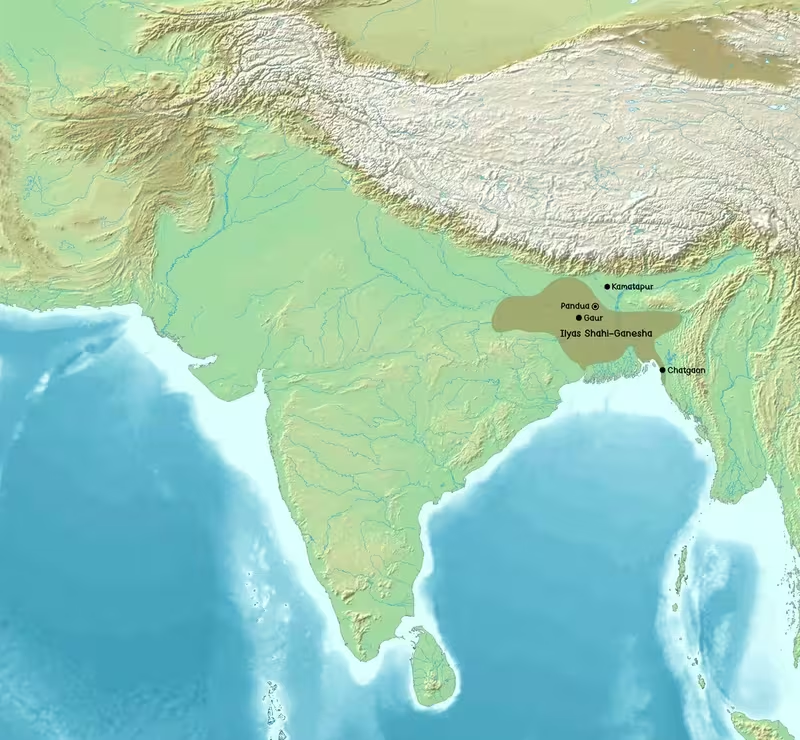
Overview
The Bengal Sultanate governed the eastern South Asian region between the fourteenth and sixteenth centuries. Its political heart lay in the Ganges-Brahmaputra-Meghna delta, a landscape of rivers, wetlands, forests, fertile agricultural zones, and seaports. From this base, the sultans controlled a succession of capitals and mint towns, conducted military campaigns across northeastern and eastern India, and maintained commercial links reaching from the Maldives and Southeast Asia to China, the Middle East, Africa, and Europe.
The sultanate was not ruled by a single continuous family. Five major dynastic phases shaped its history: the Ilyas Shahi dynasty, the House of Raja Ganesha, the restored Ilyas Shahi dynasty, the short Habshi rule, the Hussain Shahi dynasty, and the Afghan Muhammad Shahi and Karrani regimes. These houses were unrelated or only briefly connected, yet they inherited the same broad political world. Their authority rested on the sultan, the royal household, provincial officials, military commanders, landholders, Islamic scholars, merchants, and local elites.
Bengal’s independence developed from the difficulty of governing the region from Delhi. The overland distance between the Delhi Sultanate and Bengal allowed ambitious governors to establish their own bases. By 1338, Bengal had three separatist centres at Sonargaon, Gauda, and Satgaon. Shamsuddin Ilyas Shah defeated his rivals and, by 1352, had created a unified Bengal Sultanate.
The kingdom combined Persianate court culture with strongly regional institutions and traditions. Persian was the principal administrative, diplomatic, and commercial language, while Arabic remained important to Islamic religious life. Bengali was the main vernacular and eventually received recognition at court. Hindu and Muslim officials served in government, and Hindu landholders continued to control much agricultural land. The sultanate was a Sunni Muslim monarchy, but its society was religiously plural and included Hindu, Buddhist, Muslim, and foreign communities.
The Bengal Sultanate’s prosperity rested on agriculture, textiles, river transport, shipbuilding, overseas trade, and the production of silver coinage. Contemporary Chinese, Persian, Arab, and European visitors repeatedly described Bengal as wealthy and commercially active. Its cities contained mosques, bazaars, palaces, fortified enclosures, bridges, canals, workshops, and densely organized markets. Its architectural legacy remains especially visible in Bangladesh, West Bengal, Assam, and parts of the wider Bay of Bengal region.
Rise to Power
Bengal under the Delhi Sultanate
Bengal was gradually incorporated into the Delhi Sultanate during the early thirteenth century. The process began with Bakhtiyar Khalji’s conquest of Gauda between 1202 and 1204 during the reign of Muhammad of Ghor. Bakhtiyar had served as a military general of the Ghurid ruler and established the Khalji dynasty in Bengal.
After Bakhtiyar Khalji was assassinated by his own officer Ali Mardan in 1206, Bengal was governed by several maliks belonging to the Khalji tribe. Their rule was interrupted briefly by Ali Mardan himself. Delhi later attempted to impose direct control. Sultan Iltutmish sent forces under his son Nasir-ud-Din Mahmud, and in 1225 Bengal was declared a province of the Delhi Sultanate.
Direct rule, however, was difficult to sustain. Bengal was separated from Delhi by considerable overland distances, and communications were vulnerable to political disruption. Governors could therefore build local military and financial bases. When they rebelled, Delhi sometimes suppressed them militarily, but independent rule repeatedly reappeared.
Several capable governors and regional rulers demonstrated the political possibilities of an autonomous Bengal. Yuzbak Shah ruled in 1257, Tughral Khan between 1271 and 1282, and Shamsuddin Firoz Shah from 1301 to 1322. Firoz Shah established a strong administration in eastern and southwestern Bengal and conquered Sylhet. Even when Delhi appointed governors, Bengal’s regional geography and resources made it difficult for the central government to exercise consistent authority.
In 1325, Sultan Ghiyath al-Din Tughluq reorganized Bengal into three administrative regions. Sonargaon governed eastern Bengal, Gauda governed the north, and Satgaon governed the south. The arrangement did not last. By 1338, each region had a separatist ruler: Fakhruddin Mubarak Shah at Sonargaon, Alauddin Ali Shah at Gauda, and Shamsuddin Ilyas Shah at Satgaon.
The unification of Bengal
Fakhruddin Mubarak Shah expanded the power of Sonargaon and conquered Chittagong in 1340. He was succeeded by his son Ikhtiyaruddin Ghazi Shah in 1349. At Satgaon, Shamsuddin Ilyas Shah consolidated his own position. He first defeated Alauddin Ali Shah of Gauda and then overcame Ikhtiyaruddin of Sonargaon.
By 1352, Ilyas Shah had emerged victorious over the three competing Bengali centres. His achievement was more than a change of ruler. He unified the principal deltaic and riverine regions into a single sultanate and created the political framework that would endure, with interruptions, until Mughal conquest.
Ilyas Shah made Pandua his capital. From there he governed a territory organized around the river systems of the Ganges, Brahmaputra, and Meghna. The new kingdom’s power was based on control of agricultural land, waterways, strategic towns, military routes, and commercial centres. The region’s rivers made transport possible but also gave provincial rulers opportunities to resist central control. A successful sultan therefore needed both land forces and river forces.
Ilyas Shah’s campaigns quickly extended the reputation of the new state. His army raided and conquered territories across eastern South Asia. It reached Assam in the east and Varanasi in the west. Ilyas Shah also led the first Muslim army into Nepal, entered the Kathmandu Valley, and returned to Bengal with considerable treasure.
The Ekdala Wars and recognition of independence
The expansion of Bengal alarmed the Delhi Sultanate. In 1353, Sultan Firuz Shah Tughluq invaded Bengal and besieged Ekdala Fort. Bengal was unable to preserve all the territories conquered by Ilyas Shah and agreed to pay tribute to Delhi. Yet the defeat did not end Ilyas Shah’s rule. He retained firm control over Bengal.
Delhi invaded again in 1359 after the earlier peace arrangement had broken down. This time, Bengal successfully repulsed the Delhi forces. Negotiations produced a new treaty in which Delhi recognized Bengal’s independence. The treaty was a turning point. It established a political relationship between the two states without restoring Delhi’s direct rule.
The peace also helped secure the Ilyas Shahi dynasty. Ilyas Shah’s son and successor, Sikandar Shah, defeated Firuz Shah Tughluq during the second siege of Ekdala Fort in 1359. The Delhi ruler then presented Sikandar Shah with a golden crown estimated to be worth 80,000 taka. More important than the gift was the political settlement: Bengal’s independence was recognized, and it remained independent of Delhi for approximately two centuries.
Golden Age
The Bengal Sultanate’s most prosperous and influential phases developed under several rulers rather than during a single uninterrupted reign. The long Ilyas Shahi period established the state, the reign of Ghiyasuddin Azam Shah expanded its external relations, the reign of Jalaluddin Muhammad Shah strengthened regional Bengali elements, and the Hussain Shahi period extended Bengali influence across Assam, Orissa, Arakan, and neighbouring regions.
Sikandar Shah and the architecture of sovereignty
Sikandar Shah ruled for roughly three decades. His reign is associated with the construction of the Adina Mosque, one of the great architectural achievements of the sultanate. Its design drew on the Great Mosque of Damascus, reflecting the ways in which Islamic architectural forms were adapted when Islam became established in new regions.
The construction of such a monumental mosque expressed more than religious devotion. It demonstrated the resources of the court, the organizational ability of the state, and the sultan’s place within the wider Islamic world. The scale of the building also communicated Bengal’s independence from Delhi. A powerful regional court could commission architecture on an imperial scale even while developing its own local style.
The countryside remained socially complex. Much agricultural land was controlled by Hindu zamindars, and this created tensions with Muslim taluqdars. The relationship between central authority, landholding communities, military officers, and religious institutions was therefore not simply a conflict between two fixed religious blocs. The administration employed both Muslims and Hindus, while regional landholders continued to play important economic and political roles.
Ghiyasuddin Azam Shah and wider diplomacy
The reign of Ghiyasuddin Azam Shah marked an important expansion of Bengal’s foreign relations. He sent embassies to Ming China, beginning a tradition continued by later rulers. He also sponsored construction projects in Arabia and exchanged letters and poetry with the Persian poet Hafez.
Ghiyasuddin held court at Sonargaon as well as Pandua. Sonargaon was a major river port with shipping links to China, Southeast Asia, and the Middle East. Chinese envoys described it as a large metropolis. Ma Huan, who visited in 1406, recorded a city with substantial urban development, while other Chinese accounts referred to its fortified walls.
Sonargaon was also a centre of Sufi education and Persian literature. The institutions founded by Abu Tawwama during the Delhi Sultanate continued under the Bengal Sultans. Sufi teachers and scholars associated with the region included Ibrahim Danishmand, Saiyid Arif Billah, Muhammad Kamel, and Saiyid Muhammad Yusuf. Ghiyasuddin even invited Hafez to settle at Sonargaon, although the poet did not move there.
Bengal’s rulers also maintained symbolic ties with the Abbasid Caliphate in Cairo. The caliphate no longer exercised direct power over Bengal, but the caliph remained an important symbolic leader of Sunni Islam. Coins could bear the names of both the Bengali sultan and the contemporary Abbasid caliph. Such references offered religious and political legitimacy to the Bengali court.
The House of Raja Ganesha and Jalaluddin Muhammad Shah
In the early fifteenth century, the Ilyas Shahi order was challenged by Raja Ganesha, a powerful Hindu landholder. He succeeded in placing his son, Jadu, on the throne after the son converted to Islam and took the name Jalaluddin Muhammad Shah.
The transition involved both political conflict and negotiation. Qutb al Alam, a powerful Muslim holy man, was asked by Raja Ganesha for assistance because of the threat of invasion from the Jaunpur Sultanate. The eventual agreement required Jadu to convert and rule as Jalaluddin Muhammad Shah. Raja Ganesha accepted the arrangement.
Jalaluddin’s reign was relatively short but politically important. He helped an Arakanese ruler regain his throne and established control over Fatehabad. He also promoted more indigenous Bengali elements in the architecture and administration of the sultanate. At first he remained loyal to the Abbasid Caliphate, but later declared himself the Caliph of Allah, a claim that altered the language of his sovereignty.
The Jaunpur conflict ended after intervention from outside powers. The Timurid ruler of Herat, Shahrukh Mirza, directed the ruler of Jaunpur to stop attacking Bengal. Ming China also mediated after the Bengali ambassador in the Chinese court complained about the conflict. These interventions show that Bengal’s politics had become part of a wider diplomatic system linking eastern South Asia with Central Asia and China.
The Ilyas Shahi dynasty was restored in 1432. The political transition did not erase the developments of the intervening period. The sultanate continued to draw on Bengali landholders, Muslim military elites, Persianate court traditions, regional religious institutions, and an expanding urban economy.
Pandua and the movement of the capital
Nine kings ruled Bengal from Pandua over approximately ten decades. During this period the city acquired palaces, forts, bridges, mosques, and mausoleums. Chinese envoy Ma Huan described Pandua’s walls as imposing and its bazaars as orderly. Shops stood side by side, pillars were arranged in rows, and the markets contained many types of goods.
Pandua was a centre for cloth and wine. Chinese accounts referred to at least six varieties of fine muslin and four kinds of wine. The city also produced high-quality paper from the bark of mulberry trees. Its economy combined agricultural production, specialized craft industries, elite consumption, religious institutions, and long-distance trade.
Sultan Mahmud Shah moved the capital from Pandua to Gaur in 1450. A probable reason was a change in the course of nearby rivers. In a riverine environment, the location of a capital depended on navigability, flood patterns, access to trade routes, and the ability to supply the court. The movement from Pandua to Gaur illustrates how closely Bengal’s political geography was tied to changing waterways.
Administration and Governance
The sultan and the court
The Bengal Sultanate was an absolute monarchy shaped by Persianate political traditions. The sultan stood at the centre of the state, supported by the royal family, military commanders, provincial officials, landholders, court scholars, and the ulama, or Islamic scholars.
The population of the ruling establishment was ethnically and regionally diverse. Bengali, Turco-Persian, Afghan, and Abyssinian elites served at different times. Persians arrived as teachers, lawyers, scholars, clerics, administrators, and political advisers. Turks and Afghans entered military and administrative service, while Abyssinians were imported as mercenaries. In the late fifteenth century, members of the Abyssinian mercenary corps became powerful enough to place four successive usurper sultans on the throne.
The political structure therefore depended on negotiation among different communities. The court could employ Muslim and Hindu officials together. Local landholders remained important, and provincial governors could become semi-independent. The stability of a reign depended on the sultan’s ability to balance military factions, religious authorities, regional elites, and the urban economy.
Administrative divisions
The sultanate was divided into administrative units known as arsa and iqlim. These were further divided into mahals, thanas, and qasbas. The terminology reflects the influence of Persianate and Islamic administrative traditions, while the actual operation of government depended on local officials, landholders, revenue collection, and military organization.
The revenue system was maintained in the Bengali language throughout the sultanate’s history. This is significant because Persian dominated official, diplomatic, and commercial life. The continued use of Bengali in revenue administration indicates the importance of local institutions and the practical need to communicate with the agricultural population.
The government employed both Muslims and Hindus and promoted a form of religious pluralism. This did not eliminate social tensions. Hindu zamindars controlled much farmland, while Muslim taluqdars competed for authority and revenue. Yet the state’s functioning depended on cooperation across religious and ethnic lines.
Capitals and mint towns
A capital was both a royal residence and an economic centre. Pandua, Sonargaon, Gaur, and Tanda each became important at different times. The sultans also established or developed mint towns across the region. These were royal or provincial capitals where taka coins were struck.
Mint towns were economic urban centres because coin production signalled political authority. A coin bearing the name of a sultan made sovereignty visible in everyday transactions. As the sultanate expanded, the number of mint towns increased. Their distribution reflects the reach of the state into agricultural districts, river ports, military settlements, and commercial areas.
The historical taka was primarily a silver currency. Bengal was unusually successful in maintaining a predominantly silver coinage compared with Delhi and several contemporary Asian and European governments. Large transactions were conducted in silver taka, while smaller purchases used cowry shells. A single silver coin could be valued at 10,250 cowry shells, making the supply of imported cowries important to the monetary economy.
Royal mosques and political authority
Mosques served religious, social, and political functions. Imperial mosques could contain an elevated throne known as the Badshah-e-Takht, or King’s Throne. The sultan sat on this throne while addressing subjects, administering justice, and conducting government business.
The presence of a Badshah-e-Takht made the mosque a royal court as well as a place of worship. Sultans travelled between towns and held court in mosques equipped for royal audiences. The throne in the Kusumba Mosque is especially decorated and includes a small, intricately designed mihrab. The Adina Mosque contains one of the largest royal galleries in the subcontinent.
Military Campaigns
Army and navy
The Bengal Sultanate maintained an organized military consisting of cavalry, artillery, infantry, war elephants, and naval forces. Bengal’s rivers, marshes, and monsoon climate made the cavalry less reliable than in drier regions. Horses had to be imported, and cavalry could not operate effectively throughout the year.
Artillery was one of the strongest elements of the army. Portuguese historian João de Barros attributed Bengali military superiority over Arakan and Tripura partly to efficient artillery. Bengali forces used cannons and guns of different sizes. Infantry known as paiks formed the essential core of the army. They fought with bows, arrows, and firearms, and their organized battle formations attracted the attention of Babur.
War elephants transported military materials and armed personnel. Their movement was slow, but elephants remained important in riverine Bengal. The navy compensated for the limitations of cavalry. Boats and infantry could control the waterways during the part of the year when mounted forces were least effective.
A naval force had existed in Islamic Bengal since the time of Iwaz Khalji, who first organized one. War boats later played an important role in political affairs. The chief of the admiralty oversaw shipbuilding, river transport, the fitting out of boats for war elephants, recruitment of sailors, river patrols, and the collection of tolls at river ghats. The naval system declined during the Hussain Shahi period, but river power remained essential to the region’s political order.
Wars with Delhi
The Bengal-Delhi wars established the sultanate’s independence. Firuz Shah Tughluq’s first invasion in 1353 forced Bengal to pay tribute after the siege of Ekdala Fort. The second invasion in 1359 ended differently. Bengal repulsed the Delhi forces, and the resulting treaty recognized its independence.
Delhi’s interest in Bengal did not disappear. During the sixteenth century, the Lodi dynasty attacked Bengal while pursuing the defeated Sultan of Jaunpur. The Delhi Sultanate eventually agreed to peace. The repeated conflicts show that Bengal’s independence was accepted pragmatically rather than permanently removed from northern Indian politics.
The Bengal-Jaunpur War
The Jaunpur Sultanate attacked Bengal in the fifteenth century after the rise of the House of Raja Ganesha. The conflict was connected to the political legitimacy of the new ruling order. Raja Ganesha had displaced the previous dynasty, and the Jaunpur rulers challenged the authority of his family.
Diplomatic intervention prevented the war from destroying the Bengal Sultanate. Qutb al Alam helped negotiate the conversion of Raja Ganesha’s son, Jadu, who became Jalaluddin Muhammad Shah. Shahrukh Mirza of the Timurid Empire then directed the ruler of Jaunpur to halt the attacks. Ming China also mediated after a Bengali complaint reached the Yongle Emperor’s court.
The war lasted from 1415 to 1420. Bengal annexed parts of the Jaunpur Sultanate, and peace followed. The conflict demonstrates that Bengali diplomacy could draw upon relationships far beyond the immediate region.
Campaigns in Assam
Bengal’s rulers repeatedly sought influence in Assam and the Brahmaputra Valley. Shamsuddin Ilyas Shah led the first major Muslim campaign against the Kamarupa kingdom and captured Guwahati. His campaign made Bengal the first Muslim power to send an army into that region.
Sikandar Shah later campaigned in Assam, though an attack on Bengal by Firuz Shah Tughluq forced him to withdraw from central Assam. The campaign weakened Indranarayan and allowed Arimatta, a Bhuyan from Darrang, to seize power.
Under the Habshi ruler Shamsuddin Muzaffar Shah, Bengal again attacked Assam. He assembled an army of approximately 40,000 soldiers, including Afghan and Abyssinian recruits. His forces defeated the Kamata Kingdom and conquered its territory in 1492–93. Coins were issued bearing the phrase “Kamata Mardan,” or conqueror of Kamata.
The greatest extension of Bengali control in Assam occurred under Alauddin Hussain Shah. His general Shah Ismail Ghazi overthrew the Hindu Khen dynasty of Kamata in 1498. King Nilambar was imprisoned, the capital was plundered, and Bengali authority extended to Hajo. The victory was recorded in an inscription at Malda.
Bengal later confronted the Ahom kingdom. In 1532, the Bengali commander Turbak invaded Ahom territory with cavalry, elephants, guns, and cannons. The initial battle favoured the invading force, but the Ahoms regrouped. At Duimunisila, their navy inflicted heavy losses on the Bengali army, killing commanders and capturing or destroying ships and artillery.
Reinforcements under Husain Khan arrived, but the Ahoms continued to win engagements. Turbak was eventually killed near the Bharali River, and the retreating forces were pursued to the Karatoya River. The campaign ended in a decisive Ahom victory.
Arakan and Chittagong
Arakan was both a neighbour and a strategic coastal power. The Bengal Sultanate helped the exiled Arakanese ruler Min Saw Mon recover his throne after Burmese invaders displaced him. Bengali forces led by a Pashtun general restored him to the Launggyet dynasty, and Arakan became a vassal of Bengal.
The relationship later became unstable. Arakan asserted its independence and developed into a powerful coastal kingdom. Under Alauddin Hussain Shah, Bengal restored its authority in Chittagong and northern Arakan after the war of 1512–1516. Arakanese rulers nevertheless continued to contest Chittagong and at times allied with Portuguese pirates.
Arakanese kings adopted several institutions associated with the Bengali court. They used the title shah, minted coins with Arabic and Bengali inscriptions, and imitated Bengali administrative practices. Bengali Muslim influence in Arakan continued for centuries even after Arakan became independent.
Orissa
Conflict with Orissa began during the reign of Shamsuddin Ilyas Shah. He defeated Bhanudeva II of the Eastern Ganga dynasty, sacked Jajpur and Cuttack, and reached the Chilika Lake. The campaign brought substantial plunder, including 44 elephants, back to Bengal.
Under Alauddin Hussain Shah, Shah Ismail Ghazi led a campaign against Kapilendra Deva of the Gajapati Empire. He defeated the Gajapati forces, recovered Mandaran, and built a fort there. Orissa remained a major theatre of conflict because of its wealth, strategic location, and access to the Bay of Bengal.
Sulaiman Khan Karrani later conquered Orissa again. In 1568, it was annexed to the Bengal Sultanate. The region then became central to the final Mughal-Bengal conflict. The Battle of Tukaroi and the Treaty of Cuttack in 1575 marked the transition from Bengali-Afghan control to Mughal dominance.
Campaigns in Nepal and Mithila
Ilyas Shah led the first Muslim army into Nepal. Before entering the Kathmandu Valley, he occupied Tirhut and divided it into northern and southern parts. He retained the southern section, stretching from Begusarai toward the Nepal Terai, while restoring the northern area north of the Budhi Gandaki River to the Oiniwar ruler Raja Kameshwar.
Ilyas Shah established a headquarters at Ukkacala, later known as Hajipur, where he constructed a large fort and urbanized the area. His army then crossed the Terai plains and entered the Kathmandu Valley, ruled by Jayaraja Deva. The army sacked the temple of Swayambhunath and looted Kathmandu for three days before returning to Bengal with substantial spoils.
The sultanate again expanded into the Mithila region under Nasiruddin Nasrat Shah. In 1526, Bengal annexed the Oiniwar dynasty, and its ruler Laksminathasimha was killed in battle.
Cultural Contributions
Bengali, Persian, and Arabic
The culture of the Bengal Sultanate developed through interaction among local Bengali traditions and wider Islamic, Persianate, Central Asian, and Indian influences. Bengali was the most widely spoken language and the principal vernacular of the population. Persian served as the official, diplomatic, and commercial language, while Arabic remained the language of Islamic liturgy and religious scholarship.
Under the sultans, Bengali received recognition at court. This did not displace Persian from administration, but it gave Bengali a new place in official culture. Muslim poets began composing in Bengali by the fifteenth century, and by the early sixteenth century a vernacular literature shaped by Sufism and Islamic cosmology was flourishing.
The Dobhashi tradition used both Persian and colloquial Bengali. Nur Qutb Alam pioneered this form in the fifteenth century. Its poems drew on Islamic figures and stories while using Bengali literary forms. The tradition marked a deep cultural exchange rather than a simple replacement of older traditions.
Bengali Muslim literature included poems about Yusuf and Zulaikha by Shah Muhammad Sagir, works by Bahram Khan and Sabirid Khan, and longer compositions such as Nabibangsha by Syed Sultan, Janganama by Abdul Hakim, and Rasul Bijay by Shah Barid. Writers also translated Arabic and Persian works, including the Thousand and One Nights and the Shahnameh.
Hindu poets of the period included Maladhar Basu, Bipradas Pipilai, and Vijay Gupta. Their presence illustrates the coexistence of multiple literary communities in the sultanate.
Persian literature and Sufi learning
The court attracted Persian scholars, lawyers, teachers, and clerics. Sonargaon became a major centre of Persian literature during the reign of Ghiyasuddin Azam Shah. The sultan’s correspondence with Hafez is particularly well known. When Ghiyasuddin invited the poet to complete an unfinished ghazal, Hafez replied by praising the king’s court and the quality of Bengali-Persian poetry.
The Bengal Sultanate maintained and expanded institutions associated with Sufi learning. The intellectual world of the sultanate connected Bengal with the wider Islamic world, including the pilgrimage cities of Mecca and Medina. Ghiyasuddin Azam Shah sponsored madrasas in both cities. One of the teachers associated with the Meccan institution was Taqi al-Din al-Fasi.
These connections gave Bengal a place within the religious, scholarly, and literary networks of the wider Sunni world. They also strengthened the legitimacy of its independent rulers.
Manuscripts and painting
Persian manuscripts with paintings form an important part of the artistic heritage of the sultanate. One notable example is Sultan Nasrat Shah’s copy of Nizami’s Iskandar Nama, produced during his reign between 1519 and 1538. It contains epic poetry about the conquests of Alexander the Great and combines literary patronage with manuscript painting.
Illustrated manuscripts offer valuable glimpses of courtly fashion, architecture, and elite life. They show that the artistic environment of Bengal was connected to Persianate traditions while developing its own regional features.
Society and everyday life
Bengali society included royalty, aristocrats, agriculturalists, artisans, merchants, religious figures, military personnel, and foreign residents. Hindu and Muslim communities had their own endogamous groups with distinctive occupations. Sixteenth-century literary descriptions refer to numerous Muslim occupational communities, including weavers, livestock herders, fishmongers, papermakers, dyers, tailors, bow makers, wandering holy men, and sellers of food.
Persian migrants formed an important community. Turks, Afghans, Arabs, and Central Asians also settled in Bengal or entered its service. Abyssinian mercenaries were imported for domestic, military, and political purposes.
Men wore cotton shirts, turbans, sarongs, lungis, dhotis, belts, leather shoes, and robes. Women wore cotton saris, while elite women used gold jewellery. Visitors described markets, bathing places, eating establishments, drinking houses, dessert shops, hotels, and hammams. Betel nut was offered to guests.
Punishments could include expulsion from the kingdom and bamboo flogging. The Hindu minority did not eat beef. Musicians performed outside the houses of the wealthy at dawn and were rewarded with food, wine, and money. The society described by travellers was prosperous but socially differentiated, with strong distinctions of occupation, wealth, status, and religious community.
Architecture
Urban architecture
The cities of the Bengal Sultanate were shaped by rivers, fortifications, palaces, mosques, bazaars, canals, bridges, and gardens. Gaur and Pandua were the principal royal capitals for much of the sultanate’s history.
Around 1500, Gaur was described as the fifth-most populous city in the world after Beijing, Vijayanagara, Cairo, and Canton. Its population was estimated at 200,000. The city contained a citadel, a royal palace, a durbar, mosques, watchtowers, canals, bridges, large gateways, and a defensive wall.
Portuguese historian Castenhada de Lopez described Gaur’s houses as one-storeyed structures with ornamental floor tiles, courtyards, and gardens. The royal palace was divided into three sections: the royal court, the living quarters of the sultan, and the harem. A high wall enclosed the palace, while a moat surrounded it on three sides and connected it to the Ganges.
Pandua developed from a small settlement into a military garrison and then a major imperial capital. Its buildings included mosques and mausoleums. The capital’s markets sold textiles, wine, paper, and other goods, and Chinese visitors commented on the organization of its streets and shops.
The architecture of the sultanate incorporated Arab, Bengali, Persian, Indo-Turkish, and Byzantine influences. At the same time, local developments became increasingly important. Curved Bengali roofs began appearing in concrete forms during the fifteenth century. These forms were later adapted in Mughal and Rajput architecture elsewhere in the subcontinent.
Mosque architecture
Bengal’s sultanate mosques commonly featured pointed arches, multiple mihrabs, engaged corner towers, and terracotta or stone decoration. Some were rectangular and multi-domed; others were square and single-domed. The decoration of the mihrab was particularly elaborate and distinctive.
Brick was the most common building material, although stone was also used. Brick mosques with terracotta decoration could be large and expensive projects commissioned by wealthy patrons. They were not necessarily built in every Muslim neighbourhood; their construction required resources, skilled artisans, and institutional support.
Mosques appeared throughout the sultanate, from northern Bengal to coastal districts, Assam, Bihar, West Bengal, and Arakan. The period from approximately 1450 to 1550 was especially active in mosque building. Their distribution suggests the expansion of Muslim communities and the integration of rural areas into the sultanate’s religious and administrative landscape.
The mosque city developed near the southwestern Sundarbans through the patronage of Governor Khan Jahan Ali. Known historically as Khalifatabad, it contains an important group of sultanate monuments. The site was designated a UNESCO World Heritage Site in 1985.
Other surviving structures include the Pathrail Mosque in Faridpur, the Shankarpasha Shahi Masjid in Sylhet, the Panbari Mosque in Assam, and the Santikan Mosque in Rakhine State. The latter, built in the 1430s, now stands in ruins.
Mausoleums
The sultanate developed a distinctive tradition of Islamic tomb architecture. Early sarcophagi were influenced by Iranian models and often included mihrabs and arches resembling those of the Adina Mosque.
The tomb of Ghiyasuddin Azam Shah at Sonargaon shares architectural features with the Adina Mosque, which had been built by his father Sikandar Shah. The Eklakhi Mausoleum, the royal tomb chamber of Jalaluddin Muhammad Shah, represents an important indigenous development. Other tombs, including the Tomb of Fateh Khan in Gaur, use curved Bengali do-chala roofs.
These structures show how imported Islamic forms were reinterpreted through local materials, construction techniques, and architectural traditions. The resulting style became one of the most recognizable legacies of the Bengal Sultanate.
Economy and Trade
Agriculture and natural wealth
The economic strength of the Bengal Sultanate depended first on fertile land. Bengali agriculture produced rice, sesame, bananas, jackfruits, pomegranates, sugarcane, honey, ginger, mustard, onions, garlic, and other crops. The reclamation of forested land through cultivation expanded the agricultural base.
A Chinese traveller, Wang Dayuan, attributed Bengal’s prosperity to agriculture. He described a land originally covered with jungle that had been reclaimed through persistent cultivation and planting. Agricultural production supported urban populations, royal courts, armies, religious institutions, craft communities, and trade.
The Sundarbans also became more closely controlled during the sultanate. Khan Jahan Ali governed the region and established the mint town of Khalifatabad. The expansion of settled agriculture and administration into forested areas was an important part of the state’s territorial development.
Textiles and crafts
Bengal was internationally renowned for textiles. Muslin production, sericulture, cotton cloth, silk, rugs, veils, gauzes, embroidered fabrics, and turban materials all featured in accounts by Chinese, Arab, and European visitors.
Pandua produced at least six varieties of fine muslin. Marco Polo had earlier noted Bengal’s importance in the cotton trade, and Ibn Battuta admired its fine muslin. Chinese diplomats between 1415 and 1432 listed muslins, rugs, veils of different colours, gauzes, turban fabrics, and embroidered silks.
In the early sixteenth century, Ludovico di Varthema wrote that fifty ships were loaded annually with cotton and silk goods from Bengal. He stated that these textiles travelled through Turkey, Syria, Persia, Arabia, Ethiopia, and India. Bengali textiles therefore moved along both maritime and overland routes.
Paper was another important product. High-quality paper was produced from mulberry bark, especially around Pandua. Its whiteness and lightness were compared with fine muslin cloth.
Currency and monetary exchange
The sultanate’s silver taka was central to large commercial transactions. Bengali rulers maintained a strong silver currency system and struck coins in the mint towns. Coinage carried the name of the sultan and sometimes that of the Abbasid caliph, making the currency a public statement of sovereignty and legitimacy.
Small transactions used cowry shells. Bengal imported large quantities of cowries from the Maldives, and the shells circulated widely as low-value currency. The relationship with the Maldives was therefore both commercial and monetary: Bengali rice was exchanged for Maldivian cowries.
The sources of silver included reserves inherited from earlier kingdoms, tribute paid by subordinate states in bullion, and the spoils of military campaigns. Bengal’s independence also improved its financial position because tribute payments to Delhi stopped after the peace settlement of 1359.
Riverine and maritime commerce
Bengal was a major trading centre on the Bay of Bengal. Its river systems linked agricultural interiors to ports and urban markets. River boats transported grain, textiles, soldiers, elephants, timber, and other goods. Shipbuilding was a major industry, and Bengali vessels operated across the region.
Bengali ships and merchants traded in Malacca, China, the Maldives, Southeast Asia, and other Indian Ocean destinations. Chinese shipping coexisted with Bengali shipping until Chinese withdrawal from the Indian Ocean in the mid-fifteenth century. One vessel from Bengal was reportedly large enough to carry the tribute missions of Bengal, Brunei, and Sumatra to China.
Merchants from Bengal were active in the Malacca Sultanate. European visitors described wealthy Bengali merchants and shipowners. Rila Mukherjee has characterized Bengal’s ports as possible entrepôts, where goods were imported and then re-exported toward China and other markets.
The Grand Trunk Road connected Bengal to northern India, Central Asia, and the Middle East. Bengal was therefore open in two directions: the river and sea routes connected it to the Bay of Bengal and the Indian Ocean, while land routes connected it to the political and commercial systems of northern India.
Foreign traders
The prosperity of Bengal attracted merchants and travellers from many regions. Portuguese merchants visited after Vasco da Gama’s arrival in the Indian Ocean. Portuguese settlements were permitted at Chittagong, although the local trading post was entangled with pirates allied to Arakan.
European visitors including Niccolò de’ Conti, Ludovico di Varthema, Duarte Barbosa, Tomé Pires, and Caesar Frederick described Bengal’s textiles, merchants, ports, and wealth. Ming Chinese envoys also recorded the kingdom’s prosperity. European and Chinese observers called Bengal “the richest country to trade with.”
Foreign Relations
China and the Ming court
Bengal maintained unusually active relations with Ming China during the fifteenth century. Ghiyasuddin Azam Shah sent embassies in 1405, 1408, and 1409. The Yongle Emperor replied with embassies to Bengal between 1405 and 1433, including members of the Treasure Voyages led by Admiral Zheng He.
The diplomatic exchanges included gifts and tribute. In 1414, Sultan Shihabuddin Bayazid Shah sent an East African giraffe to the Chinese emperor. Bengali ships also transported envoys from Brunei and Aceh to China, demonstrating the sultanate’s role within a wider maritime network.
Ming China regarded Bengal as rich, civilized, and among the strongest states in its chain of contacts with Asian kingdoms. Chinese mediation in the Bengal-Jaunpur War further shows that relations were not limited to trade. They had political and diplomatic significance.
Central Asia and the Islamic world
Bengal communicated with the Timurid Empire and the Islamic courts of the Middle East. Shahrukh Mirza of Herat intervened in the Bengal-Jaunpur conflict. Bengal’s sultans sent embassies and gifts to neighbouring Muslim rulers, including elephants to the Delhi court and to the ruler of Jaunpur.
The rulers also maintained ties with the Abbasid caliphate in Cairo. Coins naming the caliphs supported the religious legitimacy of the Bengali monarchy. Sultan Ashraf Barsbay of Egypt sent a robe of honour and a letter of recognition to a Bengali ruler.
Bengali sultans sponsored madrasas in Mecca and Medina. These foundations connected Bengal’s court to the intellectual and religious institutions of the Hejaz.
Africa and Southeast Asia
Bengal’s connections reached East Africa. Envoys from Malindi were received at the Bengali court, and African animals formed part of the gifts carried between courts. The giraffe sent to Ming China through Bengal was an especially striking example of this long-distance diplomatic exchange.
Bengali merchants were active in Malacca, and Chinese accounts recorded links with Brunei and Aceh. Ship-owning merchants could also act as royal envoys. These relationships were commercial, diplomatic, and cultural at the same time.
Arakan and the Bay of Bengal
The Bengal Sultanate’s relationship with Arakan was central to its maritime policy. Bengal restored the Arakanese throne after Burmese conquest, received tribute, and later contested control of Chittagong. Arakan eventually became independent and emerged as a formidable coastal state, but its rulers continued to adopt Bengali titles, coinage, clothing, and administrative practices.
The Bay of Bengal was therefore not a political boundary separating Bengal from Southeast Asia. It was a zone of interaction in which merchants, ships, envoys, soldiers, religious scholars, and migrants moved between ports and courts.
Decline and Fall
The Sur interregnum
The decline of the independent sultanate began during the sixteenth century. The first Mughal ruler, Babur, defeated Bengal’s forces at the Battle of Ghaghra in 1529, although the result was a peace treaty rather than immediate annexation.
The larger crisis came with the rise of Sher Shah Suri. During his invasion of North India, Bengal was overwhelmed and incorporated into the Afghan Sur Empire. The Mughal emperor Humayun occupied Gaur during the conflict between the Mughals, Sher Shah, and the Bengal Sultans. Sher Shah’s rule interrupted the independent sultanate, but Bengal later recovered autonomy when his governors rebelled.
The Muhammad Shahi dynasty restored the sultanate after the Sur period. Its revival, however, occurred in a political environment increasingly shaped by Afghan military elites and Mughal expansion.
The Karrani dynasty
The Karrani dynasty, of Afghan origin, was the last ruling dynasty of the Bengal Sultanate. Sulaiman Khan Karrani moved the capital from Gaur to Tanda in 1565. During his reign, the sultanate annexed large parts of Orissa.
At its greatest late extent, Karrani Bengal stretched from Koch Bihar in the north to Puri in the south, and from the Son River in the west to the Brahmaputra River in the east. This was a large and wealthy territory, but it was also difficult to govern. River systems, forests, distant provinces, provincial elites, and competing military interests challenged central authority.
The Mughals under Akbar were determined to end the expansion of the Bengal Sultanate and absorb the region’s wealth. At the Battle of Tukaroi in Orissa, Mughal forces defeated the army of Daud Khan Karrani. The Treaty of Cuttack followed in 1575.
Mughal conquest
Mughal rule formally began after Akbar’s forces defeated Daud Khan Karrani at the Battle of Raj Mahal in 1576. The Mughal province of Bengal Subah was then established.
The conquest was gradual rather than instantaneous. The eastern deltaic region known as Bhati remained outside firm Mughal control until the early seventeenth century. A confederation of twelve aristocrats from the former sultanate, known as the Baro Bhuyans, controlled the region. Their leader was Isa Khan, a zamindar and former nobleman whose mother was Princess Syeda Momena Khatun.
The Baro Bhuyans formed a group of petty kingdoms and resisted Mughal expansion. Eventually, Mughal authorities suppressed the confederation and brought the whole of Bengal under their control. The end of the independent sultanate was therefore a political process involving battlefield defeats, negotiated settlements, provincial resistance, and the gradual reorganization of the region into the Mughal imperial system.
Legacy
The Bengal Sultanate was the largest and most prestigious independent Muslim-ruled authority in the medieval history of Bengal. It established a durable political tradition of regional sovereignty and created institutions that outlasted individual dynasties.
Its most visible legacy is architectural. The mosques, mausoleums, fortified remains, gateways, and urban sites of Gaur, Pandua, Sonargaon, and Khalifatabad demonstrate how Islamic forms were reshaped in a Bengali environment. Brick construction, terracotta ornament, curved roofs, multiple domes, pointed arches, and richly treated mihrabs became defining elements of the region’s architectural history.
The sultanate also helped shape the history of the Bengali language. Persian remained essential to administration and diplomacy, but Bengali gained recognition at court and became a medium for Muslim as well as Hindu literary expression. The Dobhashi tradition and the growth of Bengali Muslim poetry created a literary world that connected Islamic themes with local language and poetic forms.
Economically, the sultanate integrated Bengal’s agricultural hinterlands, river ports, craft centres, mint towns, and maritime settlements. Its textile production and shipbuilding made Bengal a leading commercial region of the Bay of Bengal. Contacts with China, the Maldives, Southeast Asia, the Middle East, Africa, Europe, and Central Asia placed Bengal within a broad international network.
Its political culture was marked by diversity and negotiation. Bengali, Turco-Persian, Afghan, Arab, and Abyssinian communities entered the court and military establishment. Hindu and Muslim officials served together, Hindu zamindars remained important landholders, and Buddhist and Hindu populations continued alongside Muslim communities. This plural society was not free of conflict, but it was central to the sultanate’s functioning.
The Bengal Sultanate also left a legacy beyond Bengal. Its campaigns and diplomatic relations affected Assam, Orissa, Arakan, Tripura, Nepal, Jaunpur, and the maritime states of Southeast Asia. Arakanese rulers continued to use Bengali-derived titles and administrative forms even after asserting independence. The sultanate’s history is therefore not only the history of a regional kingdom but also that of a connected Bay of Bengal world.
Timeline
Conquest of Gauda
Bakhtiyar Khalji conquered Gauda, beginning Bengal’s incorporation into the Delhi Sultanate.
Bengal becomes a Delhi province
Sultan Iltutmish declared Bengal a province of the Delhi Sultanate.
Three independent Bengali centres
Separatist rulers emerged at Sonargaon, Gauda, and Satgaon.
Conquest of Chittagong
Fakhruddin Mubarak Shah of Sonargaon conquered Chittagong.
Unification under Ilyas Shah
Shamsuddin Ilyas Shah defeated the rival rulers and unified the principal Bengali regions.
First Siege of Ekdala
Firuz Shah Tughluq invaded Bengal, and Bengal agreed to pay tribute after the siege.
Bengali victory over Delhi
Sikandar Shah defeated Firuz Shah Tughluq, leading to recognition of Bengal’s independence.
Ghiyasuddin Azam Shah’s reign
Bengal expanded its diplomatic relations with Ming China and the wider Islamic world.
Jalaluddin Muhammad Shah comes to power
Jadu converted to Islam and ruled as Jalaluddin Muhammad Shah after the political settlement involving Raja Ganesha.
End of the Bengal-Jaunpur War
Timurid and Ming diplomatic intervention helped end the conflict between Bengal and Jaunpur.
Capital moves to Gaur
Sultan Mahmud Shah shifted the capital from Pandua to Gaur.
Hussain Shahi dynasty begins
Alauddin Hussain Shah seized power and founded the Hussain Shahi dynasty.
Conquest of Kamata
Shah Ismail Ghazi overthrew the Khen dynasty and extended Bengali power into Assam.
War with Arakan
Bengal fought to restore sovereignty in Chittagong and northern Arakan.
Annexation of Mithila
Nasiruddin Nasrat Shah’s forces annexed the Oiniwar dynasty in the Mithila region.
Battle of Ghaghra
Babur defeated Bengali forces, after which Bengal concluded a peace treaty with the Mughals.
War with the Ahoms
Turbak invaded Ahom territory, but the campaign eventually ended in a decisive Ahom victory.
Capital moves to Tanda
Sulaiman Khan Karrani shifted the capital from Gaur to Tanda.
Annexation of Orissa
The Karrani dynasty annexed Orissa to the Bengal Sultanate.
Battle of Tukaroi
Akbar’s Mughal forces defeated Daud Khan Karrani in Orissa, followed by the Treaty of Cuttack.
Battle of Raj Mahal
Akbar’s forces defeated Daud Khan Karrani, formally beginning Mughal rule in Bengal.