Overview
The Dimasa Kingdom, also called the Kachari Kingdom, occupied a shifting but strategically important zone between the Brahmaputra valley, the North Cachar Hills, the Dhansiri valley, and the plains of Cachar. Its political history stretches from the medieval period into the early nineteenth century, when Burmese occupation and British expansion transformed the political map of Assam and adjoining regions.
The kingdom was not a static state with one capital and an unchanging frontier. Its centres of power moved from Dimapur to Maibong and, eventually, to Khaspur near present-day Silchar. Each capital reflected a different phase of Dimasa history: the fortified urban centre of Dimapur, the hill stronghold of Maibong, and the plains-based kingdom formed after the incorporation of Khaspur.
The early history of the Dimasas is difficult to reconstruct because the kingdom did not preserve a continuous royal chronicle. Much of the surviving narrative comes from Ahom Buranjis, which mainly describe warfare and diplomacy between the Ahoms and the Dimasas. Later traditions, coins, inscriptions, archaeological evidence, and accounts from neighbouring states add further information, although they do not always agree.
The kingdom grew from indigenous political communities that developed after the decline of Kamarupa. Like the Chutia and Kamata states, it demonstrates how new regional powers emerged in medieval Assam through the consolidation of local communities, control of fertile land, and the organization of military and administrative institutions.
Rise to Power
Dimasa traditions place the community’s earlier homeland in Kamarupa and connect its history with the eastern Brahmaputra region. One tradition explains the name Dimasa as “Son-of-the-big-river,” referring to a migration during which members of the community were swept away while crossing the Brahmaputra. The tradition is not a precise chronological account, but it preserves a memory of movement, political disruption, and resettlement.
The Dimasas’ early cultural connections with other communities of the region are important. Their traditions and religious beliefs show similarities with those associated with the Chutia kingdom. Linguistic studies also point to a close relationship between Dimasa and Moran, a language that survived into the early twentieth century. These connections support the possibility of an eastern Assam presence before the arrival of the Ahoms.
The goddess Kecaikhati provides another link with eastern Assam. Her principal shrine was traditionally associated with the Sadiya region, and she was revered among several Kachari-related communities, including the Rabhas, Morans, Tiwas, Kochs, and Chutias. Such shared traditions suggest that the communities later identified by different political names had older cultural relationships.
Dimasa royal traditions trace the ruling line to Hachengsa, also called Hatsengtsa or Hachengcha. According to legend, this extraordinary child was raised by a tiger and tigress in a forest near Dimapur. Divine oracles then identified him as the person who should replace the existing king. Although the story is legendary, it may preserve a political memory of a military leader who consolidated power and established a new ruling line.
The Hachengsa Sengphong, or clan, became the principal royal lineage. Beginning with Khorapha, associated with Dimapur in 1520, later rulers in Maibong and Khaspur continued to claim descent from Hachengcha. Dimasa society recognized three major ruling clans: the Bodosa, an old historical clan; the Thaosengsa, to which the kings belonged; and the Hasyungsa, associated with royal relatives.
Archaeology has significantly extended the known history of Dimapur. Salvage excavations at the Rajbari Citadel in 1979–1980 produced radiocarbon dates from charcoal found in occupation deposits. Two calibrated dates fell between 270–660 CE and 570–940 CE. These findings place confirmed Kachari occupation at Dimapur at least as early as the third century CE, and possibly earlier than the first century. The archaeological evidence therefore points to a much older settlement history than the accounts that begin with medieval Ahom encounters.
Early Relations with the Ahoms
The Ahom Buranjis provide the earliest sustained written accounts of the Dimasas. They refer to the kingdom as Timisa, a form of the word Dimasa, and call its rulers khun timisa.
According to an account concerning the first Ahom king, Sukaphaa encountered a Kachari group in the Tirap region, now in Arunachal Pradesh. The group told him that it and its chief had been forced to leave a place called Mohung, associated with salt springs, after losing it to the Nagas. The group had then settled near the Dikhou River.
Sukaphaa decided not to attack this settlement immediately. The group was large, and the Ahom ruler was also dealing with the Barahi and Moran polities. During the reign of Sukaphaa’s successor, Suteuphaa, the Ahoms negotiated with the Kachari community living between the Dikhou and Namdang rivers. The group had reportedly been in the region for about three generations. It eventually moved west of the Dikhou.
These accounts suggest that the eastern boundary of Kachari influence once reached the Mohong or Namdang River. By the late thirteenth century, Dimasa-controlled territory may have extended from the Dikhou in the east to the Kolong in the west, including the Dhansiri valley and the North Cachar Hills.
Relations between the Ahoms and Dimasas were closely connected to agriculture. The fertile riverbanks of central and eastern Assam were valuable not merely because they were inhabited, but because they could support settled wet-rice cultivation. The Dimasas appear to have built embankments and channels that diverted water into paddy fields. These works enabled agricultural production beyond subsistence requirements.
Rice beer was also part of this rice-based culture. The evidence has led historians to describe Kachari society in this period as a “rice culture,” emphasizing knowledge of wet-rice farming, water management, and the social practices associated with rice production.
Ahom settlers seeking land for wet-rice cultivation sometimes displaced Kachari groups through warfare or bribery. The resulting conflict was therefore not simply a contest between two ethnic or dynastic labels. It was also a struggle over riverbanks, irrigation, agricultural labour, and control of water resources.
Dimapur: Capital and Fortified Centre
Dimapur was the earliest clearly documented capital of the kingdom. Its urban remains include a brick wall approximately two miles long on three sides, while the Dhansiri River formed the fourth side. Water tanks within the settlement indicate that it was a substantial and carefully organized urban centre.
The surviving gateway is built of brick and displays an architectural style associated with Bengal’s Islamic building traditions. This feature reflects the kingdom’s connections with neighbouring political and commercial worlds, though the wider cultural meaning of the gateway remains difficult to determine.
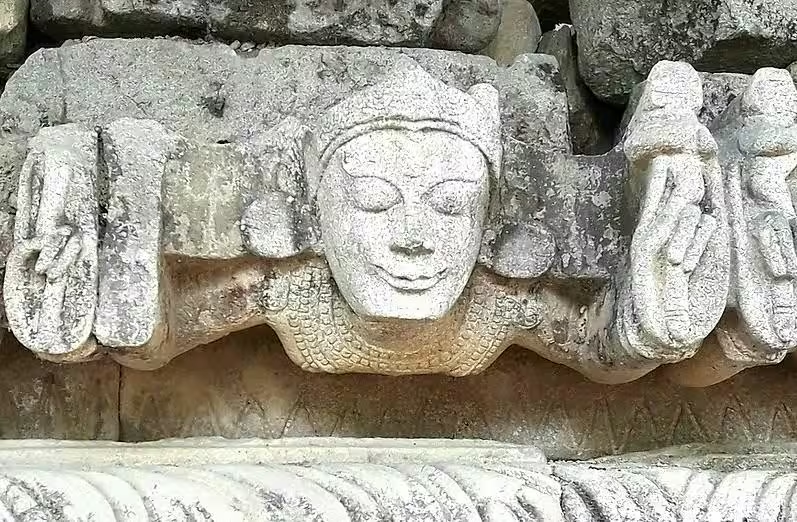
Dimapur’s most distinctive remains are its large carved sandstone pillars. Some rise to approximately twelve feet and have hemispherical tops. Their surfaces contain foliated designs and representations of animals and birds, but no human figures. Observers noted that these monuments did not display an obvious Brahmanical influence.
The absence of clear Hindu imagery is significant because later Kachari rulers adopted Sanskritic titles and royal traditions. In 1536, when Ahom accounts described the occupation of Dimapur, the city apparently lacked visible Brahmanical influence. Colonial observations in 1874 also recorded this feature. The material remains therefore suggest that the religious and cultural character of the early Dimasa capital differed from the Sanskritized court that developed in later centuries.
A silver coin dated 1520 provides one of the earliest direct pieces of evidence for the historical kingdom. It commemorated a decisive victory and named the ruler Viravijay Narayan, identified with Khorapha. The coin invoked the goddess Chandi and used a Sanskritized royal name, but it also referred to Hachengsa without clearly presenting him as an ancestor.
This combination is revealing. Khorapha’s authority was expressed through victory, while later Maibong rulers emphasized descent from Hachensa. The coin also followed the weights and measures used by Muslim rulers of Bengal and Tripura. It is considered the earliest Hindu coin from the Brahmaputra valley, yet its design demonstrates the influence of neighbouring Islamic and regional monetary systems.
The enemy defeated in 1520 is not identified. Because the Ahom Buranjis do not mention a conflict with the Kacharis at that time, it has been suggested that the opponent may have been the emerging Koch kingdom under Biswa Singha. This remains an interpretation rather than a confirmed identification.
The Fall of Dimapur
The Ahoms had lost territory east of the Dikhou to the Dimasa kingdom in 1490. After the Ahom ruler Suhungmung absorbed the Chutia kingdom in 1523–1524, he turned his attention toward recovering this territory. In 1526 he sent his commander Kan-Seng toward Marangi.
During one of these attacks, the Dimasa ruler Khorapha was killed. His brother Khunkhara then became king. The two kingdoms negotiated peace and established the Dhansiri River as a boundary. The settlement did not last. Fighting resumed when Ahom forces advanced against Dimasa troops positioned along the Dhansiri.
The Dimasas initially achieved success, but they suffered a major defeat at Marangi. In 1531, Khunkhara’s brother Detcha was killed while attacking a newly constructed Ahom fort at Marangi. The Ahom king and Kan-Seng then attacked the Nenguriya fort, forcing Khunkhara and his son to flee.
Kan-Seng’s forces proceeded toward Dimapur. Detchung, a son of Khorapha, approached Suhungmung at Nenguriya and presented his claim to the Dimasa throne. The Ahoms subsequently described the Dimasa king as thapita-sanchita, meaning established and preserved. The relationship was not simply one of conquest: the Dimasa kingdom continued to exist and later supported the Ahoms when they faced the Turko-Afghan commander Turbak in 1532 or 1533.
When Detchung, also called Dersongpha, attempted to throw off Ahom authority, Suhungmung advanced against him. Detchung was captured and killed, and the Ahom army occupied Dimapur in 1536.
The occupation did not become a permanent Ahom annexation of the city or the upper Dhansiri valley. The Ahoms concentrated their administration farther north, around the lower Dhansiri and Marangi frontier. An official known as the Marangikhowa Gohain was appointed there. The upper valley later reverted largely to forest and remained a contested frontier.
The conflict continued in later decades. In 1606, the Ahom ruler Pratap Singha led an expedition through the Kopili and Dhansiri valleys after a Kachari incursion into Ahom territory. The Dimasas attacked the surviving Ahom force at Raha and drove it away. Pratap Singha then sought conciliation, settled four hundred Ahom families around Marangi, and proposed an embankment along the Kachari boundary. His nobles opposed the plan because a fixed frontier might restrict future expansion.
Maibong and the Hill Kingdom
After Dimapur fell in 1536, the kingdom entered an interregnum lasting approximately twenty-two years. The records do not mention a king during this period. In 1558 or 1559, Madanakumara, a son of Detsung, assumed the throne under the name Nirbhaya Narayana and established the capital at Maibong in the North Cachar Hills.
The move to Maibong marked a major reorientation. Dimapur had been a large fortified centre in the Dhansiri valley. Maibong placed the court in hill country, where the kingdom could reorganize after the loss of its earlier capital and manage connections with the Cachar plains.
The claims made by the Maibong rulers also changed. Khorapha’s 1520 coin celebrated the defeat of enemies associated with Hachemsa but did not clearly define a genealogical relationship. Nirbhaya Narayana and his successors, by contrast, claimed membership in the family of Hachensa. Legitimacy increasingly rested on birth and lineage rather than solely on military achievement.
Outside observers from sedentary agricultural societies referred to the Maibong rulers as Lords of Heremba. By this period the court had begun to encounter stronger Brahmanical influence. The political culture of Maibong thus combined older Dimasa institutions with new forms of Sanskritized kingship.
Koch Expansion and Regional Power
In 1564, after subjugating the Ahoms, the Koch commander Chilarai advanced into territories associated with the Dimasa kingdom. He moved through Marangi and Dimarua and eventually made the Dimasa state a feudatory of the Koch kingdom.
The campaign rearranged the political relationships of the region. Dimarua, previously a feudatory of the Dimasa kingdom, became a Koch buffer against the Jaintia kingdom. At the same time, the Kochs occupied the Cachar region after defeating the Tripura ruler there. Chilarai established Koch administration at Brahmapur, later known as Khaspur, under his brother Kamal Narayan.
Khaspur subsequently became the core of the Dimasa kingdom in the eighteenth century. The annual tribute associated with the Koch-controlled Cachar region—seventy thousand rupees, one thousand gold mohurs, and six hundred elephants—is evidence of the area’s resources and political value.
The Dimasa ruler Satrudaman later defeated the Jaintias in a conflict over Dimarua. After the death of the Jaintia ruler Dhan Manik, Satrudaman installed Jasa Manik on the Jaintia throne. Jasa Manik later manipulated events in a way that brought the Dimasas into conflict with the Ahoms again in 1618.
Satrudaman is described as the most powerful Dimasa ruler. His authority extended over Dimarua in present-day Nagaon, North Cachar, the Dhansiri valley, the plains of Cachar, and parts of eastern Sylhet. After conquering Sylhet, he issued coins in his own name.
The kingdom’s hold over the Dhansiri valley later weakened. By the reign of Birdarpan Narayan, around 1644, Dimasa rule had withdrawn completely from the valley. It reverted to jungle and became a natural barrier between the Dimasa and Ahom kingdoms.
State Structure and Administration
The Dimasa monarchy was supported by a council of ministers known as the Patra and Bhandari. Its leading officer was the Barbhandari. These offices were held by members of Dimasa society, including people who had not necessarily adopted Hindu practices.
The most distinctive institution was the Mel, a royal assembly of clan representatives. Dimasa society contained approximately forty Sengphongs, or clans, and each sent a representative to the assembly. The representatives sat in the Mel mandap, or council hall, according to the status of their clans.
The Mel acted as a counterweight to royal power. It could participate in selecting a king, meaning that succession was not necessarily an entirely private matter within the ruling household. The system combined hereditary kingship with a broader political role for important clans.
Over time, the Sengphongs developed a hierarchy that included five royal clans. Most kings belonged to the Hachemsa clan, but other clans were connected to the royal family and the functioning of the state.
Several clans acquired specialized offices. Their members served as ministers, ambassadors, storekeepers, court writers, and other officials. Some occupational groups developed from these responsibilities. The Songyasa, for example, were associated with the king’s kitchens, while the Nablaisa were associated with fishing.
The plains of Cachar were governed differently from the Dimasa heartland. Plains communities did not participate directly in the royal court at Maibong. Instead, they were organized through khels, and the king exercised justice and collected revenue through an official called the Uzir.
This arrangement allowed the kingdom to govern populations with different political traditions. The clan assembly remained central to the Dimasa court, while the plains were managed through officials and local units. From the beginning of the eighteenth century, the Dharmadhi guru and other Brahmins at court acquired considerable influence, contributing to the gradual Sanskritization of the monarchy.
Khaspur and the Union of Two Kingdoms
The political history of Khaspur began before it became a Dimasa capital. In the medieval period, the region was associated with the Tripura kingdom. It was later conquered by the Koch ruler Chilarai, who placed it under the authority of his brother Kamal Narayan.
The Koch line at Khaspur continued until the reign of Bhima Singha. He had no male heir, and his daughter Kanchani married Laxmichandra, a prince of the Maibong kingdom. When Bhima Singha died, the Dimasas moved into Khaspur. The marriage enabled the two political formations to merge, with the Maibong ruling house inheriting control of the Khaspur kingdom.
This transition ended the independent rule of the Khaspur Koch rulers in 1745. Khaspur, a corrupted form of Kochpur, became the new capital of the united Kachari kingdom. Gopichandranarayan ruled from 1745 to 1757, followed by his brothers Harichandra and Laxmichandra.
The court’s movement to Khaspur brought the Dimasa monarchy more firmly into the plains and into contact with Brahmanical institutions. In 1790, a formal conversion ceremony took place in which Gopichandranarayan and his brother Laxmichandranarayan were proclaimed Hindus of the Kshatriya caste.
This was part of a wider process of Sanskritization. Brahmins at Khaspur constructed a royal origin legend linking the Kachari rulers to the Mahabharata. According to the legend, the Pandavas visited the Kachari kingdom during their exile. Bhima fell in love with Hidimbi, the sister of Hidimba, and married her according to the Gandharva system. Their son, Ghatotkacha, ruled the kingdom, and his descendants governed the land of the “Dilao,” identified with the Brahmaputra.
The legend is not an account of the kingdom’s early history. It was a later construction that gave the ruling house a prestigious Hindu genealogy. The name Hidimba was subsequently used for the kingdom, and the kings were called Hidimbesvar. The term continued in official records even after the East India Company took over the administration of Cachar.
Military Campaigns and Foreign Pressure
The kingdom’s history was shaped by continual interaction with stronger neighbouring powers. Its wars with the Ahoms centred on the Dhansiri, Dikhou, Marangi, and surrounding river valleys. The Dimasas sometimes lost territory, recovered it, accepted Ahom authority, or returned to resistance.
The Koch expansion in the sixteenth century placed the Dimasa state in a new political hierarchy. The kingdom became a Koch feudatory, but it retained its own ruling house and later recovered substantial power. The authority of Satrudaman demonstrates that Koch dominance did not eliminate Dimasa political agency.
In 1706, the Dimasa ruler Tamradhwaj declared independence. The Ahom king Rudra Singha responded by sending two generals against Maibong with an army said to number more than 71,000 troops. The Ahom forces destroyed the Maibong forts, and Tamradhwaj fled to the Jaintia kingdom.
The Jaintia ruler treacherously imprisoned him. From captivity, Tamradhwaj sent messengers to the Ahom court seeking assistance. Rudra Singha then dispatched forces numbering more than 43,000 against Jaintia. The Jaintia king was captured and taken to the Ahom court, where he submitted. The territories of the Dimasa and Jaintia kingdoms were consequently annexed to the Ahom kingdom.
In the eighteenth century the Dimasa state continued from Khaspur, but its political position was increasingly difficult. During the reign of Krishnachandra, from 1790 to 1813, several Moamaria rebels found refuge in Cachar. The Ahoms accused the Dimasa kingdom of sheltering the rebels, leading to repeated skirmishes between 1803 and 1805.
The kingdom also became involved in the crisis created by Burmese expansion. The ruler of Manipur sought the assistance of Krishna Chandra Dwaja Narayan Hasnu Kachari against the Burmese army. Krishna Chandra defeated the Burmese and was offered the Manipuri princess Induprabha. Since he was already married to Rani Chandraprabha, he arranged for the princess to marry his younger brother Govinda Chandra Hasnu.
Economy and Trade
The economy of the kingdom rested on agriculture, particularly settled wet-rice cultivation in fertile riverine zones. The Dimasas’ ability to construct embankments and channels allowed them to control water and expand paddy production.
These agricultural systems made river valleys politically valuable. The Ahom-Dimasa conflicts around the Dikhou and Dhansiri were closely tied to the demand for productive land. Control of water was as important as control of territory, since irrigation shaped the agricultural surplus that sustained courts, armies, and settlements.
The production of rice beer formed part of the wider rice culture. Agricultural resources also supported the political strength seen in the tribute demanded from the Cachar region under Koch authority. The reported payments of money, gold, and elephants indicate the economic and ecological wealth of the plains.
Coinage provides evidence of the kingdom’s participation in regional political and commercial systems. Khorapha’s silver coin of 1520 used a Sanskritized royal name and invoked Chandi, while its weights and measures reflected the monetary practices of Bengal and Tripura. Satrudaman also issued coins after his conquest of Sylhet.
The kingdom’s position between the Brahmaputra valley, Bengal, Tripura, Manipur, and the hill regions gave it access to multiple networks. The possibility that it participated in wider Sinitic networks, including those connected with the Ming dynasty, has also been raised, although the extent and character of such involvement remain uncertain.
Decline and Fall
The Dimasa kingdom entered the nineteenth century under pressure from several directions. Burmese occupation affected the Kachari kingdom along with the Ahom kingdom. After the Treaty of Yandabo in 1826, the British restored Govinda Chandra Hasnu to the throne.
Restoration did not restore complete authority. Govinda Chandra was unable to subjugate Senapati Tularam, who controlled the hill regions. Tularam’s domain extended between the Mahur River and the Naga Hills in the south, the Diyang River in the west, the Dhansiri River in the east, and the Jamuna and Doyang rivers in the north.
Govinda Chandra died in 1830. In 1832, Senapati Tularam Thaosen was pensioned off, and the British annexed his territory. The area eventually became the North Cachar district.
In 1833, the British annexed Govinda Chandra’s former domain, creating the Cachar district under colonial administration. Accounts also associate the completion of the hill annexation with 1834. The kingdom’s political existence thus ended through a combination of weakened internal authority, divided territorial control, and British expansion after the Burmese wars.
The annexation is sometimes described through the doctrine of lapse. At the time of British takeover, the kingdom included parts of present-day Nagaon and Karbi Anglong, North Cachar, Cachar, and the Jiri frontier of Manipur. The former kingdom’s territories were reorganized into colonial administrative units rather than preserved as a single state.
Legacy
The Dimasa Kingdom left a layered legacy across Assam and the adjoining hill regions. Its name survives in the history of Cachar, while its earlier territories are represented today by places such as Dima Hasao, Cachar, and Hailakandi. The undivided colonial Cachar district was later divided into these and other administrative units.
Dimapur remains the most visible reminder of the kingdom’s early urban phase. Its walls, water tanks, gateway, and carved pillars reveal a substantial centre with a distinctive artistic and architectural vocabulary. The radiocarbon evidence from the Rajbari Citadel also demonstrates that the site’s history reaches far beyond the medieval conflicts recorded in the Ahom chronicles.
The kingdom’s political institutions are equally important. The Mel assembly and the Sengphong system show that Dimasa kingship operated within a framework of clan representation. The court’s authority was balanced by institutions that represented the social structure of the community and could influence royal succession.
The history of the kingdom also illustrates how political identity changed over time. Early traditions emphasized migration, river crossings, clan relationships, and divine or heroic leaders. Later rulers claimed descent from Hachensa. At Khaspur, Brahmanical genealogies connected the monarchy to Hidimba, Bhima, and Ghatotkacha. These layers should be understood as successive forms of political legitimacy rather than as a single uninterrupted account of origin.
The kingdom’s experience also complicates simple divisions between hill and plain, tribe and state, or indigenous society and Hindu monarchy. Its rulers governed both hill and plains populations, used agricultural technologies associated with settled state formation, issued coins, maintained fortified capitals, negotiated with major kingdoms, and later adopted Sanskritic royal forms while preserving Dimasa institutions.
Its history is therefore not only the story of a kingdom that disappeared in the nineteenth century. It is also the history of how an indigenous society built political authority, adapted to changing regional powers, and left enduring marks on the geography and heritage of northeastern India.
Timeline
Early occupation at Dimapur
Radiocarbon evidence from Rajbari Citadel includes a calibrated date between 270 and 660 CE, placing Kachari occupation at Dimapur at least as early as the third century CE.
Early medieval expansion
Traditions and Ahom accounts suggest Dimasa influence extended across the Dhansiri valley, North Cachar Hills, and adjoining riverine tracts by the late thirteenth century.
Dimasa recovery east of the Dikhou
The Dimasas recovered territory that had been lost to the Ahoms, according to Ahom chronicles.
Coin of Khorapha
A silver coin naming Viravijay Narayan, identified with Khorapha, commemorated a victory and referred to Hachengsa.
Ahom offensive
Suhungmung sent Kan-Seng toward Marangi to recover territory from the Dimasa kingdom; Khorapha was killed during the conflict.
Battle for the frontier
Detcha was killed while attacking an Ahom fort at Marangi, and the Ahoms advanced toward Dimapur.
Fall of Dimapur
The Ahoms captured Dimapur. The Dimasa rulers later abandoned the city, though the Ahom occupation did not become a permanent annexation of the upper Dhansiri valley.
Capital established at Maibong
Madanakumara assumed the throne as Nirbhaya Narayana and established the capital at Maibong in the North Cachar Hills.
Koch expansion
Chilarai made the Dimasa kingdom a Koch feudatory and established Koch administration at Khaspur.
Renewed Ahom conflict
Political developments involving Jaintia brought Satrudaman and the Dimasa kingdom into conflict with the Ahoms.
Withdrawal from the Dhansiri
By the reign of Birdarpan Narayan, Dimasa rule had withdrawn from the Dhansiri valley, which reverted largely to jungle.
Destruction of Maibong forts
After Tamradhwaj declared independence, Rudra Singha sent a large Ahom army against Maibong and destroyed its forts.
Khaspur becomes the capital
The marriage of Kanchani, daughter of the last Koch ruler of Khaspur, to the Dimasa prince Laxmichandra led to the union of the two kingdoms.
Formal Sanskritization
Gopichandranarayan and Laxmichandranarayan were formally proclaimed Hindus of the Kshatriya caste.
Conflict with the Ahoms
Skirmishes began after Moamaria rebels took refuge in Cachar and the Ahoms accused the Dimasa kingdom of sheltering them.
British restoration
After the Treaty of Yandabo, the British restored Govinda Chandra Hasnu to the Cachar throne.
Annexation of Tularam’s territory
The British pensioned off Senapati Tularam Thaosen and annexed his hill domain.
Annexation of Cachar
The British annexed Govinda Chandra’s former domain, bringing the independent Dimasa Kingdom to an end.