Overview
In 972, the Malwa ruler Siyaka pursued a defeated Rashtrakuta army to Manyakheta and sacked the imperial capital. The attack marked a decisive change in the political history of west-central India. The Paramaras, who had probably begun as subordinate chiefs under Rashtrakuta authority, emerged as an independent dynasty with Malwa as its centre.
The Paramaras ruled Malwa and surrounding regions from approximately the ninth or tenth century until the early fourteenth century. Their best-attested period began with Siyaka’s inscriptions in the tenth century, while their last known king, Mahalakadeva, was defeated and killed in 1305 by forces serving Alauddin Khalji of Delhi. Their political fortunes fluctuated sharply. At different moments they controlled territories extending well beyond Malwa, but defeats by neighbouring powers repeatedly reduced the kingdom to its core territories.
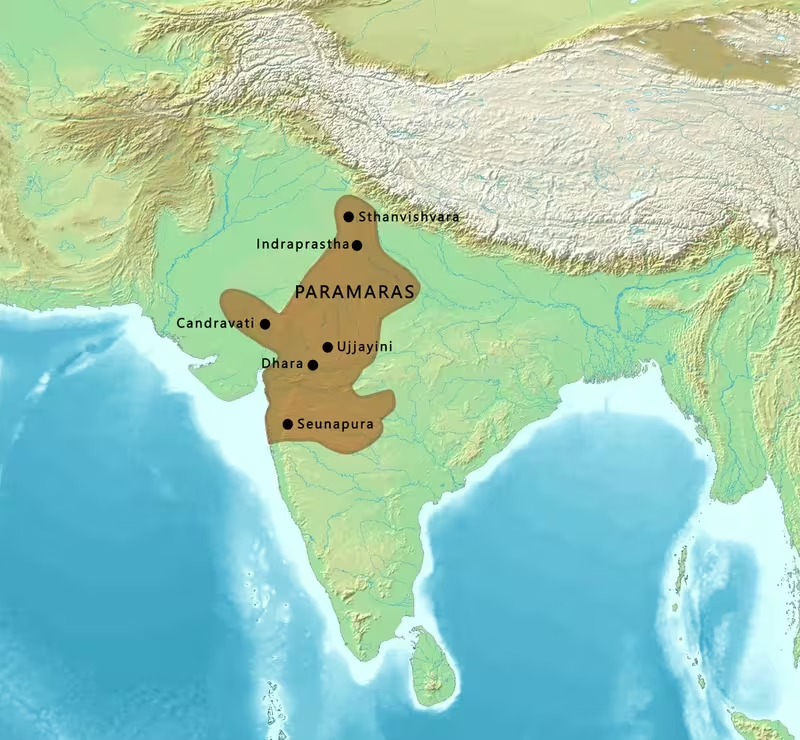
The dynasty’s capital was Dhara, present-day Dhar. In the later period, after Dhara had been attacked several times, the Paramaras shifted their capital to Mandapa-Durga, now Mandu, whose hilltop setting provided a stronger defensive position. Malwa’s location placed the dynasty between several ambitious powers: the Chaulukyas of Gujarat, the Western Chalukyas of Kalyani, the Kalachuris of Tripuri, the Chandelas of Jejakabhukti, the Chahamanas, the Yadavas of Devagiri, and eventually the Delhi Sultanate.
Paramara political history is closely associated with military conflict, but the dynasty’s cultural reputation rests especially on the court of Bhoja. Bhoja was remembered as a scholar-king, author, patron of Sanskrit intellectuals, and builder. Under him, the Paramara kingdom reached its widest known extent. His name became the focus of later legends presenting him as an ideal ruler whose learning, justice, and generosity matched his royal power.
Origins and the Problem of Ancestry
The origins of the Paramaras remain debated. Later royal records and literary works present the dynasty as belonging to the Agnikula, or “fire clan.” According to this legend, the sage Vashistha created a warrior from a sacrificial fire on Mount Abu. The hero defeated the enemies of Vashistha, recovered a wish-granting cow taken by Vishvamitra, and received the name Paramara, interpreted as “enemy killer.”
The earliest known literary appearance of this legend is in the Nava-sahasanka-charita, composed by Padmagupta Parimala for the Paramara ruler Sindhuraja around the turn of the eleventh century. The story does not appear in the earlier Paramara inscriptions currently known. This difference matters: the fire-born account may have become important only after the dynasty had established itself and sought a prestigious heroic genealogy comparable to those claimed by neighbouring royal houses.
A later version of the Prithviraj Raso expanded the story and described several Rajput dynasties as fire-born. The oldest surviving copies of that work do not contain this expanded account. The version may have been developed by sixteenth-century poets who wished to encourage Rajput unity in the face of the Mughal emperor Akbar. Colonial-era historians sometimes treated the Agnikula story as evidence that the Paramaras and other “fire-clan” Rajputs had entered India from outside and were later admitted into the Hindu social order. That interpretation is not supported by the earliest Paramara records, which do not describe the dynasty in those terms.
Another theory connects the Paramaras with the Rashtrakutas. The 949 Harsola copper plates of Siyaka mention a king called Akalavarsha, followed by the words tasmin kule, “in that family,” and then the name Vappairaja, usually identified with Vakpati I. Akalavarsha was a Rashtrakuta title, and Siyaka’s successor Munja used titles such as Amoghavarsha, Sri-vallabha, and Prithvi-vallabha, all associated with Rashtrakuta royal usage. On this basis, D. C. Ganguly proposed a Rashtrakuta ancestry.
The argument remains uncertain. There is a gap before tasmin kule in the Harsola record, so the precise relationship implied by the wording cannot be established. The Rashtrakuta titles may instead have been adopted by Paramara kings who wished to present themselves as the legitimate successors of Rashtrakuta power in Malwa. Earlier Chalukya rulers had also used some of these titles. Dasharatha Sharma pointed out that the Paramaras were already claiming an Agnikula origin by the tenth century; if they had genuinely descended from the prestigious Rashtrakutas, it would be difficult to explain why that royal ancestry disappeared so quickly from their own accounts.
A third interpretation proposes that the Paramaras were originally Brahmins who became rulers. Halayudha, a scholar patronized by Munja, described the king as a Brahma-Kshatra in his commentary on the Pingala-Sutra. Some historians understand this phrase as referring to a Brahmin family that adopted the Kshatriya role. The Patanarayana temple inscription also associates the Paramaras with the Vashistha gotra, a lineage especially associated with Brahmin genealogies. Other records, however, describe Paramara ancestors as the “crest-jewel of the Kshatriyas,” and the Prabha-vakara-charita calls Vakpati a Kshatriya. The expression Brahma-Kshatra may therefore mean a learned Kshatriya rather than a Brahmin family that changed status.
The dynasty’s original homeland is equally uncertain. The Agnikula legend led some scholars to identify Mount Abu as the ancestral home. The Harsola plates and the Ain-i-Akbari encouraged another theory, placing the origins in the Deccan. Yet the earliest Paramara inscriptions were discovered in Gujarat and concern land grants there. This has led to the possibility that the early rulers were connected with Gujarat or temporarily relocated there after a Gurjara-Pratihara intervention in Malwa.
What can be stated with greater confidence is that the Paramaras were probably subordinate to the Rashtrakutas during the ninth century. Between 808 and 812, the Rashtrakutas displaced the Gurjara-Pratiharas from Malwa. Govinda III placed the region under the protection of Karka-raja, a Rashtrakuta chief of Lata, the area bordering Malwa in present-day Gujarat. A later Rashtrakuta inscription records that Govinda appointed a vassal as governor of Malwa. The identity of that official is not known, although the epigraphist H. V. Trivedi proposed that he may have been the Paramara ruler Upendra.
Early Rulers and the Rise of Sovereignty
The earliest Paramara rulers are difficult to reconstruct. Later genealogies list a series of kings, but some names may be duplicated, omitted, or preserved only in retrospective accounts. The Udaipur Prashasti includes early rulers such as Upendra, Vairisimha, and Siyaka, while the 1274 Mandhata copper plate lists another sequence that includes Kamandaludhara, Dhumraja, Devasimhapala, Kanakasimha, Shriharsha, Jagaddeva, Sthirakaya, and Voshari. These names do not appear consistently elsewhere.
Some historians have argued that the Paramara dynasty began only in the tenth century and that several earlier names were invented or repeated to create a more ancient genealogy. Others maintain that the early rulers were historical but ruled as Rashtrakuta subordinates and therefore appeared less frequently in records describing independent kings. The absence of a ruler’s name from one inscription does not necessarily prove that the ruler was fictional.
Upendra is mentioned in the Nava-sahasanka-charita, a work composed for a later Paramara king. This has been taken as evidence that he was remembered as a genuine predecessor. Some historians identify Upendra with Krishnaraja because the two names can be treated as equivalent names of Krishna. The problem is complicated by an inscription of Munja that lists Krishnaraja, Vairisimha, and Siyaka among his predecessors, while the Harsola plates refer to Vappairaja or Vakpati I. The precise sequence of the early dynasty therefore remains unsettled.
Siyaka is the first Paramara ruler securely known from his own inscriptions. His Harsola copper plates, dated 949, suggest that he initially acknowledged Rashtrakuta overlordship. At the same time, the record gives him the grand title Maharajadhirajapati, suggesting that his submission may have been largely formal by that stage. Siyaka participated in Rashtrakuta campaigns against the Gurjara-Pratiharas and defeated Huna chiefs north of Malwa. He may also have suffered setbacks against the Chandela ruler Yashovarman.
The political opportunity came after the death of the Rashtrakuta ruler Krishna III. Siyaka defeated Krishna’s successor Khottiga on the banks of the Narmada. He then followed the retreating Rashtrakuta army to Manyakheta and sacked the capital in approximately 972. The attack weakened Rashtrakuta authority and allowed Siyaka to establish the Paramaras as a sovereign power in Malwa.
This transition was not simply a change of dynasty in a settled administrative system. It represented the fragmentation of a major imperial structure and the rise of regional powers. Malwa became the central field of Paramara ambition, while the dynasty’s claim to independence was demonstrated through warfare against the power that had once stood above it.
Rise under Munja and Sindhuraja
Siyaka’s successor was Munja, also known as Vakpati II. He continued the military expansion of the new kingdom. His campaigns brought victories over the Chahamanas of Shakambari, the Chahamanas of Naddula, the Guhilas of Mewar, Huna chiefs, and the Kalachuris of Tripuri. He also fought a ruler of the Gurjara region, who may have belonged either to the Chaulukya or the Pratihara sphere.
Munja’s most consequential campaign was directed southward against Tailapa II of the Western Chalukyas. The early stages may have favoured Munja, but the conflict ended in defeat. Munja was captured and killed by Tailapa sometime between 994 and 998. The Paramaras lost their southern territories, probably including lands beyond the Narmada River.
His defeat did not erase Munja’s reputation. He was remembered as a patron of learning and as a poet, although only a small number of his verses survive. His court attracted scholars from several parts of India. The combination of military ambition and literary patronage that characterized his rule would become even more prominent under his successor.
Munja’s brother Sindhuraja succeeded him. His reign is generally placed in the 990s to about 1010. Sindhuraja fought the Western Chalukya ruler Satyashraya and recovered territories lost after Munja’s defeat. He also campaigned against a Huna chief, the Somavanshi ruler of south Kosala, the Shilaharas of Konkana, and the ruler of Lata in southern Gujarat.
Sindhuraja’s court poet Padmagupta composed the Nava-sahasanka-charita, a literary biography that attributes numerous victories to the king. The work is valuable for preserving the dynasty’s self-image and political memory, but its celebratory style means that every claimed conquest cannot be treated as independently established. Sindhuraja nevertheless appears to have restored a measure of Paramara strength after the disaster that ended Munja’s reign.
The Golden Age of Bhoja
Sindhuraja’s son Bhoja became the most celebrated Paramara ruler. His reign is usually placed in the first half of the eleventh century. Bhoja attempted repeatedly to expand the kingdom, with mixed results, and his reign was marked by both military success and serious reversals.
Around 1018, Bhoja defeated the Chaulukyas of Lata in present-day Gujarat. Between approximately 1018 and 1020, he gained control over northern Konkan. The Shilahara rulers of that region may have served as his feudatories for a short time. Bhoja also formed an alliance with Rajendra Chola and Gangeya-deva Kalachuri against the Kalyani Chalukya ruler Jayasimha II. The outcome of this campaign is uncertain because both Chalukya and Paramara panegyrics claim victory.
The southern frontier later moved against Bhoja. After 1042, Jayasimha II’s son and successor Someshvara I invaded Malwa and sacked Dhara. Bhoja recovered control after the Chalukya army withdrew, but the invasion pushed the southern boundary of his kingdom back from the Godavari to the Narmada. The episode illustrates the temporary nature of many Paramara conquests: a strong ruler could project power across a wide region, yet the kingdom’s frontiers remained vulnerable to coordinated attacks.
Bhoja’s eastern ambitions met resistance from the Chandela king Vidyadhara. He did, however, extend influence over the Kachchhapaghatas of Dubkund, who were connected with the Chandela sphere. His attacks on the Kachchhapaghatas of Gwalior were repulsed by their ruler Kirtiraja, possibly preventing a wider attempt to seize Kannauj.
In Rajasthan, Bhoja defeated the Chahamana ruler Viryarama of Shakambhari, who was killed in the conflict. Bhoja was later forced to retreat by the Chahamanas of Naddula. These alternating successes and failures show that Paramara influence reached beyond Malwa but was rarely uncontested.
Medieval Muslim historians describe a Hindu ruler named Param Dev whose territory was avoided by Mahmud of Ghazni after the sack of Somnath. Modern historians have identified Param Dev with Bhoja, although the name may also be a corruption of Paramara-Deva or of Bhoja’s title Parameshvara-Paramabhattaraka. Bhoja may have contributed troops to the Kabul Shahi ruler Anandapala in the struggle against the Ghaznavids. He may also have participated in a Hindu alliance that expelled Mahmud’s governors from Hansi, Thanesar, and nearby areas around 1043. These identifications are not certain, but they indicate how later accounts connected Bhoja with the larger political conflicts of north-western India.
In the final years of Bhoja’s reign, or shortly after his death, the Chaulukya king Bhima I and the Kalachuri ruler Karna attacked the Paramara kingdom. According to the fourteenth-century writer Merutunga, Bhoja died from illness at the same time as this allied attack. The precise sequence of the invasion and his death remains uncertain.
At its maximum extent, Bhoja’s empire reached from Chittor in the north to the upper Konkan in the south, and from the Sabarmati River in the west to Vidisha in the east. This was the broadest territorial description associated with Paramara rule. Yet Bhoja’s achievements cannot be measured only by the size of this empire. His lasting fame came from his role as a scholar-king.
Bhoja’s writings covered a wide range of subjects, including grammar, poetry, architecture, yoga, and chemistry. He established the Bhoj Shala at Dhar as a centre of Sanskrit learning and founded a temple dedicated to Sarasvati. He is also traditionally associated with the foundation of Bhojpur, and historical evidence supports an association between him and the settlement. The Bhojeshwar Temple at Bhojpur, along with three now-breached dams in the area, is attributed to his reign.
Later legends made Bhoja the model of the just and learned king. The number of stories centred on him led to comparisons with the legendary Vikramaditya. These traditions should not be read as straightforward biographies, but they preserve the memory of a ruler whose court connected political authority with scholarship, religious patronage, and public works.
Administration and Governance
The surviving evidence does not provide a complete description of Paramara administration. Royal inscriptions, literary works, genealogies, and records of land grants reveal a monarchy supported by subordinate rulers and regional branches, but the exact structure of taxation, bureaucracy, and local government is not fully known.
The king stood at the centre of political authority. Paramara rulers adopted grand royal titles, issued land grants, supported temples and learned institutions, and led military campaigns. Their power depended not only on direct control from Dhara but also on relationships with feudatories. The dynasty’s regional branches included the Paramaras of Vagada, who ruled from Arthuna as feudatories of the Malwa Paramaras, and the Paramaras of Chandravati, Bhinmal-Kiradu, and Jalor, whose political histories became closely connected with the Chaulukyas and Chahamanas.
The use of feudatories allowed the Paramaras to project influence across areas that could not always be governed directly from the capital. It also created political weakness. Regional chiefs could be defeated, change allegiance, or establish independent authority when the central kingdom declined. The later history of Malwa shows this pattern repeatedly.
Land grants form an important part of the surviving record. Siyaka’s Harsola plates are among the earliest known Paramara inscriptions and concern grants in Gujarat. Such records indicate royal involvement in the assignment of land and the recognition of beneficiaries, although the available material does not permit a complete reconstruction of revenue administration.
The capital itself changed in response to military conditions. Dhara was the principal Paramara centre during the dynasty’s most powerful period, especially under Munja, Sindhuraja, and Bhoja. In the later period, repeated attacks made its position less secure. Either Jaitugi or Jayavarman II moved the capital to Mandapa-Durga, now Mandu, a hill settlement with stronger natural defences. The change suggests that military survival had become a more pressing concern than maintaining the older political centre.
Military Campaigns
Paramara military history can be understood through four broad phases: the break with Rashtrakuta authority, the expansion under Munja and Sindhuraja, the broad but unstable empire of Bhoja, and the defensive struggles of the later kingdom.
Siyaka’s attack on Manyakheta was the founding military act of the sovereign dynasty. His earlier service under the Rashtrakutas gave him experience within the political order he later challenged. The defeat of Khottiga on the Narmada and the sack of Manyakheta destroyed the practical authority of the Rashtrakutas over Malwa.
Munja then fought on several fronts. His victories against the Chahamanas, Guhilas, Hunas, Kalachuris, and a Gurjara ruler helped secure Paramara influence across central and western India. His defeat by Tailapa II revealed the limits of southward expansion. The loss of southern territory after Munja’s capture and death shaped the strategy of his successor.
Sindhuraja’s campaigns restored some of the ground lost to the Western Chalukyas. His victories against Satyashraya and other regional rulers strengthened the kingdom before Bhoja’s accession.
Bhoja’s military policy was more expansive. He intervened in Gujarat, Konkan, eastern Rajasthan, the Gwalior region, and the Deccan. Alliances were central to his strategy, especially the coalition involving Rajendra Chola and Gangeya-deva Kalachuri against the Kalyani Chalukyas. The conflicting claims of victory in the surviving panegyrics make the result difficult to determine.
The major threats to Bhoja came from several directions. The Chandelas resisted Paramara movement eastward. The Kachchhapaghatas blocked attempts to dominate Gwalior. The Chahamanas of Naddula forced a retreat after Bhoja’s victory over Shakambhari. The Western Chalukyas invaded Malwa and sacked Dhara. Finally, the Chaulukyas and Kalachuris attacked during the crisis surrounding Bhoja’s death.
The twelfth century brought further reversals. Jayasimha Siddharaja of Gujarat captured Dhara during the reign of Yashovarman. Jayavarman I recovered the capital but soon lost it to an usurper named Ballala. Around 1150, the Chaulukya king Kumarapala defeated Ballala with the support of Alhana, the Chahamana ruler of Naddula, and Yashodhavala, a Paramara chief of Abu. Malwa then became a province within the Chaulukya sphere.
The Paramara restoration began under Vindhyavarman, son of Udayaditya. He defeated the Chaulukya ruler Mularaja II and re-established Paramara sovereignty in Malwa. His reign still faced invasions by the Hoysalas and Yadavas of Devagiri, as well as defeat by the Chaulukya general Kumara. Even so, Vindhyavarman restored the dynasty’s central authority before his death.
Subhatavarman invaded Gujarat and plundered Chaulukya territories but was forced to withdraw by Lavana-Prasada, a Chaulukya feudatory. Arjunavarman I later invaded Gujarat and defeated Jayanta-simha, who had briefly usurped the Chaulukya throne. Arjunavarman was subsequently defeated in Lata by Kholeshvara, a Yadava general.
Devapala continued to face pressure from the Chaulukyas and Yadavas. The Delhi Sultanate captured Bhilsa between 1233 and 1234, but Devapala defeated the Sultanate governor and recovered the city. According to the Hammira Mahakavya, Devapala was later killed by Vagabhata of Ranthambhor, who suspected him of plotting with the Delhi Sultan against his life.
During the reigns of Jaitugideva and Jayavarman II, Paramara power declined substantially. The Yadava ruler Krishna, the Delhi Sultan Balban, and the Vaghela prince Visala-deva all attacked Malwa. The shift from Dhara to Mandu probably occurred during this period. Mandu’s defensive location offered a better chance of survival as the kingdom faced repeated incursions.
Arjunavarman II was a weak ruler who confronted a rebellion by his minister. The Yadava ruler Ramachandra invaded Malwa in the 1270s, while Hammira of Ranthambhor raided it in the 1280s. Bhoja II also faced an invasion by Hammira. He may have been a titular ruler dominated by his minister, or the minister may have seized part of the Paramara kingdom.
The final known phase came under Mahalakadeva. In 1305, the army of Ayn al-Mulk Multani, a general of Alauddin Khalji, defeated and killed him. Although this event ended the last clearly documented reign of a Paramara king, an inscription indicates that the dynasty survived in part of north-eastern Malwa until at least 1310. By 1338, the area had been captured by the Delhi Sultanate.
Cultural Contributions
Paramara cultural history is inseparable from the prominence of Sanskrit at the royal court. Munja patronized scholars and was himself a poet. Sindhuraja’s court supported Padmagupta Parimala, whose Nava-sahasanka-charita preserves an account of the king’s campaigns and the dynasty’s heroic identity.
Bhoja brought this relationship between kingship and learning to its highest expression. He was celebrated as an author and polymath, with works attributed to him on grammar, poetry, architecture, yoga, and chemistry. His intellectual interests were not limited to one branch of knowledge. The breadth of the subjects associated with his name helped establish his later reputation as the ideal scholar-ruler.
The Bhoj Shala at Dhar served as a centre for Sanskrit studies. A temple of Sarasvati was connected with the institution, linking education and sacred patronage. The association of the royal capital with learning contributed to Malwa’s cultural prestige even after Paramara political power weakened.
Paramara religious patronage was primarily Shaiva. Most of the dynasty’s kings are described as Shaivites, and they commissioned temples dedicated to Shiva. At the same time, the court also patronized Jain scholars. This combination indicates that Paramara religious policy was not confined to a single intellectual or devotional community.
The Bhojeshwar Temple at Bhojpur is the most prominent monument associated with Bhoja. Three dams in the surrounding area, now breached, are also attributed to him. Together, the temple and waterworks express the royal image celebrated in later traditions: a king who combined religious patronage, architecture, engineering, and public works.
The dynasty’s cultural legacy is not limited to surviving buildings. Later stories repeatedly presented Bhoja as a righteous and learned ruler, placing him alongside the legendary Vikramaditya. These accounts contain literary embellishment, but their persistence shows how strongly the Paramara court shaped the cultural memory of Malwa.
Economy and Trade
The available records do not provide a detailed account of Paramara taxation, coinage, markets, or commercial institutions. It is therefore safer to describe the economic geography of the kingdom through its political campaigns and territorial connections rather than to assign it an administrative system not documented in the surviving evidence.
Malwa formed the heart of the kingdom. Its position connected the Narmada valley, Gujarat, Rajasthan, and central India. Paramara campaigns repeatedly targeted Lata, northern Konkan, and territories around the Sabarmati and Narmada. Control or influence in these areas would have connected the dynasty with routes running between inland Malwa and the western coast, although the surviving account does not specify the precise trade mechanisms involved.
The land grants recorded in Paramara inscriptions show that the monarchy could assign land and formalize such transfers. Temple construction and support for learned institutions also required the mobilization of agricultural and regional resources. The dams attributed to Bhoja near Bhojpur indicate investment in water management, though their precise economic organization is not known.
The kingdom’s economic stability was closely tied to political control. Military defeats could remove southern territories, place Malwa under Chaulukya authority, or force the court to retreat to a defensible capital. The changing boundaries of the Paramara state therefore affected access to Gujarat, Konkan, the Narmada valley, and the eastern routes toward Vidisha.
Decline and Fall
The decline of the Paramaras was gradual rather than the result of a single defeat. The dynasty’s power had always depended on the ability of the ruler at Dhara to manage several fronts at once. The same geography that allowed expansion also exposed Malwa to attacks from Gujarat, Rajasthan, the Deccan, and northern India.
Bhoja’s death created an immediate crisis. Jayasimha I, probably his son, faced a joint Kalachuri-Chaulukya invasion. His successor Udayaditya restored some stability, defeating Chamundaraja, a vassal at Vagada, and repulsing an invasion by the Chaulukya ruler Karna with the help of allies. Udayaditya’s son Lakshmadeva was credited in the 1104–05 Nagpur Prashasti with extensive conquests, although the scale of these claims appears exaggerated. He may at least have defeated the Kalachuris of Tripuri.
Naravarman, Udayaditya’s younger son, suffered defeats against the Chandelas and the Chaulukya king Jayasimha Siddharaja. By the end of his reign, Vijayapala had created an independent kingdom north-east of Ujjain. The weakening of central authority was visible both in military losses and in the emergence of rival local powers.
The loss of Dhara to Jayasimha Siddharaja and its temporary recovery under Jayavarman I marked another major setback. Ballala’s seizure of the capital and his defeat by Kumarapala placed Malwa under Chaulukya control. The restoration under Vindhyavarman demonstrated that Paramara sovereignty could revive, but the repeated cycle of conquest and recovery consumed resources and weakened the kingdom’s long-term position.
Later rulers faced a wider range of threats. Yadava armies attacked from the Deccan. Chahamanas and Vaghelas contested western and northern approaches. Hoysalas also invaded during the reign of Vindhyavarman. The Delhi Sultanate became increasingly active in central India, capturing Bhilsa during Devapala’s reign before the Paramaras recovered it.
The move from Dhara to Mandu reflects the defensive character of the late kingdom. The court’s political centre was no longer simply the historic capital associated with Bhoja; it was a hill fortress chosen because the old capital had been sacked multiple times. Internal disputes further weakened the monarchy. Arjunavarman II faced a rebellion by his minister, and Bhoja II may have been controlled by a minister or lost part of the kingdom to him.
Mahalakadeva’s defeat and death in 1305 brought the last known Paramara monarchy to an end. Yet the dynasty did not disappear at that instant. An inscription indicates survival in north-eastern Malwa until at least 1310, while a later record shows that the area had come under the Delhi Sultanate by 1338. The final stages were therefore marked by the gradual absorption of remaining Paramara authority rather than a single uniformly documented moment of dissolution.
Branches and Later Claims of Descent
The Paramara name continued through regional branches and later claims of ancestry. The Paramaras of Chandravati ruled in the Arbuda-mandala around Mount Abu and became feudatories of the Chaulukyas of Gujarat by the twelfth century. Branches associated with Bhinmal-Kiradu and Jalor also became connected with the Chaulukyas and were later displaced or subdued by Chahamana rulers.
The Paramaras of Vagada ruled from Arthuna as feudatories of the Malwa branch. Their position illustrates how the dynasty’s wider political network depended on subordinate houses that could govern frontier areas while acknowledging a senior Paramara ruler.
The Ujjainiya branch of Bhojpur produced several later families in the Bhojpur region after the fall of the Bhojpur kingdom. Dumraon was among the notable principalities associated with this branch. The Sodhas of Amarkot, the Gandhavariyas of Mithila, and the Nimbalkars of Phaltan also claimed Paramara connections, though their later histories unfolded under different political powers.
Several princely states likewise traced their ancestry to the Paramaras. The rulers of Tehri Garhwal were said to descend from Kanakpal, a prince of Malwa. Baghal tradition connected its foundation with Ajab Dev Parmar, who was said to have travelled from Ujjain to the region of present-day Himachal Pradesh. The rulers of Danta, Muli, Rajgarh, Narsinghgarh, and Chhatarpur claimed Paramara descent in different forms. The Maratha Puar rulers of Dewas and the founder of Dhar State, Anand Rao Puar, also asserted a connection with the dynasty.
These claims should be distinguished from the securely documented history of the medieval Paramara kingdom. They show, however, the continuing prestige of the Paramara name. Descent from Malwa’s royal house could provide legitimacy to later ruling families, especially when linked to Bhoja, Ujjain, or the legendary Vikramaditya.
Legacy
The Paramaras shaped the political history of Malwa for more than three centuries. Their rise from probable Rashtrakuta subordinates to independent rulers reflects the fragmentation of imperial authority in early medieval India. Their later history shows how difficult it was for a regional kingdom to maintain a large territory while facing simultaneous pressure from Gujarat, Rajasthan, the Deccan, central India, and the Delhi Sultanate.
Their most enduring legacy is cultural. Dhara became associated with Sanskrit learning, royal scholarship, and literary patronage. Munja and Sindhuraja supported poets and intellectuals, while Bhoja transformed the ideal of the learned king into the defining image of the dynasty. The Bhoj Shala, the Sarasvati temple at Dhar, the Bhojeshwar Temple, and the dams near Bhojpur preserve different aspects of this association between knowledge, devotion, architecture, and kingship.
The dynasty’s political authority disappeared in the early fourteenth century, but its memory continued through inscriptions, literary works, temple traditions, regional genealogies, and the claims of later ruling houses. The historical Bhoja and the legendary Bhoja became intertwined, making it necessary to distinguish between documented campaigns and later stories while still recognizing the cultural power of those stories.
The Paramara past is therefore not only the history of a kingdom that rose and fell. It is also the history of how Malwa remembered sovereignty: through a warrior who challenged an empire, a capital that became a centre of Sanskrit learning, and a scholar-king whose name survived long after the dynasty’s last strongholds had been absorbed by the Delhi Sultanate.
Timeline
Rashtrakuta control over Malwa
The Rashtrakutas displaced the Gurjara-Pratiharas from Malwa and placed the region under their wider authority.
Early Paramara period
The Paramaras probably ruled in Malwa as subordinate chiefs, although the chronology and identity of several early rulers remain uncertain.
Harsola copper plates
Siyaka’s earliest known inscription records land grants in Gujarat and suggests an early relationship with the Rashtrakutas.
Sack of Manyakheta
Siyaka defeated Khottiga and sacked the Rashtrakuta capital, establishing the Paramaras as an independent power.
Munja’s southern defeat
Munja was defeated and killed by Tailapa II of the Western Chalukyas, and the Paramaras lost southern territories.
Sindhuraja’s campaigns
Sindhuraja restored Paramara influence and campaigned against the Western Chalukyas and other regional powers.
Bhoja expands westward
Bhoja defeated the Chaulukyas of Lata and later gained influence in northern Konkan.
Chalukya invasion of Dhara
Someshvara I invaded Malwa and sacked Dhara, although Bhoja later restored control.
Crisis after Bhoja
After Bhoja’s death, the Paramara kingdom faced a joint attack by the Chaulukyas and Kalachuris.
Malwa enters the Chaulukya sphere
Kumarapala defeated Ballala, and Malwa became a province of the Chaulukyas.
Paramara restoration
Vindhyavarman defeated Mularaja II and re-established Paramara sovereignty in Malwa.
Conflict with the Delhi Sultanate
The Sultanate captured Bhilsa, but Devapala defeated its governor and recovered the city.
Shift to Mandu
During the later period, the Paramara capital was moved from Dhara to the more defensible Mandapa-Durga, now Mandu.
Death of Mahalakadeva
Alauddin Khalji’s general Ayn al-Mulk Multani defeated and killed the last known Paramara king.
Surviving Paramara authority
An inscription indicates that Paramara rule continued in part of north-eastern Malwa until at least this date.
Delhi Sultanate control
A later inscription shows that the remaining territory had been captured by the Delhi Sultanate.