Overview
Around 350 CE, Konganivarma Madhava established a kingdom at Kolar in the eastern part of present-day Karnataka. Over the next seven centuries, the dynasty associated with his name ruled or influenced a broad region known as Gangavadi. Its political centre later shifted to Talakadu on the banks of the Kaveri, while its rulers navigated the changing balance of power among the Pallavas, Badami Chalukyas, Rashtrakutas, Pandyas, and Cholas.
The dynasty is generally known as the Western Ganga dynasty to distinguish it from the Eastern Gangas, who later ruled Kalinga, broadly corresponding to modern Odisha and northern Andhra Pradesh. The Western Gangas were not consistently independent throughout their history. They began as a regional power, became connected with the Badami Chalukyas, resisted Rashtrakuta authority before entering into a close alliance with it, and eventually faced the renewed expansion of the Cholas. Their history therefore illustrates how a long-lived regional kingdom could preserve its court, territories, and cultural influence while operating within larger imperial systems.
The kingdom’s core territory included much of modern south Karnataka. At different moments, Ganga authority reached into the Kongu region of modern Tamil Nadu and into parts of present-day Andhra Pradesh. The extent of this authority changed with military circumstances and political alliances. From the eighth century, the wider territory was known in inscriptions as Gangavadi-96000, or Shannavati Sahasra Vishaya, a designation associated with its eastern and western divisions.
The Western Gangas are especially remembered for their patronage of Jainism. Shravanabelagola became a major centre under their protection, and the monolithic image of Gomateshwara, commissioned by the minister Chavundaraya, represents the high point of their sculptural tradition. Their cultural contribution was broader than Jain patronage alone. The dynasty supported Shaivism, Vedic Brahmanism, and Vaishnavism; encouraged Sanskrit learning; fostered the development of Kannada literature; and built Hindu temples, Jain basadis, pillars, irrigation works, and memorials for fallen warriors.
Rise to Power
Origins and competing traditions
The ancestry of the Western Ganga founders remains uncertain. Several mythical accounts give the dynasty a northern origin, while interpretations based on inscriptions have encouraged theories of southern origins. Some records associate the rulers with the Kanvayana gotra and connect them to the Ikshvaku lineage of the solar dynasty. Such genealogical claims belonged to the political language of kingship and cannot by themselves settle the question of where the dynasty originated.
Historians who favour a southern origin have proposed several possible regions for the early clan: the southern districts of modern Karnataka, Kongu Nadu in modern Tamil Nadu, or the southern districts of modern Andhra Pradesh. These areas lie within the southern Deccan, where the three modern states approach one another. The evidence therefore permits more than one interpretation, and the early history of the clan before its rise to power remains debated.
The political circumstances of the mid-fourth century provide a more secure setting for understanding the dynasty’s emergence. Multiple local clans asserted their independence as the Pallava empire weakened in parts of South India. This weakening has sometimes been connected with the southern campaigns of the northern king Samudra Gupta. In this unsettled political environment, the early Gangas appear to have established a territorial base and created a kingdom in the southern Deccan.
Konganivarma Madhava and Kolar
The founding king was Konganivarma Madhava. Around 350, he made Kolar his capital and ruled for approximately twenty years. The early kingdom was not yet the extensive Gangavadi known from later records. It was a regional power whose position depended on consolidating territory among neighbouring clans and larger states.
Kolar’s location was important. It lay in the eastern part of the region that later formed the Ganga sphere and provided access toward the plains, the Tamil country, and the interior of Karnataka. From this base, the dynasty could extend its authority westward and southward while responding to the ambitions of the Kadambas and Pallavas.
By the time of Harivarma, who came to the throne around 390, the Gangas had consolidated their kingdom and shifted the capital to Talakadu. Talakadu stood on the Kaveri and became the political centre of the dynasty for much of its history. The move may have been strategic, particularly because it helped the Gangas contain the growing power of the Kadambas. It also placed the court closer to the fertile Kaveri country and to routes leading toward Kongu.
By about 430, the Gangas had consolidated territories corresponding to modern Bangalore, Kolar, and Tumkur districts. Around 470, they had gained control over Kongu, Sendraka, Punnata, and Pannada. Sendraka is associated with modern Chikkamagaluru and Belur; Punnata and Pannada correspond to areas around present-day Heggadadevanakote and Nanjangud. These gains show that the early kingdom was not confined to a single river valley. It incorporated uplands, plains, and border regions whose political allegiance could change with military fortunes.
Golden Age
The sixth and tenth centuries brought different forms of Ganga strength. In the sixth century, the reign of Durvinita is remembered for military success, political consolidation, and intellectual accomplishment. In the tenth century, the dynasty reached a prominent position within the Rashtrakuta political system and received territorial rewards for its military service. These periods should not be understood as a single uninterrupted imperial golden age. Ganga power rose and declined in relation to stronger neighbours, but the dynasty repeatedly restored its influence.
Durvinita and the consolidation of power
Durvinita became king in 529 after a conflict with his younger brother, whom their father, King Avinita, favoured as heir. Some accounts state that the Pallavas of Kanchi supported Avinita’s preferred successor, while the Badami Chalukya king Vijayaditya supported Durvinita, who was his son-in-law. The conflict was therefore both a succession dispute and part of a wider contest among regional powers.
The battles were fought in Tondaimandalam and the Kongu region in northern Tamil Nadu. Historians have consequently suggested that Durvinita successfully fought the Pallavas. His victory helped secure the southern and southeastern frontiers of the Ganga realm and contributed to the dynasty’s reputation as an important power in the southern Deccan.
Durvinita is regarded in the historical tradition as the most successful of the Ganga kings. He was associated not only with warfare but also with music, dance, Ayurveda, and the taming of wild elephants. Inscriptions praise him through comparisons with Yudhishthira and Manu, figures remembered in Hindu tradition for wisdom and fairness. These comparisons reveal the ideals used to describe a successful ruler: military strength had to be combined with justice, learning, and mastery of the arts.
Durvinita’s reign also shows the importance of marriage alliances. His connection with the Badami Chalukyas helped position the Gangas within a political network that opposed Pallava influence. The Gangas did not simply expand through direct conquest; they used kinship, alliance, and subordinate relationships to preserve their place among competing states.
Gangavadi and the Chalukyas
The Western Gangas were often feudatories and close allies of the Badami Chalukyas. Their relationship included matrimonial ties and joint military campaigns against the Pallavas of Kanchi. The term feudatory should not be taken to mean that the Gangas lacked political agency. They maintained their own rulers, administration, territorial interests, and military forces, while accepting the authority of a more powerful overlord when circumstances required it.
From about 725, inscriptions describe the Ganga territory as Gangavadi-96000. The numerical suffix has been interpreted in different ways. It may have referred to revenue, the number of fighting men, the number of revenue-paying hamlets, or the number of villages within the division. The evidence does not establish one explanation conclusively, but the name indicates that Gangavadi was understood as a substantial and internally differentiated territory.
King Sripurusha successfully fought the Pallava king Nandivarman Pallavamalla. The Gangas temporarily brought Penkulikottai in north Arcot under their control, and Sripurusha received the title Permanadi. The title and the territorial gain demonstrate the value of warfare in the borderlands between Karnataka and northern Tamil Nadu.
The Gangas also contested the Kongu region with the Pandyas of Madurai. In one conflict, the Gangas were defeated. Peace was then supported by a marriage between a Ganga princess and the son of Rajasimha Pandya. The marriage helped the Gangas retain control of the disputed region. This episode illustrates the mixture of military rivalry and dynastic diplomacy that shaped politics in the southern peninsula.
The Rashtrakuta alliance
In 753, the Rashtrakutas of Manyakheta replaced the Badami Chalukyas as the dominant power in the Deccan. The change placed the Gangas in a difficult position. They resisted Rashtrakuta authority for roughly a century, attempting to preserve their autonomy against a new imperial power.
King Shivamara II is particularly associated with these struggles. He fought the Rashtrakuta ruler Dhruva Dharavarsha, was defeated and imprisoned, was later released, and eventually died on the battlefield. His career captures the risks faced by a regional dynasty that resisted an empire with greater resources. The Ganga resistance continued during the reign of Rashtrakuta Govinda III.
By 819, however, a Ganga resurgence under King Rachamalla brought partial control of Gangavadi back to the dynasty. The recovery did not restore complete independence. Instead, it helped prepare the way for a negotiated relationship with the Rashtrakutas.
The Rashtrakuta ruler Amoghavarsha I recognised the futility of continued war with the Western Gangas and gave his daughter Chandrabbalabbe in marriage to Butuga I, son of the Ganga king Ereganga Neetimarga. This marriage transformed the relationship between the two dynasties. The Gangas became staunch Rashtrakuta allies and maintained that position until the end of the Rashtrakuta dynasty at Manyakheta.
Butuga II and the tenth-century ascendancy
Butuga II came to the throne in 938 with the support of Rashtrakuta Amoghavarsha III, whose daughter he had married. His reign marked the high point of Ganga military cooperation with the Rashtrakutas.
Butuga II helped the Rashtrakutas win a decisive victory over the Chola dynasty of Tanjavur at the battle of Takkolam. The victory allowed the Rashtrakutas to take control of parts of modern northern Tamil Nadu. The Gangas were rewarded with extensive territories in the Tungabhadra valley. Their position was thus strengthened through service to an imperial ally rather than through an independent conquest of a large empire.
King Marasimha II, who came to power in 963, continued to assist the Rashtrakutas. He took part in victories against the Gurjara-Pratihara king Lalla and the Paramara kings of Malwa in central India. These campaigns show that Ganga armies could operate well beyond the immediate boundaries of Gangavadi when connected to the military objectives of a larger power.
The political environment changed again toward the end of the tenth century. The Rashtrakutas were replaced at Manyakheta by the emerging Western Chalukya Empire. At the same time, the Cholas experienced a renewed expansion south of the Kaveri. The Gangas now faced pressure from both directions. Their alliance with the Rashtrakutas could not be preserved after the Rashtrakuta state had been displaced, and the Cholas increasingly threatened the Ganga heartland.
Administration and Governance
The Western Ganga state combined hereditary kingship with a layered network of territorial and local authorities. Its administrative practices were influenced by principles associated with the ancient text Arthashastra, although the actual system visible in inscriptions developed within the political conditions of southern Karnataka.
The king and the central administration
Succession was generally hereditary, but it was not always automatic. The accession of Durvinita after a succession conflict demonstrates that the choice of heir could become a political contest involving the royal family and outside powers. The king was the central source of grants, honours, military leadership, and authority over territorial divisions.
Inscriptions mention several high offices. The sarvadhikari served as a prime minister, while the shribhandari was a treasurer. The sandhivirgrahi handled foreign affairs, and the mahapradhana held the position of chief minister. These offices could also carry the additional designation dandanayaka, indicating a military command.
Other officials served the royal household and army. The manevergade acted as royal steward, the mahapasayita supervised robes and royal furnishings, the gajasahani commanded the elephant corps, and the thuragasahani commanded the cavalry. Palace officials known as Niyogis oversaw administration within the royal residence, including clothing and jewellery. The Padiyara were responsible for court ceremonies, door keeping, and protocol.
The existence of these offices indicates a court with differentiated responsibilities. The kingdom was not administered solely through personal relations between the ruler and local chiefs. It possessed treasurers, military commanders, household officers, ministers, and officials responsible for written records and public transactions.
Territorial divisions
The kingdom was divided into Rashtra, or districts, which were further divided into Visaya. A Visaya may have comprised approximately one thousand villages, although the exact meaning of numerical designations remains debated. The term Desa was also used for a territorial division.
From the eighth century, the Sanskrit term Visaya was increasingly replaced by the Kannada term Nadu. Inscriptions refer to divisions such as Sindanadu-8000 and Punnadu-6000. As with Gangavadi-96000, the numbers may have indicated revenue, villages, military obligations, or another administrative measure. They should therefore not be treated as precise population totals without further evidence.
At the local level, officials included the pergade, nadabova, nalagamiga, prabhu, and gavunda. Their roles overlapped with the needs of taxation, record keeping, defence, land management, and the supervision of grants.
The pergades were superintendents drawn from different social groups, including artisans, goldsmiths, and blacksmiths. Those serving the royal household were called manepergade, or house superintendents. Officials who collected tolls were known as Sunka vergades.
The nadabovas worked as accountants and tax collectors at the Nadu level. They could also act as scribes. The nalagamigas organised and maintained the defence of the Nadu. The prabhus formed a group of elite witnesses who confirmed land grants and the marking of boundaries.
The most frequently mentioned local officials were the gavundas. They were landlords and local elites who formed the backbone of the political order in southern Karnataka. The state relied on them to collect taxes, maintain land records, witness grants and private transactions, and raise militia when required. Their position demonstrates the decentralised character of the Ganga economy and government. Royal authority worked through local figures whose own social and economic power was considerable.
Land grants and boundaries
Ganga inscriptions describing land grants are unusually detailed in their attention to boundaries. A grant might identify rivers, streams, channels, hillocks, large boulders, village layouts, nearby forts, irrigation canals, temples, tanks, shrubs, and large trees. Such descriptions helped define the legal extent of the grant in a landscape where permanent surveying markers might be limited.
Records also distinguished wet land, cultivable dry land, forest, and waste land. They identified the soil, the crops to be grown, and the tanks or wells to be excavated. References to the irrigation of previously uncultivated lands suggest that agrarian communities were expanding and that the state, local chiefs, and beneficiaries were investing in the transformation of land.
Some hamlets belonged to hunter communities and were described as palli. From the sixth century, feudal lords were called arasa. These rulers could come from Brahmin or tribal backgrounds and controlled hereditary territories while paying periodic tribute to the king.
The velavali were loyal bodyguards of the royalty. They were warriors bound by an oath to fight for their master and, if necessary, give their lives. The tradition associated them with extreme loyalty: if the king died, they were expected to self-immolate on his funeral pyre. Whether every account describes an actual practice or an idealised obligation, the references reveal the importance placed on personal military allegiance.
Military Campaigns
Military power was central to the survival of the Western Ganga kingdom. The dynasty’s campaigns were usually directed toward securing Gangavadi, controlling the Kongu region, resisting Pallava or Rashtrakuta authority, and supporting allies against rival powers.
Conflicts with the Pallavas
The earliest Ganga expansion unfolded while Pallava power was weakening or being challenged. The Gangas consolidated their territories in eastern Karnataka and moved toward Kongu. Durvinita’s accession conflict brought the dynasty into direct contact with the Pallavas. The battles in Tondaimandalam and northern Tamil Nadu appear to have ended favourably for Durvinita and strengthened Ganga control in the southern borderlands.
Later, Sripurusha fought Nandivarman Pallavamalla and temporarily captured Penkulikottai in north Arcot. The conflict demonstrates that control of the border between Gangavadi and the Tamil country was not permanent. A Ganga king could project power into northern Tamil Nadu, but the territorial gains were vulnerable to changes in the strength of neighbouring dynasties.
The Gangas also campaigned with the Badami Chalukyas against the Pallavas of Kanchi. These joint campaigns formed part of a broader political pattern: regional kingdoms accepted alliance or subordinate status when it enabled them to confront a more immediate enemy.
Wars with the Pandyas
The Kongu region was contested by the Gangas and the Pandyas of Madurai. The Gangas suffered a defeat in one such conflict, but the resulting marriage alliance helped preserve their influence. Military success was therefore not the only measure of political strength. A defeated dynasty could still maintain its position through negotiation, marriage, and the recognition of its local interests.
Resistance to the Rashtrakutas
The Rashtrakuta takeover of the Deccan in 753 created the most sustained challenge to Ganga autonomy. Shivamara II fought Dhruva Dharavarsha, was imprisoned after defeat, and later returned to the struggle. His eventual death in battle reflects the continuing conflict between the regional kingdom and its imperial overlord.
The Ganga resurgence under Rachamalla in 819 recovered part of Gangavadi. Yet the dynasty eventually accepted the political reality of Rashtrakuta supremacy. The marriage between Butuga I and Chandrabbalabbe marked the transition from resistance to alliance.
This was not simply a surrender of military identity. The Gangas continued to maintain armies and pursue their own interests, but their military activity was now closely tied to Rashtrakuta campaigns. The alliance offered the Ganga court protection and territorial rewards while supplying the Rashtrakutas with experienced forces from the southern Deccan.
Takkolam and the Tungabhadra territories
Butuga II’s participation in the battle of Takkolam was a decisive moment. The Rashtrakutas defeated the Cholas and took control of areas in modern northern Tamil Nadu. The Gangas received extensive territories in the Tungabhadra valley in return for their service.
The battle also had long-term consequences. It temporarily checked Chola expansion, but it did not eliminate the Chola state. When the Cholas revived under Rajaraja Chola I, the political balance changed rapidly. The same southern region that had witnessed Ganga and Rashtrakuta success became the arena in which Ganga power was finally overwhelmed.
Campaigns in central India
Marasimha II aided the Rashtrakutas in campaigns against the Gurjara-Pratihara king Lalla and the Paramara kings of Malwa. These campaigns placed Ganga forces within the wider military world of the Deccan and central India. They also show why the Rashtrakutas valued the Gangas as allies: the dynasty could contribute troops to imperial campaigns while continuing to administer its southern territories.
Economy and Trade
The economy of Gangavadi depended on environmental diversity. The kingdom included the malnad uplands, the eastern plains known as Bayaluseemae, and semi-malnad areas of lower elevation and rolling hills. Each zone supported different crops and forms of production.
Agriculture in different regions
In the malnad region, major crops included paddy, betel leaves, cardamom, and pepper. The semi-malnad produced rice, millets such as ragi, corn, pulses, and oilseeds. It also supported cattle farming.
The eastern plains benefited from the Kaveri, Tungabhadra, and Vedavati river systems. There, cultivators grew sugarcane, paddy, coconut, areca nut, betel leaves, plantain, and flowers. The range of crops indicates an economy that combined subsistence cultivation with products of commercial and ritual value.
Irrigation came from excavated tanks, wells, natural ponds, and water bodies associated with dams or embankments known as katta. Inscriptions referring to the irrigation of previously uncultivated land suggest that cultivation was expanding. Irrigation construction was not merely a technical matter: it required the coordination of landholders, local officers, labour, and beneficiaries.
Records identify black soil in the Sinda-8000 territory and red soil in areas described as Kebbayya mannu. Cultivated lands were classified as wet, dry, and garden lands. Wet lands, called kalani, galde, nir mannu, or nir panya, were particularly associated with paddy and required standing water.
Pastoral production
Pastoralism was an important part of the economy. Inscriptions refer to cowherds, cattle owners, cattle donors, cowherd women, and protectors of cattle. Terms such as gosahasra, gasara, gosasi, goyiti, and gosasa indicate the social and economic importance of cattle.
Ownership of cattle may have been as significant as ownership of cultivated land. The references suggest that a social hierarchy could be connected to pastoral wealth. Cattle raids, assaults, and the abduction of women by hunter groups appear in records and literary references, revealing a society in which economic resources and military violence were closely related.
The mention of raids also points to the insecurity of frontier and pastoral zones. Cattle were movable wealth, and their capture could be both an economic attack and a political act. The presence of memorial stones for warriors further shows how the society remembered armed defence and loss.
Taxes and grants
Land exempt from taxes was known as manya. Such exemptions could cover several villages and were sometimes granted by local chieftains without explicit reference to a superior ruler. This practice suggests a decentralised political economy in which local authorities possessed significant rights over land and revenue.
Lands granted for the maintenance of heroes who died in service were called bilavritti or kalnad. Grants supporting temples at the time of consecration were called talavritti. Such grants connected military service, religious institutions, and landholding.
Taxes included kara or anthakara, described as internal taxes; utkota, gifts due to the king; hiranya, cash payments; and sulika, tolls or duties on imported goods. Siddhaya was a local agricultural tax, while pottondi was a tax on merchandise levied by a local feudal ruler. In some contexts, pottondi also denoted one-tenth, while aydalavi meant one-fifth and elalavi one-seventh.
Mannadare referred to land tax and could be collected together with kurimbadere, a shepherd’s tax payable to the chief of shepherds. Bhaga meant a share of agricultural produce or land. Other charges included kirudere, due to landlords, and samathadere, raised by army officers or local feudatories.
Villages were also expected to feed armies moving toward or away from battle. Taxes called bittuvatta or niravari generally consisted of a percentage of produce and were collected for the construction and maintenance of irrigation tanks. The tax system thus connected agriculture, military logistics, local government, and water management.
Cultural Contributions
Religious patronage
The Western Ganga kings supported the major religious traditions active in their territories. Jainism, Shaivism, Vedic Brahmanism, and Vaishnavism all received patronage at different times and in different contexts. Historians have debated whether individual kings favoured one faith more strongly than others, but inscriptions make it difficult to describe the entire dynasty as exclusively committed to a single tradition.
Madhava and Harivarma were associated with devotion to cows and Brahmins. Vishnugopa was described as a Vaishnava. Inscriptions of Madhava III and Avinita record generous grants to Jain orders and temples. Durvinita performed Vedic sacrifices, leading some historians to identify him as a Hindu ruler. At the same time, references to Shaiva ascetics and doctrines indicate that Shaivism was well established in Gangavadi.
Jainism and the rise of basadis
Jainism became particularly influential in the dynasty from the eighth century. King Shivamara I constructed numerous Jain basadis. Later, Butuga II and his minister Chavundaraya became prominent Jain patrons.
Jain worship centred on the twenty-four Tirthankaras, or Jinas, whose images were consecrated in temples. The worship of the footprints of spiritual leaders, including those associated with Bhadrabahu at Shravanabelagola, has been compared with parallel practices in Buddhism. Jain sacred landscapes included not only the Tirthankaras but also subordinate figures such as yakshas and yakshis, who had earlier been regarded as attendants.
The construction of basadis helped establish Jainism institutionally. These temples served as places of worship, patronage, inscription, artistic production, and the transmission of doctrine. Their survival provides some of the clearest evidence of the cultural presence of the Western Gangas.
Vedic Brahmanism and Vaishnavism
Vedic Brahmanism was particularly visible during the sixth and seventh centuries. Inscriptions record grants to srotriya Brahmins and identify the gotras of royal families. They also refer to Vedic rituals such as the ashvamedha, or horse sacrifice, and hiranyagarbha.
The relationship between kings and Brahmins was mutually beneficial. Rituals enhanced royal legitimacy, while land grants elevated Brahmins into wealthy landed groups. Brahmins also managed public affairs, taught in schools, served in local judicial roles, acted as trustees and bankers, supervised irrigation tanks and rest houses, collected village taxes, and raised funds through public subscriptions.
Vaishnavism appears less prominently in the inscriptions, but it was not absent. The Gangas built temples dedicated to Vishnu at Nanjangud, Sattur, and Hangala in modern Mysore district. Vishnu was represented with four arms holding the conch, discus, mace, and lotus.
Shaivism and Hindu temples
From the beginning of the eighth century, Shaiva patronage expanded across social groups, including landed elites, local landlords, assemblies, schools, and minor ruling families such as the Banas, Nolambas, and Chalukyas.
Shaiva temples generally contained a Shiva linga in the sanctum. Images of the mother goddess, Surya, and Nandi accompanied the principal shrine. Nandi was ordinarily placed in a separate pavilion facing the sanctum. Some lingas were man-made and carried etchings of Ganapati and Parvati.
Shaiva monastic orders flourished through the efforts of priests and ascetics. Centres associated with these orders included Nandi Hills, Avani, and Hebbata in modern Kolar district. The expansion of Shaivism therefore involved temples, religious specialists, monasteries, and local patronage networks.
Society and women’s authority
Women participated in local administration and could inherit territorial, fiscal, or administrative responsibilities. Ganga kings granted territorial authority to queens, including the feudal queen Parabbaya-arasi of Kundattur. Queens associated with Sripurusha, Butuga II, and the feudal ruler Permadi also held responsibilities.
The inheritance of office could pass through a daughter, wife, or son-in-law. Jakkiabbe, the wife of a fallen hero, held the position of nalgavunda. When she became an ascetic, her daughter inherited the office. These examples do not indicate that women held equal authority in every sphere, but they demonstrate that women of powerful families could exercise recognised administrative responsibilities.
Temple courtesans, known as sule or devadasis, formed part of the religious and courtly world. The system was modelled on arrangements within the royal palace. Literary references describe the chief queen, lower-ranking queens, and courtesans of the women’s royal quarter. Some courtesans and concubines were respected figures. Nandavva, for example, was associated with a local chief’s land grant to a Jain temple.
Education within the royal family included political science, elephant and horse riding, archery, medicine, poetry, grammar, drama, literature, dance, singing, and musical instruments. The curriculum reflects the expectations placed upon members of the court: administrative knowledge, military skill, literary culture, and artistic accomplishment were all valued.
Social customs and memorial traditions
The society described in Ganga records included multiple castes and social ranks. Contemporary accounts refer to ten castes within the Hindu social order: three associated with Kshatriyas, three with Brahmins, two with Vaishyas, and two with Shudras.
Brahmins were exempt from certain taxes and customs. Capital punishment was not applied to them because killing a Brahmin was treated as a grave sin. Upper-caste Kshatriyas were also exempt from capital punishment. Severe offences could instead be punished through the severing of a hand or foot.
Marriage customs included intercaste marriage, child marriage, marriage between a boy and his maternal uncle’s daughter, and svayamvara, in which a bride selected a groom from among several candidates. These practices coexisted with strong family and caste structures.
Hero stones, or viragallu, commemorated men who died in battle or in acts of service. Families received monetary assistance for maintaining these memorials. Numerous mahasatikals, also called mastikals, record women who accepted ritual death after the death of their husbands. Sallekhana, the Jain practice of ritual fasting unto death, and jalasamadhi, ritual death by drowning, were also practised. These traditions should be understood as historical practices recorded in a specific social context rather than as uniform experiences shared by all subjects.
Literature in Kannada and Sanskrit
The Western Ganga period was an era of significant literary activity in both Kannada and Sanskrit. Many works have not survived, but later writers and texts preserve references to them.
Chavundaraya’s Chavundaraya Purana, also called Trishashtilakshana Mahapurana, was composed in 978. It is an important early work of Kannada prose. Written in a clear style for a general audience, it summarised the Sanskrit Adipurana and Uttarapurana, works associated with Jinasena and Gunabhadra during the reign of Rashtrakuta Amoghavarsha I.
The Chavundaraya Purana narrates the legends of sixty-three Jain figures: the twenty-four Tirthankaras, twelve Chakravartins, nine Balabhadras, nine Narayanas, and nine Pratinarayanas. Its purpose was both literary and religious. By presenting complex Jain traditions in lucid Kannada, it helped make them accessible beyond a narrowly scholarly audience.
King Durvinita is considered the earliest proposed Kannada writer associated with the dynasty. The Kavirajamarga, composed around 850, refers to a Durvinita as an early writer of Kannada prose. Around 900, Gunavarma I composed Shudraka and Harivamsha. These works are now lost, but later references preserve their names and reputations. Gunavarma was patronised by King Ereganga Neetimarga II, and in Shudraka he compared his patron favourably with the ancient king Shudraka.
The poet Ranna was patronised by Chavundaraya during his early literary career. His Parashurama Charite is considered a eulogy of Chavundaraya, who held titles including Samara Parashurama. The relationship between ruler, minister, and poet illustrates how courtly patronage supported literary production.
Nagavarma I, a Brahmin scholar from Vengi in modern Andhra Pradesh, was also patronised by Chavundaraya. His Chandombudhi, or “ocean of prosody,” was addressed to his wife and is considered the earliest available Kannada work on prosody. He also wrote Karnataka Kadambari, an early Kannada romance in flowing champu style, combining verse and prose. The work was based on an earlier Sanskrit romance by the poet Bana.
King Shivamara II was associated with Gajashtaka, a hundred-verse Kannada work on elephant management. The text is now considered extinct. Other tenth-century writers included Manasiga and Chandrabhatta.
Sanskrit remained central to court culture and learned composition. Madhava II, brother of Vishnugopa, wrote Dattaka Sutravritti, based on an earlier work on erotics by Dattaka. A Sanskrit version of Vaddakatha, a commentary on Panini’s grammar called Sabdavathara, and a commentary on the fifteenth chapter of Bharavi’s Kiratarjuneya have been ascribed to Durvinita.
Hemasena, also known as Vidya Dhananjaya, wrote Raghavapandaviya, which narrates the stories of Rama and the Pandavas simultaneously through wordplay. His pupil Vadeebhasimha composed Gayachintamani and Kshatrachudamini, based on Bana’s Kadambari. Chavundaraya himself wrote Charitarasara.
Architecture and sculpture
Western Ganga architecture drew on Pallava and Badami Chalukya features while developing distinctive Jain forms. Ganga pillars commonly had a lion at the base and a circular shaft above. Shrines used stepped vimanas with horizontal mouldings and square pillars. Similar characteristics appeared in monuments built by subordinate powers such as the Banas and Nolambas.
The most celebrated Ganga sculpture is the monolithic image of Gomateshwara at Shravanabelagola. Chavundaraya commissioned the image, which was carved from fine-grained white granite. It stands approximately 60 feet, or 18 metres, high, with a face measuring about 6.5 feet, or 2 metres. The image has no support up to the thighs and stands upon a lotus.
Its serene expression, curled hair, balanced anatomy, monumental scale, and refined craftsmanship have led it to be regarded as one of the greatest achievements of medieval Karnataka sculpture. The image represents Bahubali, son of the Tirthankara Adinatha. Its form belongs to Jain religious tradition, while certain aspects of the consecration have been discussed in relation to broader Indian practices of worshipping powerful sacred figures.
The Gangas also built free-standing pillars known as Mahastambhas or Brahmastambhas. The Brahmadeva pillar and the Tyagada Brahmadeva pillar are notable examples. Their shafts, which could be cylindrical or octagonal, were decorated with creepers and floral motifs. A seated Brahma commonly appeared at the top, while the base carried images and inscriptions relating to Jain figures.
Jain basadis often had towers made of gradually receding storeys called talas. Small temple models decorated these levels. Semicircular windows connected the shrines, while kirtimukhas, or demon faces, were used as decorative motifs. The shrines contained images of Tirthankaras.
At Shravanabelagola, the Chavundaraya basadi, the Chandragupta basadi, and the Gomateshwara monolith are among the most important monuments associated with the Ganga period. The Chandragupta basadi, originally built in the sixth century, received additions from the Hoysala sculptor Dasoja in the twelfth century. Its doorjambs and perforated screens depict scenes from the life of Chandragupta Maurya.
The Panchakuta Basadi at Kambadahalli, dating to about 900, is an important example of Dravidian Jain architecture. Its five towers and Brahmadeva pillar are especially notable. Wall niches are framed by toranas decorated with flowers, flying divine beings, and imaginary creatures ridden by yakshas. Images of Tirthankaras occupy the niches.
Other Jain monuments associated with the Ganga period include the Jain caves at Vallimalai, the Jain temple at Seeyamangalam, and the fifth- or sixth-century Parshvanatha temple at Kanakagiri Jain tirth.
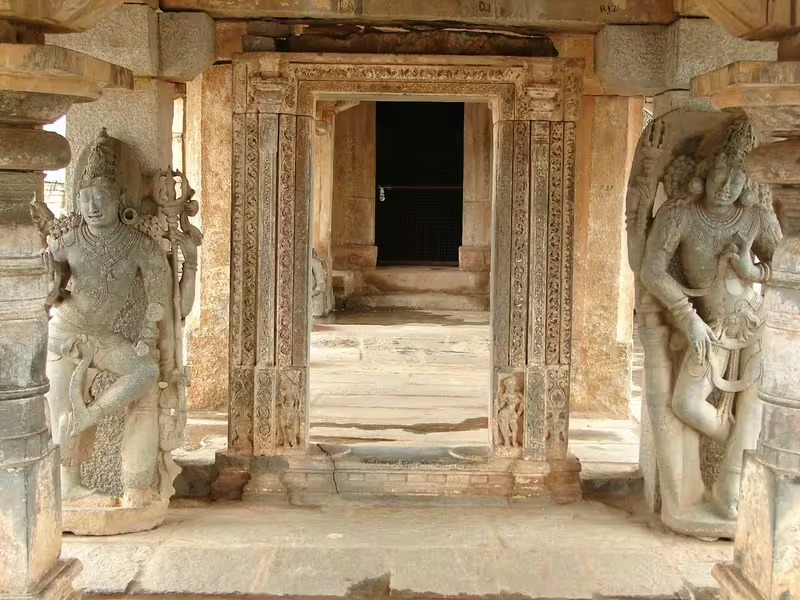
Ganga rulers also built Hindu temples. These included the Arakeshvara Temple at Hole Alur, the Kapileswara Temple at Manne, the Kolaramma Temple at Kolar, the Rameshvara Temple at Narasamangala, the Nagareshvara Temple at Begur, the Kallesvara Temple at Aralaguppe, and temples at Talakadu such as the Maralesvara, Arakesvara, and Patalesvara temples.
Hindu temples were distinguished by Dravidian gopuras, stucco figures from the Hindu pantheon, pierced screen windows in the mantapa, and carvings of the seven heavenly mothers, or saptamatrikas. Whereas Jain temples often used floral friezes, Hindu temples more commonly presented episodes from epics and Puranic narratives.
The large number of hero stones is another important legacy. These memorials could show battle scenes, Hindu deities, the Saptamatrikas, Jain Tirthankaras, and acts of ritual death. They preserve not only religious ideas but also the social memory of warfare and sacrifice.
Language, Inscriptions, and Coinage
Kannada and Sanskrit were both used extensively in administration. Bilingual inscriptions often placed origin myths, royal genealogies, titles, and blessings in Sanskrit, while the practical details of grants appeared in Kannada. The Kannada sections could describe the village, its boundaries, local authorities, rights and duties, taxes, dues, and the obligations of the beneficiary.
The balance between the two languages changed over time. From about 350 to 725, Sanskrit copper plates were especially prominent. This pattern has been connected with the importance of Brahminical grants and the growing recognition of the local language as an administrative medium.
From about 725 to 1000, lithic inscriptions in Kannada outnumbered Sanskrit copper plates. This development corresponded with the patronage of Kannada by wealthy and literate Jain communities, who used the language to communicate religious teachings and record public transactions.
A group of early bilingual copper plates discovered at Tumbula near Mysore is dated to 444. The royal genealogy is given in Sanskrit, while Kannada describes the boundaries of the village. The inscription offers a direct example of the complementary functions of the two languages.
A record from Begur near modern Bangalore, dated around 890, refers to a Bengaluru war. Written in Hale Kannada, or Old Kannada, it is the earliest known mention of the name Bengaluru in the historical record described here.
The Western Gangas minted coins bearing Kannada and Nagari legends. A common design showed an elephant on the obverse and floral-petal symbols on the reverse. The Kannada legend Bhadr, a royal umbrella, or a conch shell appeared above the elephant. Denominations included the pagoda, weighing 52 grains; the fanam, weighing one-tenth or one-half of a pagoda; and the quarter fanam.
Decline and Fall
The Western Ganga dynasty’s decline resulted from the transformation of the political order around it. For much of the eighth and ninth centuries, the Gangas had resisted the Rashtrakutas and then entered a durable alliance with them. That arrangement gave the dynasty military influence and territorial rewards. By the late tenth century, however, the Rashtrakutas had been replaced by the Western Chalukyas at Manyakheta.
The loss of the Rashtrakuta alliance altered the Gangas’ strategic position. Their former imperial protector no longer controlled the northern Deccan, while the Western Chalukyas represented a new power in the north. In the south, the Cholas were experiencing a major revival.
Rajaraja Chola I expanded Chola power south of the Kaveri. Around 1000, Chola forces conquered Gangavadi. This conquest ended the Western Ganga dynasty’s influence over the region as an independent political force. Large areas of south Karnataka then came under Chola control for approximately a century.
The end of Ganga political authority did not erase the institutions and communities formed during the dynasty’s rule. Jain centres continued to function, temples and irrigation works remained part of the landscape, and Kannada literary and inscriptional traditions continued under later powers. The dynasty’s defeat was therefore a political transition rather than a cultural disappearance.
Legacy
The Western Gangas shaped the history of southern Karnataka across approximately seven centuries. Their kingdom connected the eastern and western parts of the region, extended at times into Tamil Nadu and Andhra Pradesh, and acted as an intermediary between larger powers of the Deccan and South India.
Their political legacy lies partly in the idea of Gangavadi as a substantial territorial unit. The administrative vocabulary of Rashtra, Visaya, Nadu, Desa, and village-level offices reveals a state that relied on both royal authority and powerful local institutions. The gavundas, local landlords and elites, became especially important in the organisation of land, taxation, records, and military support.
The dynasty’s religious legacy is visible most dramatically at Shravanabelagola. The Gomateshwara monolith, Jain basadis, sacred pillars, and inscriptions turned the site into one of the major religious and artistic centres of Karnataka. Kambadahalli and other Jain sites preserve related architectural traditions.
The Gangas were not exclusively Jain rulers. Their monuments and inscriptions document patronage of Shaivism, Vedic Brahmanism, and Vaishnavism as well. Hindu temples, monastic institutions, Brahmin settlements, Jain centres, and local shrines formed part of the same cultural landscape. Their record therefore illustrates both religious plurality and changing patterns of royal preference.
In literature, the dynasty’s period saw the strengthening of Kannada as a language of administration, religious communication, prose, poetry, and technical writing. Chavundaraya Purana remains especially important as an early surviving Kannada prose work. The works associated with Durvinita, Gunavarma, Nagavarma I, Ranna, Shivamara II, and others show that the court and its patrons supported literature across genres, even though several texts are now known only through later references.
The architectural legacy combines regional and transregional elements. Pallava and Badami Chalukya features were adapted to local needs, while Jain forms such as basadis, monolithic images, and Brahma pillars developed distinctive visual identities. Hindu temples and Jain monuments together demonstrate the artistic diversity of the period.
The Western Ganga record also preserves valuable evidence for everyday institutions: irrigation, land measurement, pastoral production, taxation, local courts, schools, women’s administrative roles, royal education, memorial traditions, and the movement of armies. Their history is therefore not limited to dynastic succession. It offers a view of how political authority operated through landscapes, communities, religious institutions, and local elites in early medieval South India.