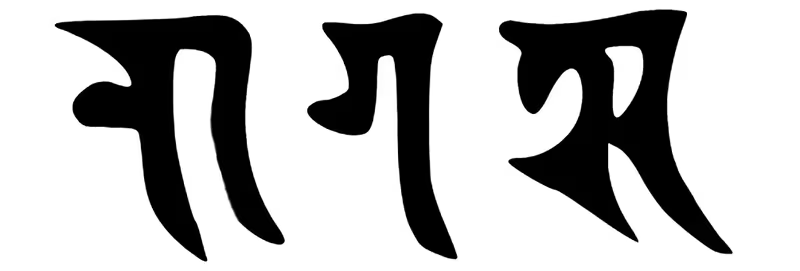
Nagari script: From Brahmic Forms to Devanagari
The earliest attestations of mature Nagari script date to 983 and 1008 CE, but the tradition had already been in regular use by the seventh century. Also called Early Nagari, it developed from the northern branch of the Brahmic script family and was first used to write Prakrit and Sanskrit. Over time, Nagari became the ancestor of Devanagari, Nandinagari, and several regional writing traditions.
Its development was gradual rather than the result of a single decisive change. Scribal practices, regional traditions, writing materials, and changes in technique all affected the appearance of its letters. Stone, copper plates, birch-bark, and palm leaf each influenced written forms, while increasing use of cursive writing encouraged movement from angular shapes toward more rounded or flowing ones.
By the eleventh century, Nagari was used across the Ganges Valley, Central India, Rajasthan, Gujarat, western India, and the Deccan. Between the eleventh and thirteenth centuries, its defining characteristics became established. The tradition then continued through regional forms, including the standardized Devanagari tradition in northern and central India and Nandinagari in southern India.
Origins and Classification
Linguistic Family
Nagari belongs to the Brahmic family of scripts and forms part of the northern branch of the Indian Brahmic scripts. It is a writing tradition rather than a spoken language. Its earliest uses included writing Prakrit and Sanskrit.
Origins
Nagari has roots in ancient Brahmi. Its development can be traced through Mauryan Brahmi and successive regional varieties conventionally designated Shunga, Kshatrapa, Kushana, Gupta, and Later Gupta scripts. The precise transition from these earlier forms into mature Nagari remains debated among scholars.
Name Etymology
The name Nagari is a vṛddhi derivation from नगर (nagara), meaning “city.” The term is sometimes also used as a synonym for Devanagari, although Early Nagari historically refers to the earlier script tradition from which Devanagari developed.
Historical Development
Gupta Antecedents and Regional Change (Mauryan Period–6th Century CE)
The shapes of early Nagari letters were affected by writing technique and material. Cursive writing encouraged more rounded and flowing forms, while stone, copper plates, birch-bark, and palm leaf produced differences in the appearance of individual letters. Scribal habits and regional traditions added further variation.
Kuṭila or Siddhamatṛka (6th–7th Centuries CE)
By the sixth century, Kuṭila, also called Siddhamatṛka, had become a major intermediate stage in the northern Indian Brahmic tradition. The development of its consonants, vowels, medial signs, and ligatures can be traced toward later Nagari forms.
Proto-Nagari (Late 7th–9th Centuries CE)
By the end of the seventh century, Proto-Nagari had developed in Malwa. It displayed broad triangular head-marks, sometimes replaced by a small stroke. Tails or footmarks were also added to the bottoms of letters.
Kuṭila reached its final form between the ninth and tenth centuries and subsequently transformed into a mature form of Nagari. The exact point of transition is disputed, because characteristic Nagari features appeared at different times and did not emerge simultaneously in every region.
Mature Nagari (11th–13th Centuries CE)
Singh identifies the eleventh to thirteenth centuries as the age of maturity for Nagari. Its principal features included the top-stroke, straight vertical line, halanta sign, uniform medial signs, and mutilated initial consonants in ligatures. The script was used across a wide area of India by the eleventh century.
Modern Period
Nagari matured into several later traditions. Devanagari became the principal standardized form of the Nagari tradition in northern and central India, while Nandinagari developed as an important southern form. Regional variation continued even after these traditions became distinct.
Scripts and Writing Systems
Early Nagari
Early Nagari was used for Prakrit and Sanskrit. Its developing forms included changing head-marks, vertical strokes, consonant shapes, vowel signs, medial signs, and ligatures. These features were shaped by both writing materials and regional scribal practice.
Devanagari and Nandinagari
By about the end of the first millennium CE, Nagari had fully evolved into Devanagari and Nandinagari. Devanagari became associated especially with northern and central India, Sanskrit, and a number of regional languages. Nandinagari was used particularly for Sanskrit manuscripts and inscriptions in southern India and the Deccan.
Script Evolution
The maturation of Nagari was not a simple branching event. Regional writing traditions continued to change, and relationships among scripts were shaped by local practice. In western India, Gujarati developed from a Nagari-derived tradition. Gujarati, Modi, and Kayethi are associated with the practical requirements of rapid handwriting. Gujarati became visually distinct from Nagari most notably through the disappearance of the continuous horizontal head-line.
Geographic Distribution
Historical Spread
Nagari was in use in the Ganges Valley, Central India, Rajasthan, Gujarat, western India, and the Deccan by the eleventh century CE. Early forms also appear outside India, including Sri Lanka, Burma, and Indonesia.
Uses Beyond India
In the seventh century, the Tibetan king Songtsen Gampo sent the ambassador Tonmi Sambota to India to acquire alphabetic and writing methods. Tonmi Sambota returned from Kashmir with a Sanskrit Nagari script corresponding to twenty-four Tibetan sounds and introduced new symbols for six local sounds.
The museum in Mrauk-u in Myanmar held two examples of Nagari script in 1972. These inscriptions, associated with the Chandra dynasty, are described as sixth-century epigraphs in mixed Sanskrit and Pali written in northeastern Nagari.
Literary Heritage
Sanskrit and Prakrit Writing
Nagari was first used to write Prakrit and Sanskrit. The surviving historical record described here emphasizes inscriptions, manuscripts, and palaeographic development rather than particular literary works.
Manuscripts and Inscriptions
Nandinagari, a southern form of the Nagari tradition, was used especially for Sanskrit manuscripts and inscriptions in southern India and the Deccan. Nagari inscriptions are also recorded outside India, including in Sri Lanka, Burma, and Indonesia.
Grammar and Phonology
Key Features
Nagari is a script and does not have an independent grammar or sound system. Its historical development is visible in changes to consonants, vowels, medial signs, ligatures, head-marks, vertical strokes, and halanta signs.
Sound System
The script was used to represent Prakrit and Sanskrit. The historical account does not provide a complete phonological inventory for either language or a separate sound system for Nagari.
Influence and Legacy
Scripts Influenced
Nagari became the ancestor of Devanagari and Nandinagari. Nagari-derived traditions also contributed to the development of Gujarati, Modi, and Kayethi. The modern Gujarati script is distinguished visually by the disappearance of the continuous horizontal head-line.
Cultural Impact
The Nagari tradition connected writing practices across northern, central, western, and southern parts of India. Its forms were adapted to different materials, regions, and scribal requirements, allowing the tradition to develop into several related scripts rather than a single uniform system.
Royal and Religious Patronage
Tibetan Adaptation
The Tibetan king Songtsen Gampo ordered foreign books to be transcribed into Tibetan and sent Tonmi Sambota to India to learn writing methods. The resulting adaptation drew on a Sanskrit Nagari script from Kashmir and represented Tibetan sounds through existing and newly innovated symbols.
Inscriptions
Nagari was preserved in inscriptions associated with rulers and dynasties outside India as well as in Sanskrit manuscripts and inscriptions in southern India and the Deccan. The sixth-century inscriptions associated with Queen Niti Candra and King Vira Candra are described as mixed Sanskrit and Pali texts in northeastern Nagari.
Modern Status
Later Development
Early Nagari developed into Devanagari, Nandinagari, and other regional forms. Because the historical tradition continued through these descendant scripts, the name Nagari may sometimes be used as a synonym for Devanagari.
Academic Study
Nagari is studied through palaeography, inscriptions, manuscripts, and comparisons among related scripts. Important discussions concern the transition from Kuṭila to mature Nagari, the timing of standardization, and the relationships among regional forms.
Learning and Study
Academic Study
The development of Nagari can be examined through the sequence from Mauryan Brahmi to the Shunga, Kshatrapa, Kushana, Gupta, Later Gupta, Kuṭila, Proto-Nagari, and mature Nagari stages. Comparative palaeographic material also distinguishes Nagari, Jaina-Nagari, Nandinagari, and related regional traditions.
Resources
Key scholarly works include A. K. Singh’s Development of Nāgarī Script and Richard Salomon’s Indian Epigraphy: A Guide to the Study of Inscriptions in Sanskrit, Prakrit, and the Other Indo-Aryan Languages.
Conclusion
Nagari was a northern Brahmic writing tradition whose history unfolded through gradual regional change. Emerging from Brahmi and passing through Gupta and Kuṭila stages, it developed recognizable Proto-Nagari forms by the seventh century and reached maturity between the eleventh and thirteenth centuries. Its top-stroke, vertical lines, halanta, medial signs, and ligatures became defining features of the mature script.
The tradition’s significance lies in both its geographic reach and its descendants. Nagari was used for Prakrit and Sanskrit, spread through inscriptions and manuscripts, and contributed to Devanagari, Nandinagari, Gujarati, Modi, and Kayethi. Its history records not one fixed script but a changing family of forms shaped by materials, handwriting, regional practice, and the needs of scribes across India and beyond.