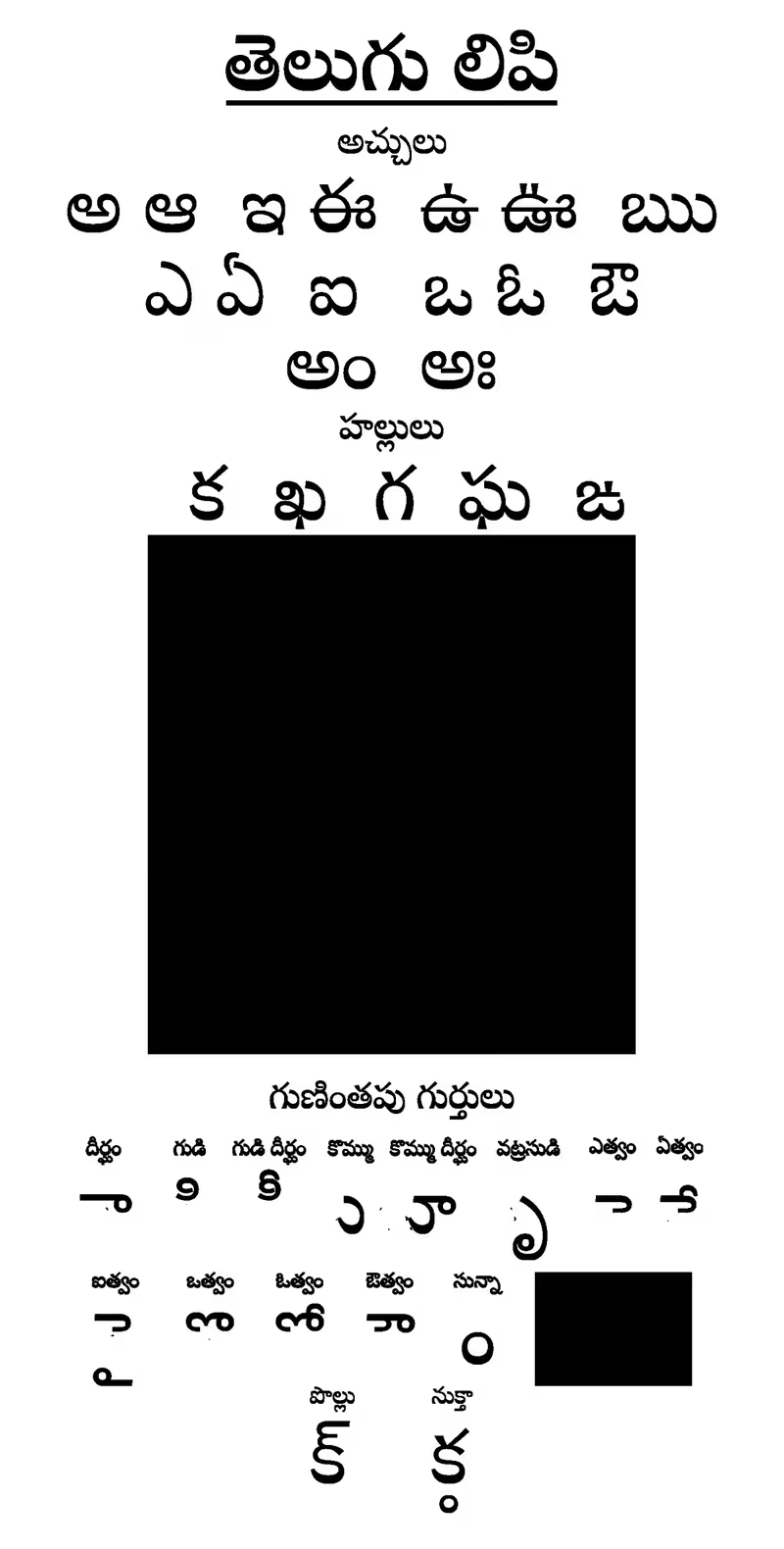
Telugu Script: From Brahmi Roots to a Digital Writing System
The Telugu script is a Brahmic abugida used to write Telugu, a Dravidian language spoken in Andhra Pradesh, Telangana, and several neighbouring states. It is also widely used for Sanskrit texts and, to some extent, for the Gondi language. The script gained prominence during the Eastern Chalukya, or Vengi Chalukya, era and shares extensive similarities with the Kannada script.
Its history reaches back to the Brahmi tradition. The Brahmi script used by Mauryan kings eventually reached the Krishna River delta, where it gave rise to the Bhattiprolu script. This script is found on an urn purported to contain the relics of Lord Buddha. Later, the Kadamba script—also derived from Brahmi—developed into the Kannada-Telugu script after the 7th century. Telugu and Kannada subsequently separated by around 1300 CE.
Telugu writing combines independent vowels, vowel diacritics, consonants, subscript forms, and other signs to represent syllables. In the modern digital environment, several Unicode code points may be combined to produce the glyph for a single syllable.
Origins and Classification
Linguistic Family
The script is used for Telugu, a Dravidian language. In script classification, it belongs to the Brahmic family and functions as an abugida. It is also used for writing Sanskrit texts and, to some extent, Gondi.
Origins
The Brahmi script associated with Mauryan kings spread to the Krishna River delta. There it contributed to the development of the Bhattiprolu script, which appears on an urn purported to contain Lord Buddha’s relics. From the wider Brahmi tradition, the Kadamba script later developed and eventually evolved into the Kannada-Telugu script after the 7th century.
The surviving historical outline connects Telugu script development with the Krishna River delta, the Bhattiprolu tradition, and the later Kannada-Telugu stage. The script gained particular prominence under the Eastern Chalukyas, also called the Vengi Chalukyas.
Name Etymology
The Telugu name for the script is తెలుగు లిపి, romanized as Telugu lipi. The medieval Muslim historian and scholar Al-Biruni referred to both the Telugu language and its script as “Andhri.”
Historical Development
Brahmi and Bhattiprolu Background
Brahmi reached the Krishna River delta through the historical expansion associated with Mauryan kings. The regional Bhattiprolu script emerged from this setting. Its surviving form is associated with an urn purported to contain Lord Buddha’s relics.
The nearby ports of Ghantasala and Masulipatnam—identified with the ancient Maisolos of Ptolemy and Masalia of the Periplus—were connected with the spread of Buddhism to East Asia. This places the early script history within a wider network of religious and maritime exchange.
Kannada-Telugu Tradition
The Kadamba script was derived from Brahmi. After the 7th century, it evolved into the Kannada-Telugu script. This shared stage helps explain the extensive similarities between the Telugu and Kannada scripts.
Telugu and Kannada did not remain a single writing tradition indefinitely. They separated by around 1300 CE, after which each developed its own established forms while retaining visible similarities.
Eastern Chalukya Era
The Telugu script gained prominence during the Eastern Chalukya era. These rulers are also described as the Vengi Chalukyas. The era forms an important stage in the historical development of the script, linking its regional growth with the political history of the eastern Deccan.
Modern Period
Telugu script remains in use for Telugu and continues to serve as a script for Sanskrit texts and, to some extent, Gondi. Its modern history also includes incorporation into digital standards. Unicode added Telugu script in October 1991.
Scripts and Writing Systems
Telugu Script
Telugu is an abugida. It has sixteen vowels, and every vowel has an independent form as well as a diacritic form used with consonants. The language distinguishes short and long vowels.
An independent vowel is used when a vowel occurs at the beginning of a word or syllable, or when it forms a complete syllable by itself. A diacritic is attached to a consonant to create a consonant-vowel syllable. The vowel అ has no separate diacritic form because an inherent vowel is already present in Telugu consonants. Other vowel diacritics alter the pronunciation of the consonant.
Consonants and Diacritics
Telugu consonants have combining forms. Subscript letters appear in consonant clusters and geminate consonants. The sign ◌్ mutes the inherent vowel so that only the consonant is pronounced.
The sign ◌ం represents a corresponding class nasal before a consonant from the relevant class. When it is not followed by anything, or is followed by a consonant from the first five rows of the consonant table, it represents a true nasal sound. The sign ◌ఁ represents a historically used ం that is no longer pronounced, or a nasalized vowel when other languages are transliterated into Telugu script. The sign ◌ః adds a voiceless breath after the vowel or syllable to which it is attached.
Script Evolution
Telugu consonant conjuncts are generally regular. In a conjunct, a trailing consonant often takes a subjoined form and may lose the talakattu, the v-shaped headstroke. These conjuncts are called vattulu in Telugu. Individual conjuncts may differ between fonts.
Consonants combined with vowel diacritics are called guṇintālu. The term guṇita refers to “multiplying oneself,” reflecting the combination of each consonant sound with vowel sounds.
The script also contains marginal or archaic signs. These include the Telugu nuqta ◌఼, used to indicate guttural plosives such as “q”; the avagraha ఽ; the Nakara pollu ౝ; the combining candrabindu nasal vowel diacritic ఀ; the combining anusvara above ఄ; the Siddham sign ౷; and the Tuumu sign ౿.
Some consonants are archaic or obsolete. ౘ, transcribed ĉa, represents /t͡sa/, while ౙ, transcribed ẑa, represents /d͡za/. Both are rarely used and are commonly replaced by చ and జ. A voiced alveolar plosive found in some inscriptions is also obsolete in modern Telugu. It is thought to have been distinguished from the trill ఱ in rare intervocalic contexts.
Geographic Distribution
Historical Spread
The early history of the script is connected with the Krishna River delta. Buddhism spread to East Asia from nearby ports including Ghantasala and Masulipatnam. The later Kannada-Telugu tradition developed in the southern Deccan, and the script gained prominence during the Eastern Chalukya era.
Modern Distribution
Telugu script is used in Andhra Pradesh and Telangana, as well as several other neighbouring states. It is one of the official scripts of the Indian Republic. Beyond Telugu, it is widely used for Sanskrit texts and is used to some extent for Gondi.
Literary Heritage
Sanskrit Texts
The Telugu script is widely used to write Sanskrit texts. The available historical account identifies this continuing use but does not specify individual Sanskrit works written in Telugu script.
Religious and Cultural Contexts
The Bhattiprolu script, an early stage in the regional history of writing, is found on an urn purported to contain Lord Buddha’s relics. The nearby ports of Ghantasala and Masulipatnam were associated with the spread of Buddhism to East Asia.
Poetry, Drama, and Scholarship
The historical account does not identify individual Telugu literary works, authors, poems, dramas, or scientific treatises. It does, however, describe the script’s use for Telugu and Sanskrit and its continuing role in written culture.
Grammar and Phonology
Key Features
Telugu script represents syllables through the combination of consonants and vowels. Its sixteen vowels have independent and diacritic forms, and short vowels are distinguished from long vowels. Consonants carry an inherent vowel unless the pollu sign removes it.
Consonant clusters and geminate consonants are represented with subscript or conjunct forms. The script’s combining behaviour is central to its abugida structure.
Places of Articulation
Telugu classifies passive articulations into five places: kaṇṭhya, or velar; tālavya, or palatal; mūrdhanya, or retroflex; dantya, or dental; and ōṣṭhya, or labial. Other articulations combine these categories, including labio-dental, labial-velar, and combinations associated with the diphthongs e and o.
Active articulation includes the tongue root for velars, the tongue body for palatals, the tongue tip for cerebral and dental sounds, and the lower lip for labials. Consonant articulation is further described through external and internal effort, including plosive, approximant, fricative, unaspirated, aspirated, unvoiced, and voiced categories.
Influence and Legacy
Related Script Traditions
Telugu script developed through traditions connected with Brahmi, Bhattiprolu, Kadamba, and Kannada-Telugu writing. Its extensive similarities with Kannada reflect the shared Kannada-Telugu stage before the two scripts separated around 1300 CE.
Cultural Impact
The script serves several linguistic and cultural functions. It writes Telugu, provides a major script for Sanskrit texts, and is used to some extent for Gondi. Its historical association with the Eastern Chalukyas and its later inclusion in Unicode connect regional history with contemporary digital communication.
Royal and Religious Patronage
Eastern Chalukyas
The Eastern Chalukyas, also known as the Vengi Chalukyas, are associated with the period when Telugu script gained prominence. Their era marks a significant phase in the script’s regional development.
Buddhism and Early Writing
The Bhattiprolu script is associated with an urn purported to contain Lord Buddha’s relics. The ports of Ghantasala and Masulipatnam were located near the area from which Buddhism spread to East Asia, providing a wider religious and maritime context for the early history of writing in the region.
Modern Status
Current Use
Telugu script is a living writing system used for Telugu in Andhra Pradesh, Telangana, and neighbouring states. It is also used for Sanskrit texts and, to some extent, Gondi.
Official Recognition
Telugu script is one of the official scripts of the Indian Republic.
Digital Representation
Unicode added Telugu script in October 1991. Unlike a syllabic script such as katakana, where one Unicode code point represents a syllable glyph, Telugu combines multiple code points to generate a glyph for one syllable through complex font-rendering rules.
On February 12, 2018, a bug was reported in iOS that caused devices to crash when a particular Telugu character sequence was displayed. The sequence combined జ, ్, ఞ, ా, and a zero-width non-joiner, displaying as జ్ఞా. Apple confirmed a fix for iOS 11.3 and macOS 10.13.4.
Learning and Study
Academic Study
Telugu script can be studied through its history, vowel and consonant systems, articulation classifications, conjuncts, archaic signs, and Unicode encoding. Its relationship to the Brahmi, Bhattiprolu, Kadamba, and Kannada-Telugu traditions provides a framework for historical study.
Resources
Resources associated with Telugu include Telugu Braille, the Telugu-to-English Dictionary, Telugu alphabet materials, and Telugu alphabet charts. The script is also represented in Unicode and supported by digital font-rendering systems.
Conclusion
Telugu script preserves a long regional history that begins with the spread of Brahmi to the Krishna River delta and continues through Bhattiprolu, Kadamba, and Kannada-Telugu developments. Its prominence during the Eastern Chalukya era and its separation from Kannada around 1300 CE mark important stages in its formation. Structurally, it is an abugida in which independent vowels, vowel diacritics, inherent vowels, consonant conjuncts, and additional nasal and breath signs work together to represent syllables. Its uses extend beyond Telugu to Sanskrit texts and some Gondi writing. With its recognition as an official script of the Indian Republic and its inclusion in Unicode since 1991, Telugu script links historical writing traditions with modern digital communication.