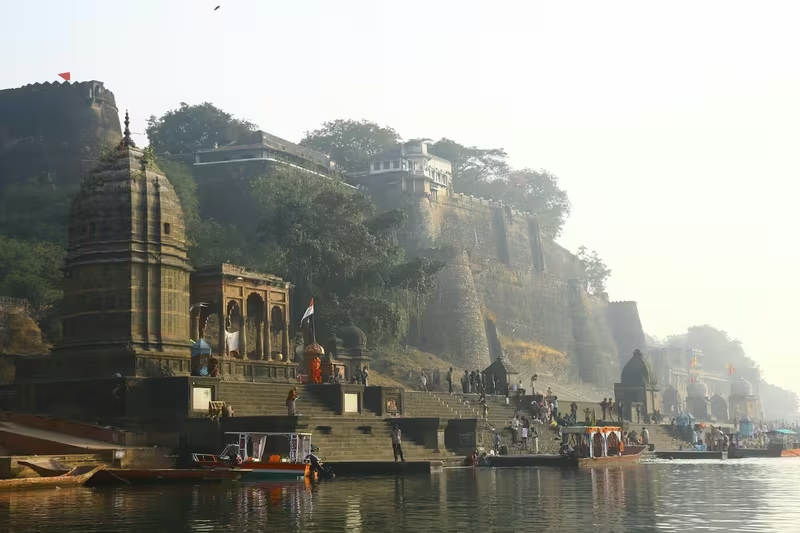
Overview
On the northern bank of the Narmada, Maheshwar brings together several layers of Indian history in a compact riverfront town. It is associated by writers including H. D. Sankalia, P. N. Bose, and Francis Wilford with the ancient city of Mahishmati, a place remembered in epic and religious traditions. In later history, it became the capital of the Malwa kingdom under the Maratha Holkars and the principal seat of Rajmata Ahilya Devi Holkar.
Maheshwar's historical character is visible in its geography and built environment. The riverfront is lined with broad stone ghats, temples, chhatris, and the fort-palace complex. The town's sacred landscape is connected to Shiva, the Narmada, and a large body of local legend. Its cultural life is also expressed through the Maheshwari saree, a handloom tradition that developed under royal patronage and continues through organized weaving communities.
The town lies in Khargone district of Madhya Pradesh, on State Highway 38 between Khargone, Barwaha, and Bandheri. It is about 13.5 kilometres east of National Highway 3 and 91 kilometres from Indore. Although its political role ended when the Holkar capital moved to Indore in 1818, Maheshwar remains a religious, cultural, and heritage centre.
Etymology and Names
In Hindi, “Maheshwar” means “Great God,” an epithet of Lord Shiva. The name reflects the town's strong Shaiva identity, expressed in its temples, riverfront rituals, and festivals devoted to Shiva.
The older name most often connected with Maheshwar is Mahishmati. This identification remains an interpretation rather than a universally settled conclusion, but it has been advanced by writers such as H. D. Sankalia, P. N. Bose, and Francis Wilford. The place is also referred to as Minnagara in Greco-Roman accounts. These names place Maheshwar within a wider historical and literary geography extending beyond its later Holkar identity.
Maheshwar is also associated with Somvanshya Shastrarjun Kshatriya traditions. In Hindu accounts, the city was the capital of Kartavirya Arjuna, also known as Sahasrarjun or Shree Shastrarjun. His story appears in connection with the Sanskrit epics and with the traditions surrounding Jamadagni, Renuka Devi, and Parashurama.
Geography and Location
Maheshwar stands on the northern bank of the Narmada River in central India. The river is not simply a geographic boundary: it is the focus of the town's religious life, architecture, legends, and visual identity. The ghats descend toward the water, while many temples and historic structures are concentrated around the fort and riverfront.
The town's position also connects it to several important historical sites in the Narmada and Malwa region. Navdatoli, a Chalcolithic archaeological site, lies on the opposite bank. Kasrawad, about 20 kilometres away, is associated with Buddhist archaeological remains and was an important Buddhist centre during the ancient and early medieval periods. Mandleshwar lies about 8 kilometres from Maheshwar, while Mandu is about 38 kilometres away. Omkareshwar, one of the twelve jyotirlingas of Shiva, can be reached by routes from the town.
Maheshwar's riverbank location shaped the character of its royal capital. The fort and palace overlook the Narmada, and public works were built around the ghats and temples. The result is a town where political authority, religious practice, and river-centered urban space remain closely connected.
Ancient History and Epic Traditions
Maheshwar's ancient past is known through a combination of historical identification, literary traditions, and nearby archaeological sites. Writers have identified it with Mahishmati, an ancient city remembered in Indian epic and religious literature. The surviving account does not provide a single secure date for the founding of the city, so its earliest history should be treated with care.
In Hindu tradition, Mahishmati was ruled by Kartavirya Arjuna, a powerful Heheya king. He is described as possessing a thousand arms, a feature that gives him the name Sahasrarjun. One of the best-known legends associated with him concerns Ravana and the Narmada.
According to the story, Sahasrarjun went to the river with his five hundred wives. When they wanted a large area in which to play, the king stopped the Narmada with his thousand arms. Ravana, travelling in the Pushpak Vimana, saw the exposed riverbed and decided to pray to Shiva there. He fashioned a Shivalinga from sand and began his worship. When Sahasrarjun's wives finished their खेल, the king released the river. The returning waters swept away Ravana's sand linga and disrupted his prayer.
Ravana then challenged Sahasrarjun, but the encounter ended in the king's victory. Sahasrarjun pinned Ravana to the ground, placed lamps on his heads and hand, and carried him home as a captive. Ravana was tied to the cradle pole of Sahasrarjun's son and remained imprisoned until his release was secured. The story forms part of the legendary landscape associated with Maheshwar, rather than a securely dated political history.
Another Mahabharata tradition concerns King Nila, described as a Nishada ruler of Mahishmati. His daughter attracted Agni, the deity of fire, who approached her in the form of a Brahman. When Nila discovered the relationship, he ordered punishment according to law. Agni then revealed himself, and the king acknowledged the deity's divine status. Agni agreed to protect the kingdom from invasion on the condition that pleasure arising from pure love would be treated as legitimate in the kingdom. The narrative presents Mahishmati as possessing a social custom that differed from the marital norms of the wider Aryavarta.
The same tradition continues into the story of Yudhishthira's planned sacrifice after the epic war. Sahadeva, the youngest Pandava, is said to have prayed to Agni because the deity protected the Nishada kingdom. After receiving Agni's support, Sahadeva moved toward Saurashtra.
The Sahasrarjun temple is associated with these stories even today. It is said to light eleven lamps in honour of Agni's blessing. Another interpretation connects the lamps to the humiliation of the ten-headed Ravana, whose heads and hand were marked by lamps when he was held captive by Sahasrarjun.
Historical Timeline
Maheshwar's past combines an ancient literary identity with a documented early modern political role.
Ancient and Early Historical Associations
The city is traditionally identified with Mahishmati, the capital of Kartavirya Arjuna. It is also connected with the Nishada king Nila in the Mahabharata tradition. Nearby Navdatoli provides evidence of an ancient settlement landscape in the Narmada valley, although the traditions about Mahishmati and the archaeological site should not automatically be treated as identical.
The town's wider historical setting included Buddhist centres and ancient temple sites. Kasrawad, near Maheshwar, was an important Buddhist centre in the ancient and early medieval periods. The region therefore carried religious and cultural importance before the rise of the Holkar capital.
The Holkar Capital
In the late eighteenth century, Maheshwar became the capital of the Malwa kingdom during the Maratha Holkar reign. Its best-known ruler was Rajmata Ahilya Devi Holkar. Under her, the town received temples, public buildings, riverfront ghats, and other works that shaped the city seen today.
Ahilya Devi's patronage was not limited to religious architecture. The town also became associated with a courtly textile culture. Weavers from Mandu and Surat were brought to Maheshwar, and the distinctive Maheshwari saree and turban tradition developed under royal support.
Maheshwar continued as the Holkar capital until 6 January 1818. On that date, Malhar Rao Holkar III shifted the capital to Indore, which was already becoming the commercial capital of the state. The transfer reduced Maheshwar's direct political role but did not erase its importance as a sacred and cultural centre.
Twentieth-Century Revival of Weaving
In 1979, the Rehwa Society was founded by the Holkars to preserve Maheshwar's handloom industry. The organization provided employment to women and helped revive the town's textile production. Its work also included a free school for the children of weavers and a low-cost health scheme.
Political Significance
Maheshwar's most important documented political role was as the Holkar capital. A capital was not merely a royal residence: it was a place where courtly authority, public works, religious patronage, and economic activity came together. The fort-palace complex, ghats, temples, and textile production all reflect this combination.
Ahilya Devi Holkar's association with Maheshwar is particularly strong. The town contains her palace, memorial chhatris, and many structures linked to her building programme. The riverfront offered a powerful setting for royal patronage. Temples and ghats made the capital a centre of public religious life, while the fort established its political presence above the Narmada.
The capital's transfer to Indore in 1818 marked a change in administrative geography. Maheshwar remained important, but its identity increasingly rested on its sacred landscape, historic buildings, and craft traditions rather than on being the seat of the Holkar state.
Religious and Cultural Importance
Maheshwar is described as a religious town with more than one hundred temples. Many are concentrated near the ghats and fort, creating a dense sacred landscape along the right bank of the Narmada. Shiva worship is especially prominent, but the town's temples represent a range of Hindu traditions.
Important temples and sacred structures include the Sahastrarjun Temple, Rajrajeshwar Mandir, Kashi Vishwanath Mandir, Chaturbhuj Narayan Mandir, Chintamani Ganpati Mandir, Pandharinath Mandir, Bhawani Mata Mandir, Gobar Ganesh Mandir, Banke Bihari Mandir, Anant Narayan Mandir, Khedapati Hanuman, Ram and Krishna temples, and Narsingh Mandir. Kaleshwar and Jwaleshwar temples stand farther from the central riverfront, while Baneshwar Temple is located on a small island in the Narmada.
The town also has a temple dedicated to Vindhyavasini Bhavani, described in the account as one of the Shakti pithas associated with the goddess. The festivals celebrated in Maheshwar include Nag Panchami, Gudi Padava, Teej, Mahashivratri, Samoti Amavas, and the Mondays of the month of Shravan. On the final Monday of Shravan, the dola of Kashivishwanath is taken out, and bhang is served as Shiva's prasad.
Another annual event is the Mahaamrityunjaya Rath Yatra, organized by Swaadhyaaya Bhavan Ashram on the Sunday immediately before Makar Sankranti. Initiated by Shri Harvilas Aasopaa, the procession begins at the ashram and ends on the banks of the Narmada.
Maheshwar has also been associated with devotional singing. Jagadguru Kripaluji Maharaj, who came from Mahu, visited the town in his early life and performed extended akhand sankirtan near the Shiva temple and on the Narmada bank.
Economy and the Maheshwari Saree
Maheshwar has been a centre of handloom weaving since the fifth century, according to the town's historical account. Its best-known product is the Maheshwari saree, a fine handloom textile recognized for colourful designs, stripes, checks, and floral borders.
The tradition became especially prominent under Ahilya Devi Holkar. She is said to have wanted appropriate royal gifts for visiting guests and invited weavers from Mandu and Surat. The resulting sarees and turbans were used by women of the royal court and presented to royal visitors. Local architecture is described as an inspiration for the designs, connecting the textile tradition to the town's fort, temples, and riverfront buildings.
The Rehwa Society's revival programme gave the craft a modern institutional structure. About 130 weavers associated with the society produce more than 100,000 metres of fine fabric each year. The weaving centre operates from one of Maheshwar's historic buildings. Alongside production, the society supports the social needs of weaving families through education and healthcare.
This combination of palace patronage, local design, and organized revival makes weaving central to Maheshwar's identity. The handloom is not only an economic activity but also a link between the Holkar court and the town's present-day cultural life.
Monuments and Architecture
The Ahilya Fort dominates the historic riverfront. It has since been converted into a heritage hotel, a project associated with Maharajkumar Shrimant Shivaji Rao Holkar, also known as Prince Richard Holkar of Indore. The fort is closely connected with the memory of Ahilya Devi Holkar and remains one of the defining architectural landmarks of the town.
The ghats are broad stone steps leading down to the Narmada. They provide space for worship, ritual bathing, festivals, and everyday interaction with the river. The chhatris of Ahilya Mata commemorate the Holkar ruler and form part of the historic riverfront ensemble.
The temples around the fort and ghats vary in scale and dedication. Kashi Vishwanath expresses the town's Shaiva identity, while Rajrajeshwar, Sahastrarjun, Baneshwar, and the goddess temples connect the town to its layered religious traditions. The concentration of temples near the river allows the historic centre to be experienced as a continuous sequence of sacred buildings, courtyards, steps, and water.
At Sahastradhara, the Narmada divides into several smaller streams and flows forcefully. A water-sports centre has been planned there. A newer religious landmark, the Ek Mukhi Datta Temple or Shiva Datta Dham at Jalkoti, stands in a large complex on the riverbank and contains images of Ek Mukhi Datta, Maa Narmada, and Ganesha.
Famous Personalities and Associations
Kartavirya Arjuna is the legendary ruler most closely associated with ancient Mahishmati. His stories connect the town to Ravana, the Narmada, Agni, and Parashurama traditions.
Ahilya Devi Holkar is the central historical personality of Maheshwar's later past. As ruler and patron, she shaped the fort, temples, ghats, and courtly textile culture that define the town's heritage.
Maheshwar's wider region is also associated with Adi Shankaracharya. At nearby Mandleshwar, the Mandleshwar Mahadev Temple is linked to a famous debate between Maṇḍana Miśra and Adi Shankaracharya. Swami Vivekananda is said to have stayed and meditated at Mandleshwar.
The nearby site of Raverkhedi contains the samadhi of Maratha Peshwa Baji Rao I, who died and was cremated there in 1740. These connections make Maheshwar part of a broader network of religious, intellectual, and Maratha historical sites along the Narmada.
Decline, Continuity, and Revival
Maheshwar's political decline was defined by the transfer of the Holkar capital to Indore in 1818. The town did not disappear; instead, its principal roles changed. Its temples, ghats, legends, and river continued to attract religious visitors, while its handlooms sustained a distinctive local economy.
The twentieth-century revival of weaving through the Rehwa Society gave the town a renewed cultural and economic foundation. The preservation of historic buildings, the conversion of the fort into a heritage hotel, and Maheshwar's appearance in films have further strengthened its position as a heritage destination.
Modern City
According to the 2001 census figures given for Maheshwar, the town had a population of 24,000. Males constituted 51 percent and females 49 percent. The literacy rate was recorded as 67 percent, above the national average of 59.5 percent at the time; male literacy was 75 percent and female literacy 59 percent. Fourteen percent of the population was under six years of age.
Maheshwar is now known for heritage tourism, pilgrimage, handloom weaving, and its Narmada landscape. Visitors encounter a town where palace architecture, temples, ghats, craft workshops, and religious festivals remain closely connected. The nearest airport is Devi Ahilya Bai Holkar Airport in Indore.
The town's scenery has also attracted film and television productions. Locations in Maheshwar and along the Narmada have appeared in films and music videos including Ashoka, Tulsi, Alai Payuthey, Leelai, Arrambam, Yamla Pagla Deewana, Tevar, Bajirao Mastani, Neerja, Gautamiputra Satakarni, Pad Man, Dabangg 3, and Kalank. These productions have brought wider attention to the fort, bazaar, ghats, temples, and riverfront.