Overview
On the eastern bank of the Bhagirathi River, Murshidabad became the capital of the Bengal Subah for seventy years during the eighteenth century. Under Nawab Murshid Quli Khan, it developed from a region associated with silk production into a wealthy court city with administrative offices, military establishments, palaces, mosques, gardens, markets, and merchant mansions.
Its prosperity rested on several connected worlds. The Nawab’s court brought administrators, soldiers, artisans, and officials to the city. Banking and merchant families from across the Indian subcontinent and wider Eurasia established themselves there. European companies—including the British, French, Dutch, and Danish East India Companies—operated factories and trading bases in the surrounding region. Murshidabad was therefore not simply a political capital; it was also a centre of finance, commerce, craft production, and culture.
The city’s fortunes changed sharply after Siraj-ud-Daulah’s defeat at the Battle of Plassey in 1757. The British East India Company installed a new political arrangement, while the treasury, courts, and revenue offices were progressively shifted to Calcutta. Murshidabad remained the residence of the Nawab and later became a district city of the Bengal Presidency, but it no longer held the authority it had possessed in the Nawabi period.
Etymology and Names
Murshidabad was named after its founder, Nawab Murshid Quli Khan. The word “Murshid” is Arabic and refers to a teacher or guide associated with integrity, sensibility, and maturity. The suffix “-abad” comes from the Persian word abad, meaning a cultivated or settled place.
The name thus connected the city directly with its founder and with the Persianate administrative and cultural world of the Mughal and Nawabi courts. No separate earlier name for the city is established in the historical account, although the wider area had older political and commercial associations.
Geography and Location
Murshidabad is located at approximately 24.18°N and 88.27°E in present-day West Bengal. The town stands on the eastern bank of the Bhagirathi River, a position that shaped both its landscape and its connections with nearby settlements.
The central heritage zone is the Kila Nizamat area, where Hazarduari Palace and associated sites form the principal focus. Other important locations in and around the town include Katra Masjid, Fauti Mosque, Jama Masjid, and the Motijhil area. Across the river are sites such as Khushbagh, Rosnaiganj, Baranagar, and Kiriteswari Temple. The wider historical landscape also includes Karnasuvarna, Azimganj, Jiaganj, Cossimbazar, and locations in the neighbouring Berhampore area.
Murshidabad’s position was especially useful when the Nawab’s authority extended over Bengal, Bihar, and Orissa. The city lay centrally within this expanded jurisdiction and became a practical base for administration, revenue collection, military activity, and commerce.
Ancient and Early History
The wider area was associated with the ancient kingdoms of Gauda and Vanga. The Riyaz-us-Salatin credited the initial development of the town to a merchant named Makhsus Khan, while the merchant’s role was also mentioned in the Ain-i-Akbari. These accounts point to an earlier commercial presence, although the later rise of Murshidabad was closely tied to Mughal administration and the Nawabi court.
By the seventeenth century, the area was well known for sericulture. English agents reported in 1621 that large quantities of silk were available there. This early connection with silk laid the foundation for a commercial economy that remained important through the city’s later history.
In the 1660s, the area became a pargana of the Mughal administration. Its jurisdiction included European companies operating in Cossimbazar, linking the area to the expanding network of overseas commerce in Bengal.
Historical Timeline
Rise under Murshid Quli Khan
In the early eighteenth century, Murshid Quli Khan served as the prime minister of the Bengal Subah. He became involved in a bitter rivalry with Prince Azim-ush-Shan, the Mughal viceroy of Bengal, who even attempted to have him killed. At the same time, the Mughal court in Delhi was losing authority across much of the subcontinent.
During this weakening of central power, Mughal Emperor Farrukhsiyar promoted Murshid Quli Khan to the status of a princely Nawab. This position gave him the opportunity to establish a princely dynasty within the Mughal aristocratic order.
Murshid Quli Khan shifted the capital of Bengal from Dhaka. Dhaka had lost strategic importance after the expulsion of the Arakanese and Portuguese from Chittagong. Murshid Quli Khan founded the new capital on the Bhagirathi and named it after himself. Murshidabad then became the political, economic, and cultural centre of Bengal.
The Nawabi Capital
The presence of the princely court, the Mughal Army, artisans, administrators, and merchants transformed the city. Wealthy families and companies established their head offices in Murshidabad. Its mint became the largest in Bengal, with a value amounting to two percent of the minted currency.
The city’s built environment reflected its new importance. Administrative buildings, gardens, palaces, mosques, temples, and mansions appeared across the urban landscape. European companies maintained factories on the outskirts, while the streets and institutions were populated by brokers, workers, peons, naibs, wakils, and ordinary traders.
Murshid Quli Khan created an efficient administrative machinery for the Nawabs who followed him. He built a palace and a caravanserai with a grand mosque known as Katra Masjid. The main military base stood near the mosque and served as the eastern gateway of the city.
The third Nawab, Shuja-ud-Din Muhammad Khan, expanded the capital’s monumental and administrative character. He patronized another palace and military base, a new gateway, a revenue office, a public audience hall, a private chamber, a treasury, and a mosque. These buildings formed part of an extensive compound called Farrabagh, or the Garden of Joy, which included canals, fountains, flowers, and fruit trees.
Siraj-ud-Daulah established a palace near Motijhil, or Pearl Lake. The Nizamat Imambara was built for Shia Muslims, and the palace complex was fortified as the Nizamat Fort. Its principal entrances were tall and imposing, with musicians’ galleries and gates high enough for an elephant to pass through. The Khoshbagh garden became the burial place of the Nawabs.
Plassey and the End of Independence
The decisive break in Murshidabad’s history came in 1757. Siraj-ud-Daulah, the last independent Nawab of Bengal, was defeated at the Battle of Plassey. Although he had received assurances of French support, his commander Mir Jafar betrayed him.
The British installed Mir Jafar’s family as a puppet dynasty and eventually reduced the Nawab to the position of a landlord, or zamindar. The British continued collecting revenue from the area’s factories, and merchant families continued to prosper under Company rule. In 1858, the British government assumed direct control of India’s administration.
The political centre nevertheless moved away from Murshidabad. The British shifted the treasury, courts, and revenue office to Calcutta. Warren Hastings removed the supreme civil and criminal courts to Calcutta in 1772, although the latter courts were brought back to Murshidabad in 1775. Under Lord Cornwallis, the entire revenue and judicial staff was moved to Calcutta in 1790.
Political Significance
Murshidabad’s importance came from its role as the seat of the Bengal Nawabs and the administrative centre of a jurisdiction covering Bengal, Bihar, and Orissa. Its central position within that territory helped make it an effective capital.
The city combined several forms of authority. The Nawab’s palace represented dynastic power; the military base provided protection; the revenue office organized the fiscal machinery; the court and public audience hall connected the ruler to officials and petitioners; and the mint expressed the city’s place in the monetary system of Bengal.
After 1757, Murshidabad’s political status was reduced but not erased. The Nawab continued to live there and ranked as the first nobleman of the province, with the style Nawab Bahadur of Murshidabad rather than Nawab Nazim of Bengal. The city later served as a district headquarters of the Bengal Presidency.
Religious and Cultural Importance
Murshidabad was a multi-community city. Its population included Bengali Muslims and Bengali Hindus, along with an influential Jain community involved in trade and commerce. Armenians also settled in the city and became financiers for the Nawab.
The city’s religious architecture reflected the court and its diverse population. Katra Masjid, the Nizamat Imambara, Jama Masjid, Fauti Mosque, and other religious buildings formed part of the urban landscape. Temples in and around the broader Murshidabad region added another dimension to its sacred geography.
Murshidabad was also a centre of art and culture. Courtly patronage, merchant wealth, European connections, and the presence of skilled artisans created an environment in which architecture, gardens, textiles, food, and ceremonial life could flourish.
Economic Role
Silk was central to Murshidabad’s economy. The region had been known for sericulture since at least the seventeenth century, and Murshidabad silk later became particularly valued for saris and scarves. The silk industry was revived with government assistance during the colonial period.
The city’s banking community was equally important. The Jagat Seth family was among Murshidabad’s most prominent banking houses. It controlled money-lending activities and financed administrators, merchants, traders, Nawabs, zamindars, and European companies, including British, French, Armenian, and Dutch interests.
European trading companies maintained a strong presence around Murshidabad. The French East India Company operated factories in Murshidabad and Dhaka. The British East India Company was based at Fort William, while Murshidabad formed part of the Dutch Bengal Department. The Ostend Company of Austria established a base nearby, and the Danish East India Company set up trading posts in the Bengal Subah.
Merchant wealth also shaped the built environment. Families constructed mansions such as Azimganj Rajbati, Kathgola House, and Nashipur House. This commercial architecture remains part of the region’s heritage.
Monuments and Architecture
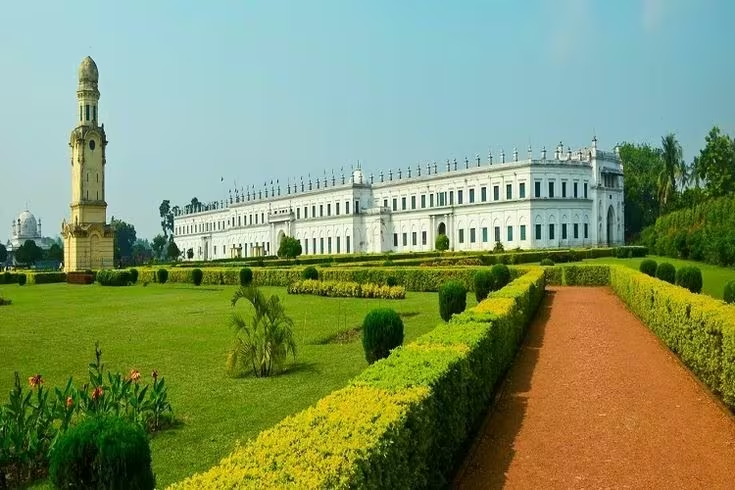
The Kila Nizamat area is the central heritage zone of Murshidabad. Hazarduari Palace, built in 1837, served as a residence for both the Nawab and British civil servants. Its construction represented the city’s continuing role as the Nawab’s residence even after political power had moved toward Calcutta.
Katra Masjid combines religious, charitable, and military associations. Built by Murshid Quli Khan, it included a grand mosque and a caravanserai, while the nearby military base marked the eastern entrance to the city.
The Nizamat Fort and Nizamat Imambara express the ceremonial and religious character of the Nawabi court. Motijhil was associated with a palace established by Siraj-ud-Daulah, while Khoshbagh served as the burial garden of the Nawabs.
Other heritage locations include Fauti Mosque, Jama Masjid, Azimganj Rajbati, Kathgola House, Nashipur House, and the sites situated across the Bhagirathi, including Khushbagh and Baranagar.
Famous Personalities
Murshid Quli Khan founded the city and made it the capital of Bengal. Shuja-ud-Din Muhammad Khan expanded its palaces, administrative buildings, and gardens. Siraj-ud-Daulah, the last independent Nawab, established a palace near Motijhil and was defeated at Plassey in 1757.
Mir Jafar became central to the political transformation that followed Plassey. Warren Hastings and Lord Cornwallis were associated with the later movement of judicial and revenue administration toward Calcutta. The Jagat Seth family represented the financial power of Murshidabad’s merchant elite.
Decline and Revival
Murshidabad’s decline began with the defeat of Siraj-ud-Daulah. The transfer of the treasury, courts, and revenue offices to Calcutta weakened the city’s administrative role. The Bengal Famine of 1770 also affected Murshidabad severely.
Yet the city remained important as the residence of the Nawab and as a commercial and district centre. Its population was estimated at 46,000 during the nineteenth century. Hazarduari Palace was built in 1837, and Murshidabad became a municipality in 1869. The revival of the silk industry, along with mango and litchi production, provided continuing economic activity.
Modern City
According to the 2011 Census, Murshidabad had a population of 44,019, including 22,177 males and 21,842 females. The city recorded 9,829 households. Its religious composition was listed as 75.09% Hindu, 23.86% Muslim, and 1.05% others.
Today, agriculture, handicrafts, and sericulture remain important. Murshidabad silk continues to be used for saris and scarves. The town’s heritage economy is centred on its palaces, mosques, gardens, merchant houses, and river-linked historical sites.
The Murshidabad Heritage Festival began in 2011. Organized by the Murshidabad Heritage Development Society, it seeks to revive the tangible and intangible heritage of Murshidabad and nearby towns such as Azimganj, Jiaganj, and Cossimbazar. Held during the winter, especially in January or February, the festival includes cultural performances, heritage walks, cruises on the Bhagirathi, and vegetarian food with an emphasis on Sheherwali cuisine.
Timeline
Silk Trade Recorded
English agents reported that large quantities of silk were available in the area.
Mughal Administration
The area became a pargana of the Mughal administration, with jurisdiction over European companies in Cossimbazar.
Capital Founded
Murshid Quli Khan shifted the capital from Dhaka and founded Murshidabad as the centre of Bengal’s administration.
Battle of Plassey
Siraj-ud-Daulah was defeated, beginning Murshidabad’s political decline and the rise of British Company influence.
Bengal Famine
Murshidabad was severely affected by the Bengal Famine.
Administration Moves to Calcutta
Under Lord Cornwallis, the revenue and judicial staffs were transferred to Calcutta.
Hazarduari Palace
Hazarduari Palace was built as a residence for the Nawab and British civil servants.
Municipality Established
Murshidabad was declared a municipality.
Heritage Festival Begins
The Murshidabad Heritage Festival began as an effort to renew interest in the region’s tangible and intangible heritage.