Overview
At 25°08′N 88°10′E, the ruins of Pandua mark the site of the first capital of the independent Bengal Sultanate. Known variously as Pandua, Hazrat Pandua, Firuzabad, and today closely associated with Adina, the city stood about 18 kilometres north of English Bazar, or Malda Town, in West Bengal.
Pandua was a capital for approximately 114 years, conventionally dated from 1339 to 1453, although the capital shifted to nearby Lakhnauti or Gaur around 1450. During its peak, it was far more than a royal residence. It was a walled administrative centre, military garrison, mint town, commercial market, and meeting place for people from Bengal and across Eurasia.
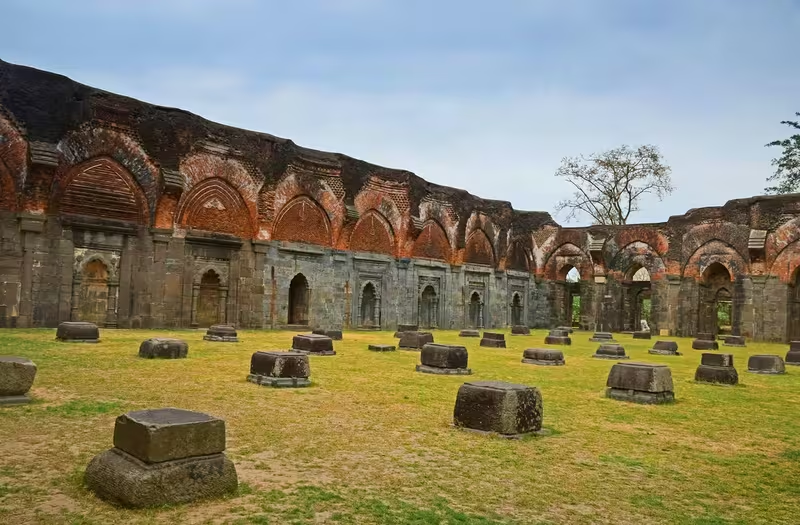
Its surviving monuments include the Adina Mosque, the Eklakhi Mausoleum, and the Qutb Shahi Mosque. Much of the royal city has disappeared, leaving behind ruins, raised mounds, and traces of a once-powerful capital.
Etymology and Names
Coins associated with the Balban dynasty of the Delhi Sultanate refer to Pandua as Firozabad, a name considered connected with the reign of Shamsuddin Firoz Shah. The city was also called Hazrat Pandua, reflecting the large presence of Sufi preachers who lived and taught there.
In modern usage, Pandua is almost synonymous with Adina, the small settlement surrounding the best-known archaeological remains. The historical city itself was larger than the surviving monuments suggest, with walls, palaces, markets, and military buildings that have largely vanished.
Geography and Location
Pandua lies in the Malda district of West Bengal, in the historic region of Bengal. Its location placed it within the political and commercial networks of the Bengal Sultanate while keeping it at a considerable distance from Delhi. This distance, combined with Delhi's preoccupation with Mongol invasions in north-western India, helped Bengal's governors establish independent authority.
The city was enclosed by walls and developed as a planned centre of power. Its eventual decline has been associated with the movement of a river, although the precise reason for shifting the capital remains uncertain. The humid conditions and monsoon climate of Bengal later contributed to the deterioration of its buildings.
Historical Timeline
Rise of the Bengal Sultanate
In 1352, the rebel governor Shamsuddin Ilyas Shah united Bengal's three Muslim states and founded the Ilyas Shahi dynasty. This act created a single independent political authority in Bengal and separated the region's administration from Delhi. Pandua became the dynasty's principal capital.
Over the following decades, nine rulers governed Bengal from Pandua. Most belonged to the Ilyas Shahi dynasty. The exceptions were Raja Ganesha, his son Jalaluddin Muhammad Shah, and his grandson Shamsuddin Ahmad Shah. These rulers commissioned palaces, forts, bridges, mosques, and mausoleums, many of which are now ruined or lost.
Capital, Mint, and Commercial Centre
Pandua remained the capital of Bengal for roughly a century. It also continued to function as a mint town after the court moved away. Its mints were known as Shahr-i-Naw and Muzzafarabad, and they produced silver taka into the sixteenth century.
The city was described as a cosmopolitan administrative and commercial centre. Its inhabitants included royalty, aristocrats, soldiers, mercenaries, local residents, foreign merchants, and travellers from across Eurasia. Merchants built ships, sailed abroad for trade, and sometimes served as royal envoys.
Shift to Gaur
Around 1450, the capital moved from Pandua to nearby Lakhnauti, also associated with Gaur. The exact cause is not established. A change in the course of a river has been suggested, but the surviving historical record does not settle the question. Pandua nevertheless retained administrative and monetary importance for some time.
Political Significance
Pandua's greatest political importance lay in its role as the seat of an independent Bengal. The establishment of the sultanate united the region under one authority and ended the dependence of Bengal's governors on Delhi.
The city was designed to express royal power. Its palace reportedly had high steps, nine walls, three gates, and a durbar room. A contemporary description presents the room as richly decorated, with brass-plated pillars carved with flowers and animals. The ruler sat cross-legged on an elevated, jewel-decorated throne, with a two-edged sword across his lap.
Religious and Cultural Importance
Pandua was known for its mosques, mausoleums, and Sufi presence. The name Hazrat Pandua reflects the prominence of Sufi preachers in the city. Its architecture combined Bengali, Arab, and Persian elements, demonstrating the cultural interaction that shaped the Bengal Sultanate.
The city was also socially diverse. Bengali was the common language, while Persian was used by courtiers and merchants. Accounts describe local dress, food, music, courtly entertainment, and customs alongside the presence of people from distant regions.
Economic Role
The markets of Pandua carried at least six varieties of fine muslin and several kinds of silk products. Four types of wine were recorded, while high-quality paper was produced from mulberry-tree bark in the surrounding area. This paper was said to resemble lightweight white cotton cloth.
A description by the Ming ambassador Ma Huan portrays well-organised bazaars, with shops placed side by side and goods displayed in orderly rows. Pandua's economy connected manufacturing, long-distance trade, royal administration, and military supply.
Monuments and Architecture
The Adina Mosque is Pandua's most celebrated monument. Sultan Sikandar Shah commissioned it after Bengal's victory in the Bengal Sultanate–Delhi Sultanate war. Modelled on the Great Mosque of Damascus, it was built as the largest mosque in the Indian subcontinent.
The Eklakhi Mausoleum is associated with the burial of Sultan Jalaluddin Muhammad Shah. It is especially notable for its terracotta Bengali architectural style. The Qutb Shahi Mosque is another surviving monument that reflects the city's Islamic architectural tradition.
The former royal palace has almost entirely disappeared. Only traces survive in raised mounds, making the standing monuments especially important for reconstructing Pandua's past.
Decline and Rediscovery
Pandua's decline began after its political importance diminished and was later intensified by the conquest of Sher Shah Suri. The city became overgrown and passed into wilderness. Nineteenth-century earthquakes damaged its remaining structures, while humidity and monsoon rains caused further decay.
The lost city was rediscovered by Francis Buchanan-Hamilton in 1808. Sir Alexander Cunningham later conducted a detailed study, and the Archaeological Survey of India carried out an aerial survey in 1931. These investigations helped identify the extent and character of the ruined capital.
Modern Status
Today, Pandua survives primarily as an archaeological landscape around Adina. Its remaining monuments preserve evidence of Bengal's independent sultanate, its courtly culture, and its connections with wider Asian trade networks. The Adina Mosque, Eklakhi Mausoleum, and Qutb Shahi Mosque remain the central landmarks of the site.