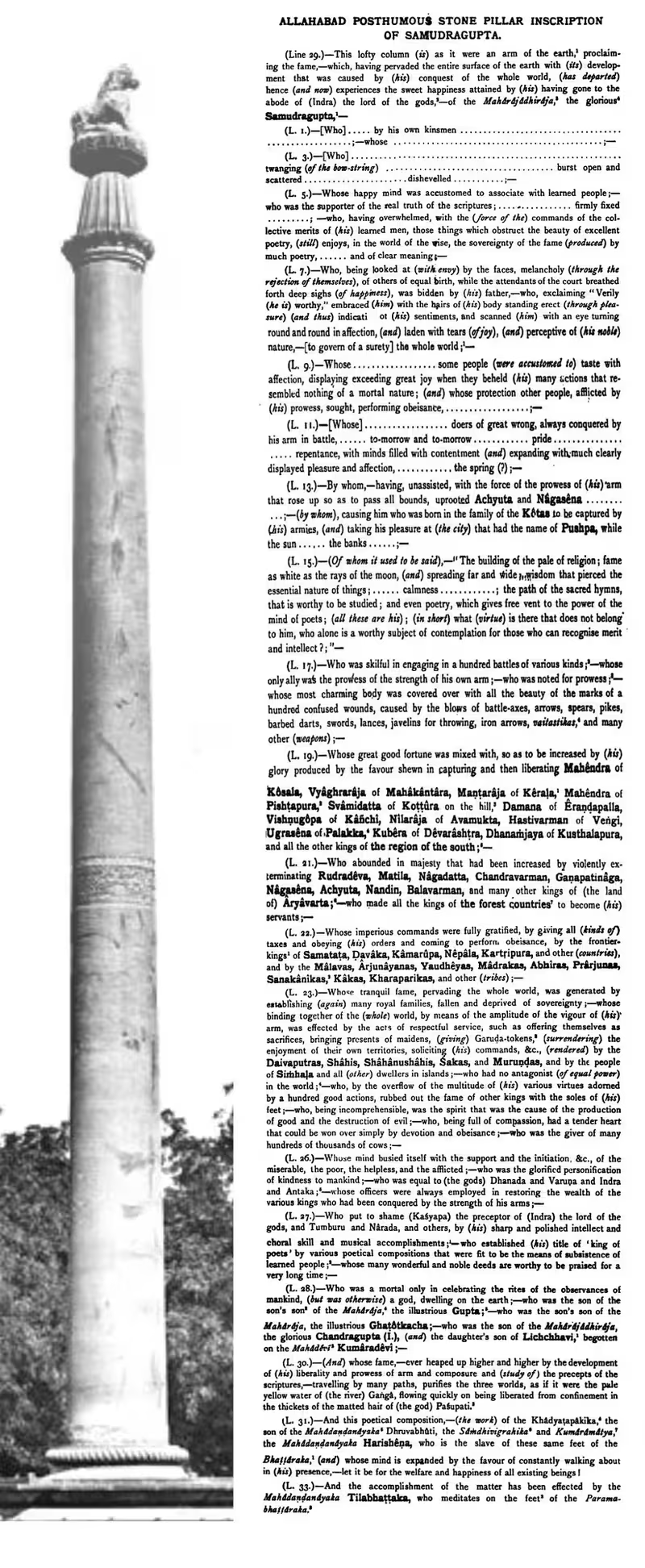

The Nine Kings: Decoding the Violence in Samudragupta's Pillar
Every conqueror needs a poet. And in the fourth century CE, the Gupta emperor Samudragupta had Harisena—a courtier who served as both minister and military officer, a man who had likely witnessed the campaigns he was commissioned to immortalize. The result was the Allahabad Pillar inscription, a prashasti or eulogy carved into sandstone that would outlast the empire itself.
But Harisena wasn't simply recording facts. He was making choices—linguistic, strategic, political. And nowhere are those choices more revealing than in his description of nine northern kings who were, in his words, "violently exterminated."
These are strong words, even for an imperial eulogy. The Sanskrit term conveys not merely defeat but obliteration, the complete erasure of royal authority. According to the inscription, Samudragupta didn't just beat these rulers on the battlefield—he annexed their territories directly into his empire, absorbing their kingdoms into the expanding Gupta realm.
Who were these nine kings? The inscription lists them in what scholars believe is mainly geographical and partly chronological order, tracing Samudragupta's campaigns across northern India. Their names survive in stone, but their stories—the actual battles, the sieges, the negotiations that might have preceded "violent extermination"—are lost to us. We have only Harisena's carefully curated account.
The Geography of Conquest
The scale of Samudragupta's northern campaigns, as described in the inscription, is staggering. At the height of his power, the empire under his direct control stretched from the Ravi River in present-day Punjab to the Brahmaputra River in Assam—essentially spanning the entire width of northern India. From the Himalayan foothills in the north, his authority extended to central India in the southwest.
This wasn't tributary control. These were annexed territories, administered directly by Gupta officials, their former royal houses displaced or destroyed. The inscription's language is unambiguous: these nine northern kingdoms ceased to exist as independent political entities.
But here's where Harisena's word choices become crucial for historical investigation. The inscription doesn't use this language of violent extermination for all of Samudragupta's conquests. In fact, it carefully distinguishes between different categories of defeated rulers—and those distinctions reveal the limits and strategies of Gupta imperial power.
The Southern Difference
When the inscription describes Samudragupta's southeastern campaign—his march along the coast advancing as far as Kanchipuram in the Pallava kingdom—Harisena changes his vocabulary. These rulers weren't "violently exterminated." They became tributaries.
The distinction matters. A tributary king keeps his throne, maintains his court, governs his territory. He simply acknowledges the overlordship of a greater power, sends gifts and tribute, perhaps provides military support when called upon. The inscription even notes that "many neighbouring rulers tried to please him"—diplomatic language suggesting negotiated relationships rather than total conquest.
Why the different treatment? Distance is one obvious factor. The logistics of directly administering territories hundreds of miles from the Gupta heartland, across difficult terrain, would have been formidable. But there's likely more to it. The southern kingdoms, particularly the Pallavas, were powerful states with their own deep roots and administrative sophistication. They could be defeated on the battlefield but not easily absorbed.
Harisena's careful linguistic distinctions—violent extermination versus tributary status—map onto strategic realities. They reveal an empire that knew its limits, that chose its battles not just militarily but administratively. The nine northern kings could be exterminated because their territories were contiguous, accessible, absorbable. The southern rulers could not.
The Kacha Problem
But the Allahabad Pillar inscription isn't our only source for Samudragupta's reign. We also have coins—gold coins that bear royal names and images. And here the historical picture becomes murkier.
Some coins from this period bear the name "Kacha," struck in a style consistent with Gupta coinage. Who was Kacha? Some scholars have suggested he was a rival claimant to the throne, perhaps Samudragupta's brother, possibly ruling briefly before being overthrown. Others argue the coins represent a different ruler entirely, or that "Kacha" was an alternative name for a known Gupta king.
The Allahabad inscription tells us that Chandragupta I, Samudragupta's father, appointed his son as successor "in front of the courtiers"—language that suggests the succession wasn't automatic or uncontested. The inscription emphasizes Samudragupta's "devotion, righteous conduct, and valour" as reasons for his selection, implying perhaps that other sons existed who lacked these qualities.
Did one of those other sons resist? Was there a civil war before the foreign conquests? The inscription is silent—and that silence is itself revealing. Harisena was commissioned to create a narrative of unbroken triumph, of an emperor who "remained undefeated in battle" and who fought "a hundred battles and acquired a hundred wounds." A succession struggle wouldn't fit that narrative.
This is the challenge of reading ancient inscriptions: they tell us what the patron wanted remembered, not necessarily what happened.
The Horse That Proved Everything
After his conquests, Samudragupta performed the Ashvamedha sacrifice—the ancient Vedic horse ceremony that proclaimed imperial sovereignty. A royal horse would be released to wander freely for a year, followed by the king's army. Any ruler through whose territory the horse passed had to either submit or fight. If the horse returned unchallenged, the king would sacrifice it in an elaborate ritual that validated his claim to paramount authority.
The Ashvamedha was more than religious theater. It was a political statement, a claim to be chakravartin—a universal ruler in the ancient Indian conception of kingship. By performing this sacrifice, Samudragupta was asserting that his conquests had restored the glory of ancient imperial traditions, that the Gupta Empire stood in direct succession to the great kingdoms of the Vedic age.
The inscription emphasizes this ritual repeatedly, linking Samudragupta's military achievements to cosmic and religious validation. Harisena wasn't just listing conquests—he was crafting a theological argument for Gupta supremacy.
The Poet-Warrior
But here's where the inscription becomes truly interesting: it doesn't present Samudragupta solely as a warrior. His gold coins and the inscription itself suggest he was an accomplished poet who played the veena, a stringed instrument. He was a patron of arts and learning, presiding over what historians now call a "cultural golden age."
This wasn't incidental to his imperial project. In ancient Indian political theory, the ideal king was both dharma-vijaya (victorious through righteousness) and cultured, a warrior-philosopher who conquered through both military might and moral authority. By presenting Samudragupta as both destroyer of enemies and patron of arts, Harisena was crafting an image of the complete ruler.
The nine "violently exterminated" kings weren't just military victories—they were obstacles to a larger civilizational project. Their destruction made possible the cultural flowering that the inscription celebrates. Violence and culture, in this narrative, are two sides of the same imperial coin.
Reading Between the Lines
So what battles does the phrase "violently exterminated" actually hide? We'll never know the full story. We don't have accounts from the defeated kingdoms, don't know how many soldiers died in these campaigns, don't know what happened to the royal families of those nine northern kings.
What we do know is that Harisena chose his words carefully. The Allahabad Pillar inscription is a masterpiece of Sanskrit literature, a prashasti that follows well-established generic conventions while adapting them to celebrate a specific ruler's achievements. Every word was weighed, every phrase crafted to create a particular image.
Modern scholars debate even basic facts about Samudragupta's reign. Did it begin around 319 CE when the Gupta calendar era was supposedly founded, or decades later around 350 CE? The sources are ambiguous, the chronology uncertain. Was he truly "undefeated in battle" as claimed, or does that phrase paper over setbacks and compromises? The inscription's silence on any failures suggests the latter.
What the inscription does reveal, when read critically, is how imperial power represented itself in fourth-century India. The distinction between annexed territories and tributary states shows an empire that understood its own limits. The emphasis on cultural patronage alongside military conquest reveals a sophisticated theory of legitimate rule. The careful crafting of Samudragupta's image—warrior, poet, religious validator—demonstrates the propaganda machinery of ancient states.
The nine kings were "violently exterminated," but their true stories were exterminated too, replaced by Harisena's carefully chosen words carved into stone. That's the nature of ancient sources: they preserve what the powerful wanted preserved.
Our job as historians is to read what's there—and to notice what's missing. To see the battles hidden in the eulogy, the choices concealed in the chronicle, the silences that speak as loudly as the inscriptions themselves. The Allahabad Pillar stands today as a monument to Samudragupta's power. But it's also a monument to the power of words, to the poet-courtier's ability to shape how we remember the past.
Harisena received his commission and fulfilled it brilliantly. Sixteen centuries later, we're still reading his words, still trying to decode what they reveal and what they conceal. The nine kings are long forgotten, their kingdoms absorbed into history. But the question of who chose these words—and what battles they hide—remains as urgent as ever.