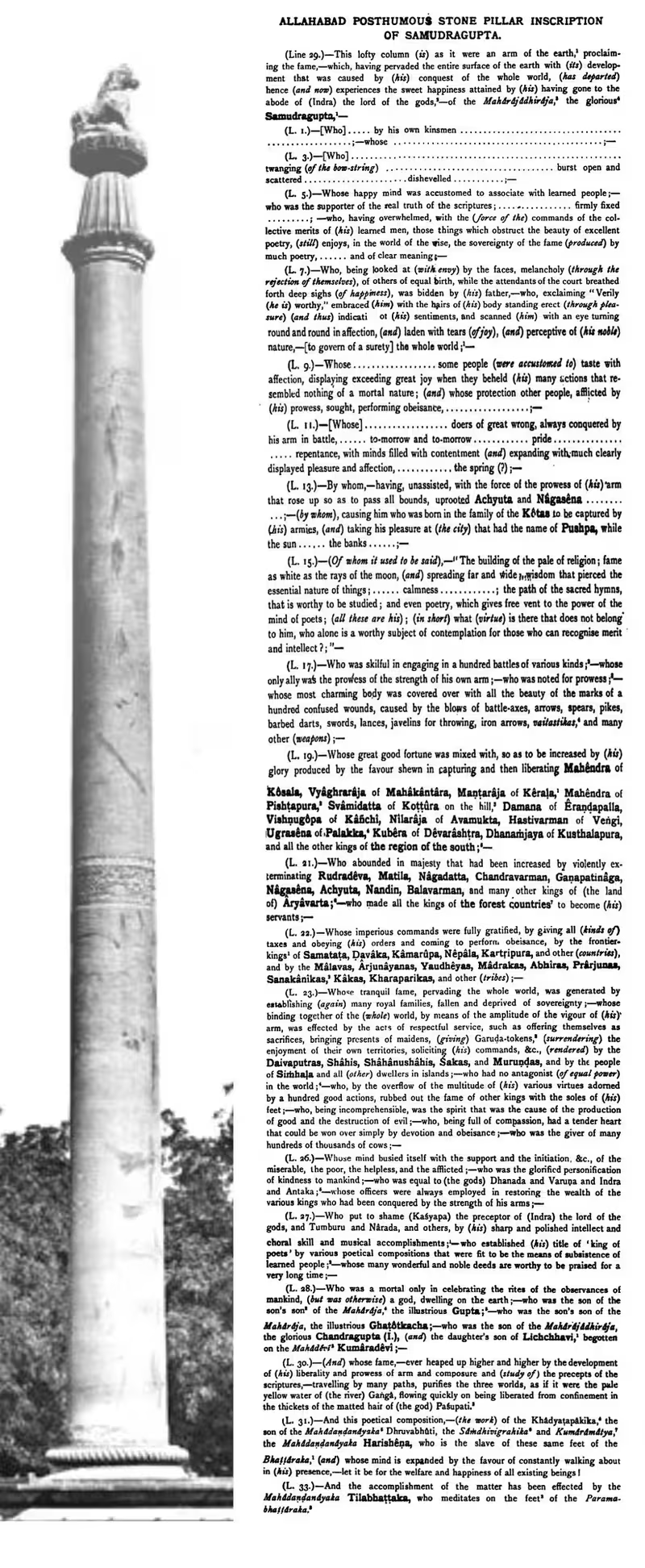

The Allahabad Pillar stands today as one of ancient India's most revealing documents—not for what it celebrates, but for what it distinguishes. Inscribed by the courtier Harisena during the reign of Samudragupta (c. 318–375 CE), this prashasti or eulogy doesn't simply list conquests. It categorizes them with legal precision, dividing the emperor's victories into fundamentally different types of political relationships. And in that distinction lies one of the most consequential innovations in Indian imperial history.
When Chandragupta I summoned his courtiers to witness his succession decision, the faces of other princes "of equal birth bore a melancholy look," according to the Allahabad Pillar inscription. The old emperor had made his choice: Samudragupta, son of the Licchavi princess Kumaradevi, would inherit the throne based on his "devotion, righteous conduct, and valour." The year was somewhere between 319 and 350 CE—scholars still debate the exact dating—but the stakes were clear. Samudragupta inherited a regional kingdom centered in the Gangetic plain. What he would build from that foundation would transform the political geography of the subcontinent.
The inheritance was substantial but not overwhelming. His father had established the Gupta dynasty's legitimacy through strategic marriage alliances—Kumaradevi's Licchavi lineage brought both prestige and territorial claims. But the young emperor faced a fragmented northern India of competing kingdoms and the vast, culturally distinct south that had never known sustained northern rule. His response would reveal not just military genius but political imagination.
Samudragupta's northern campaigns were exercises in total war and complete annexation. The Allahabad Pillar inscription credits him with defeating "several kings of northern India" and directly absorbing their territories into the Gupta Empire. This wasn't tributary relationship-building; it was state elimination. Northern rulers who opposed him were removed, their kingdoms restructured under direct Gupta administration. The Eran stone inscription boasts that he "brought the whole tribe of kings under his suzerainty," and the archaeological evidence supports the claim.
By the height of his power, Samudragupta's directly controlled empire stretched from the Ravi River in present-day Punjab to the Brahmaputra in Assam, from the Himalayan foothills to central India. This was conquest in its most traditional form: military victory followed by political absorption. The northern kings didn't become vassals; they ceased to exist as independent political entities. Their territories were integrated into a centralized imperial structure, their revenues flowing directly to the Gupta treasury, their armies disbanded or absorbed into Gupta forces.
The inscription's language is unambiguous about these conquests. These were parigrahita—"seized" territories—administered by Gupta-appointed officials. The emperor remained "undefeated in battle" throughout these campaigns, a military record that established both the capacity and willingness to impose total submission.
But then Samudragupta marched south, and something changed.
The southern campaign was no less impressive militarily. Gupta armies advanced along the southeastern coast, penetrating as far as Kanchipuram in the Pallava kingdom—deep into what is now Tamil Nadu. The logistical achievement alone was remarkable: moving northern armies through unfamiliar tropical terrain, across major river systems, into regions with their own sophisticated military traditions. The Pallavas were no minor opponents; they commanded substantial resources and had their own imperial ambitions.
Yet the Allahabad Pillar inscription describes these southern rulers not as conquered and annexed, but as tributaries. "Several rulers along the southeastern coast were also his tributaries," according to Wikipedia's summary of Harisena's text. The distinction is crucial. These kings weren't eliminated; they were subordinated. They didn't lose their thrones; they acknowledged a superior authority.
Why would an emperor who had just demonstrated his willingness and ability to completely annex northern kingdoms suddenly show restraint in the south? The answer reveals Samudragupta's strategic sophistication.
The vassal arrangement offered several advantages that outweighed total conquest. First, it solved the distance problem. Direct administration of southern territories from Pataliputra would have required extensive bureaucratic infrastructure across a thousand miles of difficult terrain. Vassal kings, by contrast, administered their own territories while acknowledging Gupta supremacy and paying tribute. They became, in effect, outsourced imperial governors with a vested interest in maintaining local stability.
Second, it preserved local legitimacy. Southern kingdoms had their own ancient dynasties, their own cultural traditions, their own languages and administrative systems. A Gupta governor imposed from the north would have been a foreign occupier requiring military backing. A local king who had submitted to Gupta authority could rule through existing structures of legitimacy, reducing the friction of imperial control.
Third—and perhaps most importantly—it created a sustainable model for expansion. Total annexation required permanent military occupation and administrative replacement. The vassal system required only periodic tribute collection and the credible threat of military intervention if obligations weren't met. It was empire on the cheap, trading absolute control for practical stability.
Harisena's inscription is remarkably explicit about these distinctions. The text doesn't blur the categories; it emphasizes them. Northern kings are listed as defeated and their territories absorbed. Southern kings are listed separately as tributaries who retained their kingdoms. Frontier rulers and tribal oligarchies occupy yet another category—"subjugated" but not fully integrated. The inscription even notes that "many neighbouring rulers tried to please him," suggesting a diplomatic sphere beyond even the tributary relationships.
This wasn't poetic license or rhetorical flourish. It was legal and political taxonomy. Harisena was documenting different types of imperial relationships, each with its own obligations and expectations. The Gupta court understood that empire wasn't a single uniform structure but a flexible system of varied political arrangements calibrated to geographic, cultural, and strategic realities.
The precision of this categorization suggests deliberate policy rather than ad hoc decision-making. Samudragupta and his advisors had developed a theory of imperial governance that recognized when direct control was feasible and when indirect rule through vassals was more practical.
The implications of this dual system rippled through Indian political thought for centuries. Later empires would face the same question: when to annex, when to accept vassalage? The Mughal Empire under Akbar would develop an even more sophisticated version of this approach, with directly administered provinces (khalisa) alongside tributary kingdoms (rajput states) and diplomatic relationships with more distant powers. The British Raj would eventually govern through a patchwork of direct rule and princely states, though without Samudragupta's military achievements to legitimize the arrangement.
What made Samudragupta's system revolutionary was its explicit acknowledgment that empire could take multiple forms simultaneously. He didn't pretend that tributary relationships were the same as direct rule, nor did he treat the distinction as a temporary compromise. The Allahabad Pillar inscription presents both forms of control as equally valid expressions of imperial power—different tools for different circumstances.
This flexibility created a template for expansion that didn't require infinite military and administrative resources. An emperor could extend influence beyond the limits of direct governance, creating a graduated sovereignty that faded at the edges rather than ending at a hard border. The tributary kings were neither fully independent nor fully conquered; they occupied an intermediate status that was precisely the innovation.
Samudragupta ultimately performed the Ashvamedha sacrifice, the ancient Vedic ritual that proclaimed universal sovereignty. A horse was allowed to wander freely for a year; any king who challenged its passage challenged the emperor's authority. That Samudragupta could perform this ritual successfully—that no ruler dared stop the horse—demonstrated that both his directly controlled territories and his tributary kingdoms accepted his supremacy.
The sacrifice was more than religious theater. It was a public demonstration that the vassal system worked, that southern kings who had been allowed to keep their thrones now acknowledged Gupta authority as completely as if they had been conquered and replaced. The strategic mercy had proven strategically sound.
His gold coins depict him not just as a warrior but as a poet and musician, playing the veena. The inscriptions credit him with literary accomplishments. This cultural sophistication may have informed his political flexibility—an understanding that power could be exercised through multiple registers, that force and diplomacy weren't opposites but complementary tools.
When his son Chandragupta II inherited the empire, he continued the expansionist policy. But he inherited more than territory; he inherited a proven model for how to govern a vast, culturally diverse subcontinent without requiring uniform administration everywhere. The vassal innovation had become imperial doctrine.
The southern kings who knelt before Samudragupta weren't subjects in the northern sense. They were something new: subordinate but sovereign, defeated but still ruling, tributary but not occupied. In accepting this arrangement, Samudragupta wasn't showing weakness or settling for less than total victory. He was recognizing that empire, at scale, required political creativity as much as military might. The strategic mercy wasn't mercy at all—it was statecraft of the highest order, a recognition that sometimes the most effective conquest is the one that leaves the conquered in place.