Bharhut Stupa and Sculptures: A Buddhist Monument That Names Its Stories
Bharhut is remarkable for the clarity with which its stone reliefs identify their own subjects. Panels on the Buddhist stupa were labelled in Brahmi characters, often stating what a scene depicts, while the monument’s inscriptions also preserve the names of donors and the communities connected with the site. This combination of image and text makes Bharhut an unusually informative monument in the history of early Indian and Buddhist art.
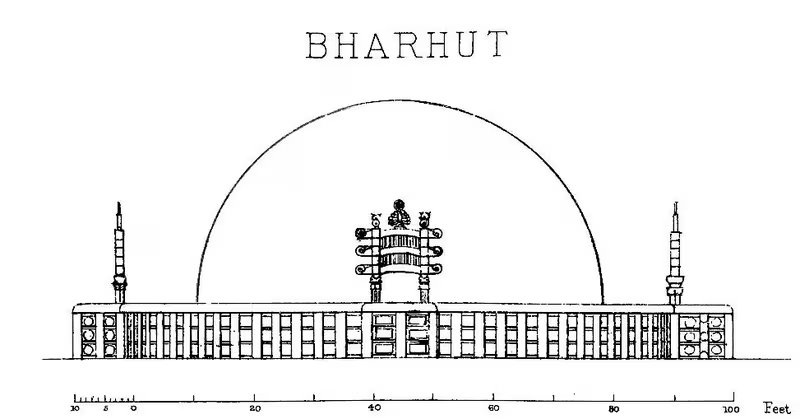
The remains belong to a stupa complex in the village of Bharhut, in the Satna district of Madhya Pradesh. The central stupa was enclosed by a stone railing and four torana gateways, in an arrangement comparable to the better-known Buddhist complex at Sanchi. Much of the railing survived, although only one gateway remains. Its carved panels include Jataka tales, scenes connected with the life of the Buddha, former Manushi Buddhas, Yakshas and Yakshinis, and other Buddhist narratives.
Bharhut’s art belongs to the early aniconic phase of Buddhist representation. The Buddha is not shown in human form; instead, the Dharma wheel, Bodhi tree, empty seat, footprints, and triratana symbol communicate his presence. The monument’s historical importance lies not only in its age, but also in the surviving evidence of how Buddhist stories, donors, craftsmen, and symbols were presented in stone.
Discovery and Provenance
Discovery
Alexander Cunningham visited Bharhut in 1873 and excavated the site the following year. His assistant, Joseph David Beglar, continued the excavation and documented the work through numerous photographs. Their investigations brought the surviving railings, gateways, pillars, capitals, narrative panels, and inscriptions to wider scholarly attention.
The stupa itself is now largely ruined. At Bharhut, little remains of the main structure beyond its foundations. The gateways and railings were dismantled and reassembled at the Indian Museum in Kolkata, where many of the most important surviving remains are now held. Other sculptures and reliefs are in museums in India and abroad.
The movement of the sculptures was not without danger. Alexander Cunningham removed sculptures and reliefs for transport to London for an exhibition aboard the SS Indus, travelling from Calcutta to London via Colombo. In 1885, the ship ran aground near Mullaitivu in northeastern Sri Lanka. The wreck was lost for more than a century and was rediscovered in 2014.
Journey Through History
The Bharhut complex may have originated under the Maurya king Ashoka in the 3rd century BCE, although the principal surviving works appear to have been added later. The railings are generally dated to approximately 125–100 BCE, while the torana gateway is dated to approximately 100–75 BCE. Many reliefs are associated with the Shunga period, though the chronology remains debated.
An inscription on a gateway pillar records the construction of the torana and its stonework by Vatsiputra Dhanabhuti. The inscription uses the phrase “Suganam Raje,” which may mean “during the rule of the Shungas” or “during the rule of the Sughanas,” a northern Buddhist kingdom. Dhanabhuti is not known from Shunga regnal lists, and the inscription does not establish that he belonged to the Shunga dynasty. He may instead have been a tributary or a ruler in a neighbouring territory such as Kosala or Panchala.
Bharhut continued to function as a Buddhist center long after the earliest reliefs were made. A small Buddhist temple was enlarged around 1100 CE, and a new Buddha image was installed. A medieval vihara also contained a colossal Buddha and several smaller Buddhist figures. A Buddha sculpture datable to the 11th or 12th century, together with a Sanskrit inscription associated with a vihara, demonstrates that Buddhist activity survived at the site for many centuries.
Current Home
Many of the best-known Bharhut remains are in the Indian Museum in Kolkata. The museum holds reassembled sections of the stone railings and gateway, along with numerous carved panels. Two panels are in the Freer Gallery of Art and Arthur M. Sackler Gallery in Washington. Other remains are preserved in museums in India and abroad.
The original site contains little of the stupa above its foundations. The monument was ultimately destroyed, and many remains were reused by local villagers as building material. The dispersal of the sculptures means that Bharhut must now be understood through both the archaeological site and the museum collections that preserve its carved elements.
Physical Description
Materials and Construction
The monument was constructed of stone. Its central stupa was surrounded by a stone railing with four torana gateways. The railing incorporated posts, crossbars, and carved panels, while the gateway carried architraves and sculptural decoration. The surviving elements were produced through stone carving, with inscriptions cut into pillars and narrative panels.
Mason’s marks in Kharosthi have been found on several elements of the Bharhut remains. These marks indicate that at least some builders came from the north, particularly from Gandhara, where the Kharosthi script was used. Alexander Cunningham observed that Kharosthi letters appeared on balustrades between the gateway architraves but not on the railings, which carried Indian markings. He therefore suggested that the more refined gateways may have been made by northern artists, while local artists produced the railings.
Dimensions and Form
The Bharhut complex followed a circular stupa arrangement enclosed by a railing and entered through four gateways. Only one of the four toranas remains. Many surviving railing panels are large round medallions containing narrative and symbolic reliefs.
No overall dimensions for the original stupa, railing, or gateway are recorded in the excavation account described here. The surviving material consists of architectural fragments, carved panels, pillars, capitals, railings, and gateway elements rather than an intact monument.
Condition
The original stupa is in a ruined condition, with little remaining beyond the foundations of the main structure. The carved railings and gateway were dismantled and reconstructed in the Indian Museum. Many sculptures have survived in generally good condition, although the monument as a whole is fragmentary and dispersed.
The site also preserves evidence of later damage and reuse. Most of the monuments were eventually destroyed, and local villagers used many of the remains as building material. The surviving museum pieces therefore represent only part of the original complex.
Artistic Details
Bharhut’s panels depict Jataka tales, episodes associated with the Buddha’s life, former Manushi Buddhas, Yakshas and Yakshinis, and other Buddhist stories. Many panels are shaped as large, round medallions. Their unusual labels in Brahmi identify the people or events shown, making the narrative program more explicit than is usual in early Buddhist sculpture.
The figures generally wear the Indian dhoti. One foreign figure, thought to be an Indo-Greek soldier, is distinguished by his dress and appearance. The gateway capital displays recumbent animals and a central anta capital with rosettes, beads-and-reels, and a palmette design. Its decorative vocabulary has been understood as incorporating Persian and Greek elements.
Historical Context
The Era
Bharhut is later than the monumental art associated with Ashoka, dated around 260 BCE, and slightly later than the early Shunga-period reliefs on the railings of Sanchi Stupa No. 2, which began around 115 BCE. Recent assessments generally place the Bharhut railing reliefs around 125–100 BCE and the gateway around 100–75 BCE.
The monument’s chronology is not settled. Some scholars have proposed that the stupa began under Ashoka, with later additions during the Shunga period. Others have associated the works with the Sughanas, described as a northern Buddhist kingdom. More recent reevaluations have tended to separate Bharhut from the Shunga period and place the stupa in the 1st century CE, based on similarities with better-dated Mathura art and questions concerning the antiquity of the Bharhut inscriptions.
Purpose and Function
Bharhut was a Buddhist stupa and monastic center. Its railing and gateway defined and ornamented the sacred space around the central mound. The reliefs presented Buddhist narratives and symbols to visitors, while the inscriptions identified scenes and commemorated donors.
The monument remained in religious use for a remarkably long period. Although the principal surviving art belongs to the late centuries BCE or early centuries CE, Buddhist worship and monastic activity continued at Bharhut for more than a millennium.
Commissioning and Creation
The gateway inscription identifies Dhanabhuti as the donor responsible for the torana and its stonework. It gives his family connections, describing him as the son of Vatsiputra, son of Agaraju, of the Goti family, and grandson of King Visadeva, son of Gagi.
The craftsmen are not individually named. The Kharosthi marks suggest participation by northern builders, while the Indian markings on the railings led Cunningham to distinguish between northern gateway artists and local railing craftsmen. Some scholars have also proposed connections with Hellenistic sculptors, based on the monument’s fluted bell, addorsed Persepolitan-style capital, flame palmette or honeysuckle motifs, rosettes, and beads-and-reels. Despite these influences, the gateway retains a strongly Indian character.
Significance and Symbolism
Historical Importance
Bharhut is among the earliest major surviving bodies of Indian and Buddhist sculpture. Its inscriptions are especially valuable for tracing the history of early Indian Buddhism and Buddhist art. A total of 136 inscriptions mention donors. These donors came from places including Vidisha, Purika, Pataliputra, Karhad, Bhojakata, Kosambi, and Nasik.
Another 82 inscriptions label panels depicting Jatakas, the Buddha’s life, former Manushi Buddhas, other stories, and Yakshas and Yakshinis. The combination of donor records and narrative labels provides evidence for the movement of people, the organization of religious patronage, and the visual presentation of Buddhist traditions.
Artistic Significance
The Bharhut sculptures represent an early phase of Indian art. Their quality is more provincial than that of the sculpture at Sanchi, Amaravati, and some other sites, but a large amount has survived, generally in good condition. Stylistically, the railing decorations are considered later than those of Sanchi Stupa No. 2, despite their close chronological relationship.
The monument also documents the interaction of local and foreign artistic traditions. Northern craftsmen may have worked on the gateways, and the architectural decoration incorporates motifs associated with Persian and Greek art. These features were adapted within a distinctly Indian form and a Buddhist narrative program.
Religious and Cultural Meaning
Bharhut follows the aniconic convention of early Buddhist art. Rather than showing the Buddha as a human figure, its reliefs use symbols to evoke his presence and teaching. The Dharma wheel represents Buddhist teaching, the Bodhi tree recalls awakening, the empty seat marks the Buddha without depicting him, footprints refer to his presence, and the triratana expresses Buddhist symbolism.
The labelled scenes also made religious narratives legible. Visitors could encounter stories of the Buddha’s previous lives, episodes connected with his life, and images of Buddhist beings within the architectural setting of the stupa.
Inscriptions and Text
The principal gateway inscription is in Prakrit and Brahmi. It records the construction of the torana and the donation of its stonework during the rule of the Sugas or Sughanas. Its genealogical details identify Dhanabhuti and several members of his family.
Bharhut’s inscriptions are not limited to the gateway. Donor inscriptions name individuals from a wide geographical area, while dozens of labels identify narrative panels. Mason’s marks in Kharosthi provide additional evidence for the movement of craftsmen. A large Sanskrit inscription associated with the medieval period was found at the site but has since been lost. This inscription should be distinguished from the Lal Pahad inscription of 1158 CE, which mentions the Kalachiri kings.
Scholarly Study
Key Research
Cunningham’s 1873 visit and excavation, followed by Beglar’s work and photographs, established the importance of Bharhut for the study of early Indian art. Their documentation recorded the arrangement and appearance of architectural pieces before the remains were removed and reconstructed in museums.
Scholars have studied Bharhut through its inscriptions, reliefs, architectural forms, and comparisons with Sanchi and Mathura. The labels on the panels have been particularly important because they connect visual scenes with written identifications. The donor inscriptions have also helped map the geographical reach of Buddhist patronage.
Debates and Controversies
The dating and political attribution of Bharhut remain debated. The gateway inscription’s reference to the Sugas may refer to the Shungas, but it may instead refer to the Sughanas, a northern Buddhist kingdom. The inscription does not prove that Dhanabhuti was a Shunga ruler.
Traditional interpretations place much of the monument in the Shunga period. More recent reevaluations have questioned this attribution and proposed a 1st-century CE date, citing similarities with datable Mathura sculptures, including works inscribed in the name of Sodasa. These reassessments also question the antiquity assigned to the Bharhut inscriptions through traditional paleography.
Legacy and Influence
Impact on Art History
Bharhut provides an early record of Buddhist narrative art, architectural sculpture, and religious patronage in India. Its labelled panels are especially significant because they show how written text and visual storytelling operated together on a Buddhist monument.
The reliefs also preserve an early stage in the development of Buddhist iconography. Their use of symbols instead of a human Buddha image illustrates the aniconic phase of Buddhist art. Alongside Sanchi, Bharhut remains central to the study of the beginnings of Indian Buddhist sculpture.
Modern Recognition
The remains are recognized through their preservation in the Indian Museum and other collections in India and abroad. Their importance has been reinforced by archaeological documentation, inscriptional study, and continuing debate over their date and artistic connections.
Bharhut is also part of a wider regional history of Buddhist survival. Minor stupas and Buddhist statues discovered near Bharhut and Sanchi, some dating to the 12th century CE, demonstrate that Buddhism remained widespread in the region even as it declined after the 9th and 10th centuries.
Viewing Today
The original Bharhut site lies in the Satna district of Madhya Pradesh, but only the foundations of the main stupa remain. The most substantial surviving architectural elements—including the reconstructed railings and gateway—are in the Indian Museum in Kolkata. Other panels and sculptures are held in museums in India and abroad, including two panels in the Freer Gallery of Art and Arthur M. Sackler Gallery in Washington.
Because the monument was dismantled and dispersed, viewing Bharhut today requires attention to both the archaeological remains and the museum collections. Together, they preserve the evidence of a Buddhist center that developed an extensive sculptural program and remained active for more than a thousand years.
Conclusion
Bharhut brings together architecture, sculpture, inscription, and religious memory in an unusually clear form. Its stone railing and gateway preserve Jataka tales, Buddhist symbols, donor records, and labels identifying the scenes depicted. The monument also records the interaction of local and northern craftsmen, as well as artistic motifs associated with Persian and Greek traditions.
Although the stupa is now ruined and its remains are dispersed, Bharhut continues to illuminate the early history of Buddhist art in India. Its aniconic imagery shows how the Buddha could be represented through symbols, while its inscriptions reveal the donors, places, and craftsmen connected with the monument. The survival of later Buddhist structures at the site further demonstrates that Bharhut was not merely an early sculptural center, but a living Buddhist institution across many centuries.