Overview
Around 855, after years of disputed succession and violence within the declining Karkota royal house, Avantivarman seized the throne of Kashmir and established the Utpala Dynasty. The dynasty ruled the valley for much of the ninth and early tenth centuries, producing a period that combined temple construction, town foundations, irrigation projects, literary patronage, and intense political instability.
The Utpala rulers governed a kingdom centred on Kashmir. Their power did not remain equally secure throughout the period. Avantivarman’s reign was comparatively stable, but the decades after his death were marked by competing claimants, ministerial interventions, military factions, palace intrigue, and the growing influence of groups identified by Kalhana as the Tantrins. Several rulers were children or figureheads, while queens, regents, treasurers, ministers, and commanders exercised power in their names.
The dynasty is known largely through Kalhana’s Rajatarangini, written in the eleventh century. Its fifth section focuses on the Utpalas. Kalhana drew on earlier historical works, genealogies, inscriptions, coins, and Puranic material. His narrative blends political events with mythical, social, spiritual, and geographical accounts, so individual episodes require careful reading. At the same time, the historical detail becomes considerably fuller from the section dealing with the Karkotas onward, and the Rajatarangini has remained central to reconstructions of Kashmir’s early medieval history. Coins issued by the major Utpala rulers have also been found.
Rise to Power
The Utpala Dynasty emerged from a succession crisis rather than from a straightforward conquest of Kashmir. After the death of Cippatajayapida, described as the last significant Karkota king, around 840, a bitter struggle broke out among his maternal uncles. Padma, Utpala, Kalyana, Mamma, and Dharma competed for control, and the conflict made the line of succession uncertain.
Several rulers from the Karkota lineage were raised to the throne and then removed. These puppet kings could not establish lasting authority or restore political stability. Tribhuvanapida’s son Ajitapida was nominated by Utpala soon after Cippatajayapida’s death. A few years later, Mamma defeated Utpala and installed Anangipida. Three years after that, Utpala’s son Sukhavarman rebelled successfully and placed Utpalapida, a son of Ajitapida, on the throne.
Sukhavarman eventually sought the kingship for himself, but he was murdered by a relative. His son Avantivarman then moved against Utpalapida. With the help of the minister Sura, Avantivarman claimed the throne around 855 or 856. This transition established the Utpala Dynasty and ended the effective dominance of the Karkota line.
The circumstances of the dynasty’s foundation shaped its later politics. The throne was not insulated from the ambitions of ministers, military groups, relatives, and palace officials. Even after the Utpala family had established itself, the succession remained vulnerable to the same practices of nomination, deposition, and armed intervention that had marked the Karkota crisis.
Golden Age
Avantivarman ruled for approximately twenty-seven years, from about 855/856 until 883. His reign is the clearest period of consolidation in Utpala history. Kalhana records no military activity during these years, and frontier territories remained outside Kashmir sovereignty. This does not indicate a large expansionist empire; rather, Avantivarman’s importance lies in the internal development associated with his rule.
His minister Suyya was credited with innovations in irrigation and water management. These measures are especially important in understanding the practical foundations of kingship in Kashmir. Control of water affected cultivation, settlement, and the ability of the state to sustain its population. The surviving account does not provide a complete technical description of Suyya’s projects, but it places him among the dynasty’s most notable administrators.
Avantivarman and his chief minister Sura also sponsored towns and temples. Avantipura, also known as Awantipora, was associated with the king, while Sura was connected with Surapura. The Avantiswami Temple, dedicated to Vishnu, was among the major religious foundations of the reign. The broader Utpala period saw the construction of temples dedicated to both Vishnu and Shiva, along with Buddhist monasteries.
The reign was also important for court culture. Avantivarman was a celebrated patron of the arts, and Ratnakara and Anandavardhana are identified as court poets. Their presence indicates that the royal court served as a centre of Sanskrit literary activity. Much of the surviving literature associated with the dynasty is traced to Avantivarman’s court.
Administration and Governance
Utpala government was a monarchy, but royal authority varied greatly from one reign to another. Under strong rulers, ministers could assist in administration and public works. Under child kings or weak rulers, those same officials and military groups could determine succession and direct state policy.
Sankaravarman’s reign illustrates both the administrative reach and the coercive capacity of the monarchy. After Avantivarman’s death, Ratnavardhana, the chamberlain, placed Sankaravarman at the centre of affairs. Counselor Karnapa instead supported Sukhavarman. Several battles followed before Sankaravarman prevailed.
In the later part of his reign, Sankaravarman introduced new revenue offices and an elaborate taxation system. These arrangements brought numerous Kayasthas into royal service. Kalhana’s account presents these officials negatively, blaming them for impoverishing villagers and damaging the king’s reputation. This judgment reflects the moral and political perspective of the Rajatarangini; it should not be treated as a neutral administrative report. Nevertheless, the account clearly suggests that the crown was expanding its fiscal machinery.
Sankaravarman also brought agraharas and the profits of temples under direct royal control, while providing minimal compensation. Religious institutions therefore became targets of state extraction. Forced labor was systematically legitimized during his reign, and refusing such service was made an offence. These policies increased the resources available to the crown but also intensified hostility toward the government.
The later Utpala period saw even greater fragmentation. During Partha’s reign, the king was a child and Nirjitavarman acted as regent, while the Tantrins and ministers exercised decisive influence. Bribes were demanded, royal finances were plundered, and powerful officials accumulated wealth. In 917, a flood was followed by a catastrophic famine. Kalhana states that ministers and Tantrins profited by selling hoarded rice at high prices.
The repeated references to taxation, forced labor, hoarding, famine, and corruption reveal the social costs of unstable government. They also show that the dynasty possessed offices capable of collecting revenue and directing labor, even when the political centre was divided.
Military Campaigns
Avantivarman’s reign was not marked by recorded military activity. Kalhana states that the frontier regions remained outside Kashmir’s sovereignty during this period. The absence of recorded campaigns may indicate a focus on internal reconstruction, although the surviving narrative does not establish the reasons.
Sankaravarman pursued a more active military policy. Kalhana describes an invasion of Gujarat by an army of nine hundred thousand infantry, three hundred elephants, and one hundred thousand cavalry. These figures are exceptionally large and should be read with caution. The account states that Alakhana, the local ruler, gave Sankaravarman territory in order to preserve his sovereignty. The campaign therefore appears in the narrative as a demonstration of military power and diplomatic pressure, though the precise scale and historical details remain uncertain.
Sankaravarman’s military success did not prevent domestic oppression. He died in 902 after being struck by a stray arrow in foreign territory while returning from a successful conquest. His ministers brought his body back to Kashmir, where funeral rites were performed. Some of his queens and servants died by sati, according to Kalhana’s account.
Gopalavarman led another notable expedition around 903 against a rebel Hindu Shahi king of Udabhanda. The king distributed the spoils of victory to a figure called Toramana-Kamaluka. Kalhana says that the victory made Gopalavarman arrogant and caused the court to become inaccessible to ordinary people. His reign soon became dominated by the influence of his mother, Queen Sugandha, and her paramour Prabhakaradeva, the royal treasurer.
The most decisive military episode of the dynasty’s final decades occurred in 936. Cakravarman, who had been driven into exile, formed an alliance with the Damaras under Samgrama. Their forces confronted Sambhuvardhana near Padmapura, identified with modern Pampore. Samkaravardhana, serving as commander for the Tantrins, was killed by Cakravarman. The opposing forces were then defeated, and Cakravarman returned to the throne.
The alliance soon collapsed. Cakravarman was accused of killing numerous Damaras despite the earlier agreement. In the summer of 937, Damara guards attacked him at night. He was chased into the sleeping chamber of Hamsi, the chief queen, and killed there. The violent end of Cakravarman demonstrated that military alliances could restore a king but could not guarantee his survival.
Cultural Contributions
Religion and royal patronage were central to Utpala cultural life. Avantivarman was personally devoted to Vishnu, yet he publicly patronized Shiva. Vaikuntha Chaturmurti continued as the tutelary deity of the Utpala Dynasty and was venerated in neighbouring regions. This combination of personal devotion and broader public patronage reflects the variety of religious foundations associated with the dynasty.
The architectural record described in the historical tradition includes temples, monasteries, and newly founded towns. Avantivarman and Sura were associated with Avantipura, Surapura, and the Avantiswami Temple. Suyya founded Suyyapura, also known as Sopore. Sankaravarman founded Sankarapura, identified with modern Pattan, and, together with Sugandha, sponsored the Shiva temples of Sankaragaurisa and Sugandhesa. A further Shiva temple at Fattegarh has been dated to his period.
Royal women also appear as patrons. During her rule, Sugandha founded Sugandhapura and Gopalapura, as well as the Vishnu temple Gopalakesava and the monastery Gopalamatha. Nanda consecrated the shrines of Nandakesava and Nandamatha. Meruvardhana built the Vishnu shrine of Meruvardhanasvamin at Puranadhisthana, identified with modern Pandrethan. Sambavati was associated with the Shiva shrine of Sambveswara.
These foundations show that the cultural history of the dynasty cannot be reduced to the actions of kings alone. Queens and other members of the royal household participated in the creation of religious landscapes. The surviving accounts also point to a religiously varied environment in which Vaishnava and Shaiva temples existed alongside Buddhist monasteries.
Literary patronage reached a high point under Avantivarman. Ratnakara and Anandavardhana are named as court poets, and their association with the reign demonstrates the importance of Sanskrit intellectual culture at the Utpala court. Later, however, Kalhana portrays the literary environment under Sankaravarman as impoverished: court poets allegedly lived without pay, while fiscal pressures and political disorder damaged scholarship.
Economy and Trade
The available accounts provide more information about agriculture, taxation, and royal extraction than about long-distance trade. Suyya’s irrigation and water-management works under Avantivarman indicate the importance of controlling and improving the agricultural environment. Town foundations, including Avantipura and Suyyapura, likewise suggest organized settlement and state-supported urban development.
The fiscal policies of Sankaravarman reveal a more demanding relationship between the crown and the countryside. New revenue offices, expanded taxation, and compulsory labor increased the state’s ability to mobilize resources. The crown also assumed direct control over agraharas and temple income. These measures may have strengthened royal finances in the short term, but Kalhana associates them with rural poverty and widespread resentment.
Food scarcity became especially severe during the period of Partha and Nirjitavarman. A flood in 917 was followed by famine, and officials and Tantrins were accused of hoarding rice and selling it at inflated prices. This episode shows how natural calamity and political exploitation could reinforce each other.
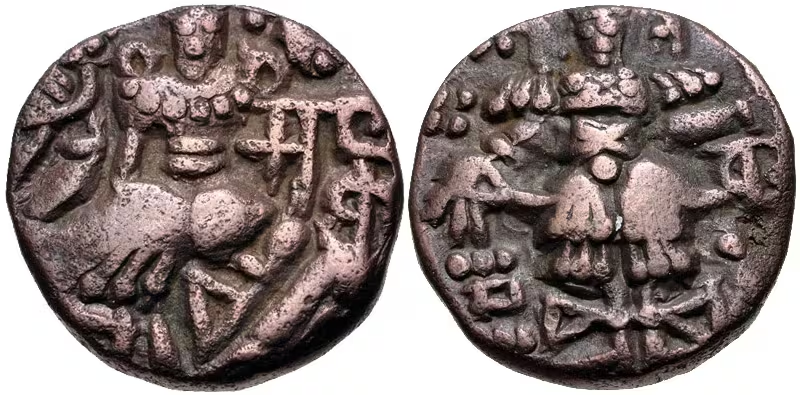
Coins issued by all the major Utpala rulers have been found, demonstrating that the dynasty maintained a coinage tradition. The available account does not identify the denominations, monetary standards, or the wider trade routes in which these coins circulated. It is therefore safer to describe the economy through the evidence for irrigation, taxation, temple revenues, labor, food supply, and coin production than to reconstruct commercial networks not documented here.
Decline and Fall
The decline of the Utpala Dynasty was a prolonged political disintegration rather than a single defeat. After Sankaravarman’s death in 902, Gopalavarman ruled for only two years under Sugandha’s regency. The king died after a conspiracy involving Prabhakaradeva, who had been caught embezzling state funds. A relative of the treasurer, Ramadeva, was employed to assassinate Gopalavarman through witchcraft, according to Kalhana’s account. Gopalavarman died of fever, and Ramadeva later committed suicide when the conspiracy became known.
Gopalavarman left no child, although Queen Jayalakshmi was pregnant. His brother Samkata briefly became king but died after ten days. Sugandha then claimed the throne, initially intending to secure it for her grandson. When the child died soon after birth, she ruled in her own right for approximately two years.
Sugandha’s authority was challenged by the Tantrins and ministers. She attempted to install Nirjitavarman, a blood relative and grandson of Suravarman, but opponents objected to his lameness and placed his young son Partha on the throne instead. Nirjitavarman remained regent, while Sugandha and her advisers were removed.
Partha’s reign lasted about ten years, from 906 to 921, but it was dominated by competing factions. Sugandha attempted to recover the throne in 914 with the support of the Ekangas. She was defeated, imprisoned, and executed. Partha and Nirjitavarman continued to struggle for authority, while members of the royal household and ministerial families supported rival successors.
Cakravarman was installed as a child and ruled until 933 or 934, initially under the regency of his mother and later his grandmother Ksillika. Suravarman I briefly replaced him, but was forced to abdicate when he could not raise the bribes demanded by the Tantrins. Partha was restored, then removed again when Cakravarman promised greater payments. After Cakravarman’s second restoration in 935, he appointed Tantrins to important offices but soon fled when he could not collect sufficient taxes.
Cakravarman’s return with Damara support in 936 briefly restored royal authority. His later rule, however, was described as cruel and excessive. Kalhana particularly criticized the influence of Hamsi and Nagalata, women from the Domba community who entered the king’s circle. Hamsi became chief queen and placed Dombas and their dependants in important positions. The account uses highly charged caste language and presents these developments as signs of ritual and political disorder; it should therefore be read as a partisan moral judgment as well as a record of factional conflict.
After Cakravarman’s assassination, Unmattavanti became king with the help of ministers. He was effectively controlled by Parvagupta, who wanted the throne. Kalhana attributes numerous acts of extreme violence to Unmattavanti, including the murder of members of his own family. The king died from a chronic illness in 939. Before his death, palace servants presented Suravarman II as his son and had him crowned.
Suravarman II ruled for only a few days. Commander-in-Chief Kamalvardhana rebelled from Madavarajya, removed the king, and forced him to flee with his mother. Kamalvardhana then convened an assembly of Brahmins to select a new ruler. The assembly rejected both Kamalvardhana’s own claim and the request of Suravarman II’s mother. Instead, it chose Yasaskara, the son of Prabhakaradeva. This decision ended Utpala rule.
Legacy
The Utpala Dynasty left two contrasting legacies. Politically, its history records the dangers of an unstable succession. The repeated elevation of child rulers, the power of ministers and military groups, the demands of the Tantrins, and the use of bribery and force weakened the monarchy. Fiscal oppression, forced labor, famine, and court violence further damaged the relationship between the ruling house and its subjects.
Culturally and institutionally, however, the period was productive. Avantivarman’s reign was associated with irrigation, new settlements, temples, Buddhist monasteries, and literary patronage. The Avantiswami Temple and the foundations linked with Avantipura remain important markers of Kashmir’s early medieval heritage. Later rulers and royal women continued to sponsor Shaiva and Vaishnava shrines, monasteries, and towns.
The dynasty’s story is preserved most fully through Kalhana’s Rajatarangini, whose account combines historical memory with moral interpretation. It provides detailed narratives of rulers, ministers, queens, military commanders, religious institutions, administrative practices, and social conflict. Although its accuracy is debated and its language can be highly judgmental, it remains indispensable for understanding Kashmir’s early medieval political world.
After Yasaskara’s accession, the political order moved beyond the Utpalas. The later history of Kashmir would eventually involve Didda, who in about 980 placed her nephew Samgramaraja on the throne, establishing the Lohara Dynasty. The Utpala period therefore stands between the Karkota order and the later Lohara political formation: a time of architectural achievement and administrative experimentation, but also of succession crises that repeatedly fractured royal power.
Timeline
Karkota succession crisis
After the death of Cippatajayapida, competing relatives and factions struggle for control of Kashmir.
Foundation of the Utpala Dynasty
Avantivarman deposes Utpalapida with the support of Minister Sura and claims the throne.
Death of Avantivarman
Avantivarman’s long reign ends, followed by a struggle between Sankaravarman and Sukhavarman.
Death of Sankaravarman
Sankaravarman dies from a stray arrow while returning from a successful campaign.
Expedition against Udabhanda
Gopalavarman leads a campaign against a rebel Hindu Shahi ruler.
Sugandha’s failed restoration
Sugandha attempts to regain the throne, is defeated by the Tantrins, imprisoned, and executed.
Flood and famine
A flood is followed by famine, while ministers and Tantrins are accused of profiting from hoarded rice.
Cakravarman restored
Cakravarman and the Damaras defeat Sambhuvardhana near Padmapura, modern Pampore.
Assassination of Cakravarman
Damara guards attack and kill Cakravarman after his alliance with them breaks down.
End of Utpala rule
Kamalvardhana removes Suravarman II, and an assembly selects Yasaskara as ruler.