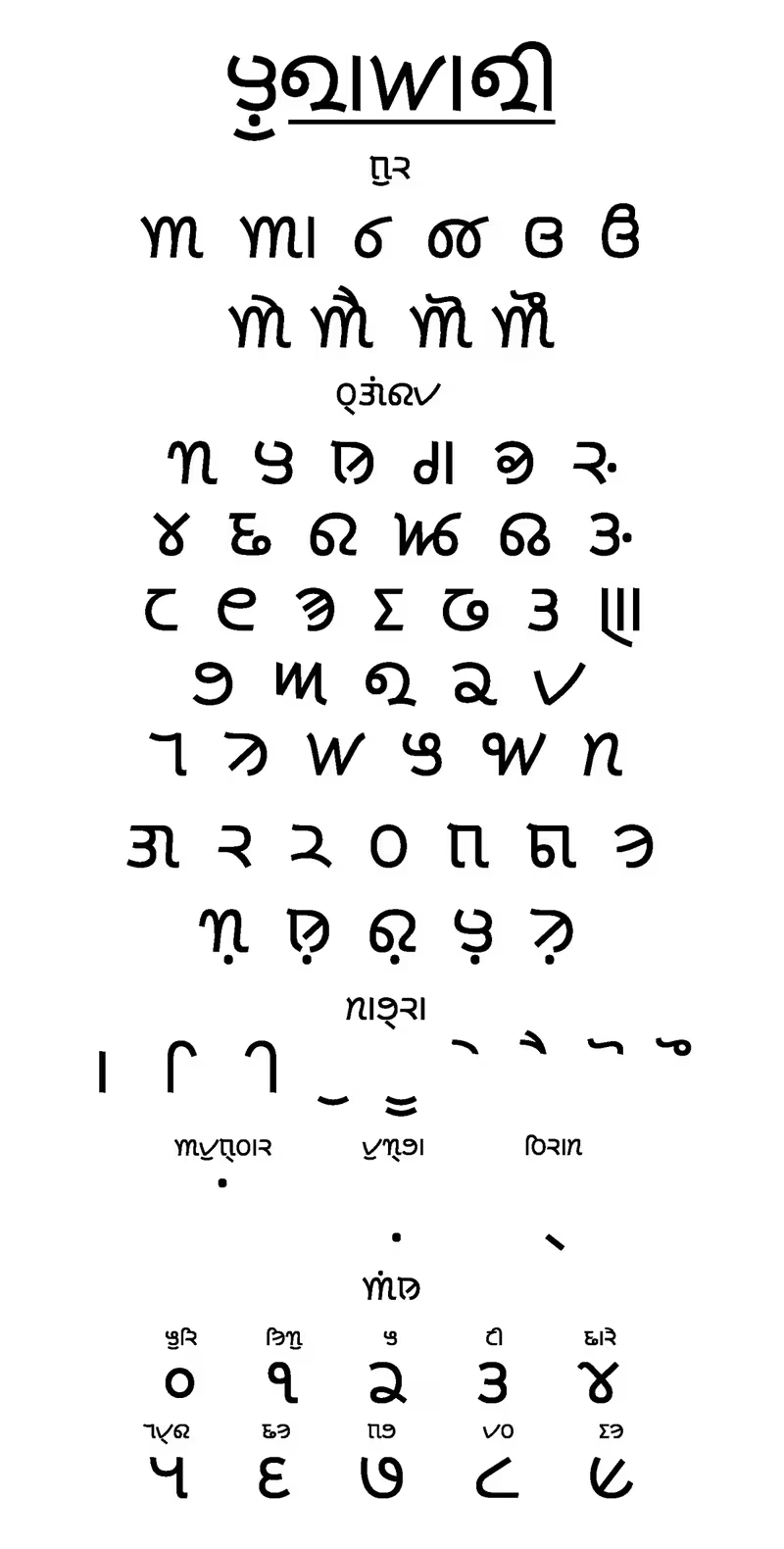
Khudabadi Script: A Mercantile Writing System for Sindhi
In 1868, the Bombay Presidency assigned Narayan Jagannath Vaidya, the Deputy Educational Inspector of Sindh, to replace the Abjad script used for Sindhi with Khudabadi. This decision came after a wider debate over how Sindhi should be written under British rule. Khudabadi, also known as Khudawadi, had developed earlier at Khudabad and was used by Sindhi traders, merchants, and other communities for letters, accounts, and business records. Its practical value extended beyond ordinary communication: traders used it to keep commercial information secret from people outside Sindhi groups.
Khudabadi is a Landa script for writing Sindhi. It is one of four scripts associated with Sindhi writing, alongside Perso-Arabic, Khojki, and Devanagari. Although its use declined as the principal written form of Sindhi, some Sindhi Hindus in India continue to use it. The Government of India recognizes both Khudabadi and Devanagari for writing Sindhi, while Khudabadi has also received a Unicode encoding for modern digital use.
Origins and Classification
Script Tradition
Khudabadi is a Landa script whose deeper roots lie in Brahmi. Like other Indian, Tibetan, and Southeast Asian scripts connected with the Brahmi tradition, it shares structural features with scripts such as Bengali, Odia, Gurmukhi, and Devanagari. Its appearance differs from those scripts, especially in its angles and overall structure, but closer examination reveals similarities.
Khudabadi is an abugida. Consonants carry an inherent vowel, while vowel signs, or matras, modify that vowel. Vowels at the beginning of a word are written as independent letters.
Origins
The script was created by the Sindhi diaspora living in Khudabad. Its initial purpose was to send written messages to relatives who lived in the writers’ hometowns. Because the script was considered simple, its use spread quickly among other Sindhi groups for letters and messages.
The script’s name comes from Khudabad, the city where it originated. The alternative form Khudawadi is also used.
Historical Development
Khudabad Origins
The first development of Khudabadi is associated with the Sindhi diaspora at Khudabad. Written communication helped connect people living away from their hometowns with their relatives. The script continued in use for a long period after its initial adoption.
Mercantile Use
Sindhi traders began maintaining their accounts and other business books in Khudabadi. Knowledge of the script became important when employing people who intended to travel overseas, because business accounts and books could be kept secret from foreign people and government officials.
As its commercial use grew, schools also began teaching Sindhi in Khudabadi. The script therefore served both practical educational purposes and the specialized needs of trade.
British Rule and Script Debate
After Mir Nasir Khan Talpur’s defeat, British rule began in Sindh. British observers found several different writing practices in use. Pandits wrote Sindhi in Devanagari, Hindu women used Gurmukhi, government servants used the Perso-Arabic script, and traders kept their business records in Khudabadi. The British did not initially know Khudabadi and called it “Hindu Sindhi” to distinguish it from Sindhi written in Perso-Arabic.
British scholars considered Sindhi close to Sanskrit and argued that Devanagari would be suitable. Government servants favored Arabic because they did not know Devanagari and would have had to learn it. Captain Richard Francis Burton supported the Arabic script, while Captain Stack supported Devanagari.
Sir Bartle Frere, Commissioner of Sindh, referred the question to the Court of Directors of the British East India Company. The resulting direction supported Arabic Sindhi for government offices because Muslim names could not be written in Devanagari. It also proposed Arabic-script Sindhi schools for Muslims and Khudabadi-script Sindhi schools for Hindus.
In 1868, the Bombay Presidency assigned Narayan Jagannath Vaidya to replace the Abjad script used for Sindhi with Khudabadi. The Presidency decreed a standardized form modified with ten vowels. This initiative did not lead to further major progress for Khudabadi, although traders continued using it for their records until the independence of Pakistan in 1947.
Scripts and Writing Systems
Khudabadi
Modern Khudabadi has 37 consonants, 10 vowels, and 9 vowel signs written as diacritics added to consonants. It also includes 3 miscellaneous signs, a symbol for nasal sounds called anusvara, a virama symbol for conjuncts, and 10 digits.
When consonants occur together, special conjunct symbols combine the essential parts of the letters. The nukta, borrowed from Devanagari, represents additional signs found in Arabic and Persian but not otherwise found in Sindhi. Khudabadi is written from left to right and follows the patterns and style of other Landa scripts.
Other Sindhi Scripts
Sindhi has been written in four scripts: Perso-Arabic, Khudabadi, Khojki, and Devanagari. In Sindh and in many places in India where Hindu Sindhi migrants have settled, the dominant modern script is Arabic in Naskh styles with 52 letters. Khudabadi and Devanagari remain in use in some circles in India.
Unicode Encoding
Khudabadi was added to the Unicode Standard in June 2014 with version 7.0. Its Unicode block is called Khudawadi and occupies the range U+112B0–U+112FF.
Khudabadi is also used as a unified encoding for Sindhi scripts other than Khojki. Many of the other Sindhi scripts are named after the mercantile villages where they were used, but are not sufficiently developed for separate encoding. Khudabadi is therefore recommended for representing Landa-based Sindhi scripts that have been in use, while local scripts may be encoded separately in the future.
Geographic Distribution
Historical Spread
Khudabadi originated in Khudabad in Sindh. From there, its use spread among Sindhi groups through letters, messages, trade records, and business books. Its historical reach also followed Sindhi traders and the wider Sindhi diaspora.
Modern Distribution
Some Sindhi Hindus continue to use Khudabadi in the present day. It is found in some circles in India, particularly among Hindu Sindhi communities that settled in different parts of the country. The Government of India recognizes Khudabadi and Devanagari for writing Sindhi.
Literary and Documentary Heritage
Khudabadi’s documented role was primarily practical and educational rather than associated with a named literary canon in the historical account. It was used for written letters and messages, commercial accounts, business books, and school instruction. Its importance also lay in restricting access to commercial information, since non-Sindhi groups and officials did not generally understand it.
Grammar and Phonology
Script Features
Khudabadi represents Sindhi through the conventions of an abugida. Every consonant has an inherent vowel, and matras change that vowel. Initial vowels are represented by independent vowel letters. Conjunct symbols are used when consonants occur together, while anusvara marks nasal sounds and virama represents conjunct formation.
The available historical description focuses on the script’s structure rather than Sindhi grammar or phonology. It identifies the inventory of consonants, vowels, vowel signs, miscellaneous signs, nasal marking, conjunct marking, and digits.
Influence and Legacy
Khudabadi preserves an important part of Sindhi commercial and educational history. It connected the Sindhi diaspora, supported private correspondence, and provided traders with a specialized system for maintaining accounts. Its use also reveals the coexistence of several writing traditions among Sindhi communities: Devanagari among Pandits, Gurmukhi among Hindu women, Perso-Arabic among government servants, and Khudabadi among traders.
Its Unicode encoding has extended that legacy into digital text. The Khudawadi block gives Khudabadi a standardized place in computing and offers a unified encoding for several related Landa-based Sindhi scripts.
Modern Status
Current Use
Khudabadi is not the predominant script for Sindhi today. Arabic in Naskh styles is dominant in Sindh and in many places where Hindu Sindhi migrants have settled. Nevertheless, some Sindhi Hindus in India continue to use Khudabadi, and the Government of India recognizes it alongside Devanagari for writing Sindhi.
Preservation and Digital Representation
Unicode encoding is the clearest modern preservation measure described for Khudabadi. Since 2014, the script has been represented in the Unicode Standard through the Khudawadi block, U+112B0–U+112FF.
Learning and Study
Academic Study
Khudabadi can be studied through its relationship to the Brahmi-derived Landa tradition, its use in Sindhi correspondence and trade, and its place among the four scripts used for Sindhi. Its history also illustrates the effects of British administrative and educational policy on script choice.
Resources
Modern learners can examine the script through its Unicode range, its consonants and vowels, its diacritic vowel signs, conjunct symbols, nukta, anusvara, virama, and digits. Its historical use in letters, accounts, business books, and schools provides the main contexts for understanding the script.
Conclusion
Khudabadi is a Sindhi writing system shaped by diaspora, commerce, education, and changing administrative policy. Originating at Khudabad, it spread through letters and messages before becoming especially valuable to Sindhi traders who used it for accounts and business records. Its history records the coexistence of multiple Sindhi scripts and the debate under British rule over whether Sindhi should be written in Arabic, Devanagari, or Khudabadi.
Although Arabic in Naskh styles is now predominant, Khudabadi survives in some Sindhi Hindu communities in India and remains recognized alongside Devanagari for writing Sindhi. Its addition to Unicode in 2014 ensures that this historically important Landa script can also be represented in contemporary digital text.