Konkani Language: A Western Coast Language in Many Scripts
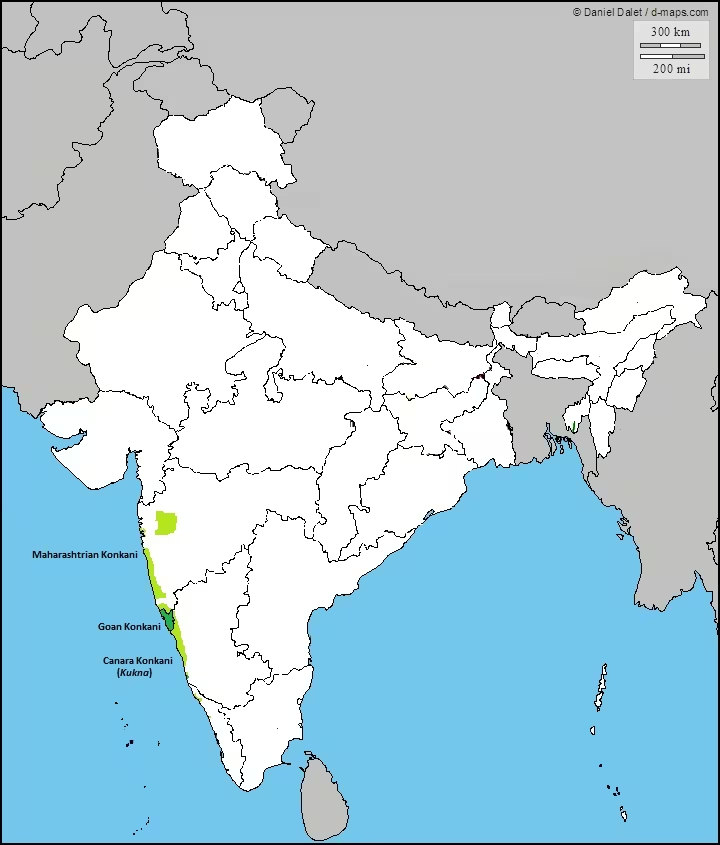
The first known Konkani inscription is associated with Arvalem and is dated to the second century CE, while another early inscription at Shravanabelagola belongs to the period between 981 and 1117 CE. These records show a language with a long written history, although some of the inscriptions were historically and incorrectly described as “Old Marathi.” Konkani is spoken primarily along India’s western coast, especially in the Konkan region, and is the official language of Goa. It is also used in Karnataka, Maharashtra, Kerala, Gujarat, Daman, Diu, and Silvassa, as well as by migrant communities outside the Konkan.
Konkani belongs to the Southern Indo-Aryan branch and forms part of the Marathi–Konkani group. Its structure preserves elements associated with older Indo-Aryan forms, while its vocabulary and grammar reveal contact with Dravidian languages, Portuguese, Arabic, Persian, Turkish, Kannada, Marathi, Tulu, and Malayalam. The language is not represented by a single script: it is currently written in Devanagari, Roman, Kannada, Malayalam, and Perso-Arabic scripts. This multiplicity reflects Konkani’s history of migration, regional contact, religious diversity, and political change.
Origins and Classification
Linguistic Family
Konkani is an Indo-Aryan language and belongs to the Southern Indo-Aryan language group. More specifically, it is part of the Marathi–Konkani group. It is described as inflexive and as less distant from Sanskrit than many other modern Indo-Aryan languages.
Linguists describe Konkani as a fusion of several Prakrit vernaculars. This combination is connected with the repeated arrival of migrants on the Konkan coast. Speakers of different Indo-Aryan and Dravidian vernaculars came into contact in the region, and their interaction contributed to the formation of Konkani’s vocabulary, grammar, pronunciation, and dialect structure.
Konkani also retains elements of Vedic structures and shows similarities with both Western and Eastern Indo-Aryan languages. Its relationship with neighbouring languages is therefore complex. It shares features with Marathi and Gujarati, but also has innovations and structures that connect it with Eastern Indo-Aryan languages such as Bengali and Oriya through the influence of Magadhi Prakrit.
Origins
The early development of Konkani is associated with the western coast of India. Indo-Aryan vernacular speakers may have arrived in the region in more than one wave. The first wave is placed around 1100–700 BCE, and a second wave around 700–500 BCE. These speakers used old Indo-Aryan vernaculars that may have been loosely related to Vedic Sanskrit. They encountered Dravidian and Desi dialect communities, and an ancient Konkani Prakrit emerged through this confluence.
Some linguists regard Shauraseni as the progenitor of Konkani, while others emphasise Paisaci. The archaic form of Old Konkani is sometimes called Paishachi because of the Dardic features identified in the language. These features have been compared with characteristics found in present-day Kashmiri.
Maharashtri Prakrit also played a major role. It was the official language of the Satavahana Empire, which ruled Goa and the Konkan in the early centuries of the Common Era. Because Maharashtri was one of the most widespread Prakrits of its period, some linguists have described Konkani as the “first-born daughter of Maharashtri.” At the same time, the old language spoken alongside Old Marathi was distinct from its Marathi counterpart.
The earliest written evidence is important but must be interpreted carefully. The first known Konkani inscription, at Arvalem, is dated to the second century CE and has sometimes been claimed as Old Marathi. The second-oldest Konkani inscription is among the inscriptions at Shravanabelagola, dated between 981 and 1117 CE. It too was wrongly described as Old Marathi from the time it was discovered and interpreted. Other Konkani inscriptions are scattered across the Konkan, especially from Kurla in Bombay, now Mumbai, to Ponda in Goa.
Name Etymology
The name Konkani is not recorded in literature before the thirteenth century. The first known literary reference to the name occurs in “Abhanga 263” by the Hindu Marathi saint poet Namadeva, who lived from 1270 to 1350.
Konkani has been known by several names, including Canarim, Concanim, Gomantaki, Bramana, and Goani. Learned Marathi speakers have tended to call the language Gomantaki. Portuguese writers commonly called it Língua Canarim, while Catholic missionaries used Língua Brahmana. The Portuguese later adopted Língua Concanim.
The term Canarim has attracted particular attention because it overlaps with the name associated with Kannada. The sixteenth-century Jesuit Thomas Stephens used Canarim in the title of his work Arte da lingoa Canarim. One possible explanation connects the word with the Persian term for “coast,” kinara, which would make it “the language of the coast.” European writers distinguished between a plebeian form called Canarim and a more regular form used by educated people, called Língua Canarim Brâmana or Brâmana de Goa. The latter was preferred for writing, sermons, and religious purposes.
Several explanations have been proposed for Konkan and therefore Konkani:
- V. P. Chavan connected the name with the Kannada word konku, meaning uneven ground. The explanation corresponds to the hilly character of the Konkan and also relates konku to something that is not straight or is crooked.
- Another explanation derives the name from the Kukkana, or Kokna, tribe, described as the original inhabitants of the land where Konkani originated.
- A Puranic explanation connects the name with the legend of Parashurama. In the story, Parashurama shoots an arrow into the sea and commands the Sea God to recede to the point where the arrow lands. The reclaimed land is called Konkan, interpreted as “piece of earth” or “corner of earth,” from kōṇa meaning corner and kaṇa meaning piece. The legend appears in the Sahyadrikhanda of the Skanda Purana.
Historical Development
Indo-Aryan Vernaculars and Dravidian Contact
The early history of Konkani developed within a multilingual western coastal environment. The first Indo-Aryan vernacular speakers may have arrived between approximately 1100 and 500 BCE. Their speech interacted with Dravidian and Desi dialects, producing the ancient Konkani Prakrit.
The second wave of Indo-Aryan speakers is believed to have been accompanied by Dravidians from the Deccan plateau. Paishachi is also described as an Aryan language spoken by Dravidians. These overlapping movements help explain why Konkani has both Indo-Aryan and Dravidian characteristics.
The grammatical influence of Dravidian languages on Indo-Aryan syntax and structure is difficult to establish precisely. Some linguists explain unusual features in Middle Indo-Aryan and New Indo-Aryan by proposing that these languages developed on a Dravidian substratum. Konkani words often cited as having Dravidian origins include naall “coconut,” madval “washerman,” choru “cooked rice,” and mulo “radish.” Linguists have also suggested that the substratum of Marathi and Konkani is especially closely related to Kannada.
Prakrit and Apabhramsha Development
Konkani’s early development involved several Prakrit traditions. Shauraseni influence is present but is less prominent than Maharashtri influence. Some Konkani forms are closer to Pali than to corresponding Shauraseni forms.
A notable Shauraseni-related feature concerns the sound found at the end of many nouns. A final ao in Shauraseni becomes o or u in Konkani. Examples include dando, suno, raakhano, dukh, rukhu, and manisu. Another archaic feature is the retention of the sound represented by ण at the beginning of some words, including णव, “nine.”
Archaic Konkani derived from Shauraseni vernacular Prakrit was commonly spoken until about 875 CE. During its later development, it became Apabhramsha, which can be regarded as a predecessor of Old Konkani. The language preserved older phonetic and grammatical developments, retained a wide range of verbal forms found in Sanskrit, and maintained grammatical forms no longer found in Marathi.
Konkani was also substantially influenced by Magadhi Prakrit. Pali, the liturgical language of Buddhists, contributed to Konkani Apabhramsha grammar and vocabulary. Several linguistic innovations shared by Konkani and Eastern Indo-Aryan languages such as Bengali and Oriya have roots in Magadhi.
Early Inscriptions
Although many stone inscriptions and copper plates found in Goa and other parts of the Konkan, dating from the second century BCE to the tenth century CE, are written in Prakrit-influenced Sanskrit, their place names, grants, agricultural terms, and some personal names appear in Konkani. This suggests that Konkani was spoken in Goa and the wider Konkan even when Sanskrit was used for much of the formal inscriptional text.
The inscription at the foot of the Jain monolith Bahubali at Shravanabelagola is dated to 981 CE. It is written in a variant of Nagari and reads:
“śrīcāvuṇḍarājē̃ kara viyālē̃, śrīgaṅgārājē̃ suttālē̃ kara viyālē̃”
The meaning is given as: “Chavundaraya got it done, Gangaraya got the surroundings done.” S. B. Kulkarni and Jose Pereira identify the language of these lines as Konkani.
Another Nagari inscription is associated with Shilahara King Aparaditya II and is dated to 1187 CE. Earlier claims described it as Marathi. A 2024 study found that the last two lines of the Parel inscription, also called the Mahavali inscription because it was discovered at Mahavali in Kurla, Bombay, are in Konkani.
Additional inscriptions and copper plates occur throughout Goa and the Konkan. Copper plates found in Ponda date from the early thirteenth century, while plates from Quepem belong to the early fourteenth century. These texts were written in Goykanadi. A Nagari stone inscription at the Nageshi temple in Goa, dated 1463 CE, records that the ruler of Goa, Devaraja Gominam, granted land to the Nagueshi Maharudra temple when Nanjanna Gosavi was the state’s religious head, or Pratihasta. The inscription includes words such as kullgga, kulaagra, naralel, tambavem, and tilel.
Early Konkani Language
Early Konkani differed in several ways from contemporary forms. Pronouns such as dzo, jī, and jẽ were used in older Konkani but have been replaced in modern Konkani by koṇa. The conjunctions yedō and tedō, meaning “when” and “then,” are no longer in use. The older ending -viyalẽ has been replaced by -aylẽ. The pronoun moho, comparable to the Brajbhasha form mōhē, has been replaced by mākā.
A hymn dedicated to Lord Narayana and attributed to the twelfth century contains the following passage:
“jaṇẽ rasataḷavāntũ matsyarūpē̃ vēda āṇiyēlē̃. manuśivāka vāṇiyēlē̃. to saṁsārasāgara tāraṇu. mōhō to rākho nārāyāṇu”
The passage describes Narayana as the one who brought the Vedas from the ocean in the form of a fish, offered them to Manu, and became the saviour who carries the world across the ocean of existence.
A later sixteenth-century hymn includes:
“vaikuṇṭhācē̃ jhāḍa tu gē phaḷa amṛtācē̃, jīvita rākhilē̃ tuvē̃ manasakuḷācē̃.”
These surviving examples show older vocabulary, pronouns, conjunctions, and grammatical forms that are not all retained in contemporary Konkani.
Medieval Migrations and Dialect Formation
The medieval period was marked by invasions of Goa and the movement of Konkani-speaking families to Canara, now coastal Karnataka, and Cochin. Several major migrations are associated with political and religious upheaval:
- Between 1312 and 1327, General Malik Kafur of the Delhi Sultans, followed by Alauddin Khalji and Muhammad bin Tughluq, destroyed Govepuri and the Kadambas.
- After 1470, the Bahmani kingdom captured Goa, and in 1492 Sultan Yusuf Adil Shah of Bijapur captured it again.
- After the Portuguese conquest of Goa in 1510, some converted Muslims moved to territory held by Bijapur.
- Following the Christianisation of Goa, the Goa Inquisition, and the sackings of Goa and Bombay-Bassein, Hindu converts migrated to Canara.
These movements encouraged Konkani speakers to learn regional languages. Local words entered the dialects spoken in Karnataka and Kerala. For example, dār, meaning “door,” gave way to bāgil. In the Salcette dialect, the phoneme a was replaced by o.
New Konkani communities developed through intermarriage, conversion, and migration. The Konkani Muslim communities of Ratnagiri and coastal Karnataka emerged through a mixture of Arab seafarers, Middle Eastern businessmen, British people, local communities, and Hindu converts to Islam. The Siddis, descended from Bantu peoples from southeast Africa who were brought to the Indian subcontinent as slaves, also adopted Konkani.
Portuguese Influence
Portuguese rule had a particularly strong effect on the Konkani spoken by Catholics in Goa and, to some extent, in Canara. Portuguese became the official and social language among Christians, and missionaries produced religious literature in Konkani using the Roman script.
Most older Konkani Hindu literature shows little Portuguese influence. The dialects spoken by many Goan Hindus also contain relatively limited Portuguese influence. Catholic dialects and religious texts, however, include numerous Portuguese lexical items, especially religious terms. Missionaries often adapted native words connected with Hindu religious concepts to express Christian ideas. Examples include krupa for grace, Yamakunda for hell, and Vaikuntha for paradise.
Portuguese influence also appears in the syntax of Goan Catholic literature. Portuguese loanwords later became common in everyday Konkani speech. The influence extends to Marathi–Konkani spoken in the former Northern Konkan district of Thane and to a Konkani variety used by the Bombay East Indians Catholic community.
Contemporary Development
Contemporary Konkani is written in Devanagari, Kannada, Malayalam, Persian, and Roman scripts. Speakers generally write in the script associated with their region, community, or literary tradition. The Goan Antruz dialect written in Devanagari has been promulgated as Standard Konkani.
Konkani’s modern history has also involved efforts to unite communities divided by religion, caste, dialect, and script. Vaman Raghunath Varde Valaulikar, known affectionately as Shenoi Goembab, worked to unite Hindus and Christians and opposed both Portuguese dominance and the pre-eminence of Marathi over Konkani. His death anniversary, 9 April, is celebrated as World Konkani Day, or Vishwa Konkani Dis.
Madhav Manjunath Shanbhag, an advocate from Karwar, travelled through Konkani-speaking areas with companions and promoted the idea of “one language, one script, one literature.” He organised the first All India Konkani Parishad in Karwar in 1939. At least twenty-nine successive sessions of the All India Konkani Parishad have been held.
Scripts and Writing Systems
Brahmi and Early Nagari
The Brahmi script was used in the early inscriptional record associated with Konkani but later fell out of use. Inscriptions from the wider Konkani region between the second century BCE and the tenth century CE include Prakrit-influenced Sanskrit, often written in early Brahmi or archaic Dravidian Brahmi, alongside Konkani place names and technical terms.
Later, some inscriptions were written in old Nagari. The Shravanabelagola inscription of 981 CE is written in a variant of Nagari. The 1187 inscription associated with Aparaditya II is also written in Nagari. Nagari continued to appear in later records, including the 1463 inscription at the Nageshi temple in Goa.
Kandevi or Goykandi
Kandevi, also called Goykandi, was used for Konkani from the period of the Kadambas. It lost popularity after the seventeenth century. The script is very different from Halegannada, although the two have notable similarities.
Kandevi or Goykandi letters were generally written with a distinctive horizontal bar, resembling the Nagari scripts. The script may have developed from the Kadamba script, which was extensively used in Goa and the Konkan. Copper plates from Ponda and Quepem were written in Goykanadi.
Devanagari
Devanagari has an important place in the modern history of Konkani. The earliest known Devanagari inscription is dated to 1187 CE. In the present period, Devanagari is the official script used for Konkani in Goa and Maharashtra, and the Goan Antruz dialect written in Devanagari has been promoted as Standard Konkani.
The use of Devanagari in Goa was interrupted by Portuguese rule. After the Portuguese conquest in 1510 and the restrictions imposed by the Inquisition, some early forms of Devanagari fell out of use. Portuguese authorities promulgated a law banning the use of non-Roman scripts for Konkani in Goa.
Roman Script
The Roman script has the oldest preserved and protected literary tradition in Konkani, beginning in the sixteenth century. Thomas Stephens wrote the first known printed Konkani book, Doutrina Christam em Lingoa Bramana Canarim, in 1622. His Arte da Lingoa Canarim, the first book exclusively devoted to Konkani grammar, was printed in Portuguese in 1640.
Roman-script Konkani is often called Romi Konkani. Many Konkani Christians in Goa have used it for a long time, especially for literature, Catholic liturgy, religious writing, newspapers, theatre, and online content. The literary heritage of Romi Konkani since the sixteenth century was one of the factors considered when the Sahitya Akademi recognised Konkani as an independent literary language in 1975.
After Devanagari Konkani became Goa’s official language in 1987, the Sahitya Akademi supported only writers using the Devanagari script. Catholic organisations and activists have continued to demand official recognition for Romi Konkani. In January 2013, the Goa Bench of the Bombay High Court issued notice to the state government on a public-interest petition seeking official status for the Roman script, but that status had not been granted.
Kannada, Malayalam, and Perso-Arabic
Konkani in Karnataka is widely written in the Kannada script. Many people in Karnataka use Kannada, although Saraswats in the Uttara Kannada district use Devanagari. Konkani organisations and activists in Karnataka have requested that Kannada be used as the medium of instruction for Konkani in local schools. The Karnataka government approved Konkani as an optional third language for students from sixth to tenth standard in either Kannada or Devanagari scripts.
The Konkani community in Kerala has used the Malayalam script. In recent years, there has been movement toward Devanagari in Kerala.
Konkani Muslims use the Arabic script, also described as the Perso-Arabic script, to write the language. There has been a trend toward greater use of Arabic script among Muslim communities alongside increased mixing of Urdu and Arabic words into Muslim Konkani dialects.
Script Evolution and Division
Konkani has become a language of multiple scripts rather than a language with one script used everywhere. This has contributed to an outward division of the same language even though speakers share substantial understanding and dialects sometimes converge.
The choice of script is connected with geography, religion, education, literary history, and political policy. Devanagari is official in Goa and Maharashtra, Roman script is strongly associated with Goan Catholic writing and theatre, Kannada is central to Konkani in Karnataka, Malayalam has a history in Kerala, and Perso-Arabic is used by Konkani Muslims.
Geographic Distribution
Historical Spread
Konkani originated and spread along the western coastal region of India known as the Konkan. Historically associated native lands include:
- The Konkan division of Maharashtra
- Goa
- Daman
- Diu and Silvassa
- Uttara Kannada, Udupi, and Dakshina Kannada in Karnataka
- Belagavi, Mysore, and Bengaluru
- Kasaragod, Kochi, Alappuzha, Thiruvananthapuram, and Kottayam in Kerala
The language is also spoken by migrants outside the Konkan proper. Communities have been recorded in Nagpore, Surat, Kochi, Mangalore, Ahmedabad, Karachi, and New Delhi.
Konkani dialects extend from Damaon in the north to Karwar in the south and beyond. Because of limited linguistic contact and exchange with standard and principal forms of Konkani, many dialects are only partially mutually intelligible.
Northern, Central, and Southern Konkani
N. G. Kalelkar broadly divided Konkani dialects into three groups based on historical events and cultural ties:
Northern Konkani includes dialects spoken in Damaon, Diu, Silvassa, and the Konkan division of Maharashtra. These dialects have cultural ties with Marathi. Malvani, Chitpavani, and Damani are among the varieties in Maharashtra that face pressure from assimilation into the linguistic majorities of non-Konkani states and territories.
Central Konkani includes the dialects of Goa, where Konkani experienced close contact with Portuguese history and culture. In common usage, Goan Konkani refers primarily to dialects spoken in Goa, including Antruz, Bardeskari, and Saxtti. In a broader linguistic sense, Goan Konkani may include dialects outside Goa’s official boundaries, such as Malvani Konkani, Chitpavani Konkani, Karwari Konkani, and Mangalorean Konkani.
Southern Konkani includes dialects spoken in Karnataka and in the Kasaragod and Cochin districts of Kerala. These dialects have absorbed substantial vocabulary from Kannada, Tulu, and Malayalam.
Modern Distribution and Census Figures
The Census Department of India estimated 2,489,016 Konkani speakers in 2001. The 2011 census recorded 2,256,502 speakers in India, representing 0.19% of the country’s population. The distribution in 2011 included:
- Karnataka: 788,294 speakers
- Goa: 964,305 speakers
- Maharashtra: 399,255 speakers
- Kerala: 69,449 speakers
Konkani ranked nineteenth among the scheduled languages by number of speakers. The number of speakers fell by 9.34% between 2001 and 2011. Konkani was the only scheduled language besides Urdu to have a negative growth rate during that decade.
A large number of Konkani speakers live outside India as expatriates, naturalised citizens, and permanent residents. Their numbers are difficult to determine because Konkani is a minority language and is often not separately recognised in censuses and surveys conducted by governments and organisations serving Indians abroad.
Konkani communities are found in Kenya, Uganda, Pakistan, the Persian Gulf countries, Portugal, the European Union, the British Isles, and the wider Anglosphere. Migration has also brought Konkani to the United States, Canada, and the United Arab Emirates. Many families continue to speak the dialects of their ancestors, although these varieties are increasingly influenced by dominant languages.
Centres of Konkani Activity
Mangalore, Panaji, Goa, Mumbai, and Karwar have been important centres for Konkani cultural, literary, educational, and organisational activity. The World Konkani Centre at Shakti Nagar in Mangalore was inaugurated on 17 January 2009 on a three-acre site called Konkani Gaon, or Konkani Village. It was established as a nodal agency for the preservation and development of Konkani language, art, and culture.
Literary Heritage
Early Literature
The Goa Inquisition began in 1560. During the Inquisition, books found in Konkani were burned, and old Konkani literature may consequently have been destroyed.
The earliest known Konkani writer is Krishnadas Shama of Quelossim in Goa. He began writing on 25 April 1526. His works included prose versions of the Ramayana and Mahabharata, as well as Krishnacharitrakatha. The manuscripts have not been found, although transliterations in Roman script survive in Braga, Portugal. The script used for his original work is unknown.
The loss of manuscripts makes it difficult to reconstruct the full history of early Konkani literature. Inscriptions, hymns, later transliterations, and printed works provide important evidence, but the surviving record is uneven.
Religious Literature
The first known printed book in Konkani was written by the English Jesuit priest Thomas Stephens. Published in 1622, Doutrina Christam em Lingoa Bramana Canarim means “Christian Doctrine in the Canarese Brahman Language” in Old Portuguese. Stephens also wrote Arte da Lingoa Canarim, printed in 1640 and regarded as the first book exclusively on Konkani grammar.
Catholic religious literature played a major role in preserving Roman-script Konkani. Missionaries used local terms for Christian ideas and developed a literary language containing both Konkani structures and Portuguese influence. Catholic liturgy and religious writing remained associated with the Roman script.
Konkani religious writing was not limited to Christianity. Early and medieval hymns dedicated to Hindu deities also survive. The twelfth-century hymn to Lord Narayana and the later hymn invoking Vaikuntha demonstrate the use of Konkani for Hindu devotional expression.
Poetry and Prose
Krishnadas Shama’s prose works of 1526 represent an early phase of Konkani literary activity. His subjects included the Ramayana, the Mahabharata, and Krishna’s story.
In the modern period, Shenoi Goembab became a pioneer of Konkani literature. He wrote numerous works in Konkani while campaigning for unity among Konkani speakers. His movement opposed the dominance of Portuguese among Christians and the pre-eminence of Marathi among Hindus. He is remembered as a central figure in the revival of modern Konkani literature.
Konkani literature has been produced in several scripts. Roman-script writing was especially important among Goan Catholics, while Devanagari became the official literary script supported by the Sahitya Akademi after 1987. Kannada-script literature is prominent in Karnataka, and Malayalam-script writing has existed among Konkani speakers in Kerala.
Periodicals and Newspapers
The first Konkani periodical was Udentichem Sallok, published in Poona in 1888 by Eduardo Bruno de Souza. It began as a monthly, became a fortnightly, and ceased publication in 1894.
Sanjechem Nokhetr, started in 1907 by B. F. Cabral in Bombay, was the first Konkani newspaper. It carried detailed news of Bombay and British India. Other newspapers included Novem Goem, begun in 1982, and Goencho Avaz, begun in 1989. Goencho Avaz became a monthly after approximately a year and a half. Bhaangar Bhuin is identified as the current Konkani daily, while Sunaparant was published in Panjim for many years.
Konkani weeklies have included O Luzo-Concanim, a Konkani–Portuguese bilingual weekly begun in 1891, and several bilingual publications issued between 1892 and 1897. O Goano, published from Bombay in 1907, was trilingual in Portuguese, Konkani, and English. The Society of the Missionaries of Saint Francis Xavier has published Vauraddeancho Ixtt, a Roman-script Konkani weekly, since 1933.
Other periodicals include:
- Kodial Khaber, a fortnightly published from Mangalore since 2007
- Katolik Sovostkai, begun in 1907
- Dor Mhoineachi Rotti, a long-running religious periodical begun in 1915
- Gulab, a colour monthly from Goa begun in 1983
- Bimb, a Devanagari monthly
- Panchkadayi, a Kannada-script monthly
- Raknno, a Kannada-script weekly from Mangalore
- DIVO, a Kannada-script weekly from Mumbai
- Kutmacho Sevak, Dirvem, and Amcho Sandesh
- Kajulo, a Kannada-script children’s magazine
- Uzwad and Naman Ballok Jezu from Udupi
- Ekvottavorvim Uzvadd, a Devanagari monthly published from Belgaum since 1998
Digital Literature and Audio
Konkani publishing expanded onto the internet in the early twenty-first century. The first complete literary website in Konkani, using the Kannada script, was maaibhaas.com, started in 2001 by Naveen Sequeira of Brahmavara.
In 2003, daaiz.com was started by Valley Quadros Ajekar from Kuwait. The site helped create a wider international readership through literary contests and columns. Through Ashawadi Prakashan, several Konkani books were published, including Sagorachea Vattecheo Zori, regarded as the first Konkani e-book. It was a compilation of one hundred poems, released digitally in 2005 at Karkala.
Pattim Gamvak, written in Kannada-script Konkani by Valley Quadros Ajekar, was the first e-novel in that script. It appeared on maaibhaas.com in 2002–03.
Poinnari.com, started in 2015, became the first Konkani literary web portal using three scripts: Kannada, Nagari, and Roman. It also conducted the first national-level Konkani literary contest in dual scripts in 2017.
Kathadaaiz was the first digital audio book, published in 2018 by poinnari.com. It is also available through the YouTube channel of Ashawari Prakashan.
Veez, started in 2018 by Austine D’Souza Prabhu in Chicago, is described as the first digital weekly in Konkani. It publishes Konkani in four scripts: Kannada, Nagari, Roman, and Malayalam.
Theatre, Film, and Music
Konkani cultural expression extends beyond books and newspapers. The Tiatr theatre tradition has produced substantial content in Romi Konkani. Much online content is also written in the Roman script.
Konkani songs and accents have appeared in Hindi popular culture. Konkani fisher-folk songs recur in Hindi films, and several Hindi films feature characters with a Goan Catholic accent. A song from the 1957 film Aasha contains the Konkani words mhaka naka, meaning “I don’t want.” The words were added by John Gomes, a Goan, to the song “Eena Meena Deeka.”
A 2007 Nike campaign for the Cricket World Cup used the Konkani song “Rav Patrao Rav.” It was based on the older song “Bebdo,” composed by Chris Perry and sung by Lorna Cordeiro. The new lyrics were written by Agnello Dias, recomposed by Ram Sampat, and sung by Ella Castellino.
The Konkani cultural event “Konkani Nirantari,” organised by Mandd Sobhann in Mangalore on 26 and 27 January 2008, entered the Guinness Book of World Records for a forty-hour non-stop Konkani musical marathon. It surpassed the previous record of thirty-six hours held by a Brazilian musical group.
On 1 February 2024, “Addicted” by EZD and Chrystal Farrell entered the Spotify charts in the United Arab Emirates at third position. It was described as the first Konkani song to enter those charts.
Grammar and Phonology
Sentence Structure
Konkani is generally an SOV language: subject, object, and verb. The verb normally appears at the end of the clause. Modifiers and complements tend to precede the head, and postpositions are more common than prepositions. Konkani is therefore head-last in its syntax, unlike English, which is SVO.
Konkani grammar resembles that of other Indo-Aryan languages but has also been influenced by Dravidian languages. Kannada influence is especially visible in the syntax of Konkani spoken in Dravidian regions. In yes-or-no questions, question markers are sentence-final, and the negative marker is also sentence-final. Copula deletion in Konkani is notably similar to Kannada. Konkani used in Dravidian regions has borrowed numerous phrasal-verb patterns, even though phrasal verbs are less common in Indo-Aryan languages generally.
Nouns and Gender
Konkani nouns have three grammatical genders, like Marathi and Gujarati. The gender system is grammatical and does not necessarily correspond to biological gender.
Most Indo-Aryan languages lost the neuter gender during the Middle Ages. Maharashtri retained it, and it is more strongly preserved in Marathi than in Konkani. Konkani nevertheless retains a three-gender system.
Nouns have four stems, which can be direct or oblique and singular or plural. Direct stems are identical to the nominative case. Oblique stems are used to form other cases. Konkani case structure has been analysed in different ways. One analysis identifies cases formed by attaching clitics to the end of the oblique form according to number. Genitive clitics vary according to the gender, number, and direct or oblique status of the following head noun, similarly to adjectives.
Adjectives
Many Konkani adjectives take suffixes that agree with the gender, number, and direct or oblique status of the following noun. Other adjectives are indeclinable and retain the same form regardless of the head noun.
Verbs
Konkani verbs are classified as tatsama or tadbhava. The present indefinite form of the auxiliary is fused with the present participle of the primary verb, and the auxiliary may be partly dropped.
In Goan Konkani, “I eat” and “I am eating” may sound similar because the auxiliary is lost in colloquial speech. Hāv khātā corresponds to “I am eating.” In Karnataka Konkani, however, hāv khātā means “I eat,” while hāv khātoāsā or hāv khāter āsā means “I am eating.” The word jito, “living,” occurs across dialects, as in to jitoāsā, “he is living.”
Konkani has lost the passive voice. Transitive verbs in their perfect forms are equivalent to passives.
Verb stems are formed from a root with a suffix indicating valency. Common suffixes include -ʌ and -ɛ for intransitives, -i for transitives, and -ɵj or -aj for causatives. Aspect markers are added to the stem: -t for the imperfect and -l for the perfect.
For tenses other than the present, a base is formed by adding tense and aspect markers. These include -(a)l for the non-past, -l for the past perfect, and -al for the past imperfect. Personal endings are then added. In the present tense, different personal endings are added directly after the aspect marker.
Konkani also has an oblique verbal base formed with the suffix -ũ. This base is used to form participles and the optative mood.
Vocabulary and Sanskritisation
Konkani vocabulary includes tatsama words borrowed from Sanskrit without change, tadbhava words that developed from Sanskrit, deshya indigenous words, and antardeshya foreign words.
Sanskrit has played a major role in Konkani vocabulary, although Konkani is not as highly Sanskritised as Marathi. The language retains Prakrit and Apabhramsha structures, verbal forms, and vocabulary.
The Catholic literary dialect historically drew many words from Portuguese but later adopted Sanskritic vocabulary. The Catholic Church also adopted a policy of Sanskritisation. Southern Konkani dialects, influenced by Kannada, underwent re-Sanskritisation over time.
Sound System
Konkani has nine vowels, each with a nasal counterpart; thirty-six consonants; five semi-vowels; three sibilants; one aspirate; and many diphthongs. Different types of nasal vowels are a distinctive feature.
One of the most notable phonological features is the use of /ɵ/, the close-mid central vowel, instead of the schwa found in Hindustani and Marathi. Konkani also distinguishes two front vowels, /e/ and /ɛ/, where many Indian languages use only one of the three front vowels represented by the Devanagari grapheme ए.
Vowel length is not phonemic. Vowels in monosyllables are long, while other vowels are short. Stress is predictable and non-phonemic, and Konkani lacks phonemic tone.
The palatal and alveolar stops are affricates. Palatal glides are genuinely palatal, while other consonants in the palatal column are alveopalatal. Phonemic palatalisation occurs in all obstruents except palatal and alveolar consonants. Where a palatalised alveolar would be expected, a palatal consonant occurs instead.
Among glides, only the labial glides /ʋ/ and /ʋʱ/ show this contrast. Among other sonorants, only unaspirated consonants exhibit it. In initial position, many speakers replace aspirated consonants with unaspirated ones. Vowels are shortened after phonemic aspirates and fricatives, preserving the contrast. Aspirated consonants in non-initial position are uncommon and generally occur only in careful speech. The consonant /ɖ/ is pronounced [ɽ] except initially or after another consonant.
Developments from Sanskrit
Metathesis is characteristic of Middle and Modern Indo-Aryan languages, including Konkani. In the Sanskrit word स्नुषा, snuṣā, meaning “daughter-in-law,” the sound represented by ष is dropped and snu remains. This develops through metathesis into the Konkani form sun.
Anusvara is important in Konkani. The language retains anusvara on the initial or final syllable. Visarga, represented by ḥ, is entirely lost and becomes u or o. Thus Sanskrit dīpaḥ becomes Konkani divo, and duḥkha becomes dukh.
Konkani does not have the Sanskrit vowels ऋ, ॠ, ऌ, and ॡ, nor the consonant ष. Sanskrit compound letters are avoided. Sanskrit forms such as द्वे, प्राय, गृहस्थ, and उद्योत become Konkani forms represented as be, piray, girest, and ujjo.
Alternations
Open-mid vowels alternate with close-mid vowels, particularly when the following syllable contains a close or close-mid vowel. This alternation was once more regular but has become less transparent because of vowel deletion.
Vowels may be deleted in medial syllables between consonants that do not form clusters. In suffixes containing /j/, the /j/ becomes /ij/ when attached to a monosyllable. When added after a consonant cluster, it produces palatalisation of the final consonant. Alveolar sibilants become palatal before front vowels or palatal consonants.
Influence and Legacy
Languages and Structures in Contact
Konkani’s history demonstrates sustained contact among Indo-Aryan and Dravidian languages. Marathi and Gujarati share vocabulary and grammatical features with Konkani. Konkani and Gujarati have words in common that are not found in Marathi. The Konkani o, unlike the Marathi a of a different Prakrit origin, resembles the Gujarati sound.
Konkani case endings lo, li, and le and Gujarati no, ni, and ne have the same Prakrit roots. In both Konkani and Gujarati, present indicative forms lack gender, unlike Marathi.
Kannada has had particularly strong influence on Konkani grammar and vocabulary because original Konkani-speaking territories were close to Karnataka. Southern dialects also absorbed words and patterns from Tulu and Malayalam. Portuguese deeply affected the Catholic dialects of Goa and Canara, while Arabic, Persian, and Turkish contributed vocabulary to the language more broadly.
Loanwords
Arabic and Persian words entered Konkani during the period when Goa was a major centre of trade visited by Arabs and Turks. Words such as karz “debt,” fakt “only,” dusman “enemy,” and barik “thin” are now used in everyday Konkani.
Some borrowed words have changed or extended their meanings. Mustaiki, derived from Arabic mustaid, meaning “ready,” is one example. Kapan khairo, literally “eater of one’s own shroud,” means “a miser.”
Portuguese words are especially common in Catholic Konkani and in religious vocabulary. Missionaries adapted native religious terms to express Christian concepts, and Portuguese influence also became visible in the syntax of Goan Catholic writing.
Multilingualism
Konkani speakers have a very high degree of multilingualism. In the 1991 census, 74.20% of Konkani speakers were bilingual and 44.68% were trilingual. The corresponding national averages were 19.44% for bilingualism and 7.26% for trilingualism.
Several conditions contributed to this multilingualism. Konkani speakers often live in areas where they do not form a majority and must interact in the local language. The limited availability of Konkani schools also encouraged the use of other languages. Konkani speakers in Daman, Goa, and Maharashtra have frequently been bilingual in Marathi, contributing to the belief among some observers that Konkani is a Marathi dialect.
Cultural Impact
Konkani culture has developed across religious, regional, and caste communities. Its songs, religious literature, theatre, newspapers, television programmes, films, digital publications, and musical performances have all contributed to the language’s public presence.
The language’s cultural history is also marked by division. Migration produced regional dialects. Portuguese rule created strong differences between Catholic and Hindu literary traditions. The use of different scripts separated communities in print and education. The modern Konkani movement has therefore often focused on unity across religion, caste, region, dialect, and script.
Royal and Religious Patronage
Early Kingdoms and Political Change
Goa and the Konkan were ruled by the Konkan Mauryas and the Bhojas. Their territories experienced migrations from northern, eastern, and western India, bringing speakers of different vernaculars into contact.
The Satavahana Empire ruled Goa and the Konkan during the early centuries of the Common Era and used Maharashtri Prakrit as its official language. The widespread use of Maharashtri contributed to Konkani’s early development.
A branch of the Kadambas ruled Goa for a long period and had roots in Karnataka. Their political and geographical connections help explain the long influence of Kannada on Konkani grammar and vocabulary. The Kandevi or Goykandi script is also associated with the Kadamba period.
Medieval conquests and political changes led to further movement. The campaigns of the Delhi Sultans, the Bahmani capture of Goa, the rule of Sultan Yusuf Adil Shah of Bijapur, and the Portuguese conquest in 1510 all contributed to population movement and language change.
Religious Institutions
Temples, Catholic churches, missionary organisations, and religious communities all played roles in the preservation and transformation of Konkani. The Nageshi temple inscription of 1463 records a land grant to a temple in Konkani-related vocabulary and grammar. Hindu devotional hymns demonstrate the use of Konkani for religious poetry.
Catholic missionaries produced some of the earliest surviving printed Konkani works. Thomas Stephens’s 1622 Christian doctrine and 1640 grammar established a Roman-script literary tradition. Catholic liturgy and religious periodicals continued to use Roman-script Konkani.
Religious divisions also contributed to the language’s vulnerability. Konkani declined partly because Portuguese became the social and official language among Christians, Marathi became dominant among many Konkani Hindus, and a divide developed between Konkani Christians and Hindus. Modern organisations have often attempted to overcome these divisions.
Modern Status
Current Speakers
The 2011 Census Department of India figure for Konkani speakers was 2,256,502, or 0.19% of India’s population. Of these, 964,305 were in Goa, 788,294 in Karnataka, 399,255 in Maharashtra, and 69,449 in Kerala.
The number represented a decline of 9.34% from the 2001 estimate of 2,489,016. Konkani was the only scheduled language besides Urdu to record a negative growth rate during the decade.
The number of Konkani speakers outside India is difficult to calculate. Konkani is often not separately recorded in censuses and surveys of Indian communities abroad. Significant communities live in East Africa, Pakistan, the Persian Gulf, Portugal, Europe, the British Isles, North America, the United Arab Emirates, and other parts of the Anglosphere.
Official Recognition
The status of Konkani became a major political issue after Goa’s annexation by India in 1961. Goa became a Union Territory under direct central administration. When Indian states were reorganised along linguistic lines, there were demands to merge Goa with Maharashtra, partly because many Marathi speakers lived in Goa and some people regarded Konkani as a Marathi dialect.
The 1967 Goa Opinion Poll retained Goa as an independent state. English, Hindi, and Marathi nevertheless continued to be preferred for official communication, while Konkani remained marginalised.
The Sahitya Akademi appointed a committee of linguistic experts under its president Suniti Kumar Chatterji to settle the dispute over Konkani’s status. On 26 February 1975, the committee concluded that Konkani was an independent and literary language, classified as Indo-European and heavily influenced by Portuguese in its modern form.
In 1986, Konkani activists launched an agitation for official status in Goa. The agitation became violent in several places, and six Catholic agitators died: Floriano Vaz, Aldrin Fernandes, Mathew Faria, C. J. Dias, John Fernandes, and Joaquim Pereira.
On 4 February 1987, the Goa Legislative Assembly passed the Official Language Bill, making Konkani the official language of Goa. On 20 August 1992, the Seventy-First Amendment to the Constitution of India added Konkani to the Eighth Schedule.
Endangerment
Konkani has been classified in the “Unsafe” category of the UNESCO Atlas of the World’s Languages in Danger since 2009.
The language faces several pressures:
- Fragmentation into dialects that can be partly or sometimes substantially mutually unintelligible
- Dominance of Marathi and widespread bilingualism among Konkani Hindus in Goa, Daman, and Maharashtra
- Inroads by Urdu into Konkani Muslim communities
- Tensions among religious and caste groups
- Migration within India and abroad
- Limited access to Konkani education in schools and colleges
- A shortage of Konkani schools outside native-speaking areas
- Parents’ preference for potaachi bhaas, “language of the stomach,” over maai bhaas, “mother tongue”
- The use of English by some parents to help children succeed in school
Preservation Organisations
Several organisations have worked to preserve, promote, and unify Konkani. The All India Konkani Parishad, founded on 8 July 1939, provided a common forum for Konkani people from different regions.
The Konkan Daiz Yatra began in Bombay in 1939 and is described as the oldest Konkani organisation. The Konkani Bhasha Mandal was founded in Mumbai on 5 April 1942 during the Third Adhiveshan of the All India Konkani Parishad.
The government of Goa founded the Goa Konkani Akademi on 28 December 1984 to promote Konkani language, literature, and culture. The Thomas Stephens Konknni Kendr, based in Panaji, conducts research on Konkani language, literature, culture, and education. The Dalgado Konkani Academy is also based in Panaji.
The Vishwa Konkani Parishad, founded on 11 September 2005, aims to act as an inclusive and pluralistic organisation for Konkanis worldwide. Mandd Sobhann began as a Konkani music experiment in Mangalore on 30 November 1986 and developed into a performance tradition, a cultural revival movement, and an organisation.
The Karnataka Konkani Sahitya Akademy was established by the Karnataka government on 20 April 1994. The Konkani Ekvott serves as an umbrella organisation for Konkani bodies in Goa.
The first World Konkani Convention was held in Mangalore in December 1995. The Konkani Language and Cultural Foundation emerged immediately afterward. The World Konkani Centre, inaugurated in Mangalore in 2009, works toward preservation and development of Konkani language, art, and culture.
The North American Konkani Association unites Konkani communities in the United States and Canada. It supports smaller associations and provides a platform for young adults of Konkani descent. Konkani Sammelans are held every two to four years in different North American cities, while a Konkani Youth Convention is held annually.
Learning and Study
Academic Study
Konkani has been studied through inscriptions, comparative linguistics, dialect research, grammar, literature, and script history. S. M. Katre’s 1966 work The Formation of Konkani examined six typical Konkani dialects using modern historical and comparative linguistic methods. The work argued that Konkani’s formation was distinct from Marathi.
The Sahitya Akademi’s 1975 recognition of Konkani as an independent language marked an important stage in its academic and literary status. Konkani is studied in connection with Indo-Aryan Prakrits, Sanskrit, Apabhramsha, Dravidian languages, Portuguese, and the regional languages of the western and southern coast.
Dialect study remains important because Konkani displays considerable variation according to region, religion, caste, and local-language influence. Northern, central, and southern dialects have different pronunciation, vocabulary, tone, prose styles, and grammatical features.
Resources
Konkani learning and literary resources are available through several organisations and digital platforms. Online initiatives include:
- maaibhaas.com, a Kannada-script literary website begun in 2001
- daaiz.com, a literary portal begun in 2003
- poinnari.com, a portal using Kannada, Nagari, and Roman scripts
- Online Konkani dictionary projects
- Konkani news websites
- Resources for learning Goan Konkani
- Resources for learning Mangalorean GSB Konkani
- Resources for learning Mangalorean Catholic Konkani
- The World Konkani Centre in Mangalore
- Konkanverter, a Konkani script-conversion utility
Konkani periodicals and digital works demonstrate the importance of learning more than one script. A reader may encounter the language in Devanagari, Roman, Kannada, Malayalam, or Perso-Arabic depending on region and community.
Conclusion
Konkani’s history is inseparable from the western coast of India, where Indo-Aryan and Dravidian speech communities interacted for centuries. Its early development drew on Prakrits, Sanskrit, Apabhramsha, and Pali, while later migrations and political changes brought strong influence from Kannada, Tulu, Malayalam, Marathi, Portuguese, Arabic, Persian, and Turkish. Inscriptions from Arvalem and Shravanabelagola, medieval hymns, the works attributed to Krishnadas Shama, and the Roman-script publications of Thomas Stephens reveal a literary history extending across many centuries.
The language’s diversity is both a cultural strength and a preservation challenge. Konkani is spoken in multiple regions and communities, written in five scripts, and represented by numerous dialects. Its recognition by the Sahitya Akademi in 1975, official status in Goa from 1987, and inclusion in the Eighth Schedule in 1992 established an important public foundation. Organisations, schools, writers, periodicals, theatres, digital projects, and cultural centres continue efforts to preserve Konkani as a living language of India and the global Konkani community.