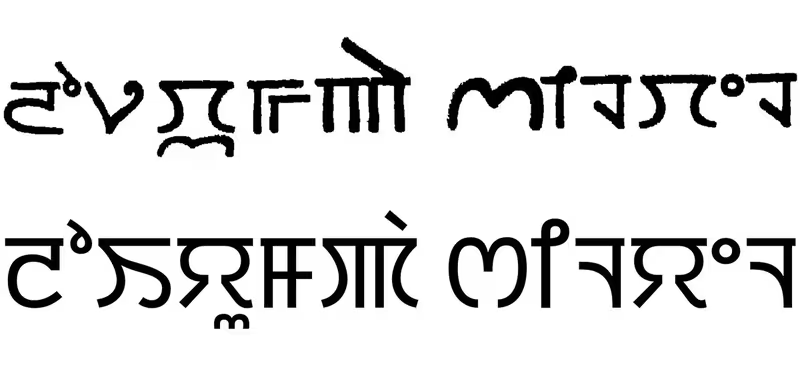
Meitei Script: A Revived Writing System of Manipur
Coins issued during the reign of the Meitei king Ura Konthouba provide some of the earliest evidence for the Meitei script, with records dated between the sixth and seventh centuries CE. Also known as Meitei Mayek, Kanglei Mayek, or Kok Sam Lai Mayek, it is an abugida in the Brahmic family used to write the Meitei language. Its historical record includes copper-plate inscriptions, stone inscriptions, royal edicts, and early literary works.
The script was used in Manipur until the 18th century, when it was replaced by the Bengali script. In the 20th and 21st centuries, it underwent a significant revival. A modernized form was approved for educational institutions in 1980, and the script was added to the Unicode Standard in 2009. Beginning in 2021, the Government of Manipur began using it officially alongside Bengali script under the Manipur Official Language (Amendment) Act, 2021. In 2022, a joint meeting of Meitei language organizations and journalism bodies agreed that Meitei-language newspapers would change from Bengali script to Meitei script from 15 January 2023.
Origins and Classification
Linguistic Family
Meitei script is an abugida in the Brahmic family. Its precise origin remains undetermined. One theory describes it as a variety of, or a direct development from, Gupta Brahmi. Another places it within the Tibetan group of scripts, which itself ultimately developed from Gupta Brahmi.
Singh’s account in People of India describes Meitei Mayak as a variety of Gupta Brahmi. Languages and Scripts similarly states that the old Manipuri script developed from Gupta Brahmi. Other linguistic and historical works also characterize the script as deriving directly from Gupta Brahmi.
A different classification associates Meitei Mayek with Tibetan, Balti, Hingna, U-Chhen, and U-Med. This view connects the group with the Gupta Brahmi-derived Kutilya tradition and emphasizes that Meitei Mayek was modified to represent the sounds of the Meitei language. Other works state more directly that the Meitei script developed on the basis of Tibetan scripts. Unicode also identifies Meitei Mayek as derived from the Tibetan group of scripts.
Origins
The earliest known epigraphic evidence dates between 568 and 658 CE. This evidence includes engravings on coins and copper plates. Because the competing explanations of the script’s development remain unresolved, the surviving record does not establish a single uncontested parent tradition.
Name Etymology
The script has several names. Meitei Mayek means the Meitei script. Kanglei Mayek is another name for it, while Kok Sam Lai Mayek refers to its first three letters. The names of the letters themselves are associated with human body parts. The first letter, kok, means “head”; the second, sam, means “hair”; and the third, lai, means “forehead.”
Historical Development
Early Epigraphic Period (568–658 CE)
The Meitei script appears in the Yumbanlol, also called Yumpanlol, composed somewhere between 568 and 658 CE. This work consisted of copper-plate inscriptions concerning an ancient Meitei literary work.
The Old Manipuri script also appears on coins issued during the reigns of Ura Konthouba, dated approximately 568–653 CE, and Ayangba, dated approximately 821–910 CE. These coins are preserved in the Mutua Museum in Imphal.
Medieval Inscriptions (8th–16th Centuries)
An early copper-plate inscription dates to the eighth century CE and was produced during the reign of King Khongtekcha, approximately 721 CE. Scholar Yumjao discovered it at Phayeng in 1935. It is among the earliest known examples of Meitei literature.
A stone inscription found in Khoibu, in present-day Tengnoupal district of Manipur, contains royal edicts associated with King Senbi Kiyamba, who died in 1508. The inscription represents one of the earliest portions of the Chietharol Kumbaba, or Royal Chronicle of Manipur, and is one of the primary texts written in Meitei script.
Replacement by Bengali Script (18th Century)
Meitei script continued in use until the 18th century. It was then replaced by the Bengali script. The change created a long period in which Meitei-language writing was associated with Bengali script rather than with the older indigenous writing system.
Modern Period
A modernized version of Meitei script was approved by Manipuri law in 1980 for use in educational institutions. The modernized script was encoded in Unicode in 2009.
The script’s official status expanded in the 21st century. Beginning in 2021, the Government of Manipur began using Meitei script alongside Bengali script under the Manipur Official Language (Amendment) Act, 2021. In 2022, representatives of the Meetei Erol Eyek Loinasillol Apunba Lup, the All Manipur Working Journalists’ Union, and the Editors’ Guild, Manipur, agreed that Meitei-language newspapers would switch to Meitei script from 15 January 2023.
Scripts and Writing Systems
Meitei Script
Meitei script is an abugida. It uses consonant letters with vowel signs, while independent vowels are used when a word begins with a vowel. Unlike most Brahmic scripts, the vowels are not listed separately before the consonants; instead, they occur within the main sequence of the script.
The script has fifteen consonant letters for native words because the Meitei language does not have voiced consonants. Nine additional consonant letters are available for writing loan words. There are also seven independent vowel letters, including ꯑ, which serves as a default vowel carrier.
Vowel Diacritics and Final Consonants
Syllables are formed by adding vowel diacritics, known as cheitap eeyek, to consonants. The script has seven vowel diacritics and a diacritic for the final consonant /ŋ/.
Some letters have a second form, called lonsom, used at the end of a word. These forms indicate stop consonants.
Script Evolution
Historical forms of the script are documented through coins, copper plates, and stone inscriptions. The modernized form was approved for education in 1980 and later encoded digitally. The Unicode block for Meitei script is U+ABC0–U+ABFF, while characters for historical orthographies are included in the Meetei Mayek Extensions block at U+AAE0–U+AAFF.
Geographic Distribution
Historical Spread
The script is associated with the Meitei language and the region of Manipur. Historical evidence comes from inscriptions and coins connected with Meitei kings and places in present-day Manipur, including Khoibu and Phayeng.
Centers of Learning
The available historical record identifies several repositories of Meitei script materials. Coins are preserved in the Mutua Museum in Imphal. The earliest stone inscription from Khoibu is kept in the Manipur State Museum, Imphal. These objects provide important evidence for the script’s historical use.
Modern Distribution
Meitei is identified as the official language of Manipur and Assam and as one of India’s 22 official languages. In modern Manipur, Meitei script is used officially alongside Bengali script. It is also supported by keyboards and input methods for Gboard, Apple iOS 13, Linux, Macintosh operating systems, Microsoft SwiftKey, and Windows.
Literary Heritage
Classical Literature
The Yumbanlol is an ancient Meitei literary work associated with copper-plate inscriptions dated between 568 and 658 CE. The eighth-century copper plate discovered at Phayeng is also described as one of the earliest known examples of Meitei literature.
Royal Chronicles
The Chietharol Kumbaba, or Royal Chronicle of Manipur, includes early portions represented by the stone inscription found at Khoibu. The inscription contains royal edicts associated with King Senbi Kiyamba.
Religious and Cultural Traditions
The book Wakoklon Heelel Thilel Salai Amailon Pukok Puya explains how the letters originated and received their names. It is widely considered the source of the Meitei script. In the traditional Meitei religion of Sanamahism, Meitei letters and numerals are believed to have been created by the supreme God.
Grammar and Phonology
Key Features
The writing system reflects the sound structure of Meitei. Native words use fifteen consonant letters, while nine additional consonants are available for loan words. Independent vowels occur at the beginning of words, and vowel diacritics are attached to consonants in other contexts.
Sound System
Meitei does not have voiced consonants. The script includes a special diacritic for the final consonant /ŋ/. Its lonsom forms are used at word-final positions to indicate stop consonants.
Influence and Legacy
Script Classification
The principal historical question surrounding Meitei script concerns its relationship to Gupta Brahmi and the Tibetan group of scripts. Some scholarship presents it as a direct Gupta Brahmi development, while other works place it among scripts of the Tibetan group. Both explanations connect the wider history of the writing system with Gupta Brahmi.
Cultural Impact
The body-part names of the letters are a distinctive feature of Meitei script. This naming system links the written characters with Meitei terminology and traditional explanations of the script’s origin. The script’s continued use in education, official administration, newspapers, and digital systems demonstrates its modern cultural revival.
Royal and Religious Patronage
Meitei Kings
Coins attributed to Ura Konthouba and Ayangba preserve early examples of the Old Manipuri script. The Khongtekcha copper plate and the royal edicts associated with Senbi Kiyamba further connect the script with the courtly and administrative history of Manipur.
Religious Institutions
Sanamahism preserves a traditional account in which Meitei letters and numerals are creations of the supreme God. The Wakoklon Heelel Thilel Salai Amailon Pukok Puya records explanations of the letters’ origins and nomenclature.
Modern Status
Current Use
The number of Meitei script users is not specified in the historical record presented here. The script is described as revived and is used in modern educational, official, journalistic, and digital contexts.
Official Recognition
Beginning in 2021, the Government of Manipur officially used Meitei script alongside Bengali script under the Manipur Official Language (Amendment) Act, 2021. The script is also supported by contemporary operating systems, keyboards, and mobile input methods.
Preservation Efforts
The 1980 legal approval of a modernized form for educational institutions marked a major preservation and revival step. Unicode encoding in 2009 made the script available in standardized digital environments. The 2022 decision to move Meitei-language newspapers to Meitei script from January 2023 further strengthened its public use.
Learning and Study
Academic Study
Meitei script has been examined in linguistic and historical works addressing Gupta Brahmi, the Tibetan group of scripts, early Manipuri writing, and Meitei manuscripts. Its inscriptions, coins, copper plates, and royal texts provide materials for historical study.
Resources
Modern learners can encounter Meitei script through Unicode-enabled devices and input methods. It is supported by Gboard, Apple iOS 13, Linux, Macintosh operating systems, Microsoft SwiftKey, and Windows. The Unicode block U+ABC0–U+ABFF and the Meetei Mayek Extensions block U+AAE0–U+AAFF support modern and historical orthographies.
Conclusion
Meitei script preserves a long written history associated with the Meitei language and Manipur. Its earliest known records include coins and copper plates dated between 568 and 658 CE, followed by inscriptions connected with Meitei kings, early literature, and the Royal Chronicle of Manipur. Although Bengali script replaced it in the 18th century, Meitei script was modernized for education in 1980, encoded in Unicode in 2009, and restored to official use in Manipur beginning in 2021. Its abugida structure, body-part-based letter names, vowel diacritics, lonsom forms, and historical orthographies make it a distinctive member of the Brahmic writing traditions. The modern revival has extended its presence from museums and inscriptions to schools, newspapers, government use, and digital platforms.