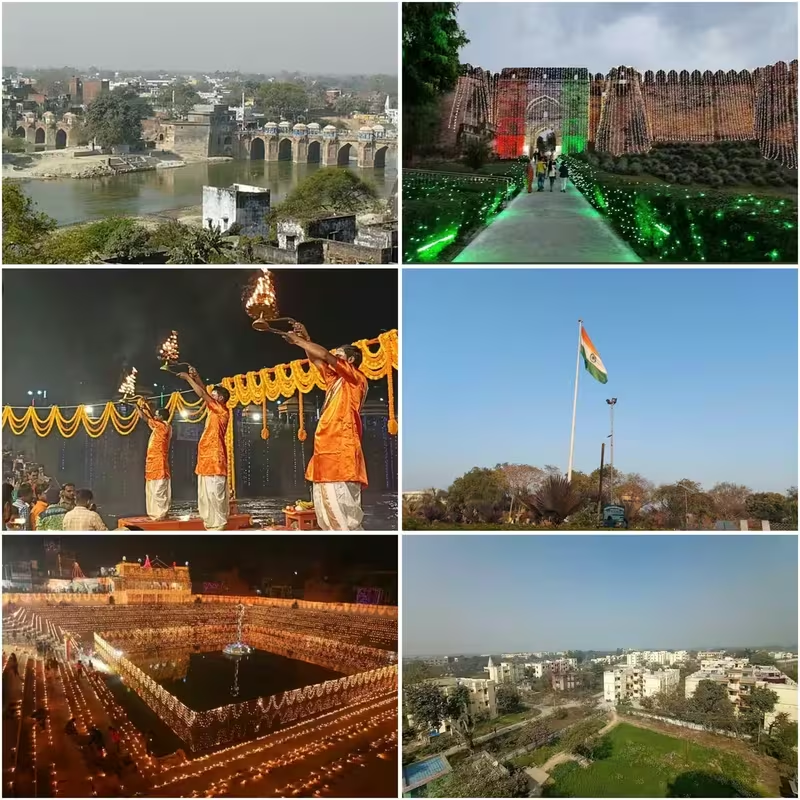
Overview
Jaunpur stands on the Gomti River in eastern Uttar Pradesh, where the history of regional rulers, Delhi sultans, independent Muslim kings, colonial administration, and modern India meet. The city became especially influential between the fourteenth and fifteenth centuries, when it served as the center of the Sharqi Sultanate.
The Sharqi rulers created a state that extended east toward Bihar and west toward Kanauj. Its armies challenged the Delhi Sultanate and, under Husain Shah, attempted repeatedly to conquer Delhi. Jaunpur was also a center of Urdu and Sufi learning, and its surviving mosques display an architectural style that brings Hindu and Muslim motifs together.
Etymology and Names
In 1359, Delhi Sultan Feroz Shah Tughlaq invaded the city and named it in memory of his cousin Muhammad bin Tughluq. Muhammad’s given name was Jauna Khan, which explains the name Jaunpur. The city’s later identity became closely linked to the Sharqi dynasty, whose rulers made it the political center of the eastern sultanate.
Geography and Location
Jaunpur lies in the eastern part of Uttar Pradesh on the Indo-Gangetic plain. The Gomti passes through the city, while the Sai, Varuna, Pili Nadi, Mayur, and Basuhi are among the other local rivers. This riverine setting helped shape the city’s settlement, transport, and political importance.
The wider district also contains Gujar Tal, described as the largest lake in the Varanasi division. Efforts have been made to develop it as an ecotourism site. Jaunpur’s location in Purvanchal placed it between major political zones: Delhi to the west, Bihar to the east, and Bengal beyond.
Ancient and Early Regional History
The earliest ruling traditions associated with Jaunpur identify Ahirs or Yadavs as important local rulers. Heerchand Yadav is named as the first ruler of Jaunpur in this tradition. Forts attributed to the Ahirs or Yadavs stood at Chandwak and Gopalpur villages.
The Chaukiya Devi temple is also connected in local historical accounts with the Yadavs or Bhars. The attribution is uncertain: it may have been built by either group, although the account considers Bhar construction more likely. These traditions point to a pre-Sultanate landscape in which local ruling communities, forts, and the worship of Shiva and Shakti were significant.
Historical Timeline
Tughlaq Rule
Feroz Shah Tughlaq’s invasion in 1359 brought Jaunpur into the political orbit of the Delhi Sultanate. In 1388, he appointed Malik Sarwar as governor of the region. Delhi was then weakened by factional struggles, allowing Malik Sarwar to declare independence in 1393.
Malik Sarwar and his adopted son Mubarak Shah established the ruling house later known as the Sharqi dynasty, or the dynasty of the East.
The Sharqi Sultanate
During the Sharqi period, conventionally dated from 1394 to 1479, Jaunpur became a major military and cultural power in northern India. Its greatest territorial strength came under Shams-ud-din Ibrahim Shah, who ruled from 1402 to 1440. His kingdom extended toward Bihar and Kanauj, and he even marched on Delhi.
Jaunpur’s ambitions also brought it into conflict with Bengal. With the support of the Muslim holy man Qutb al-Alam, Ibrahim Shah threatened the Bengal Sultanate under Shihabuddin Bayazid Shah.
Husain Shah, who ruled from 1456 to 1476, commanded an army described as perhaps the largest in India at the time. He attempted to conquer Delhi but was defeated three times by Bahlul Khan Lodi. The Delhi Sultanate eventually reconquered Jaunpur under Sikandar Lodi. Accounts place the end of Jaunpur’s independence in the late fifteenth century, with the reconquest associated with 1493.
Mughal, British, and Nationalist Eras
Jaunpur’s monuments survived the political changes that followed, although many Sharqi structures were destroyed when the Lodis took the city. A major bridge over the Gomti was built in 1564 during the reign of Mughal emperor Akbar and continues to serve transportation.
In the colonial period, Jaunpur district was annexed into British India under the Permanent Settlement of 1779. This brought the area within the Zamindari system of land revenue collection.
During the Revolt of 1857, Sikh troops in Jaunpur joined the Indian rebels. British control was eventually restored by Gurkha troops from Nepal. Jaunpur later became a district administrative center. Another important episode in the freedom movement occurred at Nibhapur railway station, where freedom fighters led by Pandit Badrinath Tiwari unfurled the national flag and faced repeated government suppression.
Political and Military Significance
Jaunpur’s political importance came from its position as the heart of an independent sultanate. The Sharqi state was strong enough to threaten Delhi, contest influence in Bengal, and control territory stretching across parts of the middle Gangetic region.
The city’s fortifications reinforced this role. The Jaunpur Qila, a Tughlaq-era fortress, remains in good condition and reflects the city’s earlier function as a defended political center.
Religious and Cultural Importance
The Sharqi period made Jaunpur a major center of Urdu and Sufi knowledge and culture. The dynasty is also associated with good communal relations between Muslims and Hindus. One explanation offered for this tradition is that the Sharqi rulers were originally indigenous converts to Islam rather than descendants of Persian or Afghan elites.
The city’s religious landscape includes Atala Masjid, Jama Masjid—also called Badi Masjid—Lal Darwaza Masjid, Jhanjhari Masjid, and Sheetala Chaukia Dham Mandir. Together, these sites reflect the overlapping religious and architectural histories of Jaunpur.
Monuments and Architecture
Jaunpur’s mosques are especially notable for their architectural language. They combine traditional Hindu and Muslim motifs with original elements developed in the city. Atala Masjid, Jama Masjid, and Lal Darwaza Masjid are the best-known surviving examples of this tradition.
The Shahi Bridge is another major landmark. Built over the Gomti in 1564, it connects Jaunpur’s Mughal-era history with its continuing life as a modern city. The Shahi Quila preserves the memory of the Tughlaq foundation and the military importance that Jaunpur retained under the Sharqis.
Modern City
Jaunpur is the headquarters of Jaunpur district and has two Lok Sabha and nine Vidhan Sabha constituencies. In the 2011 Census, Jaunpur Nagar Palika Parishad had a population of 180,362, including 93,718 males and 86,644 females. Its recorded sex ratio was 1,024 females per 1,000 males.
The city’s literacy rate was 71 percent overall, with male literacy at 75.2 percent and female literacy at 66.5 percent. Hinduism was followed by 63 percent of the population, while Muslims formed a substantial minority of about one-third. Hindi was the first language of 90.86 percent of residents and Urdu of 8.81 percent.
Jaunpur is served by Jaunpur City railway station, Jaunpur Junction, Shahganj Junction, Janghai Junction, and Kerakat railway station. The nearest airport is Lal Bahadur Shastri Airport near Varanasi. The city is also home to Veer Bahadur Singh Purvanchal University and Umanath Singh Autonomous State Medical College.
Timeline
Tughlaq Invasion
Feroz Shah Tughlaq invaded Jaunpur and named it after Jauna Khan, the given name of Muhammad bin Tughluq.
Malik Sarwar Appointed
Feroz Shah Tughlaq appointed Malik Sarwar governor of the region.
Sharqi Independence
Malik Sarwar declared independence as Delhi’s Sultanate weakened.
Ibrahim Shah’s Reign
Ibrahim Shah began the reign under which the Jaunpur Sultanate reached its greatest height.
Husain Shah’s Reign
Husain Shah ruled Jaunpur and made repeated attempts to conquer Delhi.
Delhi Reconquest
Sikandar Lodi reconquered Jaunpur, ending the independent sultanate.
Shahi Bridge Built
The old bridge over the Gomti was constructed during Akbar’s era.
British Annexation
Jaunpur district entered British India under the Permanent Settlement.
Revolt and Suppression
Rebel activity spread through Jaunpur before British control was restored by Gurkha troops.