Overview
Nagaur lies almost midway between Jodhpur and Bikaner, in the dry interior of Rajasthan. Its position on a broad, flat plain helped make it a fortified settlement of unusual strategic value. Medieval routes from Gujarat and Sindh moved northward through the region, while routes from Multan and the Indus crossed the desert to the west. Control of Nagaur therefore depended on more than the strength of its walls: rulers also needed the military and economic power to sustain a fort in an arid landscape.
The city is known historically as Nagaur, Nagor, and Nagore, and an older name recorded for it is Ahichhatrapur. Its political history includes Rajput traditions associated with the Parmars and Chauhans, Sultanate administration, the principality founded by Shams Khan, Mewar’s expansion, Mughal governance, and the Rathore rule of Marwar. The city’s heritage is not only military. Sufi shrines, Jain temples, Hindu pilgrimage sites, markets, and desert forts all form part of the wider Nagaur landscape.
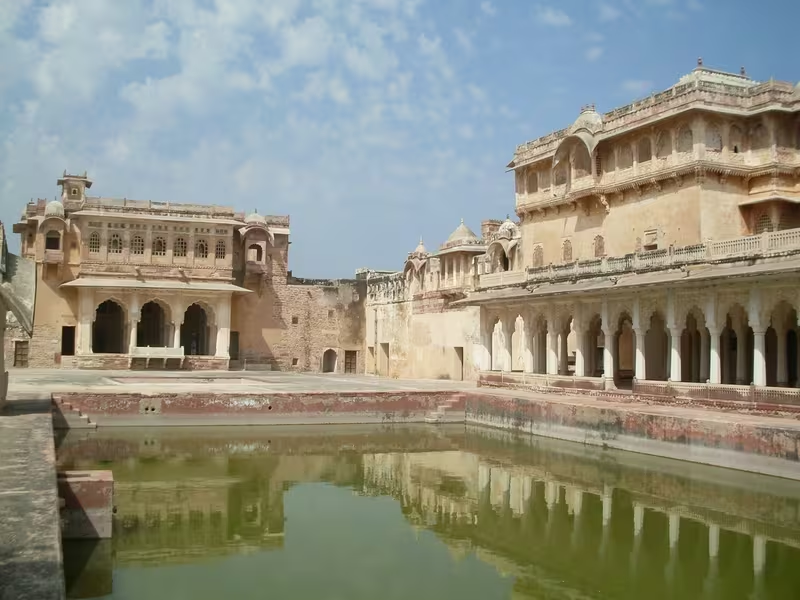
At the centre of this history stands Nagaur Fort. Built in the early twelfth century and altered repeatedly over the centuries, it witnessed struggles among regional powers and was later transformed by palace construction and renovation. Today, its buildings and gardens also provide a setting for cultural performances, including a Sufi Music Festival.
Etymology and Names
Nagaur is also written as Nagor and Nagore. The ancient name of the city is given as Ahichhatrapur, although the surviving historical account does not establish precisely when that name was replaced by Nagaur. The city’s changing names reflect the layered linguistic and political history of Rajasthan, where settlements were known differently in regional, courtly, and religious settings.
The district and city are now both identified with Nagaur. The modern city serves as the administrative headquarters of Nagaur district, while the historical name Nagaur continues to describe a much larger cultural and geographical region containing towns such as Merta, Khimsar, Kuchaman, Ladnun, and Jayal.
Geography and Location
Nagaur is located at 27.2° north latitude and 73.73° east longitude, at an average elevation of 302 metres. The district is bordered by Bikaner, Churu, Sikar, Jaipur, Ajmer, Pali, and Jodhpur. Its landscape combines plains, hills, sand mounds, and areas associated with the Great Indian Thar Desert.
The climate is extremely dry. Summers are hot, and sandstorms are common. The district’s recorded maximum temperature is 47.2°C, while its lowest recorded temperature is 0°C. Winter generally extends from the middle of November to the beginning of March. Rainfall is concentrated in a short season from July to mid-September, and the district receives an average of 36.16 centimetres annually.
These conditions shaped Nagaur’s history. A fort in this environment required dependable political authority and access to food and water. During the siege of 1755, the attacking army attempted to exploit precisely this vulnerability by cutting off supplies to Nagaur Fort.
Vegetation is sparse, particularly in the western part of the district, where low herbs and grasses grow around sand dunes. Khejri trees are common and are valued for fodder, gum, soil protection, and religious significance. Babul, neem, peepal, rohira, shisham, and other trees occur in the greener south-eastern and northern areas.
Ancient and Early Rajput History
Nagaur’s early history is preserved mainly through historical traditions connected with Rajput dynasties. The account of the city associates its earlier ruling landscape with Gaur and Parmar Rajputs, while also describing the shelter taken around Nagaur by Naagvanshi Kshatriyas. The Parmar rulers are said to have dominated the region for a long period and to have been respected by the Sisodiyas of Chittor and the Rathores of Jodhpur.
Nagaur Fort is attributed to the Parmar Rajputs and is dated to the early twelfth century. The fort’s long history of alteration means that the visible complex represents several periods rather than a single construction phase. Nagaur later came under the powerful Chauhan clan. From the period of the Ghaznavid invasions until the reign of Prithviraj Chauhan at the end of the twelfth century, Chauhan rulers are described as maintaining control over Jangladesh and keeping it free from foreign rule.
The political reality was likely complex. Between Ajmer and Delhi, numerous local Hindu landholders coexisted with Muslim authorities, paying revenue and sometimes serving in armies. A similar arrangement may have existed in the lands between Ajmer and Nagaur. This helps explain how local chiefs, regional Rajput rulers, and Sultanate power could all form part of Nagaur’s changing political history.
Historical Timeline
Sultanate and Regional Rule
Nagaur became connected with the expanding power of the Delhi Sultanate. Before becoming Sultan, Balban was given an estate centred on the desert town. In 1391, during the reign of Nasir-ud-din Muhammad Tughlaq, Jalal Khan Khokhar was assigned as governor of Nagaur.
Between 1405 and 1407, Shams Khan, the brother of Muzaffar Shah I, founded the Nagaur principality. This brought the town into the political orbit of the Gujarat Sultanate. Nagaur’s position made it valuable, but also exposed it to conflict with powerful Rajput kingdoms.
In 1455, the combined forces of Shams Khan and the Gujarat Sultanate were defeated by Rana Kumbha, the influential Rajput ruler of Mewar. After this defeat, Nagaur and its surrounding territories came under the dominion of the Sisodiya rulers of Mewar.
Mughal and Marwar Periods
During the Mughal period, Nagaur continued to be a politically important centre. In the seventeenth century, Amar Singh Rathore served as the emperor’s representative, or subedar, of Nagaur. His appointment shows that the town remained significant within the Mughal administrative and military system.
Later, Bakht Singh of Marwar became lord of Nagaur through his elder brother, Abhai Singh of Jodhpur. Many of the palatial structures inside the fort were built by Bakht Singh. From Nagaur, he conducted military campaigns, including an invasion of Bikaner and a conflict with Jaipur at the Battle of Gangwana. The fort thus served not only as a defensive structure but also as a residence and political court.
The Siege of 1755
In 1755, Jai Appa Sindhia attacked Nagaur after plundering several places in Rajasthan. His army halted near Samas Pond at Tausar, about 3.5 kilometres from Nagaur Fort, and surrounded the settlement. The attackers cut off food and water supplies.
Maharaja Vijay Singh called a court to seek volunteers willing to strike at Sindhia. Gaji Khan Khokhar of Chawata Kallan and Kan Singh of Dotalai accepted the task. According to the local account, they disguised themselves as traders, opened a shop near the Maratha camp, and observed the army for two months.
On Friday, 25 July 1755, at approximately 11 in the morning, they attacked Jai Appa Sindhia with daggers and killed him. Both men were themselves killed during the fighting. The Maratha army continued the struggle around Nagaur for several months but eventually withdrew. The episode remains part of Nagaur’s local historical memory, preserved in a proverb praising the Khokhars’ ferocity.
Political and Military Significance
Nagaur’s importance came from the combination of its location and its fortification. The city stood on routes connecting western and northern India, yet it occupied a difficult desert environment where water and provisions could determine the outcome of a campaign. Its rulers had to maintain both a strong military presence and the economic networks needed to supply the town.
This explains the succession of powers associated with Nagaur: Chauhans, Sultanate governors, the Gujarat Sultanate, Mewar, the Mughals, Marwar, and the Marathas. The city was repeatedly incorporated into larger political systems while also retaining its own local chiefs, shrines, markets, and traditions.
Religious and Cultural Importance
Nagaur shares with Ajmer a history of early Sufi activity. One of the earliest Sufis associated with the town was Sultan Tarkin, whose shrine was established during a period of Hindu rule. Later, Hamiduddin, a disciple of Khwaja Moinuddin of Ajmer, came to Nagaur. His teachings incorporated certain Hindu principles. He became a strict vegetarian and kept a cow at his shrine, an example of the local interaction between religious communities.
Rol, also called Rol Sharif, contains several mosques, including the Shahi Jama Masjid. The village is associated with the Jubba Mubarak of Muhammad, described as a holy relic brought from Bukhara by Qazi Hamiduddin Nagauri. Devotees gather there for the annual urs of Qazi Sahib and the accompanying Urs Mela.
Nagaur’s religious landscape also includes the tenth-century Jain temples of Ladnun and Jain Vishva Bharati University, a centre associated with Jain thought, spirituality, purification, and ahimsa. At Jayal, the Dadhimati Mata Temple, also known as the Goth-Manglod temple, is described as the district’s oldest temple and is associated with the Gupta period. It is revered as the family deity of the Dadhich Brahmins.
Economy and Trade
Nagaur’s medieval economy benefited from its position on long-distance routes. Traders moving from Gujarat and Sindh toward northern India passed through the region, as did traffic connected with Multan and the Indus. The flat terrain made movement possible, but the desert environment made fortified control points and reliable supply systems essential.
Agriculture remains important in the district. Merta’s agricultural produce market is particularly prominent for cumin and is counted among Rajasthan’s major cumin markets. This commercial role connects the modern district to the older pattern in which Nagaur’s position, surrounding settlements, and transport routes supported regional exchange.
Monuments and Architecture
Nagaur Fort is the city’s defining monument and one of the notable examples of Rajput-Mughal architecture. Its first construction is placed in the early twelfth century, but repeated alterations reflect the changing rulers who occupied it. The fort contains defensive structures, palatial buildings, gardens, and interior spaces. Major renovations were carried out in 2007, after which ninety fountains were operating across its gardens and buildings.
The fort’s later palace architecture is especially associated with Bakht Singh of Marwar. Its courtyards and buildings now function as heritage spaces as well as cultural venues, hosting a Sufi Music Festival.
Several important sites lie elsewhere in the district. Khimsar Fort, about 42 kilometres from Nagaur on the road toward Jodhpur, is a five-hundred-year-old desert fort later converted into a hotel. Kuchaman Fort stands on a steep, difficult-to-access hill and is noted for its distinctive water-harvesting system. The Jodhpur rulers used it for minting gold and silver currency.
Merta’s Meera Bai Temple, also called the Charbhuja Temple, is described as four hundred years old. Kurki, about 30 kilometres from Merta, is associated with Meera Bai’s birth. At Chhoti Khatu, a small fort is attributed to Prithviraj Chauhan, while the Phool Bawadi stepwell is associated with the Gurjara-Pratihara period.
Famous Personalities and Local Traditions
Amar Singh Rathore, the Mughal subedar of Nagaur, is among the best-known political figures connected with the city. Bakht Singh shaped the fort’s later palatial character and used Nagaur as a base for military activity.
Hamiduddin remains central to Nagaur’s Sufi history. Meera Bai is linked to Merta and Kurki through temple and birthplace traditions. Kharnal, near Nagaur, is associated with Veer Tejaji, a widely revered local hero and deity. The village is described as his birthplace and is connected with the Dholiya gotra of the Jat community. Jhorda, north of Nagaur, is associated with the saint Baba Hariram.
Modern City and Heritage
Nagaur is now a municipal city and the administrative headquarters of Nagaur district. Its heritage is distributed across a broad region rather than concentrated in a single monument. Nagaur Fort provides the central historical landmark, while nearby towns and villages preserve temples, mosques, shrines, stepwells, forts, and traditions associated with saints, rulers, and local heroes.
The city’s modern identity combines administration, agriculture, pilgrimage, and heritage tourism. Its dry climate and desert setting remain defining features, while the continuing use of historic spaces for music festivals and religious gatherings gives the old fort and surrounding settlements a living cultural role.
Timeline
Nagaur Fort built
The fort is attributed to the Parmar Rajputs and is dated to the early twelfth century.
Chauhan influence
Nagaur was associated with the powerful Chauhan clan during the medieval period.
Sultanate governor appointed
Jalal Khan Khokhar was assigned as governor of Nagaur during the reign of Nasir-ud-din Muhammad Tughlaq.
Nagaur principality founded
Shams Khan founded the Nagaur principality between 1405 and 1407.
Mewar victory
Rana Kumbha defeated the combined forces of Nagaur and the Gujarat Sultanate.
Amar Singh Rathore
Amar Singh Rathore, later associated with the Mughal administration of Nagaur, was born.
Siege of Nagaur
Jai Appa Sindhia was killed during the siege after two defenders disguised themselves as traders.