Overview
In the sixth century BCE, Vaishali stood as the capital of the Licchavi-led Vajjika League in the eastern Gangetic plain. Known in ancient usage as Vesali or Vaiśālī, it was organised not as the seat of a single hereditary monarch but as the centre of a gaṇasaṅgha, an aristocratic republican system in which assemblies exercised political authority. Its position in the history of early Indian state formation gives the city a distinctive importance.
Vaishali is also bound closely to the histories of Buddhism and Jainism. The Buddha visited it repeatedly, spent his final rainy season there, admitted women into the Buddhist monastic order there, and announced his approaching mahāparinirvāṇa three months before his death. The city is associated with the Buddha's relics and with the Second Buddhist Council. Nearby Kundagrama is identified as the birthplace of Mahavira, the twenty-fourth and last Tirthankara of Jainism.
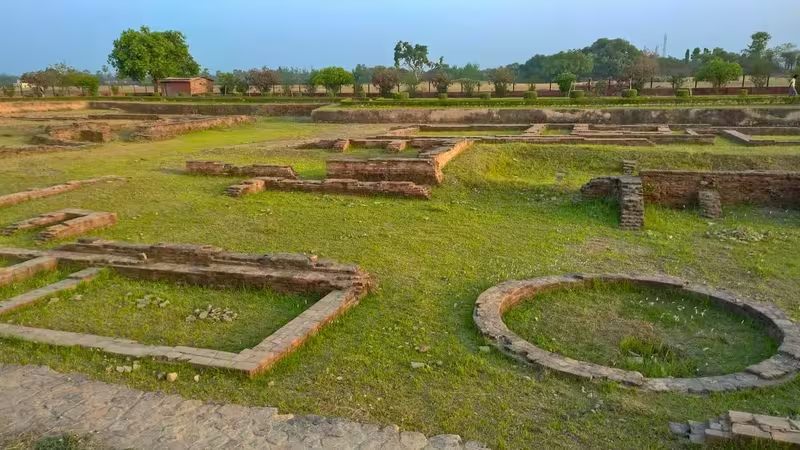
The ancient city is now an archaeological site spread across modern villages in Vaishali district, north of Patna in Bihar. Its remains include the Relic Stupa, the ruins known as the Fort of Raja Vishal, the excavated complex at Kolhua, and one of the best-preserved Ashokan pillars, crowned by a single Asiatic lion. Chinese travellers Faxian and Xuanzang recorded the city centuries after its political prominence had passed, helping later archaeologists identify the ruins at modern Basarh with ancient Vaiśālī.
Etymology and Names
The city is known by several forms of the same ancient name. Vesali is the Pali form, while Vaiśālī is the Sanskrit form. The name is traditionally derived from King Vishal of the Mahabharata age. Puranic and other literary traditions connect the early settlement with Nābhānediṣṭha, described as a descendant of Vaivasvata Manu and the founder of the city.
These early traditions belong to a legendary and literary account of the region's past rather than to a securely dated archaeological sequence. They describe the settlement of descendants of Vaivasvata Manu in the Gangetic plain and place Vaishali within the line of the Ikshvaku, or Solar, dynasty. The historically clearer political identity of Vaishali begins with the emergence of the Licchavi republic and the Vajjika League around the sixth century BCE.
Geography and Location
Ancient Vaishali lay in the eastern Gangetic plain, in a region described in connection with the former kingdom of Mahā-Videha. The territory of Mahā-Videha extended between the Sadanira River in the west, the Kauśikī River in the east, the Ganges in the south, and the Himalaya mountains in the north. This setting placed Vaishali within a broad zone of movement and interaction between the northern Gangetic territories and the growing powers south of the Ganges.
The political centre of the Licchavis was moved to Vesālī after the Licchavikas occupied Videha and displaced the weakened monarchical system associated with the Vaidehas. Vaishali had previously been a marginal location in relation to the older Vaideha capital of Mithilā. Under the Licchavis, however, it became their largest city, capital, and stronghold.
The archaeological site is not confined to a single modern urban settlement. It is distributed among villages in Vaishali district, with important remains at Basarh and Kolhua. This scattered character reflects the way the ancient city and its religious landscape are represented today: separate archaeological mounds, stupas, monastic remains, tanks, and structural ruins mark different parts of the historic settlement.
Ancient History
The Mahā-Videha Background
According to the historical reconstruction presented in literary and political traditions, the Mahā-Videha kingdom was established around 800 BCE. Its territory occupied the northern part of the eastern Gangetic plain. Before the rise of the Licchavis, Mithilā served as the Vaideha capital and administrative centre.
Around the seventh or sixth century BCE, the Licchavikas, an Indo-Aryan tribe, invaded Videha and temporarily occupied Mithilā. The occupation weakened the existing monarchical structure. The Licchavikas then replaced it with a republican system. Rather than continuing to govern from the old royal centre, they established their principal political centre at Vesālī, a location that could serve as a capital and defensive stronghold in the changing political environment of the region.
The Vajjika League
The Licchavikas organised their state as a gaṇasaṅgha, an aristocratic republic. The Licchavika Assembly held sovereign and supreme authority over the territory controlled by the league. The Licchavis also created the Vajjika League, a confederation named after the Vajji tribe, which was among the most powerful communities in the region around Vesālī.
The Vajjika League was not a centralised kingdom in the later imperial sense. Its constituent groups had different degrees of autonomy. The Videha republic retained control over aspects of internal administration but remained under Licchavi supervision, particularly in foreign policy. The Nāyikas formed another constituent republic, with internal autonomy but league control over war and external relations. The Mallakas maintained their own sovereign rights within the league and joined the Licchavi-led confederation in response to shared dangers.
This political structure makes Vaishali an important example of the variety of state systems in early Indian history. The city was the seat of an aristocratic assembly and the headquarters of a league in which several communities negotiated their relations while accepting Licchavi leadership. The league was probably established between the Kosalan conquest of Kasi and the Magadhan conquest of Anga, placing its formation around the sixth century BCE.
Chetaka, or Ceḍaga, was the head of the Licchavikas and of their Council during the sixth century BCE. This position also made him head of the Council of the Vajjika League. His political influence extended beyond the city through a network of family and diplomatic marriages. His sister Trishala was married to Siddhartha, the head of the Nāyika group. Their son was Mahavira.
Historical Timeline
The Buddha and Vaishali
The Buddha's association with Vaishali is central to the city's religious history. After leaving Kapilavastu in search of spiritual knowledge, Siddhartha is said to have come first to Vaishali. There he undertook initial training under Uddaka Rāmaputta and Āḷāra Kālāma. After his enlightenment, he visited Vaishali frequently.
The city also shaped the organisation of the Buddhist community. The Buddha is described as having arranged the sangha on the pattern of Vaishalian democracy. Vaishali was the place where he first permitted women to enter the Buddhist order, initiating his maternal aunt Mahaprajapati Gautami.
During his final visit, the Buddha spent his last varshavasa, or rainy-season retreat, at Vaishali. He announced that he would attain mahāparinirvāṇa three months later. Before departing for Kusinagara, where he died, he left his alms bowl with the people of Vaishali. Buddhist traditions also connect the city with one of the portions of the Buddha's relics distributed after his death.
The Second Buddhist Council
In 383 BCE, the Second Buddhist Council was convened at Vaishali by King Kalashoka. The council forms part of the city's long association with the institutional history of Buddhism. Its location demonstrates that Vaishali continued to serve as an important religious centre even after the political circumstances of the Vajjika League had changed.
After the Buddha's death, the Licchavis, Mallakas, and Sakyas claimed shares of his relics. The Vaidehas and Nāyikas did not appear separately among the claimants because they were dependencies of the Licchavis and did not possess the same independent sovereign status within the political order.
Mauryan and Later Periods
The Mauryan period left a visible mark at Vaishali. At Kolhua, the Archaeological Survey of India found remains extending from the Mauryan period in the third century BCE to the post-Gupta period in the seventh century CE. The Ashokan pillar at the site is one of the most striking survivals.
A brick stupa associated with the story of a monkey chief offering honey to the Buddha was initially built during the Mauryan era. It was later enlarged with a circumambulatory path during the Kushan period and modified again during the Gupta period. These successive alterations show that the site remained a place of ritual activity long after the Mauryan rulers.
By the time the Chinese monk and traveller Xuanzang visited Vaishali in the early seventh century CE, the city had declined sharply. He described its capital as ruined and said that it could be called a village or town rather than a city. Archaeological evidence indicates that the citadel and probably Vaishali itself had been deserted by the time of the Later Gupta dynasty, around 600 CE.
Political Significance
Vaishali's political significance rests on its role as the capital of the Vajjika League and the Licchavi republic. The city was not merely a settlement associated with a confederation; it was the location from which the Licchavi Assembly exercised sovereign authority over the league's territory.
The structure of the Vajjika League also reveals that early Indian political life included arrangements other than hereditary monarchy. The Licchavi-led system combined a dominant republic, dependent republics, and allied communities. Some constituent groups controlled their internal affairs, while the league managed common military and foreign-policy concerns. The Mallakas, in contrast, retained their own sovereign rights within the confederation.
Chetaka's position as head of both the Licchavi Council and the Vajjika Council illustrates the centrality of Vaishali. His authority, and the marriage connections established by his family, linked the city to other political centres, including Magadha, Anga, Vatsa, Avanti, Sindhu-Sauvīra, and Kosala. These relationships also helped spread Jain affiliation among ruling families in northern South Asia.
The ruins known as the Fort of Raja Vishal may preserve the remains of the political centre associated with this period. Earlier excavations found Northern Black Polished Ware dated between 500 and 200 BCE. The remains have been interpreted as a citadel or palace complex of the Vajjika League period. Historian Nayanjot Lahiri dates the remains to the sixth century BCE.
Religious and Cultural Importance
Vaishali is a shared centre of Buddhist and Jain memory. In Buddhist tradition, it is the city of the Buddha's repeated visits, his final rainy-season retreat, his announcement of his approaching death, and his last sermon before his mahāparinirvāṇa. It is also associated with the Buddha's alms bowl and with a share of his relics.
In Jain tradition, Mahavira was born and raised in Kshatriyakund, identified with the Kundagrama area of Vaishali. He was the son of Siddhartha of the Nāya clan and Trishala, the sister of Chetaka. Mahavira abandoned worldly possessions at the age of thirty and became an ascetic before attaining his position as the twenty-fourth Tirthankara.
Chetaka himself is described in Jain texts as a republican president and a committed follower of Jainism. His daughter Sujyeṣṭhā became a Jain nun. Other marriage alliances connected the family to rulers of Sindhu-Sauvīra, Anga, Vatsa, Avanti, and Magadha. Vaishali consequently became a major centre of Jain affiliation during the period associated with Mahavira.
The city's later cultural history is also reflected in written records. Faxian, who travelled in the fourth century CE, and Xuanzang, who visited in the seventh century CE, both mentioned Vaishali. Their descriptions were later used by the British archaeologist Alexander Cunningham, who identified ancient Vaiśālī with the modern village of Basarh in 1861.
Economic Role
The available historical record places Vaishali's strongest importance in politics and religion rather than in a detailed account of its markets, crafts, or commercial institutions. Its location in the eastern Gangetic plain, however, gave it a significant regional position. The city was connected to the territories of Videha, the Licchavis, the Mallakas, the Nāyikas, and the larger political world south of the Ganges.
As the capital and stronghold of the Vajjika League, Vaishali coordinated relations among several communities. Its importance lay in the administration of a confederated territory, the movement of political representatives, and the maintenance of alliances. The city's religious institutions also drew visitors and helped sustain its significance after the decline of the Vajjika political system.
Monuments and Archaeology
Relic Stupa
The Relic Stupa is traditionally identified as the place where the Licchavis reverentially encased one of the eight portions of the Buddha's relics. It is therefore among the most important Buddhist remains at Vaishali. Recent research has suggested that it may be one of the earliest archaeologically known stupas.
Buddhist tradition connects the relics with the Buddha's departure from Vaishali. After his last discourse, he travelled towards Kusinagara. The Licchavis followed him and refused to return even after he left his alms bowl with them. The Buddha then created the appearance of a river in flood, compelling them to turn back. The relic tradition and the archaeological remains preserve different aspects of the city's memory.
Fort of Raja Vishal
Near the modern villages of Basarh are extensive ruins locally called “Raja Vishal ke Garh,” or the Fort of Raja Vishal. Excavations found Northern Black Polished Ware from approximately 500 to 200 BCE. The remains are believed to represent a citadel or palace connected with the Vajjika League period.
The structure is especially important because it gives the republican capital a physical political setting. Literary descriptions of assemblies and confederate rule can be connected, cautiously, with the remains of a substantial fortified or administrative complex.
Kolhua
Kolhua contains one of the richest archaeological concentrations at Vaishali. Excavations revealed the Kutagarshala, a swastika-shaped monastery, a tank, votive stupas, miniature shrines, a principal stupa, and the Ashokan pillar. The remains span the Mauryan period through the post-Gupta period.
The 11-metre polished sandstone pillar is topped by a lion capital. It is considered likely to be one of Ashoka's earliest pillars. Unlike some Ashokan pillars, it carries no edicts, although it has inscriptions from the Gupta period. Its single Asiatic lion gives it a distinctive appearance.
The nearby brick stupa commemorates the monkey chief's offering of honey to the Buddha. It was first constructed during the Mauryan period and subsequently expanded and modified. The Markat-Hrad, a brick-lined tank measuring approximately 65 by 35 metres, is traditionally said to have been dug by monkeys for the Buddha. Its seven tiers and bathing ghats remain part of the archaeological landscape.
Kutagarshala, described as the Buddha's seasonal residence, underwent three principal phases. It developed from a small Chaitya associated with the Sunga-Kushana period into a larger Gupta-period temple and later into a monastery with partition walls after the Gupta period. The Gupta-era swastika-shaped monastery has twelve rooms arranged around a central courtyard, an eastern entrance, and a toilet. Finds from the site include semi-precious beads, terracotta figures, seals, inscribed pottery, and a distinctive terracotta crowned monkey.
Museum and World Peace Pagoda
The Vaishali Museum was established by the Archaeological Survey of India in 1971. It preserves and displays antiquities discovered during exploration and excavation around ancient Vaishali.
Near the coronation tank stand a Japanese temple and the Viśvā Śānti Stūpa, or World Peace Pagoda. The stupa was built by Nipponzan-Myōhōji, a Japanese Nichiren Buddhist organisation. A small part of the Buddha's relics found at Vaishali has been enshrined in its foundation and in its chhatra.
Famous Personalities
Mahavira was the twenty-fourth and last Tirthankara of Jainism. He was born into a Kshatriya family at Kundagrama, identified with a suburb or area associated with Vaishali. His parents were Siddhartha of the Nāya clan and Trishala, the sister of Chetaka.
Chetaka, also known as Ceṭaka or Ceḍaga, was the head of the Licchavi republic and the Vajjika Council. Jain accounts describe him as a committed follower of Mahavira.
Gautama Buddha visited Vaishali frequently and delivered teachings there. He admitted Mahaprajapati Gautami into the Buddhist order at the city and spent his final rainy season there.
Vimalakirti is the central figure of the Vimalakirti Sutra and is associated with Vaishali as a lay Buddhist practitioner.
Faxian and Xuanzang were Chinese Buddhist travellers whose accounts preserved important descriptions of Vaishali. Their writings later assisted Alexander Cunningham in identifying the ancient city at Basarh.
Decline and Revival
Vaishali's political decline followed the disappearance of the Vajjika League as the dominant force in the region. By the early seventh century, Xuanzang found the capital ruined and described it as more like a village or town than a city. The citadel and likely the main urban settlement had been deserted by the Later Gupta period, around 600 CE.
The religious landscape survived longer than the political city. At Kolhua, buildings and stupas were repeatedly enlarged, rebuilt, or modified from the Mauryan period through the post-Gupta period. This continuing activity shows that Vaishali remained meaningful as a pilgrimage landscape even after its role as a republican capital had faded.
Modern interest in Vaishali grew after the identification of Basarh with ancient Vaiśālī in the nineteenth century. Archaeological excavation and conservation have since brought together the city's political, Buddhist, and Jain histories. Since 2010, parts of the site, including the Relic Stupa and Ashokan pillar, have been included as a tentative site under the UNESCO World Heritage list in the category of Silk Road sites in India.
Modern City
Vaishali today is an archaeological and pilgrimage landscape in Bihar's Vaishali district. The remains are distributed among modern villages rather than concentrated in a single preserved ancient city. Visitors encounter the Relic Stupa, the ruins associated with Raja Vishal, the excavated complex at Kolhua, the Ashokan pillar, the World Peace Pagoda, and the Vaishali Museum.
The site serves both Buddhist and Jain pilgrims. Its significance comes from the overlap of several historical layers: the Licchavi republic and the Vajjika League, the Buddha's final years, Mahavira's birthplace, Mauryan patronage, Gupta-period monastic activity, and the memories preserved by Chinese pilgrims.
In February 2019, Bihar Chief Minister Nitish Kumar laid the foundation stone for the Buddha Samyak Darshan Museum and Memorial Stupa, intended to house Buddha relics. In September 2020, Prime Minister Narendra Modi inaugurated Vaishali railway station. The rail connection links the area with Hajipur and Patna, improving access to the archaeological site and pilgrimage centres.