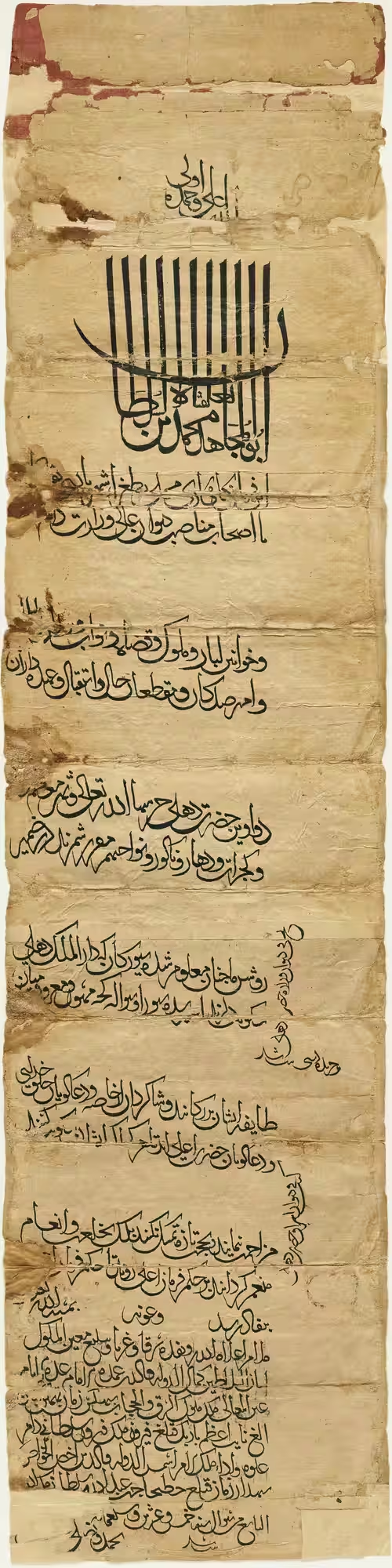

When Tughluq's Army Marched to Conquer China—And Vanished in the Himalayas
In the annals of military disasters, few match the sheer audacity and catastrophic failure of Sultan Muhammad bin Tughluq's 1337 attempt to invade China. This is the story of how one of medieval India's most brilliant—and erratic—rulers sent thousands to their doom in the world's highest mountains.
The Sultan's Grand Ambition
In the sprawling court of Delhi, Sultan Muhammad bin Tughluq pored over maps with the intensity that had become his trademark. It was the mid-1330s, and the Sultan who had already moved an entire capital city was conceiving something even more audacious: an invasion of China through the Himalayan passes.
Muhammad bin Tughluq was no ordinary ruler. Since ascending the throne in February 1325 following his father Ghiyasuddin Tughlaq's death, he had demonstrated both brilliance and bewildering judgment in equal measure. A polyglot who could converse fluently in Persian, Hindavi, Arabic, Sanskrit, and Turkic, he was as comfortable discussing medicine and philosophy as he was planning military campaigns. The famous Moroccan traveler Ibn Battuta, who spent years at his court, documented the Sultan's extraordinary intellect—and his equally extraordinary paranoia.
History would remember him by two contradictory epithets: "The Wisest Fool" and "The Mad Sultan." Both would prove grimly appropriate.
The plan taking shape in Tughluq's mind was grand in conception. The Mongol Yuan dynasty ruled China, and the Sultan believed the time was ripe for expansion northward. He had conquered territories stretching from Warangal to Madurai, bringing much of the Indian subcontinent under Delhi's control. Why not extend the Sultanate's reach beyond the Himalayas?
In the court, advisors exchanged worried glances. They had learned to recognize the Sultan's moods—the dangerous combination of intellectual brilliance and impulsive decision-making that had already led to the disastrous forced relocation of Delhi's population to Daulatabad. But who would dare contradict a sultan known for his paranoid tendencies and swift punishments?
Assembling the Expedition
Tughluq's military record provided some justification for confidence. As a young prince in 1321, his father had sent him to campaign in the Deccan Plateau against the formidable Kakatiya dynasty. Two years later, in 1323, the young Muhammad had successfully besieged Warangal, the Kakatiya capital, ending King Prataparudra's reign and bringing that ancient dynasty to its knees. He had proven himself a capable military commander.
Now, as Sultan, he mobilized resources on an unprecedented scale. According to historical accounts, Tughluq assembled an army numbering somewhere between 100,000 to 370,000 soldiers—the exact figure lost to time, but all sources agree it was massive. This wasn't merely an expeditionary force; it was an entire nation on the move.
The Sultan drew on his administrative experience, creating elaborate logistics for the campaign. Just as he had established halting stations every two miles during the Daulatabad migration, with provisions for food and water and khanqahs staffed by Sufi saints, he now planned supply lines for his Himalayan venture. Revenue officials who had assessed the financial aspects of conquered territories in the south were now tasked with calculating the costs of mountain warfare.
Outside Delhi's walls, the army gathered like a monsoon cloud. War elephants trumpeted, cavalry horses stamped and snorted, and foot soldiers drilled in formation. Supply wagons stretched as far as the eye could see. On the northern horizon, the Himalayan peaks gleamed white—beautiful, distant, and utterly indifferent to human ambition.
The March to the Mountains
The massive army began its northward march with drums beating and banners flying. Initially, the campaign proceeded through familiar territory. The Sultan's postal service, which he had established between Delhi and Daulatabad, was extended to keep communication flowing. Regular dispatches were sent back to the capital reporting progress.
But as the army pushed deeper into the foothills and then into the true mountains, conditions deteriorated rapidly. This was not the Deccan Plateau where Tughluq had won his early victories. This was not even the relatively manageable terrain between Delhi and Daulatabad, where his forced population transfer had already cost countless lives due to inadequate provisions.
This was the Himalayas—the roof of the world.
The broad roads that had served the Sultan's previous grand projects were impossible to construct here. The halting stations every two miles became a logistical fantasy in terrain where a day's march might cover only a fraction of that distance. The thin air at high altitude left soldiers gasping for breath. Paths that seemed wide enough for a supply train would suddenly narrow to ledges barely accommodating a single file of men.
The war elephants, so formidable on the plains, became liabilities. Their enormous weight made them dangerous on mountain paths, and their need for vast quantities of food and water strained supply lines already stretched to breaking. Horses stumbled on rocky trails. Men from the plains, unaccustomed to the cold, shivered in inadequate clothing as temperatures dropped with altitude.
Still, the army pressed forward. The Sultan's orders were clear, and his reputation for punishing failure was well-known. Officers drove their men upward into the thinning air and thickening snow.
Reaching the High Passes—And Meeting Resistance
Historical sources disagree on exactly how far Tughluq's army penetrated into the mountains. Some accounts suggest they reached the borders of China itself; others indicate they never made it past the outer Himalayan ranges. What is certain is that somewhere in those frozen heights, the Sultan's grand ambition collided with harsh reality.
The mountain tribes who inhabited these regions were not the organized kingdoms Tughluq had conquered in the Deccan. They were hardy, intimately familiar with the terrain, and utterly unimpressed by the Sultan's vast army. To them, these plainsmen stumbling through the passes were not conquerors but prey.
The tribes struck when and where the invaders were most vulnerable—in narrow defiles where numbers meant nothing, at high camps where altitude sickness had already weakened the troops, during storms when visibility dropped to nothing. They knew every path, every shortcut, every killing ground.
For the Delhi Sultanate's soldiers, trained in the warfare of the plains and the Deccan, this was a nightmare. Their formations, so effective in open battle, became death traps in the mountains. Their superior numbers couldn't be brought to bear when only a dozen men could fight abreast in a narrow pass. Their supply lines, already stressed, became easy targets for raiders who would strike and vanish into the landscape like snow leopards.
The Catastrophe Unfolds
What began as harassment became a rout. The mountain tribes, emboldened by early successes, intensified their attacks. Supply convoys were ambushed and destroyed. Isolated units were surrounded and annihilated. The weather, which had been merely harsh, turned vicious.
Historians record that the army was "destroyed" by the mountain tribes. The exact sequence of events is unclear—whether there was one decisive battle or a series of escalating disasters—but the outcome was unambiguous. The massive force that had marched so confidently from Delhi was being torn apart.
Commanders faced an impossible situation. Advance deeper into hostile territory with dwindling supplies and mounting casualties? Hold position in an environment that killed as surely as enemy arrows? Or retreat and face the Sultan's wrath for failure?
Nature made the decision for them. Landslides, triggered by monsoon rains or simply the passage of so many men and animals, blocked passes. Soldiers fell from narrow paths into chasms thousands of feet deep. Disease, always the companion of armies, spread rapidly through camps where men huddled together for warmth. High-altitude sickness claimed victims daily.
The war elephants, those symbols of the Sultan's might, became tragic figures. Unable to navigate the treacherous descent, many were simply abandoned, left to die slowly in the cold. Others panicked during attacks, causing more casualties among their own forces than among the enemy.
The Retreat—And the Reckoning
The retreat was worse than the advance. An army in retreat is always vulnerable; an army retreating through the Himalayas while under constant attack was doomed. Men threw away weapons and armor to move faster. Officers lost control of their units. Discipline, the foundation of military effectiveness, dissolved in the face of sheer survival instinct.
The mountain tribes pursued relentlessly, picking off stragglers and harrying the main body. Every pass that had been difficult to ascend became a potential ambush site on the descent. Supplies were exhausted. Men ate their horses, then their leather equipment, then died of starvation.
Historical accounts suggest that only a fraction of the original force made it back to Delhi. Some sources claim the entire army was lost; others suggest a remnant survived to tell the tale. The truth likely lies somewhere between—enough survived to carry news of the disaster, but not enough to constitute a military force.
The financial cost was staggering. The Sultan had invested enormous resources in the campaign—resources that could never be recovered. The human cost was incalculable. Tens of thousands of soldiers, support personnel, and camp followers had marched north. Most never returned.
The Aftermath—The Wisest Fool's Legacy
In Delhi, Sultan Muhammad bin Tughluq received the news of his catastrophic defeat. For a man who had demonstrated such brilliance in languages, philosophy, and administration, the Himalayan disaster stood as a monument to the dangers of unchecked ambition and poor judgment.
The campaign's failure accelerated the decline of Tughluq's reign. His treasury, already strained by grand projects like the capital relocation, was severely depleted. His military reputation, built on victories like Warangal, was shattered. Provincial governors, sensing weakness, began asserting independence. The vast empire he had inherited and expanded began to fragment.
Ibn Battuta, who documented so much of Tughluq's reign, noted the Sultan's increasingly erratic behavior in later years. Modern historians have suggested he exhibited traits of paranoid personality disorder—a diagnosis that seems grimly fitting for a ruler who could conceive brilliant administrative reforms and disastrous military adventures with equal conviction.
Muhammad bin Tughluq would reign until his death in March 1351, but the shadow of the Himalayan disaster never lifted. The man who spoke five languages and honored Jain monks and participated in Hindu festivals, who showed religious tolerance unusual for his time, who created sophisticated revenue systems and postal services—this same man had sent thousands to their deaths in the mountains for a dream of conquest that was never realistic.
The Himalayan campaign remains one of history's great military disasters, a cautionary tale about the limits of ambition. The mountains that had seemed so distant from Delhi's plains had proven utterly unforgiving. The Sultan who was called the Wisest Fool had earned both parts of that epithet.
Today, when we look at the Himalayas, those magnificent peaks that have inspired poets and challenged mountaineers, we might remember that somewhere in those heights lie the bones of Tughluq's army—a monument to hubris, ambition, and the eternal indifference of mountains to the dreams of men.