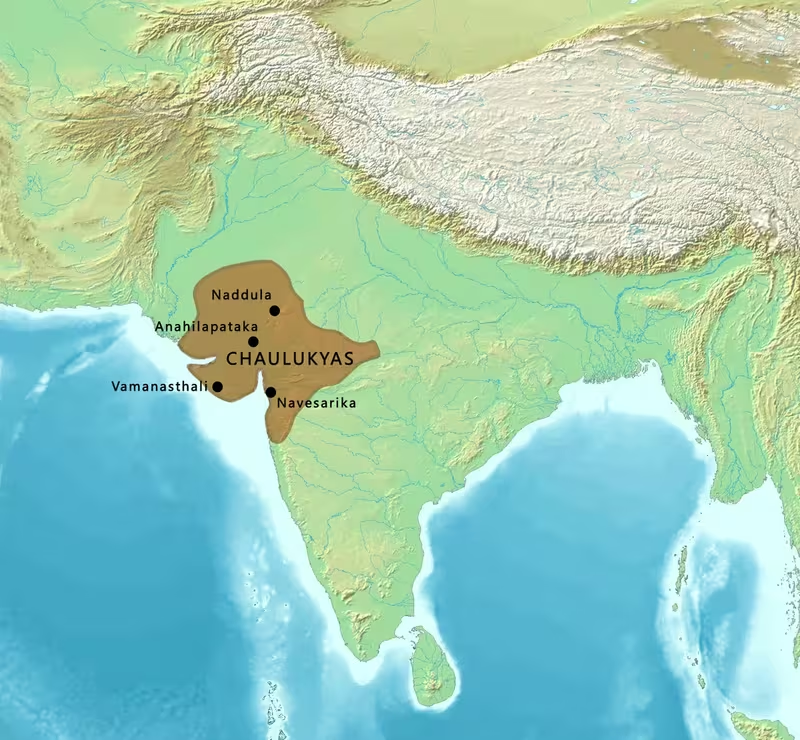
Overview
Around 940 CE, Mularaja displaced Samantasimha, the last ruler of the Chavda dynasty, and established a new royal house at Anahilavada, the city now associated with Patan in Gujarat. The dynasty that grew from this change of power became known as the Chaulukyas, while vernacular traditions more often called them Solankis. For roughly three centuries, their kingdom shaped the political history of Gujarat, Saurashtra, parts of Rajasthan, and, at its greatest extent, Malwa and territories farther east.
The Chaulukya kingdom was not a uniformly expanding empire. Its boundaries shifted according to the strength of its kings, the loyalty of feudatories, and the pressure exerted by neighbouring powers. Chudasamas contested Saurashtra, the Paramaras held or invaded Malwa and Arbuda, the Chahamanas challenged Chaulukya influence in Rajasthan, and the Chalukyas of Kalyani competed for control of Lata. In the late twelfth and early thirteenth centuries, the kingdom also faced Ghurid and Yadava attacks.
The dynasty reached its political height under Jayasimha Siddharaja and Kumarapala in the twelfth century. These rulers expanded Chaulukya authority, cultivated alliances with rival royal families, and presided over a court associated with Sanskrit learning, Jain scholarship, and ambitious temple construction. Their period also produced the Māru-Gurjara, or Chaulukya, style of architecture, whose influence extended well beyond Gujarat.
The kingdom weakened after Kumarapala. Rebellions, invasions, and the growing independence of provincial commanders reduced royal authority. The Vaghelas, originally Chaulukya generals, eventually took the throne in the 1240s and founded a new dynasty.
Rise to Power
The Chaulukyas emerged during the decline of two older political powers: the Gurjara-Pratihara and Rashtrakuta empires. In this changing political landscape, regional ruling houses competed to control Gujarat and its surrounding territories. Mularaja took advantage of this setting when he supplanted Samantasimha, the last Chavda king, around 940 CE.
Later accounts describe Mularaja as Samantasimha’s nephew, although the political circumstances of the transition are more firmly established than the details of their family relationship. His accession marked the beginning of Chaulukya power at Anahilavada. The city remained the dynasty’s principal capital throughout its history and served as the centre from which the rulers coordinated campaigns, alliances, and relations with subordinate chiefs.
Mularaja’s reign was marked by efforts to secure the kingdom’s western and southern frontiers. The twelfth-century writer Hemachandra states that Mularaja defeated Graharipu, the ruler of Saurashtra. He also records that Mularaja defeated Barapa, a Lata Chalukya chief, with the assistance of his son Chamundaraja. These campaigns indicate that the early Chaulukya kingdom was already involved in struggles over both Saurashtra and Lata, two regions that remained strategically important throughout the dynasty’s history.
Chamundaraja succeeded Mularaja around 996 CE. During his reign, the Paramara ruler Sindhuraja appears to have attacked Lata, which was then under Chaulukya suzerainty. Mularaja forced Sindhuraja to withdraw, although a later claim that Chamundaraja personally killed Sindhuraja in battle is doubtful. That story is absent from earlier accounts and is therefore treated cautiously.
The Chalukyas of Kalyani captured Lata sometime before 1007 CE under Satyashraya. Chamundaraja’s successor, Durlabharaja, attempted to recover the region. Around 1008 CE, he defeated the Lata Chalukya ruler Kirtiraja, also called Kirtipala, who was a subordinate of the Kalyani Chalukyas. The victory was temporary: Kirtiraja soon regained control, and the Paramara ruler Bhoja later defeated him. The contest over Lata demonstrates the difficulty of maintaining authority in a region claimed by several powerful houses.
The Early Eleventh Century and the Somnath Raid
Durlabharaja was succeeded by his nephew Bhima I. His reign began during a period of intense conflict and became closely associated with the invasion of the Ghaznavid ruler Mahmud in 1024–1025 CE.
Mahmud entered Chaulukya territory and raided the Somnath temple. Bhima withdrew to Kanthkot while the invasion proceeded, and the attack took place without a major Chaulukya field battle stopping the Ghaznavid army. After Mahmud’s departure, Bhima restored Chaulukya authority. The episode was a severe military and political shock, but it did not end the dynasty or permanently remove its control over Gujarat.
Bhima subsequently concentrated on restoring order and strengthening his position among subordinate chiefs. He suppressed revolts by Paramara leaders of Arbuda, who had previously served as Chaulukya feudatories. He also defeated and imprisoned Krishnadeva, a ruler of the Paramara branch at Bhinmal. His conflict with the Naddula Chahamana ruler Anahilla, however, ended badly. Anahilla’s sons Balaprasada and Jendraraja defeated Bhima and compelled him to release Krishnadeva.
Later accounts credit Bhima with a victory over Hammuka, a ruler of Sindh, but the accuracy of this episode is uncertain. The same caution applies to stories about Bhima’s role in the fall of the Paramara king Bhoja. Semi-legendary accounts state that Bhima allied with the Kalachuri ruler Lakshmi-Karna and that the two invaded Bhoja’s kingdom of Malwa from opposite directions. Bhoja reportedly died from illness during the campaign. Chaulukya writers later claimed that Bhima captured Bhoja’s capital, Dhara, or even seized Bhoja himself, but these claims are not supported by firm historical evidence.
The alliance with Lakshmi-Karna soon gave way to rivalry over the division of the gains. This pattern—temporary cooperation followed by competition—recurred frequently in western Indian politics. Rulers often needed the support of neighbouring dynasties against a common rival, but the same victories could create new disputes over territory and prestige.
Karna and the Struggle for Malwa and Lata
Bhima’s son Karna succeeded him around 1064 CE. His reign was marked by continued conflict with the Paramaras, Chahamanas, and Kalachuris.
The Paramara ruler Udayaditya, supported by the Shakambhari Chahamana king Vigraharaja III, forced Karna to retreat from Malwa. The Kalachuris meanwhile captured Lata. Karna recovered the region by 1074 CE and annexed it to the Chaulukya kingdom, but the conquest did not last. Within three years, a ruler named Trivikramapala had taken Lata from him.
Karna also faced the Naddula Chahamanas. Their ruler Prithvipala defeated him, and Prithvipala’s successor Jojalladeva occupied Anahilapataka, the Chaulukya capital. The occupation may have occurred while Karna was campaigning elsewhere. The Shakambhari Chahamana king Durlabharaja III also appears to have won a military success against Karna, although Chahamana accounts greatly magnify the scale of the victory.
The traditions surrounding Karna also preserve stories about his campaigns against Bhil and Koli communities, who are described as raiding Chaulukya territory. According to these accounts, Karna defeated a Bhil chief named Asha and founded a city called Karnavati. Some historians identify Karnavati with modern Ahmedabad, but that identification is not certain. The episode nevertheless reflects the way later narratives connected royal authority, territorial conquest, and the foundation of cities.
Karna’s reign did not produce the durable expansion achieved by his son Jayasimha, but it kept the Chaulukya kingdom active in the contests that shaped western and central India. Control of Lata and Malwa remained unstable, and the kingdom’s rulers had to balance direct campaigns with the management of feudatories.
Golden Age under Jayasimha Siddharaja
Karna’s son Jayasimha Siddharaja, who ruled approximately from 1092 to 1142 CE, transformed the Chaulukya kingdom into the leading power of much of western India. His reign is generally regarded as a high point in the dynasty’s political history.
Jayasimha defeated Khangara, also known as Navaghana, the Chudasama ruler of Saurashtra. This victory strengthened Chaulukya authority in the peninsula and brought an important western region more firmly within the king’s sphere. He also defeated the Shakambhari Chahamana ruler Arnoraja. Their relationship later changed from rivalry to alliance: Jayasimha accepted Arnoraja as an ally, and Arnoraja married Jayasimha’s daughter Kanchanadevi.
The marriage had consequences beyond a temporary diplomatic settlement. Their son Someshvara was raised at the Chaulukya court, and Someshvara’s sons included Prithviraja III, better known as Prithviraj Chauhan, and Hariraja. Through this connection, the Chaulukya court became linked to the later Chahamana ruling line of Ajmer and Delhi.
Jayasimha also expanded eastward. In 1135–1136 CE, he annexed the Paramara kingdom of Malwa with the support of Asharaja and Arnoraja. The Paramara rulers defeated in this campaign were Naravarman and his successor Yashovarman. Jayasimha continued as far as the Chandela kingdom, ruled by Madanavarman. The conflict with the Chandelas was inconclusive: both sides claimed victory, and the available accounts do not establish a decisive conquest.
His campaigns also included victories over smaller rulers. One of these was Sindhuraja, probably a Soomra ruler of Sindh. These operations extended Chaulukya influence and reinforced Jayasimha’s reputation as a conquering monarch, although the exact degree of direct administrative control in every conquered region is difficult to establish.
Jayasimha’s power rested not only on conquest. His use of subordinate rulers, marriage alliances, and local feudatories allowed the Chaulukya kingdom to project authority over a broad area without replacing every regional ruling house. The Chahamanas of Naddula and other chiefs could retain local power while acknowledging the Chaulukya king. This arrangement was effective when the central monarchy was strong, but it also created the conditions for later provincial autonomy.
Kumarapala and the Widest Extent of the Kingdom
Jayasimha was succeeded by his relative Kumarapala. The succession was not straightforward. Kumarapala had spent part of his early life in exile to avoid persecution by Jayasimha. After Jayasimha’s death, he returned to Anahilavada and ascended the throne in 1143 CE with the assistance of his brother-in-law Kanhadadeva.
Arnoraja opposed Kumarapala’s accession, but Kumarapala defeated him decisively. He appears to have supported Katukaraja, the son of his ally Asharaja, in capturing the throne of Naddula. Katukaraja’s younger brother Alhanadeva continued as Kumarapala’s vassal. These events show Kumarapala using succession disputes among neighbouring houses to preserve Chaulukya influence.
Relations with the Shakambhari Chahamanas later became more cooperative. Arnoraja’s son Vigraharaja IV subdued Chaulukya feudatories at Naddula, but the broader relationship improved when Someshvara—Arnoraja’s son and Jayasimha’s grandson—became a Chahamana ruler, possibly with Kumarapala’s support.
Kumarapala also intervened in Malwa. After Jayasimha’s death, the Paramara ruler Jayavarman I recovered the kingdom, but an usurper named Ballala soon displaced him. Kumarapala captured Malwa from Ballala, who was killed in battle by Yashodhavala, a Paramara feudatory of Arbuda serving the Chaulukyas. Kumarapala then suppressed a rebellion by Vikramasimha, another Paramara chief of Arbuda. The Paramara branch at Kiradu continued to acknowledge his overlordship.
In the early 1160s, Kumarapala sent an army against Mallikarjuna, the Shilahara ruler of northern Konkana. The campaign may have been a response to a Shilahara raid into southern Gujarat. It ended with Mallikarjuna’s death. Kumarapala’s Naddula Chahamana feudatory Alhanadeva also suppressed disturbances in Saurashtra at the king’s request.
At the height of Kumarapala’s authority, the kingdom extended from Chittor and Jaisalmer in the north to the Vindhyas and the Tapti River in the south. It included Kachchha and Saurashtra in the west and reached at least as far east as Vidisha, also known as Bhilsa. This was the broadest territorial description associated with Chaulukya power.
Kumarapala is also closely associated with Jainism. Jain accounts describe him as the last great royal patron of the faith, although the timing and nature of his conversion or patronage are presented through later religious traditions. His court was associated with Hemachandra, a major Jain scholar who wrote on grammar, literature, and dynastic history. The relationship between royal power and Jain intellectual culture became one of the defining features of the Chaulukya period.
Administration and Governance
The Chaulukya state was a hereditary monarchy centred on Anahilavada. The king’s authority depended on royal officials, military commanders, provincial governors, allied rulers, and feudatories. The surviving historical record gives a clearer picture of campaigns and dynastic relationships than of taxation, village administration, or the routine operation of the bureaucracy.
Feudatories formed an essential part of the political structure. The Chahamanas of Naddula and Jalor and the Paramara chiefs of Arbuda served the Chaulukya rulers at different times. Their obligations could include military assistance, suppression of local disturbances, and recognition of the Chaulukya king’s supremacy. In return, they retained authority in their own territories.
This system could produce impressive military coalitions. At Kasahrada in 1178 CE, a large army opposing the Ghurids included the Naddula Chahamana ruler Kelhanadeva, the Jalor Chahamana ruler Kirtipala, and the Arbuda Paramara ruler Dharavarsha. The participation of these chiefs demonstrates the military value of the feudatory network.
The arrangement was also vulnerable to political fragmentation. A feudatory who grew sufficiently powerful could resist royal commands or claim independence. During the reign of the young Bhima II, provincial governors rebelled, and the Vaghela commanders Arnoraja, Lavanaprasada, and Viradhavala became increasingly influential. By the final phase of the dynasty, Lavanaprasada and Viradhavala used royal titles such as Maharajadhiraja and Maharaja while still formally acknowledging Bhima II and later Tribhuvanapala.
The dynasty’s inscriptions used several forms of its name. Chaulukya was the normal self-designation, with variants such as Chaulukika, Saulkika, Chaulakya, and Chaullakya appearing in particular records. Solanki or Solankhi was the vernacular form that became prominent in later usage.
Military Campaigns and Foreign Invasions
Chaulukya military history was shaped by conflicts on several fronts. In the west, the dynasty fought the Chudasamas for Saurashtra. In the north and northeast, it faced the Chahamanas. In the east, it contended with the Paramaras of Malwa. In the south, Lata and northern Konkana linked the kingdom to the politics of the Deccan and western coast.
The 1024–1025 CE raid by Mahmud of Ghazni was the most famous early external attack. Mahmud entered the kingdom, raided Somnath, and departed before Bhima could mount an effective resistance. Bhima subsequently restored the kingdom and resumed campaigns against local rivals.
The Ghurid invasion of 1178 CE posed another serious threat. Muhammad of Ghor entered the Chaulukya kingdom, but his army was defeated at Kasahrada, also known as Kayadara. The Chaulukya victory depended on a broad coalition that included important feudatories. It demonstrated that the kingdom could still mobilize substantial regional support under Bhima II.
The political situation changed after the Ghurids defeated Prithviraja III and other major northern Indian rulers in the mid-1190s. On 4 February 1197, the Ghurid general Qutb al-Din Aibak invaded Anahilapataka and inflicted a major defeat on the Chaulukyas. Bhima’s generals Lavanaprasada and Shridhara later forced the Ghurid forces to withdraw, and the capital returned to Chaulukya control by 1201.
The recovery was temporary in its wider implications. Around 1204, Subhatavarman, the Paramara king of Malwa, invaded Lata and probably sacked Anahilapataka while the kingdom was still unsettled by the Ghurid attacks. Lavanaprasada and Shridhara again compelled the invader to retreat.
The Yadavas also attacked the southern Chaulukya territories under Jaitugi and Simhana, successors of Bhillama V. The Chaulukya feudatory Kelhanadeva forced Bhillama to withdraw in an earlier invasion, while Lavanaprasada and Viradhavala later resisted further Yadava attacks. These campaigns placed increasing pressure on the kingdom and exposed the limits of a monarchy dependent on powerful regional commanders.
Cultural Contributions
The Chaulukya period is particularly remembered for architecture. Māru-Gurjara architecture, also called the Chaulukya style, developed in Gujarat and Rajasthan between the eleventh and thirteenth centuries. Its later influence reached Jain temples across India and, through Jain communities, to locations beyond the subcontinent.
The style is associated with elaborate temple construction and with both Hindu and Jain religious patronage. The Modhera Sun Temple and the earliest of the Dilwara Temples were constructed during the reign of Bhima I. The religious identities of their patrons and the later histories of these monuments are distinct, but together they illustrate the range of sacred building under Chaulukya rule.
The dynasty’s founder Mularaja is said to have built the Mulavasatika temple for Digambara Jains and the Mulanatha-Jinadeva temple for Svetambara Jains. These traditions suggest that Jain communities were present at the royal centre from the earliest period of Chaulukya power.
A step-well associated with Queen Udayamati, the wife of Bhima I, is also preserved in popular tradition. The account credits her with commissioning the Queen’s step-well. The tradition reflects the broader association of Gujarat’s royal and mercantile communities with elaborate water architecture.
Religion at the Chaulukya court was not restricted to a single tradition. The rulers supported Hindu temples, Jain institutions, and, according to the historical account, mosques intended to maintain good relations with Muslim traders. Kumarapala’s later Jain patronage became especially prominent in Jain narratives, but the dynasty’s religious policy also included support for other communities.
The courtly culture of the dynasty included Sanskrit literary production. Hemachandra used the terms Chaulukya and Chulukya in his writings and recorded several additional forms of the dynastic name. The court poet Someshvara likewise used Chaulukya and Chulukya in works connected with the dynasty and its officials. These texts preserve political traditions while also showing the intellectual life of the royal court.
Economy and Trade
The available historical record provides limited detail about Chaulukya taxation, coinage, and commercial institutions. It does, however, place the kingdom in a region connected to important inland and coastal zones. Gujarat, Saurashtra, Kachchha, Lata, and northern Konkana were repeatedly contested because of their strategic and commercial value.
The dynasty’s control over Anahilavada gave it a stable political centre in northern Gujarat. Authority over Saurashtra and Kachchha extended the kingdom toward the western coast, while control of Lata connected it to southern Gujarat and the routes leading toward the Deccan. The repeated struggles over these areas indicate their importance to regional power.
The Chaulukyas endowed mosques to maintain good relations with Muslim traders. This policy suggests that commercial communities formed part of the kingdom’s political landscape and that the court recognized the value of accommodating merchants engaged in long-distance trade. The record does not provide enough information to reconstruct the scale or organization of this commerce in detail.
Temple construction also required substantial patronage from rulers, queens, religious communities, and local elites. The development of the Māru-Gurjara style, Jain temple networks, and step-well traditions indicates the availability of resources for major public and religious works, although the precise systems through which those resources were collected are not documented here.
Decline and Fall
The decline of Chaulukya power began after Kumarapala’s reign. Ajayapala retained much of Kumarapala’s territory but died after a short reign. His young sons, Mularaja II and Bhima II, succeeded him one after another. The minority and youth of the rulers gave provincial governors opportunities to challenge the central government.
During Bhima II’s reign, several governors rebelled in the hope of creating independent states. Arnoraja, a loyal Vaghela feudatory, came to the king’s aid and died fighting the rebels. His descendants Lavanaprasada and Viradhavala became the most powerful figures in the kingdom.
External pressure compounded internal instability. The Hoysala ruler Veera Ballala II appears to have raided Lata. Yadava armies invaded from the south, while the Shakambhari Chahamana ruler Prithviraja III fought the Chaulukyas. Bhima’s general Jagaddeva eventually negotiated peace with Prithviraja before 1187.
The Ghurid occupation of Anahilapataka in 1197 exposed the vulnerability of the royal centre, even though Chaulukya generals recovered the capital. The Paramara invasion around 1204 created another crisis. Between 1205 and 1210, Bhima’s relative Jayantasimha, also called Jayasimha, usurped the throne. In the early 1210s, the Paramara ruler Arjunavarman defeated Jayantasimha and later formed a matrimonial alliance with him. Bhima eventually regained the throne between 1223 and 1226.
The Yadava invasions continued, and Chaulukya feudatories in northern Marwar rebelled. Lavanaprasada and Viradhavala suppressed both the Yadava attacks and the rebellions. The Guhilas of Medapata, associated with Mewar, also rebelled sometime between 1207 and 1227 and declared their independence.
By the end of Bhima’s reign, Lavanaprasada and Viradhavala had adopted grand royal titles, although they still nominally acknowledged Bhima and his successor Tribhuvanapala. After Tribhuvanapala, the Vaghelas took the throne in the 1240s. This transfer ended Chaulukya rule and began the Vaghela dynasty.
Legacy
The Chaulukyas left a lasting mark on the history of Gujarat and Rajasthan. Their capital at Anahilavada remained a major centre of political authority, while their campaigns connected Gujarat to the wider struggles of Malwa, Rajasthan, Sindh, the Deccan, and northern India.
Their architectural legacy is especially enduring. The Māru-Gurjara style developed under Chaulukya rule and later became strongly associated with Jain temple construction. Its influence spread across India and to diaspora communities around the world. The Modhera Sun Temple, the Dilwara tradition, and the step-well associated with Queen Udayamati remain connected to the cultural memory of the period.
The dynasty’s religious history also shaped its later reputation. Mularaja’s association with both Digambara and Svetambara Jain foundations, Kumarapala’s patronage of Jainism, Hindu temple construction, and support for mosques serving Muslim traders all point to a politically varied religious environment.
The name Solanki continued after the dynasty itself disappeared. The Vaghelas claimed descent from a sister of Kumarapala, while several later princely-state families calling themselves Solanki claimed Chaulukya ancestry. Among them were the rulers of Lunavada, a state that was tributary to the Marathas before coming under British rule.
The history of the Chaulukyas also illustrates the limits of dynastic origin stories. Their records generally used the name Chaulukya, but later traditions linked them to several different genealogies. A Brahma-created hero emerging from a vessel or folded palm appears in royal origin legends shared with other Chalukya-related houses. The Agnikula story, which presents several Rajput clans as born from a fire-pit on Mount Abu, was associated with the Chaulukyas only in later accounts.
These legends are valuable evidence for how later communities understood political ancestry, but they do not establish a single historical origin. The Chaulukyas themselves did not claim the Agnikula origin in their early records, and evidence connecting them definitively to other Chalukya dynasties or to a foreign tribal origin remains inconclusive.