Overview
At Mukhalingam, near the modern Odisha–Andhra Pradesh border, the early Eastern Ganga kingdom developed around Kalinganagara and a network of territories in southern Kalinga. From these beginnings in the fifth century, the dynasty grew into the power that ruled much of Odisha, northern Andhra Pradesh, and adjoining regions. Its political history is conventionally divided into three phases: the Early Eastern Gangas, ruling approximately from 493 to 1077; the Imperial Eastern Gangas, ruling from about 1077 to 1436; and the Khemundi Gangas, whose branches continued until the end of princely and zamindari authority in modern India.
The dynasty is especially remembered for its religious and architectural patronage. The Jagannath Temple at Puri, the Konark Sun Temple, the Madhukeswara temple at Mukhalingam, the Ananta Vasudeva Temple at Bhubaneswar, and other monuments are associated with the Ganga period or its continuing traditions. These buildings were not isolated expressions of royal devotion. They represented political authority, the organization of resources, the patronage of religious institutions, and the cultural formation of Odisha.
The Eastern Gangas are distinguished from the Western Gangas of Karnataka. Their own traditions and inscriptions connected them with a lunar lineage, while the Western Gangas claimed descent from the solar line. At the same time, inscriptions, scripts, temple forms, dynastic relationships, and genealogical traditions have led several historians to argue that the Eastern Gangas had an important connection with the Western Ganga country of Karnataka. The precise details of this relationship remain debated, but the evidence points to sustained links between Kalinga and the Deccan.
The dynasty’s history also reflects the changing geography of eastern India. Its rulers fought the Vishnukundinas, Somavanshis, Cholas, Kalachuris, rulers of Bengal, and forces associated with the Delhi Sultanate. They governed a territory in which Telugu was important in the earlier court, while Odia gained official standing in the later medieval period. Their gold fanams, provincial administration, regnal calendar, temples, and surviving branches all show how the dynasty connected political power with regional institutions.
Rise to Power
Kalinga after the Mahameghavahanas
After the decline of the Mahameghavahana dynasty, Kalinga was divided among several smaller kingdoms and feudatory chiefships. Their rulers used titles such as Kalingadhipathi, meaning “lord of Kalinga.” In the fourth century, parts of the region were also connected to the wider political world of the Guptas, while local dynasties such as the Pitribhaktas, Matharas, and Vasishthas rose in southern Odisha.
The Eastern Gangas emerged in southern Kalinga during the fifth century. The earliest phase of their history is difficult to reconstruct because the surviving records are uneven and later genealogies combine political memory with dynastic claims. Indravarman I is the earliest known independent ruler of the dynasty and is known from the Jirjingi copper-plate grant. He is also described as the effective founder of the Ganga kingdom in Kalinga.
The early Ganga rulers controlled territory around Dantapura and Kalinganagara. Dantapura is identified with modern Dantapuram in the Srikakulam district of Andhra Pradesh. Kalinganagara, in turn, is identified with Mukhalingam, also near Srikakulam. The two places formed an important political centre in a region where southern Kalinga, the Godavari country, and the eastern Deccan met.
The Indravarman tradition
The early rise of Indravarman I is connected with a conflict against the Vishnukundina ruler Indrabhattaraka. The Godavari grant of Raja Prthivimalla and the Ramatirtham grant associated with the Vishnukundina king refer to a major conflict known as the Chaturdanta Samara, or battle of the four-tusked elephants. According to this account, Indravarman, the son of Mitavarman, commanded an alliance of small kingdoms in southern Kalinga against the Vishnukundina monarch.
Indravarman’s victory allowed him to establish an independent position. He adopted the title Trikalingadhipati, “lord of the three Kalingas,” and moved his political centre northward in response to Vishnukundina pressure. The title was an important statement of ambition. It referred to the three broad regions of Kalinga: Kalinga proper in the south, Utkala in the north, and Dakshina Kosala to the west.
Indravarman’s son Hastivarman continued the struggle for power. His kingdom stood between the Vigrahas of South Toshali and the Mudgalas, two ruling houses associated with the political structure of Odisha. Hastivarman took part in campaigns against the Vigrahas and claimed authority over northern parts of ancient Kalinga. His title Sakala-Kalingadhipati, “ruler of the whole of Kalinga,” expressed the same wider political aim.
The early Eastern Gangas did not always rule as fully independent monarchs. A Ganga ruler named Jayavarmadeva described himself as a subordinate of Sivakara Deva I of the Bhauma-Kara dynasty in a Ganjam grant. This indicates that the Gangas could remain influential regional rulers while acknowledging a stronger central authority. The dynasty’s rise therefore took place through alternating phases of independence, alliance, and subordination.
Karnataka connections and the Mahendra region
Several records connect the Eastern Ganga royal family with Gangawadi in present-day Karnataka. The Korni and Visakhapatnam copper plates of Anantavarman Chodaganga, the Dasgoba copper plate of Rajaraja III, and the Nagari copperplate of Anangabhima III trace the lineage back to Kamarnava I. The Kendupatna copper plate of Narasimhadeva II and the Puri copper plate of Narasimhadeva IV also state that Kamarnava came from Gangawadi.
The Korni plate describes Kamarnava I as the eldest son of Virasimha. He is said to have left Kolahalapura, identified with Kuvalalapura or Kolar, after giving up his rightful claim to the throne to his paternal uncle. He travelled east with four brothers, reached the Mahendra mountain, worshipped Shiva as Gokarnaswamin, and received the bull emblem associated with the deity. He then descended on the eastern side of the mountain, defeated a local ruler called Sabaraditya or Baladitya, and acquired Kalinga.
This account is a dynastic origin tradition rather than a simple political chronicle. It presents migration, divine sanction, conquest, and royal legitimacy as parts of one story. Historians have nevertheless found supporting evidence for a Karnataka connection. The script used by the seventh-century ruler Indravarman resembles the common Telugu-Kannada script used by the Badami Chalukyas and the Vengi Chalukyas. Some features of Eastern Ganga temple architecture also resemble forms associated with Karnataka.
The relationship between the Western and Eastern Gangas is not accepted in precisely the same way by all historians. The Western Gangas claimed solar descent through the Ikshvaku line, while later Eastern Ganga genealogies claimed lunar descent through Vishnu, Brahma, Atri, and Chandra. Yet links between the two regions appear in inscriptions, architecture, religious traditions, and marriage relations. The Eastern Kadambas, who served as chiefs, governors, and feudatories under the Eastern Gangas, provide another connection with Karnataka.
The deity worshipped at Mahendragiri also formed part of this wider religious geography. Early and later Eastern Ganga rulers repeatedly referred to the sacred feet of Gokarneswara. The deity was connected by tradition with the Mahabaleshwar temple at Gokarna in Karnataka. Later records also associated the Kalinga deity with Madhukeswara or Jayanteswara. This combination of names suggests that the migration traditions, the Eastern Kadamba presence, and the religious landscape of Mahendragiri were closely intertwined.
Revival in the eleventh century
After the early Ganga period, the Chalukyas of Vengi gained control over parts of the region. The Ganga line was revived by Vajrahasta Aniyakabhima I, also called Vajrahasta IV, who ruled approximately from 980 to 1015. He benefited from internal conflict and restored Ganga power in Kalinga. During this later phase, Shaivism became particularly prominent, and the great temple complex at Mukhalingam was built or developed.
The decisive transformation came during the reign of Anantavarman Vajrahasta V in the mid-eleventh century. He defeated rival powers, made land grants to three hundred Brahmin families, and assumed the titles Trikalingadhipati and Sakala-Kalingadhipati. His claims challenged the centralized authority of the Somavanshi dynasty and prepared the way for the imperial phase of Eastern Ganga rule.
Vajrahasta V was followed by Devendravarman Rajaraja I, who defeated the Somavanshi king Mahasivagupta Janmenjaya II and established Ganga authority in the Vengi region. He also fought the Cholas. The conflict was eventually accompanied by a marriage alliance: the Chola princess Rajasundari married the Eastern Ganga ruler. This combination of war and dynastic marriage helped stabilize relations between the two royal houses.
Golden Age
Anantavarman Chodaganga
The imperial era began with Anantavarman Chodaganga, who succeeded Rajaraja I in approximately 1077. He inherited a kingdom that had already recovered from the weakness of the preceding period, but his reign expanded Ganga power on a much larger scale.
At the beginning of his rule, the Cholas attacked from the south and temporarily took part of the Ganga kingdom, including the territory around Visakhapatnam. Chodaganga gradually recovered the lost lands. He also conquered Utkala from the Somavanshi rulers, extending the Ganga realm into northern Odisha. His campaigns continued eastward against the Pala sphere of influence. He defeated the chief of Mandara, sacked his capital at Aramya—identified with modern Arambagh in Hooghly district—and pursued him toward the Ganges. During these operations, he appears to have received support from Vijayasena, a ruling chief in Radha.
The geographical scale attributed to Chodaganga’s reign is considerable. He is described as ruling from the Ganges in the north to the Godavari in the south. His title Trikalingadhipati expressed authority over the three divisions of Kalinga and marked the consolidation of Kalinga, Utkala, and western territories under one dynasty.
Chodaganga’s reign also marked an important religious transition. Although the Gangas had long been associated with Shaivism, Chodaganga later embraced Srivaishnavism under the influence of Ramanuja. In his Sindurapura grant, he described himself as Paramavaishnava. This did not erase the Shaiva character of earlier Ganga rule. Instead, it shows how the dynasty could incorporate different forms of Hindu devotion within its royal identity.
The construction of the Jagannath Temple at Puri is associated with Chodaganga’s reign. The temple became one of the central institutions of Odisha, joining royal authority, pilgrimage, ritual service, and regional identity. The temple’s later history extends beyond the Ganga dynasty, but its association with Chodaganga remains one of the defining memories of his reign.
The later imperial rulers
Chodaganga was succeeded by Kamarnava VII, his eldest son. Kamarnava fought the Kalachuris of Ratnapura for control of the Sambalpur–Bolangir tract but was unsuccessful. The rulers who followed—Raghava Deva, Rajaraja Deva II, and Anangabhima Deva II—are presented in the surviving account as having less eventful reigns than the great expansion under Chodaganga.
Rajaraja Deva III came to the throne in 1198. In 1205, Bakhtiyar Khalji sent Muhammad Sheran Khalji with part of his forces toward Jajnagar. The invading force advanced as far as Lakhnauti but withdrew without invading Odisha after Bakhtiyar Khalji’s death. This episode is treated as the first attempted Muslim invasion of Odisha, and it was unsuccessful.
Anangabhima Deva III became ruler in 1211. He recovered the western Sambalpur–Bolangir tract from the Kalachuris of Ratnapura after a long history of conflict between the two powers. The Chateshwar Temple inscription credits Vishnu, the Brahmin minister of Anangabhima, with playing a prominent role in the victory. The inscription presents the Kalachuri ruler as so frightened by Vishnu that he imagined seeing the minister everywhere in his kingdom.
Anangabhima also faced the forces of Ghiyasuddin Iwaz Shah, the governor of Bengal. The Bengal ruler attempted to conquer Odisha but was repulsed by the Ganga army. The Tabaqat-i Nasiri states that the Bengal governor took tribute from the Odishan king, but this claim has been rejected by the scholars cited in the historical account. During Anangabhima’s reign, Odisha remained free from successful Muslim conquest.
Narasimha Deva I and the northern campaigns
Narasimha Deva I, the son of Anangabhima III, was among the most powerful Eastern Ganga rulers. He followed an aggressive military policy and carried Ganga power northward. He captured Lakhnor and ended Muslim rule in Radha. In 1245, he advanced into Varendra as far as Lakhnawati and besieged the capital.
The siege did not last. The ruler of Bengal requested reinforcements from the Delhi Sultanate, and the campaign did not lead to the permanent annexation of Bengal. Nevertheless, Narasimha’s expedition demonstrated that the Eastern Gangas were not merely defending Odisha; they could also carry war into the political sphere of Bengal.
The Konark Sun Temple is associated with Narasimha Deva I and is described as a commemoration of his victory. The temple’s scale, iconography, and architectural ambition reflect the resources available to the imperial court. It also connected royal power with the worship of the sun. Narasimha was the first Odishan king known to use the title Gajapati, meaning “lord of war elephants” or “king with an army of elephants,” in a 1246 inscription at the Kapilash Temple.
Narasimha Deva I’s reign represents the high point of Ganga military power. The dynasty controlled a broad territory, resisted attacks from the west and north, and invested in monumental architecture. Yet the political structure remained vulnerable to the pressures that emerged after his death.
Administration and Governance
The Ganga state was a monarchy in which the emperor stood at the top of the administrative and military order. The empire was divided into large provinces called maha-mandalas. Each maha-mandala was governed by a mahamandalika. These provincial divisions were further divided into mandalas, which were subdivided into visayas resembling districts.
The administration reached the village through the grama. Villages functioned as self-governing units under a gramika. Other village officials included the karanika, who acted as an accountant; the dandapani, associated with policing; and the gramavatta, who served as a village watchman. This structure combined royal authority with local administration rather than replacing local communities with a single uniform bureaucracy.
The surviving descriptions emphasize offices and territorial divisions more clearly than they do taxation. Land grants were an important part of political and religious policy. Vajrahasta V is said to have made grants to three hundred Brahmin families after his victories. Copper-plate records preserved such grants and recorded royal claims, genealogies, religious affiliations, and administrative authority.
The Ganga military system had several ranks and designations. The emperor was the supreme commander and was assisted by a commander-in-chief. Military officers included the Maha Senapati, Senapati, Maha Pasayati, Pasayati, Dalapati, and Nayaka. The presence of these titles in plates and inscriptions indicates a developed hierarchy of command.
The empire also maintained a royal navy during the reign of Chodaganga. Its ports and fortified cities supported both military security and trade. The state’s geography—stretching along the coast and across the routes linking Kalinga with the Deccan and Bengal—made maritime and riverine communications important.
Language and court culture
Telugu served as an official language of the court during the early medieval period. This reflects the dynasty’s political base in southern Kalinga and its connections with the Telugu-speaking areas of the eastern Deccan. As the empire expanded northward, Odia gained official status in the later medieval period. The emergence of Odia from Odra Prakrit formed part of a broader process of regional cultural consolidation.
The use of more than one political language did not indicate a divided kingdom. It reflected the changing geographical centre of power and the variety of communities governed by the dynasty. Inscriptions and grants are therefore important not only for reconstructing political history but also for understanding the development of regional languages.
The Anka regnal-year system
The Eastern Gangas used a distinctive regnal-year system called the Anka year. An Anka year did not correspond in a simple way to the number of solar years that had passed since a ruler’s accession. Its rules produced a calculation different from the ordinary duration of a reign.
The system survived beyond the imperial dynasty and remains part of the Odia calendar. The regnal year is connected with the titular reign of the Gajapati Maharaja of Puri. In this way, an administrative convention of the medieval Ganga period became part of a continuing calendrical and royal tradition.
Military Campaigns
The Eastern Ganga military history began with the struggle against the Vishnukundinas. Indravarman I’s victory in the Chaturdanta Samara enabled him to establish independence and claim authority over the three Kalingas. Hastivarman continued campaigns against the Vigrahas and expanded Ganga influence into northern Kalinga.
For several centuries, the dynasty alternated between regional strength and subordinate status. Its rulers faced the Bhauma-Karas, the Chalukyas of Vengi, and other regional powers. The revival under Vajrahasta IV restored Ganga political authority, while Vajrahasta V transformed that authority into a direct challenge to the Somavanshis.
The conflicts with the Somavanshis were especially important because they determined who would control northern Odisha. Vajrahasta V adopted expansive titles after his victories, and Rajaraja I later defeated Mahasivagupta Janmenjaya II. These campaigns laid the territorial foundation for the imperial kingdom of Chodaganga.
Relations with the Cholas combined confrontation and diplomacy. Chola forces temporarily occupied parts of the Ganga kingdom during Chodaganga’s early reign, but he recovered the lost territory. The marriage between the Chola princess Rajasundari and the Eastern Ganga ruler helped settle relations between the two dynasties. The episode illustrates the importance of dynastic marriages in a region where war and alliance were closely connected.
The Kalachuris of Ratnapura controlled the Sambalpur–Bolangir tract at different points and became persistent rivals. Kamarnava VII failed to take the region, while Anangabhima III later recovered it. The struggle shows that Ganga authority was not equally secure in every part of the empire. Western Odisha remained a zone of competition among the Gangas, Kalachuris, and other regional powers.
The northern campaigns of Narasimha Deva I brought the dynasty into direct conflict with Muslim rulers in Bengal. His forces captured Lakhnor, entered Radha, and advanced to Lakhnawati. The campaign did not create permanent Ganga control over Bengal, but it checked the expansion of Bengal’s Muslim power into Odisha during his reign.
The first recorded attempt associated with Bakhtiyar Khalji’s forces occurred in 1205, when Muhammad Sheran Khalji advanced toward Jajnagar but withdrew without invading Odisha. Ghiyasuddin Iwaz Shah later attempted to conquer the kingdom and was repulsed by Anangabhima III’s forces. After Narasimha Deva I, however, the political balance changed. The sultan of Delhi, Firuz Shah Tughlaq, invaded Odisha between 1353 and 1358 and levied tribute on the Ganga king.
The military system that had supported expansion therefore increasingly became a defensive institution. The empire’s decline was gradual rather than the result of one single defeat. External pressure, the weakening of central authority, and the loss of territory reduced the power of later rulers.
Cultural Contributions
Temple architecture
The Eastern Gangas were major patrons of religious architecture. Their temples are among the most recognized examples of the Kalinga and Hindu architectural traditions. The monuments connected with their rule include the Jagannath Temple at Puri, the Konark Sun Temple, the Madhukeswara temple at Mukhalingam, the Nrusinghanath Temple at Simhachalam, the Ananta Vasudeva Temple at Bhubaneswar, the Chateshwar Temple, the Meghesvara Temple, and the Nagnath Temple.
The Mukhalingam complex is particularly important for the early Ganga period. The temples are associated with Shaiva worship and with the development of architectural forms that show connections with the Deccan. Percy Brown suggested that the temples of Mukhalingam predated those of Bhubaneswar and reflected Badami Chalukya forms originating in Karnataka. A temple tower in Odisha combines Rekha and Pidha Deul decorative types, forms also associated with earlier Kadamba architecture.
These comparisons do not establish that every architectural feature was imported from Karnataka. They do, however, support the argument that the Eastern Ganga kingdom participated in a wider exchange of architectural techniques, religious forms, and artistic traditions between Karnataka, the eastern Deccan, and Kalinga.
The Madhukeswara temple at Mukhalingam was associated with the Eastern Kadambas and the religious traditions of Banavasi. One interpretation holds that Kamarnava II built the temple at the request of an Eastern Kadamba feudatory and relative. Another view suggests that the temple already existed as a shrine to Gokarneswara and was renovated and renamed Madhukeswara. Inscriptions reportedly used the names Madhukeswara, Jayanteswara, and Gokarneswara for the deity, preserving the layered connections between Kalinga and Karnataka.
Puri and the Jagannath tradition
The Jagannath Temple at Puri is the most influential religious monument associated with the Eastern Gangas. Its construction is linked to Anantavarman Chodaganga. The temple became a major pilgrimage centre and an institution closely connected with the political identity of Odisha.
The temple’s significance cannot be reduced to royal construction alone. Its religious traditions developed over time, and its institutional life continued under later dynasties. Yet the Ganga period gave the shrine a powerful place within the political and cultural order of the kingdom. The temple represented a meeting point of royal patronage, pilgrimage, ritual service, and regional identity.
Chodaganga’s transition from a predominantly Shaiva dynastic environment toward Srivaishnavism also provides an important context for the development of the Puri tradition. His self-description as Paramavaishnava shows that Vaishnava devotion had acquired a place in royal ideology even as Shaiva temples continued to flourish.
Konark and royal commemoration
The Sun Temple at Konark is associated with Narasimha Deva I. It was built to commemorate his victory in the northern campaigns. The temple therefore functioned both as a religious monument and as a royal statement. Its dedication to the sun connected the ruler’s achievements with a cosmic and divine order, while its monumental scale displayed the resources of the imperial state.
The temple is part of the broader architectural legacy of the Ganga period, in which military success, religious patronage, and the projection of kingship were closely linked. The construction of such monuments required the organization of labour, materials, skilled artisans, and ritual authorities. Their survival provides physical evidence for the strength and ambition of the imperial court.
Shaivism and Vaishnavism
The Gangas were strongly associated with Shaivism. The temples at Mukhalingam, Chateshwar, Meghesvara, and Nagnath demonstrate the continuing importance of Shiva worship. The deity of Mahendragiri, Gokarneswara, was particularly important in dynastic tradition.
At the same time, the dynasty supported Vaishnavism. Chodaganga’s adoption of Srivaishnavism under Ramanuja’s influence and his use of the title Paramavaishnava indicate the growing importance of Vaishnava theology in the royal sphere. The Ananta Vasudeva Temple at Bhubaneswar reflects the wider presence of Vaishnava temple worship in Odisha.
The evidence suggests not a simple replacement of one religious tradition by another, but a broadening of royal patronage. Shaiva, Vaishnava, and other Hindu institutions existed within the political world of the Ganga kingdom.
Economy and Trade
The Eastern Ganga kingdom prospered through trade and commerce. Its wealth was used substantially for the construction and maintenance of temples. The kingdom’s coastal position connected it with ports, fortified cities, river routes, and inland corridors leading toward the Deccan and northern India.
The existence of a royal navy during Chodaganga’s reign indicates that maritime movement formed part of the state’s strategic world. The coastline of Kalinga offered access to sea routes, while the Godavari and other river systems linked the coast with inland territories. Control of ports and fortified cities supported both commercial activity and military operations.
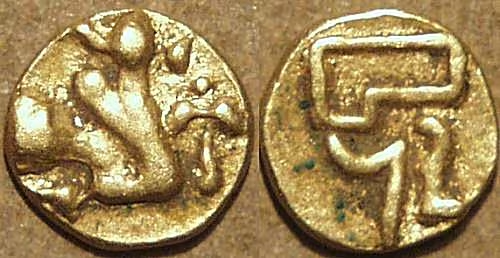
The dynasty’s currency consisted of gold fanams. The obverse generally showed a couchant bull accompanied by other symbols. The reverse carried a sign representing the letter sa, understood as an abbreviation of samvat, meaning year. This was often flanked by elephant goads or accompanied by an elephant goad and battle axe. A number below represented the ruler’s regnal year according to the Anka system. Some coins also carried the legend śrī rāma.
The dating system on the coins is particularly notable. Earlier coinages, including those of the Western Satraps and Guptas, used separate symbols for units, tens, and hundreds. A number such as 123 could be represented through symbols for 100, 20, and 3. Eastern Ganga coins instead used single-digit symbols whose position indicated tens or hundreds. This produced a place-value system resembling the use of zero as a positional placeholder.
Land grants formed another part of the economic and political order. Royal grants to Brahmins, temples, and religious institutions transferred rights over land and established relationships between the court and local elites. The grant of land to three hundred Brahmin families by Vajrahasta V is an example of how conquest and patronage could be joined. Such grants also helped extend the dynasty’s influence into newly incorporated territories.
Decline and Fall
The imperial Eastern Ganga kingdom began to weaken after the death of Narasimha Deva I in 1264. The dynasty continued to rule for more than a century, but the balance of power changed. The sultan of Delhi invaded Odisha between 1353 and 1358 and imposed tribute on the Ganga ruler. The Musunuri Nayaks defeated Odishan forces in 1356, adding to the pressures on the kingdom.
The later rulers—Bhanu Deva I, Narasimha Deva II, Bhanu Deva II, Narasimha Deva III, Bhanu Deva III, and Narasimha Deva IV—maintained the dynasty, but their reigns did not reproduce the expansion associated with Chodaganga and Narasimha Deva I. The empire’s political centre and military capacity were increasingly challenged.
Narasimha Deva IV is identified as the last known ruler before the final transition. He ruled until approximately 1425. He was followed by Bhanu Deva IV, sometimes described in the historical tradition as a “mad king.” Bhanu Deva left no inscriptions, making his reign more difficult to reconstruct. His minister Kapilendra eventually seized power in 1434–35 and founded the Suryavamsha dynasty.
The end of the imperial line did not mean the disappearance of the Ganga family. A branch survived at Paralakhemundi, and other branches ruled regional estates and princely territories. The historical account therefore distinguishes between the end of the imperial Eastern Ganga state and the continued existence of Ganga-descended houses.
The Khemundi branch is said to have begun in the fourteenth century when Narashingha Deba, a son of Bhanudeva II, established the Khemudi kingdom. Later branches included the Paralakhemundi, Badakhemundi, Sanakhemundi, Hindol, Bamanda, and Chikiti lines. These houses continued in different forms until the abolition of zamindari and the integration of princely states into independent India.
Legacy
The Eastern Ganga legacy is most visible in the landscape of Odisha. The Jagannath Temple at Puri and the Konark Sun Temple have become central symbols of the region’s religious and architectural heritage. Mukhalingam preserves the memory of the earlier Ganga capital and the dynasty’s connections with the eastern Deccan and Karnataka. Other temples across Odisha and Andhra Pradesh show the breadth of Ganga patronage.
The dynasty also contributed to the formation of a distinct Odishan political culture. Its rulers brought together Kalinga, Utkala, and Dakshina Kosala within an imperial framework, while the later use of Odia in official contexts supported the growth of regional identity. The Anka calendar and the Gajapati tradition at Puri preserve institutional memories that outlasted the medieval kingdom.
The surviving branches demonstrate how dynastic identity could persist after imperial authority ended. The Paralakhemundi line remained influential into the modern period. Jagannatha Gajapati Narayana Deo II ruled in the eighteenth century, when Odisha was contested by the Mughals, Marathas, French, and British. Krushna Chandra Gajapati, who ruled Paralakhemundi from 1913 to 1974, was regarded as an architect of a united Odisha and became the first prime minister of the Orissa province formed in 1936. Gopinath Gajapati later served in the Lok Sabha, and Kalyani Gajapati became the titular head of the dynasty in 2020.
Other Ganga-descended branches also entered modern political history. The Hindol state was established in 1554 by Chandradeva Jenamani and Udhavadeva Jenamani, associated with the Badakhemundi family. The Bamanda kingdom was established by Saraju Gangadeb, whose family traced descent through a local Ganga administrator. The Chikiti line was connected with the ancient Svetaka mandala of the Early Gangas. These branches acceded to India and became part of Odisha after independence in 1947.
The dynasty’s relationship with the wider eastern Indian world is also remembered through traditions about Kalinga Magha and the Jaffna kingdom. Kalinga Magha was believed to have been a prince of the Chodaganga line, although this connection is presented as a belief rather than an established fact. Such traditions reflect the reach of Kalinga’s political and cultural memory beyond the territory directly ruled by the Eastern Gangas.
The Eastern Gangas should therefore be understood not only as builders of individual temples or as opponents of successive invaders. They created a political order that connected coastal commerce, military power, religious institutions, regional languages, and monumental architecture. Their imperial state eventually declined, but the institutions, sacred sites, and dynastic branches associated with it continued to shape Odisha’s historical identity.