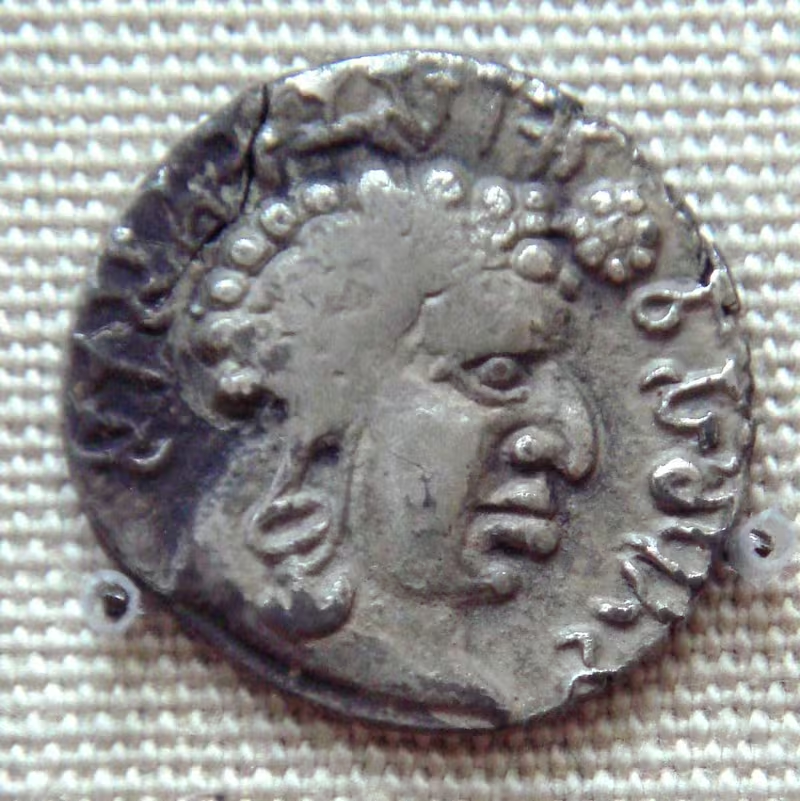
Overview
At its height, the Satavahana kingdom linked the western Deccan, the Krishna-Godavari region, inland market towns, and the maritime routes of the Indian Ocean. Its rulers governed from changing centres that included Pratishthana, present-day Paithan in Maharashtra, and Amaravati or Dharanikota in the eastern Deccan. Their political history unfolded across a broad region corresponding mainly to modern Maharashtra, Telangana, and Andhra Pradesh, with periods of authority in parts of Gujarat, Madhya Pradesh, Karnataka, and Kalinga.
The dynasty is usually dated from approximately the late 2nd or 1st century BCE to the early 3rd century CE. The precise beginning remains disputed. The Puranas preserve traditions of an Andhra dynasty that ruled for several centuries and describe its first king as overthrowing the Kanva dynasty. Archaeological and numismatic evidence, however, does not securely support every early date proposed from those texts. Most modern historians therefore place the effective beginning of Satavahana rule later than the earliest chronology derived from the Puranas.
The name itself is also uncertain. Forms such as Satavahana, Satakarni, Satakani, and Shalivahana appear in inscriptions, coins, literary works, and later traditions. The Puranas call the dynasty the Andhras, Andhra-bhrityas, or Andhra-jatiyas, but the word does not occur in the dynasty’s own records as a dynastic name. It may have referred to an ethnic identity, a territory, or a political association remembered by later writers.
The Satavahanas were more than a succession of kings. They formed a political and cultural bridge across the subcontinent. Their rule connected the Indo-Gangetic world with the southern tip of India, facilitated trade with the Roman Empire, supported Buddhist and Brahmanical institutions, and encouraged the production of sculpture, painting, literature, and coinage. Their inscriptions also preserve evidence of officials, provincial organisation, religious donations, merchants, guilds, and the social groups that sustained the kingdom.
Rise to Power
The question of origins
The Satavahana homeland cannot be identified with complete certainty. Two major possibilities have been debated. One places the dynasty’s origin in the eastern Deccan, especially the historic Andhra region of present-day Andhra Pradesh and Telangana. The other locates its first political base in the western Deccan, particularly around Pratishthana and the northern Maharashtra region.
The eastern-Deccan theory draws attention to the Puranic use of the name Andhra and to coins found at Kotilingala in Telangana. These coins bear the legend of a ruler named “Rano Siri Chimuka Satavahanasa.” Coins attributed to Kanha and Satakarni I have also been reported from the site. Some historians have identified Chimuka with Simuka, the founder named in Satavahana genealogical traditions, and have viewed Kotilingala as an early centre of Satavahana authority.
That interpretation is not universally accepted. The Kotilingala coin sample is small, and the coins may have reached the settlement from another mint. The identification of Chimuka with the founder Simuka has also been challenged. Some scholars have treated Chimuka as a later ruler, while P. V. P. Sastry, who initially identified the two figures, later distinguished them. The Puranas themselves may have been compiled or redacted after the Satavahana period, making it difficult to know whether the dynasty was called Andhra during its own time.
The western-Deccan theory rests especially on the distribution of early inscriptions. The earliest known Satavahana inscriptions are concentrated in and around western Deccan sites such as Nashik and Naneghat. The Pandavleni inscription at Nashik belongs to the reign of Kanha. Naneghat preserves the inscription of Nayanika, widow of Satakarni I, while a later inscription connected with Satakarni II was found at Sanchi in Madhya Pradesh. Coins attributed to Kanha and Satakarni I have also been found at Nevasa, Nashik, and Pauni.
This evidence has led some historians to propose that the dynasty first rose around Pratishthana and then expanded eastward. The conclusion remains tentative because the surviving early evidence is limited. The absence of early eastern-Deccan inscriptions may reflect the accidents of preservation rather than the actual absence of Satavahana authority.
Other theories have connected the dynasty with Karnataka or with a territory called Satavahanihara or Satahani-rattha. These proposals likewise remain debated. Inscriptions from Bellary belong mainly to the later phase of Satavahana history, and the evidence does not provide a simple answer. The most responsible conclusion is that the dynasty’s early political base remains uncertain, although western Deccan evidence is especially strong for its earliest securely documented phase.
Simuka and the foundation of the dynasty
Simuka is named as the first ruler in a royal list associated with the Naneghat inscriptions. The Puranas preserve several variant forms of his name, including Sishuka, Sindhuka, Chhismaka, and Shipraka. These may represent copying errors or altered forms transmitted through manuscripts.
A particularly important inscription from Kanaganahalli records the sixteenth year of “King Siri Chimuka Satavahana.” It has been dated approximately to 110 BCE by the evidence presented here. Another inscription from the same site may name the ruler as Simuka and associates him with a Nagaraja called Sakhadhabho. These records suggest that a ruler named Chimuka or Simuka stood close to the beginning of the documented dynasty, although the precise relationship between this figure and the founder of later traditions remains disputed.
The date of Simuka’s reign is equally uncertain. Dates proposed for the beginning of Satavahana rule range from the 3rd century BCE to the late 1st century BCE. The earlier chronology depends heavily on the Puranas, the supposed duration of Andhra rule, and an interpretation of the “Andarae” mentioned by Megasthenes. The later chronology is more consistent with the surviving inscriptions and coins.
The Puranic tradition states that the first Andhra king overthrew the Kanva dynasty. Some scholars identify the first ruler with Simuka, while others suggest that Simuka restored Satavahana rule after a Kanva interregnum. The evidence does not resolve whether the Satavahanas succeeded the Mauryas directly, displaced the Kanvas, or preserved an earlier regional authority that later expanded.
Kanha and Satakarni I
Simuka was succeeded by his brother Kanha, also known as Krishna. Kanha’s reign is associated with the westward expansion of the kingdom as far as Nashik. The inscription in Cave 19 at the Pandavleni Caves refers to a maha-matra, or officer in charge, during his reign. This title suggests that the early Satavahana state inherited or adapted elements of the administrative vocabulary associated with the Mauryan political tradition.
Satakarni I followed Kanha and expanded Satavahana authority further. He conquered western Malwa, Anupa in the Narmada valley, and Vidarbha, taking advantage of political instability caused by incursions into northern India. His reign marks an important stage in the transformation of the dynasty from a regional power into a major Deccan kingdom.
Satakarni I performed major Vedic sacrifices, including the Ashvamedha and Rajasuya. The Naneghat inscription of his widow Nayanika records these ceremonies and the substantial gifts made to Brahmin priests and other participants. The inscription mentions, among other donations, 10,001 cows for the Bhagala-Dasaratra sacrifice and 24,400 coins for another ceremony whose name is unclear.
The Hathigumpha inscription of the Kalinga ruler Kharavela may also refer to Satakarni I under the name Satakani or Satakamini. The damaged inscription has generated several interpretations. Some historians believe Kharavela sent an army against Satakarni. Others argue that Satakarni tried to avoid an invasion by sending horses, elephants, chariots, and men as tribute. Another interpretation holds that Kharavela’s army changed direction after failing to advance against Satakarni, while a different reading presents Kharavela and Satakarni as friendly rulers whose territories were crossed without conflict. Since the inscription is only partially legible, the precise event cannot be established.
Golden Age
Expansion under Satakarni II
Satakarni II is associated with a long reign, although the chronology is disputed. He extended Satavahana authority into eastern Malwa and gained access to the Buddhist centre at Sanchi. The decorated gateways surrounding the earlier Mauryan and Sunga-period stupa are generally associated with the Satavahana period. An inscription on the Southern Gateway records that it was produced by Ananda, the son of Vasithi, who served as the foreman of the artisans of King Siri Satakarni.
This record is valuable because it places Satavahana authority within the cultural and political environment of central India while also revealing the role of specialised artisans attached to the royal establishment. The dynasty’s relationship with Sanchi was not simply military or administrative. It also involved patronage, craftsmanship, and the movement of artistic conventions across the Deccan and central India.
Satakarni II was followed by Lambodara and then Apilaka. Coins attributed to Apilaka have been found in eastern Madhya Pradesh. After these rulers, the dynasty’s political history becomes difficult to reconstruct. Hala and several short-lived successors appear to have ruled during a period of instability.
Hala and the literary court
Hala is remembered as the compiler of the Gaha Sattasai, an anthology of poems in Maharashtri Prakrit. Linguistic evidence suggests that the text in its surviving form was re-edited over the following one or two centuries, so it should not be treated as a completely untouched record of Hala’s court. Even so, its association with the Satavahana king reflects the importance of Prakrit literary culture within the dynasty.
The poems offer glimpses of rural life, agriculture, social relationships, emotions, and popular beliefs. They also demonstrate the prestige of a literary language distinct from Sanskrit. The minister Gunadhya is traditionally associated with the Brihatkatha, although the surviving evidence does not allow the work’s original form or date to be established with certainty.
Gautamiputra Satakarni and the first revival
The Satavahana kingdom reached one of its strongest phases under Gautamiputra Satakarni. His reign is dated differently by historians. Dates ranging from approximately 60–84 CE to 103–127 CE have been proposed. The chronology remains unsettled because the evidence comes from inscriptions, coins, and interpretations of the Western Satrap conflict.
Gautamiputra’s mother, Gautami Balashri, commissioned a major inscription at Nashik after his death. The inscription presents him as the restorer of Satavahana glory and celebrates his victory over the Kshaharata family of Nahapana. It describes him as the destroyer of the Sakas, Yavanas, and Pahlavas and as a ruler who crushed the pride of Kshatriyas.
The political achievement most securely connected with Gautamiputra is his recovery of territory from Nahapana and the Western Satraps. Coins of Nahapana were overstuck with Gautamiputra’s names and titles, providing strong numismatic evidence for a change of authority. The practice also made a political statement: existing silver currency was revalidated under the victorious ruler.
Gautamiputra assumed titles including Raja-Raja and Maharaja and was described as lord of the Vindhyas. The Nashik inscription gives his kingdom an enormous extent, stretching from Gujarat in the north to northern Karnataka in the south and from Saurashtra in the west to Kalinga in the east. Such inscriptions were political statements as well as geographical descriptions. It is not certain that he exercised equally effective control across the entire claimed area, and the territory was not necessarily continuous.
The final years of Gautamiputra’s reign may have been administered by his mother. The inscriptional evidence has led historians to connect this arrangement with illness or military preoccupation, though the precise circumstances are unknown. Gautami Balashri’s role is significant in its own right: the record presents a royal woman as the patron and commemorator of a major political achievement.
Vasisthiputra Pulamavi
Gautamiputra was succeeded by his son Vasisthiputra Sri Pulamavi, also called Pulumavi or Pulamayi. The dates proposed for his reign vary, but he is generally placed after Gautamiputra in the late 1st or early 2nd century CE.
Pulumavi appears in numerous inscriptions, and his coins have been found across a wide geographical area. This distribution suggests that he preserved much of his father’s realm and governed a prosperous kingdom. He is also believed to have extended Satavahana authority into the Bellary region.
Some of Pulumavi’s coins show ships with double masts. These issues have been interpreted as evidence of maritime trade and naval capacity, although a coin image alone cannot establish the precise nature of state-controlled naval operations. The coins nevertheless fit the broader evidence for Satavahana participation in coastal commerce.
The stupa at Amaravati may have been renovated during Pulumavi’s reign. Amaravati became one of the most important centres of Buddhist art in the eastern Deccan, and the development of its sculptural style belongs to the wider period of Satavahana and post-Satavahana political activity.
Administration and Governance
The Satavahana state was a hereditary monarchy, but it was not governed through a completely centralised bureaucratic system. The political structure included royal officials, provincial divisions, hereditary lords, royal princes, and local powers. Its administration appears less top-heavy than the Mauryan model, although it retained administrative forms that may have developed under Mauryan influence.
Officials and ranks
The ruler was designated Rajan, and the office was hereditary. Some subordinate Rajas issued coins in their own names, indicating that political authority was distributed among several levels of power. The maharathis were hereditary lords who could grant villages in their own names and maintained matrimonial relations with the ruling family. Mahabhojas formed another important category of local or regional authority.
The title Mahasenapati could have different meanings in different contexts. Under Pulumavi II, it referred to a civil administrator, while under Pulumavi IV it could designate the governor of a janapada. The title Mahatalavara is translated as “great watchman,” although its precise institutional role is not fully clear.
Royal princes, or kumaras, could be appointed as provincial viceroys. This allowed the dynasty to place members of the ruling family in strategically important regions while also giving them administrative experience and independent political standing.
Provincial organisation
The ahara appears to have been the largest known geographical subdivision of the Satavahana polity. Inscriptions refer to Govardhanahara, Mamalahara, Satavanihara, and Kapurahara. Several of these divisions seem to have been named after the officials who governed them, suggesting an organised relationship between royal appointment, territorial administration, and revenue collection.
Nashik inscriptions associated with Gautamiputra record grants of agricultural land to ascetic communities. These grants included tax exemption and protection from interference by royal officials. One inscription states that Gautamiputra’s minister Sivagupta approved the grant on the king’s verbal order. Another records a grant by Gautamiputra and his mother and names Syamaka as minister of the Govardhana ahara. The charter was approved by a woman named Lota, who James Burgess interpreted as the chief lady-in-waiting of Gautami Balashri.
These records reveal several features of government. Land grants required formal approval; ministers played a role in the process; provincial officials administered local divisions; and religious communities could receive protection from ordinary fiscal and administrative demands. At the same time, the inscriptions do not allow the stability or effectiveness of the system to be measured across the entire kingdom.
Settlements and local life
Satavahana inscriptions distinguish among nagara, or city; nigama, or market town; and gama, or village. This vocabulary suggests a hierarchy of settlements connected to agriculture, commerce, administration, and craft production.
The kingdom’s most important political and commercial centres included Pratishthana, Nashik, Junnar, Dharanikota, Dhanyakatakam, Amaravati, Karad, and Paithan. Ports and coastal settlements such as Sopara, Kalyan, Bharuch, Kuda, and Chaul appear frequently in religious donation records. These settlements formed a network through which merchants, officials, artisans, monks, and religious endowments moved.
Military Campaigns
Conflict with regional powers
The Satavahana kingdom developed in a politically competitive Deccan. Its rulers expanded into Malwa, the Narmada valley, Vidarbha, and the eastern Deccan, while also confronting the Western Satraps. The wars were not a single uninterrupted conflict but a recurring struggle over the northern Deccan, the western coast, inland routes, and the passes connecting them.
The earliest phase of expansion under Satakarni I took advantage of upheaval in northern India. His campaigns brought western Malwa, Anupa, and Vidarbha into the sphere of Satavahana power. The possible confrontation with Kharavela illustrates the uncertain political environment of the period: rulers could threaten one another militarily, negotiate through tribute, or permit the movement of armies across their territories.
The Western Satraps and Nahapana
The Western Satraps became the most persistent rivals of the Satavahanas. Between approximately 15 and 40 CE, their influence expanded into the northern Deccan Plateau, the northern Konkan coastal plains, and the mountain passes connecting these regions. Nahapana’s authority over former Satavahana territory is attested by inscriptions issued by his governor and son-in-law Rishabhadatta.
This expansion disrupted Satavahana access to western trade routes and important settlements. The response came under Gautamiputra Satakarni, whose victory over the Kshaharata family restored much of the lost territory. The Nashik inscription presents this victory as a major act of dynastic restoration, while the overstruck coins provide material evidence of the change.
Gautamiputra’s victory did not permanently end Western Satrap power. The political boundary between the two states continued to change, and the Satavahanas had to defend their western possessions again under later rulers.
Rudradaman I and the second Western Satrap invasion
Pulumavi was succeeded by his brother Vashishtiputra Satakarni. He formed a marriage alliance with the Western Satrap ruler Rudradaman I by marrying Rudradaman’s daughter. The alliance did not prevent war.
The Junagadh inscription of Rudradaman states that he defeated Satakarni, lord of Dakshinapatha, twice. It also says that Rudradaman spared the defeated ruler because of their close family connection. The identity of this Satakarni is disputed. Some historians identify him with Gautamiputra Satakarni, others with Vasisthiputra Pulumavi, and still others with a later ruler named Shivaskanda or Shiva Sri Pulumayi.
Rudradaman’s victories recovered most of the former territories held by Nahapana. The Satavahanas retained the extreme southern areas around Pune and Nashik, while their core territories remained in the Deccan and eastern central India. The episode demonstrates both the reach of Western Satrap military power and the limits of dynastic marriage as a means of preventing conflict.
The revival under Sri Yajna Satakarni
Sri Yajna Satakarni, the last major ruler of the principal Satavahana line, briefly restored the kingdom’s strength. His reign is dated approximately to the late 2nd century CE, though the precise dates vary. His coins are found in both western and eastern Deccan regions, while inscriptions at Nashik, Kanheri, and Guntur suggest a geographically broad kingdom.
Sri Yajna recovered much of the territory lost to the Western Satraps and issued silver coins that imitated their monetary forms. His coins depicting ships suggest continued participation in maritime trade. The recovery was temporary. During the last years of his reign, the Abhiras captured the northern parts of the kingdom around Nashik.
Cultural Contributions
Religious patronage
Satavahana religious policy was plural rather than exclusive. The dynasty patronised Brahmanism and Buddhism, performed Vedic sacrifices, and claimed or asserted Brahmanical status, while also supporting Buddhist monasteries and monuments. Jain literary works preserve traditions connected with Satavahana rulers, although the evidence does not show that the dynasty adopted Jainism as a state religion.
The Naneghat inscription of Nayanika records the Ashvamedha, Rajasuya, and Agnyadheya sacrifices conducted by Satakarni I. It also lists substantial payments and gifts to priests and participants. These records show the importance of Vedic ritual to royal legitimacy.
At the same time, Buddhist establishments flourished across the Deccan. The Pandavleni inscription from Kanha’s reign states that a cave was excavated by a maha-matra in charge of shramanas, or non-Vedic ascetics. This has been interpreted as evidence that the early Satavahana administration included responsibility for Buddhist monks, although the precise relationship between the government and individual monasteries remains uncertain.
Many Buddhist donors were merchants. Monasteries were often located along trade routes and may have served as resting places, centres of exchange, and venues for charitable activity. Their inscriptions also preserve donations made by people who were not necessarily members of the Buddhist community, including Brahmins.
Inscriptions and writing
Most known Satavahana inscriptions use Brahmi script and a Middle Indo-Aryan language generally described as Prakrit. The language is closer to Sanskrit than to the literary Maharashtri Prakrit used in the Gaha Sattasai. Royal inscriptions frequently record religious donations, genealogies, victories, and administrative permissions.
The earliest surviving inscription associated with the dynasty comes from Nashik Cave 19 and refers to the excavation of the cave during Kanha’s reign. Naneghat preserves Nayanika’s account of royal lineage and sacrifices. Labels once accompanied sculpted portraits of Satavahana rulers at the site, although the portraits have eroded.
The Sanchi gateway inscription names Ananda, son of Vasithi, as the foreman of the artisans of Siri Satakarni. Such records provide evidence for organised craft production and for the movement of artistic and administrative practices across political boundaries.
Sanskrit was used less frequently. A fragmentary inscription near the Nashik prashasti uses Sanskrit verses in the vasanta-tilaka metre to describe a deceased king, probably Gautamiputra. Another Sanskrit inscription from Sannati may refer to Gautamiputra Sri Satakarni. These examples show that Sanskrit was present in the political and religious environment, even though Prakrit remained dominant in the dynasty’s inscriptions and coin legends.
The evidence also points to the use of local Dravidian languages. Some interpretations identify the language called Desi with an early form of Telugu or another southern vernacular. Satavahana rulers’ names sometimes appear in both Prakrit and a local language. Bilingual coins have also been reported, with Middle Indo-Aryan on one side and a Dravidian language on the other.
Sculpture and visual culture
Satavahana sculpture developed distinctive features that are visible in cave complexes, stupa decoration, gateways, relief panels, and architectural elements. The tradition has not always been classified as an independent school, but it possesses recognisable characteristics.
The Bhaja Vihara cave contains early examples of Satavahana-period sculptural activity, including profuse decoration and pillars with lotus capitals crowned by sphinx-like mythical animals. At Sanchi, relief panels on the gateways depict Buddhist subjects and religious processions. One panel known as the Chankama represents devotees on either side of the promenade where the Buddha was believed to have walked after enlightenment.
Other sculptural subjects included dvarapalas, Gajalakshmi, Shalabhanjikas, royal processions, decorative pillars, and scenes connected with Buddhist narratives. The figures share visual features with the Sanchi gateways, including elaborate jewellery, distinctive costumes, and physiognomic conventions.
Several bronze objects associated with the period reveal both Indian and Mediterranean influences. A hoard from Bramhapuri included objects interpreted as showing Roman and Italian connections, including a small figure of Poseidon, wine jugs, and a plaque depicting Perseus and Andromeda. Other metal objects attributed to the period include an elephant in the Ashmolean Museum, a yakshi in the British Museum, and a cornucopia found at Posheri.
Amaravati and Buddhist architecture
The Satavahanas contributed to the development of Buddhist architecture in the Krishna River valley. The stupa at Amaravati became the centre of a sophisticated sculptural tradition characterised by elegant, slender figures and marble reliefs. Scenes from the life of the Buddha and Buddhist narratives were carved into architectural panels.
Other important stupas were built or enlarged at Goli, Jaggiahpeta, Ghantasala, Amaravati, Bhattiprolu, and Shri Parvatam. The Satavahana period also saw the enlargement of earlier stupas, including the replacement of earlier brick and wooden elements with stone.
The Amaravati style later influenced sculpture in Southeast Asia. This influence reflects the wider movement of objects, ideas, artistic forms, and religious traditions through the maritime networks connected with the eastern Deccan.
Ajanta paintings
The earliest surviving paintings at Ajanta, apart from prehistoric rock art, belong to the Satavahana period. Two phases of artistic activity are distinguished at the caves. The first occurred during the 2nd and 1st centuries BCE, when early chaitya caves were excavated. The later phase took place in the second half of the 5th century under the Vakatakas.
Only fragments of the earlier paintings survive in Caves 9 and 10. Both are chaitya-grihas containing stupas. The most important surviving Satavahana-period painting is the fragmentary Chhadanta Jataka in Cave 10, which shows the Bodhisattva in the form of an elephant with six tusks.
The human figures in the surviving paintings resemble figures on the Sanchi gateways in physiognomy, costume, and jewellery. These similarities reveal a shared visual culture extending across central India and the Deccan.
Economy and Trade
Agriculture and settlement
The Satavahana period witnessed economic expansion through the intensification of agriculture, the clearance of forests, and the construction of irrigation reservoirs. Fertile areas along major rivers supported larger settlements and increased agricultural production.
The expansion of cultivation was accompanied by the exploitation of mineral resources. New settlements developed near mining areas, and these sites supported the production of ceramics and other crafts. Archaeological evidence from Kotalingala and other sites, together with inscriptions mentioning artisans and guilds, indicates a growth in specialised production.
Agricultural land could be granted to religious communities with tax exemptions. Such grants connected royal authority, local administration, agrarian production, and religious institutions. They also reveal that the state claimed an interest in regulating the movement of revenue and officials through rural areas.
Markets and craft production
The Satavahana economy included villages, market towns, cities, craft centres, ports, and routes through mountain passes. The distinction between nagara, nigama, and gama suggests that settlements had different administrative and economic roles.
Craft production increased during the period. Pottery and other manufactured goods have been recovered from archaeological sites, while inscriptions refer to artisans and guilds. Monasteries located along trade routes may have supported commerce by providing accommodation and safe places for merchants and travellers.
Important inland centres included Pratishthana, Nashik, Junnar, Karad, Ter, Nevasa, Govardhana, Dhanyakatakam, and Dharanikota. These places connected the agricultural interior with coastal ports and long-distance routes.
Maritime connections and Roman trade
The Satavahanas controlled sections of India’s western and eastern coasts and participated in the growing trade between India and the Roman Empire. The Periplus of the Erythraean Sea identifies Pratishthana and Tagara as important trade centres. Nanaghat, a major pass, linked Pratishthana with the coast.
Ports and coastal settlements named in inscriptions include Sopara, Kalyan, Bharuch, Kuda, and Chaul. On the eastern side, the Krishna River valley and Amaravati region connected inland production with maritime routes along the Coromandel Coast.
Satavahana coins bearing ships with double masts suggest an awareness of, and participation in, maritime commerce. These images may also have carried political meaning by presenting the ruler as connected to seaborne wealth and commercial power.
Coinage
The Satavahanas were early Indian rulers to issue state coinage bearing images associated with their rulers. Their coins were struck mainly in lead, copper, and potin, with smaller numbers of silver and gold issues. The variety of sizes, designs, and metal types suggests that coins were produced at multiple mints and that regional differences existed within the kingdom.
Most coin legends use a Prakrit dialect. Some reverse legends appear in a Dravidian language written in a script related to Brahmi. Coins commonly display elephants, lions, horses, chaityas, and the Ujjain symbol, a cross with four circles at its ends.
The number of rulers represented by coins cannot be determined simply by counting names. Several rulers used recurring names and titles such as Satavahana, Satakarni, and Pulumavi. Some figures on the coins may have been local elites rather than Satavahana monarchs.
Gautamiputra Satakarni’s silver coinage was generally struck over coins of the Western Satraps, especially after his victory over Nahapana. Sri Yajna Satakarni later issued silver coins that imitated Western Satrap forms. These practices show that coinage was both an economic instrument and a medium of political competition.
Decline and Fall
The Satavahana kingdom did not collapse in a single decisive event. Its decline unfolded through military pressure, territorial contraction, the growth of regional powers, and the increasing independence of feudatories.
After Gautamiputra’s recovery of western territories, the Western Satraps regained much of their influence under Rudradaman I. The Satavahana realm was reduced to its core areas in the Deccan and eastern central India, although later rulers recovered part of the lost territory.
Sri Yajna Satakarni briefly revived the kingdom. His inscriptions and widely distributed coins indicate authority in both eastern and western Deccan. Yet the Abhiras captured the northern region around Nashik toward the end of his reign. After his death, the political structure became increasingly fragmented.
Sri Yajna was followed by Madhariputra Swami Isvarasena, Vijaya, Vasisthiputra Sri Chadha Satakarni, and Pulumavi IV. Vijaya ruled for six years, while Chadha Satakarni ruled for ten. Pulumavi IV, the last ruler of the principal line, governed until approximately 225 CE. Buddhist monuments continued to be constructed during this late phase, including works at Nagarjunakonda and Amaravati, showing that cultural activity continued even as political unity weakened.
After Pulumavi IV, the former empire divided into several regional states:
- A northern collateral branch of the Satavahana family survived into the early 4th century.
- The western region around Nashik came under the Abhiras.
- The Krishna-Guntur region was ruled by the Andhra Ikshvakus.
- The southwestern territories in northern Karnataka were controlled by the Chutus of Banavasi.
- Southeastern areas came under the Pallavas.
This fragmentation marked the end of the Satavahanas as a major unified power, but not the end of their political and cultural influence.
Legacy
The Satavahana legacy is visible across the history of the Deccan. Politically, the dynasty helped establish a durable model of large-scale rule over a territory that connected western and eastern India. Its rulers governed a landscape of different languages, economic zones, religious communities, and regional elites. The kingdom’s changing capitals reflect this geography: power moved or was shared between inland centres, river valleys, and strategic routes.
The dynasty’s religious legacy is equally varied. Satavahana rulers performed Vedic sacrifices and claimed Brahmanical status, while officials, merchants, royal women, and local donors supported Buddhist caves, monasteries, stupas, and sculptures. This overlapping patronage helped create the rich religious landscape of the Deccan.
In art history, the period is associated with the development of the Sanchi gateways, early Ajanta painting, the Amaravati sculptural tradition, and numerous cave and stupa complexes. These monuments preserve not only religious imagery but also evidence of artisans, donors, royal officials, merchants, and the movement of artistic techniques.
The dynasty’s coinage offers rare information about political authority, chronology, language, trade, and regional identity. Lead and copper issues circulated alongside silver coins modelled on Western Satrap forms. Images of ships, animals, stupas, and dynastic names created a visual language through which Satavahana rulers asserted their presence.
The Satavahanas also played a major role in connecting the Indo-Gangetic Plain with southern India. Trade routes crossed the Deccan, while ports opened the kingdom to commerce with the Roman world and other regions of the Indian Ocean. Merchants and monasteries were important agents in this process, carrying not only goods but also religious practices, artistic ideas, languages, and cultural forms.
Because the surviving evidence is uneven, the Satavahana past must be reconstructed through inscriptions, coins, archaeology, Buddhist and Jain literature, Puranic traditions, and foreign accounts. These records sometimes disagree, especially over origins, chronology, territorial extent, and the identity of individual rulers. That uncertainty is part of the dynasty’s historical character: it was a large and changing Deccan polity whose history cannot be reduced to a single capital, language, region, or religious identity.
Timeline
Early Satavahana foundation
Simuka or a closely related early ruler is associated with the beginning of the documented Satavahana line; the exact date remains disputed.
Kanha’s western Deccan rule
Kanha, also called Krishna, is associated with the extension of Satavahana authority toward Nashik.
Expansion under Satakarni I
Satakarni I expanded into western Malwa, Anupa, and Vidarbha and performed major Vedic sacrifices.
Naneghat royal record
Nayanika’s inscription recorded Satakarni I’s lineage, sacrifices, and substantial religious gifts.
Satakarni II and Sanchi
Satakarni II is associated with eastern Malwa and the Satavahana-period embellishment of the Sanchi stupa.
Reign of Hala
King Hala became associated with the Gaha Sattasai, an important anthology of Maharashtri Prakrit poetry.
Western Satrap expansion
The Western Satraps expanded into parts of the northern Deccan and western coastal region.
Revival under Gautamiputra Satakarni
Gautamiputra defeated the Kshaharata ruler Nahapana and recovered important western territories.
Accession of Vasisthiputra Pulumavi
Pulumavi maintained a prosperous kingdom and is associated with coins showing ships with double masts.
Conflict with Rudradaman I
The Junagadh inscription records Rudradaman’s two victories over a Satakarni connected to the Western Satrap conflict.
Revival under Sri Yajna Satakarni
Sri Yajna restored some western and eastern Deccan territory and issued coins associated with maritime trade.
Late Satavahana fragmentation
After Sri Yajna Satakarni, the dynasty faced growing pressure from Abhiras and other regional powers.
End of the principal line
Pulumavi IV’s reign ended around the early 3rd century CE, after which the Satavahana realm divided among several successor states.