Overview
From the fortified hill of Devagiri, the Seuna dynasty governed a large part of the western Deccan between the late twelfth and early fourteenth centuries. At its greatest extent, its territory ran from the Narmada River in the north to the Tungabhadra River in the south. It included much of present-day Maharashtra, northern Karnataka, parts of Madhya Pradesh, the Konkan, and areas reaching toward western Telangana and Gujarat.
The dynasty is widely known as the Yadavas of Devagiri, but its historically attested name was Seuna or Sevuna. The name probably derived from Seunachandra, the dynasty's second ruler. Its kings claimed descent from Yadu, a legendary figure celebrated in the Puranas, and this genealogy encouraged the later use of the name “Yadava.” The claim connected the ruling house to Mathura and Dvaraka, but surviving historical evidence does not establish that the dynasty actually migrated from those places.
The Seunas began as regional feudatories. Their early rulers operated first under the Rashtrakutas and later under the Western Chalukyas of Kalyani. As Chalukya authority weakened in the twelfth century, Bhillama V transformed the family from a subordinate regional house into an independent kingdom. His successors expanded across the Deccan, fought the Hoysalas, Kakatiyas, Paramaras, Shilaharas, and Vaghelas, and developed Devagiri into the centre of a powerful state.
The dynasty's history also reflects the multilingual character of the Deccan. Kannada and Sanskrit dominated its earlier inscriptions, while Marathi became increasingly prominent during the final half-century of its rule. The period saw important works in Marathi, Kannada, and Sanskrit, including Dnyaneshwar's Dnyaneshwari and Śārṅgadeva's Sangita Ratnakara. The kingdom ended after repeated intervention by the Khalji dynasty of the Delhi Sultanate, but its political and cultural influence continued to shape the history of the Deccan.
Rise to Power
Early rulers and regional authority
The earliest historically attested ruler of the dynasty was Dridhaprahara, who ruled approximately from 860 to 880. He is associated with the establishment of Chandradityapura, identified with modern Chandor. His rise appears to have taken place during a period of instability in Khandesh, when warfare between the Pratiharas and Rashtrakutas created opportunities for local military leaders. Dridhaprahara was remembered as a protector of the people against enemy raiders, although the details of his campaigns are not known.
His son Seunachandra, ruling around 880–900, gave the dynasty the name Seuna-vamsha. He is also associated with the foundation of Seunapura, possibly modern Sinnar. Seunachandra probably entered Rashtrakuta service after assisting the empire against its northern neighbours, the Paramaras. This relationship placed the emerging family within the political structure of the Deccan without yet making it an independent power.
The next generations are less clearly documented. Dhadiyappa, Bhillama I, and Rajugi ruled during the first half of the tenth century, but little reliable information survives about their individual reigns. The family's position improved under Vaddiga I, also called Vandugi or Baddiga. He married Vohivayya, a daughter of Dhorappa, the younger brother of the Rashtrakuta emperor Krishna III. Vaddiga also participated in Krishna III's military campaigns. The marriage and military association probably increased the family's standing, although the precise territorial benefits cannot be established.
The political order changed in the late tenth century when Tailapa II overthrew the Rashtrakutas and established the Western Chalukya power at Kalyani. Bhillama II, who ruled around 985–1005, acknowledged Tailapa's authority and became a Chalukya feudatory. He played an important role in Tailapa's victory over the Paramara king Munja. His successors continued to strengthen their connections with the Chalukya court. Vesugi I married Nayilladevi, the daughter of a Chalukya feudatory from Gujarat, while Bhillama III married Avalladevi, a daughter of the Chalukya king Jayasimha II.
These marriages show that the early Seunas were integrated into the political world of the Deccan. Their alliances extended across dynastic boundaries, and their rulers served larger imperial powers while maintaining authority in their own region. Bhillama III may have assisted Jayasimha II and Someshvara I in campaigns against the Paramara king Bhoja, although the surviving records do not give a complete account of his military role.
Restoration under Seunachandra II
The family's power appears to have declined during the reigns of Vesugi II and Bhillama IV. The change in fortunes came under Seunachandra II, who rose to prominence around the middle of the eleventh century. Yadava records present him as a restorer of the family's fortunes, using the image of the god Hari recovering the earth in his boar incarnation. His rule is attested by the Deolali inscription of 1052.
Seunachandra II held the feudatory title Maha-mandaleshvara and commanded the allegiance of several subordinate chiefs, including a family based in Khandesh. An inscription from 1069 records a ministry of seven officers, suggesting that his authority rested on more than personal military power. The exact functions of these officers are not specified, but the record indicates an organised royal administration.
At this time, the Western Chalukya kingdom was divided by a succession struggle between Someshvara II and his brother Vikramaditya VI. Seunachandra II supported Vikramaditya. When Vikramaditya ultimately secured the Chalukya throne, Seunachandra's position improved, and he was raised to the status of Maha-mandaleshvara. His support for the successful claimant strengthened the Seuna family's influence within the Chalukya political system.
Seunachandra's son Airammadeva, also called Erammadeva or Irammadeva, succeeded him around 1085. He had assisted his father during the conflict with Someshvara II. An inscription at Asvi credits him with helping Vikramaditya VI obtain the Chalukya throne. Airammadeva's queen was Yogalla, but little else is known about his reign.
Airammadeva was followed by his brother Simhana I, who ruled approximately from 1105 to 1120. Seuna records associate him with Vikramaditya VI's performance of the Karpura-vrata ritual. An inscription of 1124 places Simhana's authority over the Paliyanda-4000 province, identified with the region around modern Paranda.
The next fifty years are difficult to reconstruct. An inscription from Anjaneri dated 1142 names a ruler called Seunachandra, but the standard dynastic records do not include a Seunachandra III. Historian R. G. Bhandarkar suggested that this individual may have been a Seuna sub-feudatory rather than a ruler of the main line. Such uncertainty reflects the fragmentary character of the evidence for the period.
Mallugi and Bhillama V
Mallugi, who ruled around 1145–1160, was a loyal feudatory of the Chalukya king Tailapa III. His general Dada and Dada's son Mahidhara fought Tailapa's rebellious Kalachuri feudatory Bijjala II. Mallugi also captured Parnakheta, identified with modern Patkhed in Akola district. Seuna records claim that he seized the elephants of the ruler of Utkala and raided the kingdom of the Kakatiya ruler Rudra, but they do not provide enough detail to measure the results of these campaigns.
Mallugi was followed by his elder son Amaragangeya and then by Amar-mallugi, also called Mallugi II. Kaliya-ballala came next, although his relationship to Mallugi is uncertain and he may have been an usurper. Around 1175, Bhillama V came to the throne.
Bhillama inherited a changing political environment. The Western Chalukyas, who had long been the nominal overlords of the Seunas, were fighting former feudatories including the Hoysalas and Kalachuris. Bhillama first tested the strength of neighbouring powers. He raided territories controlled by the Chaulukyas of Gujarat and the Paramaras, but did not permanently annex them. Kelhana, a Naddula Chahamana feudatory of the Gujarat Chaulukyas, forced him to retreat.
At the same time, the Hoysala ruler Ballala II invaded the Chalukya capital of Kalyani and forced Bhillama's overlord Someshvara to flee. The weakening of Chalukya authority created an opening for Bhillama. Around 1187, he forced Ballala II to retreat, captured Kalyani, and declared himself a sovereign king.
Bhillama then established Devagiri as the new capital. The site offered a formidable natural stronghold and stood in a strategically important position within the Deccan. The rise of Devagiri marked the transition from Seuna feudatory rule to an independent kingdom.
Independence did not end the struggle with the Hoysalas. In the late 1180s, Ballala II launched a campaign against Bhillama and decisively defeated the Seuna army at Soratur. The Yadavas were driven north of the Malaprabha and Krishna rivers. These waterways became the effective boundary between the Seuna and Hoysala realms for approximately the next two decades.
Golden Age
Jaitugi and the expansion of sovereignty
Bhillama V was succeeded by his son Jaitugi, who ruled from about 1191 until either 1200 or 1210. Jaitugi's most important known campaign was directed against the Kakatiya kingdom. Around 1194, he invaded Kakatiya territory and compelled its rulers to accept Seuna suzerainty. This victory extended Seuna influence eastward and prepared the ground for the larger expansion associated with his son.
Jaitugi's reign also consolidated the new political order created by Bhillama. The dynasty had moved from a position of dependence on the Chalukyas to direct competition with the major powers of the Deccan. The Seuna state now possessed a capital designed for defence, a growing network of feudatories, and a royal house capable of intervening in the affairs of neighbouring kingdoms.
Simhana II
Simhana II, who succeeded Jaitugi around 1200 or 1210, is generally regarded as the greatest ruler of the dynasty. His reign lasted until approximately 1246. Under him, the Seuna kingdom reached its greatest territorial extent and became a leading power in the western Deccan.
At its height, the kingdom probably stretched from the Narmada River in the north to the Tungabhadra River in the south. Its western boundary reached the Arabian Sea, while its eastern influence extended into the western part of present-day Telangana. The kingdom included Maharashtra, northern Karnataka, areas of Madhya Pradesh, the Konkan, and territories controlled through subordinate rulers.
Simhana's expansion relied on both direct conquest and the submission of feudatories. He campaigned against the Hoysalas while they were engaged in conflict with the Pandyas. The Rattas of Saundatti, formerly subordinate to the Hoysalas, became Seuna feudatories and helped extend Seuna power southward. Simhana's general Bichana later subdued several other chiefs, including the Rattas, the Guttas of Dharwad, and the Kadambas of Hangal and Goa.
In 1215, Simhana invaded the northern Paramara kingdom. Court poet Hemadri claimed that the campaign led to the death of the Paramara king Arjunavarman, but this statement is considered doubtful. The campaign nevertheless demonstrates the reach of Seuna military power into central India.
Around 1216, Simhana defeated Bhoja II, the Shilahara ruler of Kolhapur. Bhoja had previously acknowledged Seuna authority but attempted to assert independence. His defeat resulted in the annexation of the Shilahara kingdom, including Kolhapur, to the Seuna state.
Campaigns in Gujarat and the Deccan
The political situation in Lata, in present-day Gujarat, drew Simhana into another conflict. The rulers of Lata shifted their allegiance among the Yadavas, Paramaras, and Chaulukyas. Around 1220, Simhana sent an army under his general Kholeshvara. Kholeshvara killed the defending ruler Simha and captured Lata. Simhana then appointed Simha's son Shankha as a Yadava vassal.
The arrangement did not end the struggle. Lavanaprasada, a Chaulukya general, invaded Lata and captured Khambhat, an important port. With Seuna assistance, Shankha invaded Chaulukya territory twice but was forced to retreat. The conflict ended around 1232 with a peace treaty. Later, in the 1240s, Lavanaprasada's grandson Visaladeva seized power in Gujarat and became the first ruler of the Vaghela dynasty. During Visaladeva's reign, Simhana's forces again invaded Gujarat but were unsuccessful. The Seuna general Rama, son of Kholeshvara, was killed in one of these battles.
The Seuna kingdom remained engaged with its southern neighbours as well. The Kakatiya king Ganapati served Simhana as a feudatory for several years before asserting independence toward the end of Simhana's reign. Ganapati did not adopt an aggressive policy toward the Seunas, so the two kingdoms avoided a major confrontation during Simhana's rule.
Simhana's success was therefore not the result of a single uninterrupted conquest. His power depended on campaigns, negotiated submission, dynastic ties, and the ability to intervene when neighbouring states were divided. Some victories produced territorial annexation, as in Kolhapur; others created temporary vassal relationships or ended in negotiated settlements.
Administration and Governance
The Seuna kingdom was a hereditary monarchy whose authority was exercised through a combination of royal officials, provincial divisions, and feudatories. The early dynasty's position as a subordinate house under the Rashtrakutas and Western Chalukyas shaped its political organisation. Even after independence, Seuna rulers continued to rely on subordinate chiefs who governed territories in return for military and political allegiance.
The title Maha-mandaleshvara, held by Seunachandra II, suggests authority over a substantial territorial unit and over lesser chiefs. The inscriptional record refers to sub-feudatories and provincial areas such as Paliyanda-4000. The numerical designation in such a provincial name indicates a territorial administrative convention, although the precise meaning of the number is not explained in the surviving account.
The 1069 inscription of Seunachandra II records seven ministers or officers, each carrying a high-sounding title. The inscription does not preserve enough information to reconstruct a complete administrative system, but it confirms the presence of a royal ministry. Later rulers also appointed powerful military commanders who acted as generals, governors, and agents of expansion. Kholeshvara, Bichana, Tikkama, Rama, and Balige-deva are examples of commanders whose activities shaped Seuna territory.
Feudatories could be valuable allies, but they were also a persistent source of instability. The Rattas, Kadambas, Guttas, Shilaharas, and other regional houses sometimes changed allegiance between the Seunas and Hoysalas or attempted to rule independently. Simhana II's general Bichana suppressed several such chiefs. Mahadeva later had to put down a rebellion by the Kadamba feudatories, while Ramachandra faced a rebellion in Khed and Sangameshwar in the Konkan.
This pattern reveals the limits of medieval royal authority. A powerful king could compel local rulers to provide allegiance and military support, but the relationship required continued negotiation and occasional force. When the central kingdom weakened, subordinate chiefs could shift sides or challenge the dynasty directly.
The court's language also changed over time. Approximately five hundred Seuna inscriptions are known, and Kannada is the most common language among them, followed by Sanskrit. Inscriptions from Karnataka are particularly important for understanding the dynasty's earlier political environment. Some use Kannada language and script, while others use Kannada with Devanagari script. Marathi appears in roughly two hundred inscriptions, usually as a translation or addition to Kannada and Sanskrit material. During the final half-century of Seuna rule, Marathi became the dominant language of epigraphy.
This linguistic transition may have helped the rulers connect with Marathi-speaking subjects and distinguish themselves from the Kannada-speaking Hoysalas. The earliest known use of “marathe” as a self-designation appears in a 1311 inscription recording a donation to the Pandharpur temple. In that context, the term meant “belonging to Maharashtra,” rather than referring to the later Maratha caste.
Military Campaigns
The Seuna military history can be divided into three broad phases: service under larger empires, the struggle for independence, and imperial expansion from Devagiri.
During the feudatory period, Seuna rulers participated in the campaigns of their overlords. Vaddiga I joined the Rashtrakuta emperor Krishna III's military operations. Bhillama II helped Tailapa II defeat the Paramara king Munja. Seunachandra II supported Vikramaditya VI during the Western Chalukya succession conflict. These interventions gave the Seunas opportunities to obtain territory and status while avoiding a direct challenge to the dominant power.
The struggle with the Hoysalas became central after Bhillama V's declaration of independence. Bhillama's early raids in Gujarat and Paramara territory achieved no lasting annexation, and he was forced to retreat by Kelhana. His success against Ballala II around 1187 allowed him to seize Kalyani and establish Devagiri, but Ballala later defeated him at Soratur. The Malaprabha and Krishna rivers then formed a frontier between the two kingdoms.
Jaitugi shifted Seuna attention eastward. His invasion of the Kakatiya kingdom around 1194 brought the Kakatiyas under Seuna suzerainty. Under Simhana II, Seuna armies again moved south against the Hoysalas and their former feudatories. The Rattas of Saundatti changed allegiance, helping Simhana expand beyond the earlier frontier. The Hoysala conflict continued under later rulers, with both sides claiming success in some encounters.
Simhana's campaign against the Paramaras in 1215 extended Seuna influence northward. His defeat and annexation of the Shilahara kingdom at Kolhapur around 1216 strengthened Seuna control over the western Deccan. The campaign in Lata around 1220 demonstrated the importance of Gujarat's political and commercial region, although the subsequent struggle with the Chaulukyas ended in a treaty rather than permanent Seuna domination.
The later thirteenth century saw more mixed results. Krishna defeated a Paramara king before 1250, but did not annex the weakened kingdom. His conflict with the Vaghelas of Gujarat was inconclusive, with each side claiming victory. His war with the Hoysalas also produced competing claims. Mahadeva suppressed the northern Konkan Shilahara rebellion but failed to conquer the Kakatiya and Hoysala kingdoms. His Kakatiya campaign took advantage of rebellions against Queen Rudrama, yet appears to have been repulsed. His invasion of Hoysala territory was likewise defeated by Narasimha II.
Ramachandra initially pursued an aggressive policy. In the 1270s, he invaded the Paramara kingdom, which had been weakened by internal conflict, and defeated its army. He also sent Tikkama against the Hoysalas in 1275. Tikkama gathered considerable plunder, but the Seuna army had to retreat in 1276. During Ramachandra's reign, the Kakatiyas recovered some ground and captured Seuna territory including Raichur.
Ramachandra also expanded toward the northeast. According to the Purushottamapuri inscription, he subdued the rulers of Vajrakara and Bhandagara, then occupied Tripuri, the former Kalachuri capital near modern Jabalpur. The same record describes the construction of a temple at Varanasi. This may indicate that Ramachandra occupied Varanasi for two or three years during the confusion created by the Delhi Sultanate's invasion of the Gahadavala kingdom, though the precise extent and duration of Seuna control remain uncertain.
The final military phase began with the arrival of armies from northern India. A 1278 inscription describes Ramachandra as a great boar protecting the earth from the oppression of the Turks. This may refer to a military action against Muslim officials in the coastal region between Goa and Chaul, but the inscription's language may also be conventional royal praise.
In 1296, Ala-ud-din Khalji raided Devagiri. Ramachandra was restored after agreeing to pay a substantial ransom and annual tribute. The arrangement temporarily preserved the Seuna kingdom, but the tribute was not paid regularly and arrears accumulated. In 1307, Ala-ud-din sent Malik Kafur, accompanied by Khwaja Haji, against Devagiri. The governors of Malwa and Gujarat were ordered to support the expedition. The resulting army was large enough to overwhelm the weakened Seuna forces with little battle. Ramachandra was taken to Delhi, but Khalji reinstated him as a governor on the condition that he assist in campaigns against other southern kingdoms.
In 1310, Malik Kafur used Devagiri as the base for an attack on the Kakatiya kingdom. The wealth seized from the Kakatiyas helped finance the Khalji army. Ramachandra's successor, Simhana III, challenged Khalji supremacy. Malik Kafur returned to Devagiri in 1313, and Simhana III was killed in the ensuing battle. The Khalji army occupied the capital, and the kingdom was ultimately annexed in 1317 after the brief rule of Harapaladeva.
Cultural Contributions
Language and literature
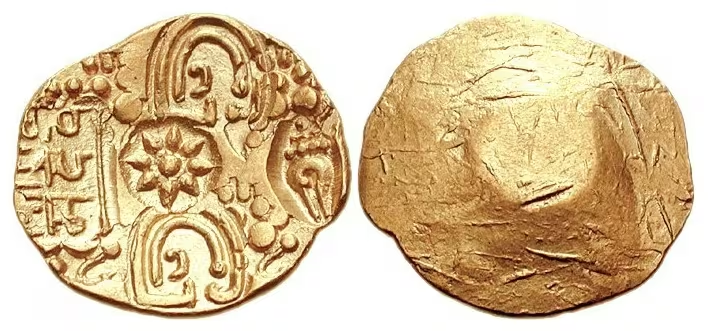
The Seuna period was marked by the coexistence of Kannada, Sanskrit, and Marathi. Kannada remained the court language for much of the dynasty's history, as demonstrated by numerous inscriptions. Early Seuna coins also carried Kannada legends, suggesting that Kannada was important in royal communication.
Jain scholar Kamalabhava, associated with the reign of Bhillama V, wrote the Santhishwara-purana. Achanna composed the Vardhamana-purana in 1198. Under Simhana II, Amugideva composed numerous vachanas, or devotional songs. Chaundarasa of Pandharpur wrote the Dashakumara Charite around 1300.
Sanskrit retained an important role in courtly and intellectual life. Simhana II patronised learning and established a college of astronomy dedicated to studying the work of Bhaskaracharya. Śārṅgadeva composed the Sangita Ratnakara, an authoritative Sanskrit work on Indian music, during Simhana's reign. The work became an important contribution to the history of Indian musical theory.
Hemadri, a minister in the Seuna court, compiled the encyclopedic Chaturvarga Chintamani. He also wrote works on medical science and is associated with the promotion of bajra cultivation. His name is traditionally connected with the Hemadapanti style of temple construction, although the precise extent of his personal role in building the temples attributed to him is not established by the account preserved here.
Other Sanskrit works associated with the period include Jalhana's Suktimuktavali, Jayasimha Suri's Hammiramadhana, Bhaskaracharya's Karnakutuhala and Siddhanta Shiromani, and Anantadeva's commentaries on works by Varahamihira and Brahmagupta. Harapaladeva is associated with Sangeetasudhakara, a treatise on Indian classical music that distinguishes Hindustani and Carnatic music and acknowledges Muslim influence on Indian musical traditions.
Marathi gained particular prominence during the later Seuna period. The dynasty was the first major ruling house to use Marathi as an official language, although this development occurred gradually and did not replace Kannada and Sanskrit immediately. There is no clear evidence that the royal court directly financed Marathi literary production, but Marathi was evidently regarded as important for communication with the wider population.
The saint-poet Dnyaneshwar composed the Dnyaneshwari around 1290, during Ramachandra's reign. This Marathi commentary on the Bhagavad Gita gave the regional language a new religious and literary status by making a Sanskrit sacred text accessible in Marathi. Dnyaneshwar also composed devotional abhangas. Mukundaraja wrote the philosophical works Paramamrita and Vivekasindhu during the Seuna period.
The Mahanubhava sect became prominent in present-day Maharashtra during the dynasty's final years and further strengthened Marathi as a literary language. Mahimabhatta's Lilacharita, a biography of the sect's founder Chakradhara, contains a story that Hemadri resented Chakradhara's popularity and that Ramachandra ordered his death. Chakradhara is said to have escaped through yogic powers. This episode is of doubtful historicity and should not be treated as a secure account of court policy.
Architecture and temples
The Gondeshwar temple at Sinnar, in Nashik district, is an important surviving monument associated with the Seuna period. It is variously dated to the eleventh or twelfth century. The temple follows a panchayatana plan, with a principal shrine dedicated to Shiva and four subsidiary shrines dedicated to Surya, Vishnu, Parvati, and Ganesha.
The building reflects a religious environment in which different Hindu deities were incorporated into a single architectural complex. Its association with Sinnar is also notable because Seunapura, a town linked to the dynasty's early ruler Seunachandra, has been identified with modern Sinnar. The temple therefore stands within a landscape connected to the dynasty's formative history.
Temples traditionally described as Hemadapanti are associated with Hemadri and the Seuna age. The surviving account identifies this connection but does not establish that Hemadri personally designed or constructed every building later placed under his name. The architectural legacy of the dynasty should therefore be understood through both surviving monuments and later traditions of attribution.
Economy and Trade
The available historical record provides more information about political authority, warfare, inscriptions, and literature than about the detailed structure of the Seuna economy. It does, however, reveal several features of the kingdom's economic geography.
The Seuna realm occupied a broad section of the Deccan and included routes linking the interior with the Arabian Sea. Its territory included the Konkan and at times extended into Lata in Gujarat. The struggle over Khambhat, an important port, demonstrates the commercial and strategic value of Gujarat's western coastline. Seuna involvement in the region was closely tied to political allegiance, military control, and access to important centres of power.
The capture of Kolhapur and the control of territories in Maharashtra and northern Karnataka gave the dynasty access to productive inland regions as well as routes across the Deccan plateau. Devagiri's position was especially valuable. The capital was not only a natural fortress but also a central point from which armies could move toward Gujarat, Malwa, the Konkan, Telangana, and the southern Deccan.
The system of feudatories was also economically significant. Local rulers retained authority over their regions while acknowledging the Seuna monarch and providing political or military support. Such arrangements allowed the central court to govern a large territory without replacing every local dynasty with direct officials. They also created instability, since feudatories could change allegiance when the balance of power shifted.
Inscriptions recording donations, including the 1311 donation to the Pandharpur temple, offer evidence of religious patronage and the movement of resources toward temples. The material does not provide a detailed account of taxation, market regulation, or coinage, so these aspects should not be reconstructed beyond the available evidence. The early Seuna coins with Kannada legends do, however, indicate the importance of royal monetary issues and the use of Kannada in official representation.
The later conflict with the Delhi Sultanate exposed the financial pressures facing the kingdom. After the 1296 raid, Ramachandra agreed to pay a high ransom and annual tribute. The failure to meet these obligations created arrears and gave Ala-ud-din Khalji a continuing reason to intervene. The seizure of wealth from the Kakatiyas in 1310 subsequently helped finance the Khalji army, demonstrating how military conquest and the transfer of accumulated resources shaped the politics of the period.
Decline and Fall
The Seuna kingdom did not collapse immediately after the death of Simhana II. His successors continued to rule a substantial state, but their campaigns were less consistently successful and their control over feudatories remained difficult to maintain.
Krishna, also called Kannara, defeated a Paramara king before 1250, but did not permanently annex the Paramara kingdom. His wars with the Vaghelas of Gujarat and the Hoysalas ended inconclusively, with both sides claiming victory. Mahadeva suppressed the rebellion of the northern Konkan Shilaharas but failed to overcome resistance in Kakatiya and Hoysala territory. His Kadamba feudatories also rebelled, although his general Balige-deva put down the revolt around 1268.
Mahadeva's son Ammana held the throne only briefly in 1270. He was dethroned by Ramachandra, the son of Krishna. Ramachandra initially restored an aggressive style of expansion. He defeated the Paramaras, campaigned against the Hoysalas, expanded toward the northeast, and suppressed rebellions in the Konkan. Yet his reign also witnessed territorial losses, including Raichur to the Kakatiyas.
The appearance of armies from the Delhi Sultanate changed the scale of the threat. Earlier Seuna conflicts had been contests among neighbouring Deccan and western Indian dynasties. The Khalji campaigns were directed from Delhi and mobilised forces drawn from several northern regions. The 1296 raid on Devagiri showed that the capital's natural defences could not alone protect the kingdom from a determined expedition.
Ala-ud-din Khalji did not immediately annex Devagiri. Instead, he restored Ramachandra in return for ransom and tribute. This arrangement preserved a measure of local Seuna authority, but it placed the kingdom in a subordinate relationship. The tribute was not paid as required, and the accumulated arrears weakened the political settlement.
Malik Kafur's expedition of 1307 brought the kingdom under much tighter control. Supported by the governors of Malwa and Gujarat, the Khalji army defeated the weakened Seuna forces with little resistance. Ramachandra was taken to Delhi, but was later reinstated as a governor after promising to help the Khaljis in their southern campaigns. Devagiri then became a base for further Delhi Sultanate operations, including Malik Kafur's attack on the Kakatiyas in 1310.
Ramachandra was succeeded by Simhana III, also called Shankaradeva. He challenged Khalji authority, prompting Malik Kafur to return to Devagiri in 1313. Simhana III was killed in the battle, and the capital was occupied. The remaining Seuna line continued briefly under Harapaladeva, but the kingdom was annexed by the Khalji Sultanate in 1317.
The end of the dynasty was therefore the result of several connected developments: instability among feudatories, territorial pressure from neighbouring kingdoms, the financial burden of tribute, and the military capacity of the expanding Delhi Sultanate. The Seunas remained powerful for generations, but the political system that had enabled their rise could not withstand sustained intervention from a larger imperial power.
Legacy
The Seuna dynasty left a lasting mark on the history of the western Deccan. Its political centre at Devagiri later remained important under successive regimes. Many years after the Seuna kingdom ended, Muhammad Tughluq of the Tughluq dynasty renamed the city Daulatabad. The later history of the site reflects the strategic value first exploited by the Seunas.
The dynasty's linguistic legacy is especially important. Its early records demonstrate the centrality of Kannada and Sanskrit in the political culture of the Deccan. Its later inscriptions show the growing importance of Marathi. This transition should not be read as evidence that the dynasty had a simple or exclusive ethnic identity. The historical record suggests instead that the Seuna court developed within a Kannada-speaking political environment, ruled a largely Marathi-speaking region, and gradually adopted Marathi more prominently as a language of public connection and official expression.
The dynasty's claimed descent from Yadu also illustrates the role of political genealogy. The Seuna rulers linked themselves to Mathura and Dvaraka after they had become politically prominent. Similar claims were made by the Hoysalas, and no early records directly connect either dynasty to the Yadavas of northern India. These traditions were important as statements of royal identity, but they should not be treated as straightforward records of migration.
In literature, the period brought together Jain, Hindu, devotional, philosophical, musical, astronomical, and medical traditions. Kannada works by Kamalabhava and Achanna, Sanskrit works by Śārṅgadeva, Hemadri, Jalhana, and others, and Marathi writings by Dnyaneshwar and Mukundaraja all belong to the intellectual world of the dynasty's period. The Dnyaneshwari in particular became a landmark in the history of Marathi religious literature.
The Seuna architectural legacy survives in monuments such as the Gondeshwar temple at Sinnar. Their history is also preserved through hundreds of inscriptions, including records in Kannada, Sanskrit, and Marathi. Together, these sources reveal a kingdom that was politically ambitious, culturally multilingual, and deeply connected to the shifting networks of power across the medieval Deccan.