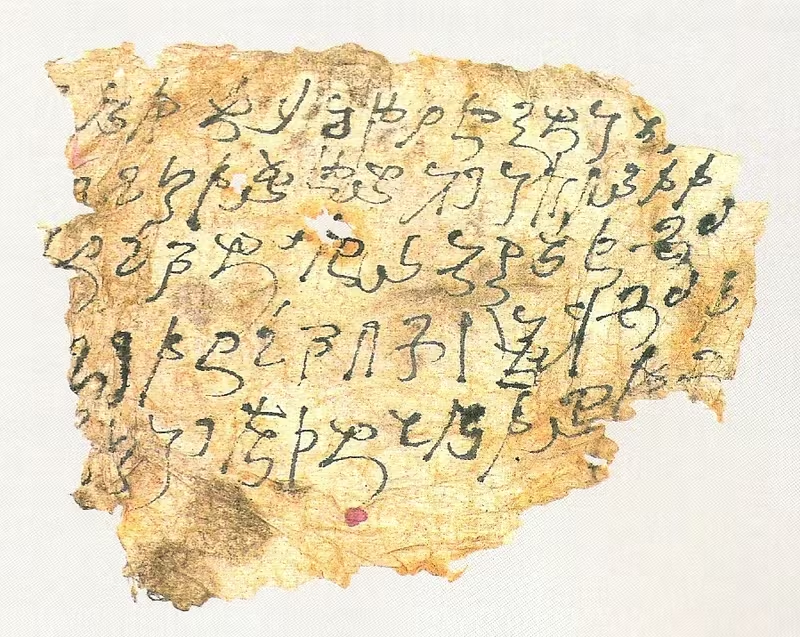
Kharosthi: The Right-to-Left Script of Gandhara
In the Gandhara region of present-day Afghanistan and Pakistan, an Indic script developed between the 5th and 3rd century BCE that was written mostly from right to left. Known as Kharosthi, or the Gandhari script, it served the people of Gandhara across parts of South Asia and Central Asia. Its use extended beyond its homeland to Bactria, Sogdia, and communities along the Silk Road. Kharosthi remained in use in Gandhara until around the 5th century CE, while evidence may point to survival as late as the 7th century in Khotan and Niya in the Tarim Basin.
The script is preserved in rock and coin inscriptions, the Edicts of Ashoka, and Buddhist manuscripts. The Major Rock Edicts at Mansehra and Shahbazgarhi are among the best-known inscriptions written in Kharosthi. The discovery of Gandharan Buddhist texts on birch bark has further transformed knowledge of the script and of early Buddhist manuscript culture. Although Kharosthi disappeared from regular use, its decipherment in the 1830s and its inclusion in Unicode have kept it central to the study of ancient writing in South and Central Asia.
Origins and Classification
Linguistic Family
Kharosthi is an ancient Indic script associated especially with Gāndhārī. It is more accurately described as a writing system than as a spoken language. Its alphabet displays a clear dependency on the Aramaic alphabet, but it also contains extensive modifications suited to the writing of an Indic language.
The script is also known by several earlier names, including Indo-Bactrian script, Kabul script, and Arian-Pali. The name “Gandhari script” reflects its close association with Gandhara and its people.
Origins
Kharosthi originated in Gandhara between the 5th and 3rd century BCE. One theory holds that Aramaic arrived in the Indus Valley with the Achaemenid conquest around 500 BCE. In this view, the script evolved over more than two centuries and reached its final form by the 3rd century BCE, when it appears in some of the Edicts of Ashoka.
The surviving evidence does not establish every stage of this proposed development. No intermediate forms have yet been found to confirm the evolutionary model. At the same time, an Aramaic inscription from the 4th century BCE found in Sirkap demonstrates the presence of Aramaic in present-day Pakistan. Sir John Marshall considered this evidence to support the later development of Kharosthi from Aramaic.
Scholars remain divided over whether Kharosthi evolved gradually or was the deliberate work of a single inventor. The rock and coin inscriptions from the 3rd century BCE onward show a unified and standardized form.
Name Etymology
The name Kharosthi may derive from the Hebrew kharosheth, a Semitic word associated with writing. Another proposed origin is the Old Iranian form xšaθra-pištra, meaning “royal writing.” Neither explanation is presented as certain.
Historical Development
Early Development in the Achaemenid and Gandharan Context (5th–3rd Century BCE)
The proposed history of Kharosthi begins with the use of Aramaic for administrative work during the reign of Darius the Great. This administrative script contrasted with the monumental Old Persian cuneiform used for public inscriptions. After Aramaic reached the Indus Valley, it may have been adapted over time in Gandhara.
The 4th-century BCE Aramaic inscription from Sirkap is important because it confirms that Aramaic was present in the region before the earliest standardized Kharosthi examples. However, the absence of intermediate forms means that the precise path from Aramaic to Kharosthi remains uncertain.
Standardized Kharosthi and the Edicts of Ashoka (3rd Century BCE)
By the 3rd century BCE, Kharosthi appears in a unified form on rock and coin inscriptions. Some of the Edicts of Ashoka were written in the script, including the Major Rock Edicts at Mansehra and Shahbazgarhi. These inscriptions were later important in the modern decipherment of Kharosthi.
Kharosthi also appeared on coins of the Indo-Greek Kingdom. These bilingual coins placed Greek writing on the obverse and Pali written in Kharosthi on the reverse. Their parallel texts provided the key evidence used by early nineteenth-century scholars to recover the reading of the script.
Manuscripts and Buddhist Use (1st Century BCE–3rd Century CE)
Kharosthi was used for Gandharan Buddhist texts written on birch bark. Collections held by different institutions contain manuscripts dating from the 1st century BCE to the 3rd century CE. These are described as the oldest Buddhist manuscripts yet discovered.
The British Library received an important set of Gandharan Buddhist manuscripts in 1994. The entire British Library collection is dated to the 1st century CE. The manuscripts were discovered near Hadda, just west of the Khyber Pass in Pakistan, and were donated to the library after their discovery.
Late Use and Disappearance (2nd–7th Century CE)
Although Brahmi remained in use for centuries, Kharosthi seems to have been abandoned after the 2nd–3rd century CE in much of its earlier sphere. It died out in its homeland around the 5th century CE. Evidence may indicate that it survived until the 7th century in Khotan and Niya, two cities in the Tarim Basin.
Once Brahmi-derived scripts supplanted it, knowledge of Kharosthi may have declined rapidly because of the substantial differences between the Semitic-derived script and its successors.
Modern Period
Kharosthi was rediscovered by Western scholars during the 19th century. James Prinsep deciphered it in 1835, publishing his work in the Journal of the Asiatic Society of Bengal in India. Carl Ludwig Grotefend published an independent decipherment in 1836 in Germany, evidently without awareness of Prinsep’s article. Christian Lassen followed in 1838.
Their work depended especially on bilingual coins from the Indo-Greek Kingdom. The decipherment of Kharosthi made it possible to read the Kharosthi portions of the Edicts of Ashoka and to study a large body of inscriptions and manuscripts.
Scripts and Writing Systems
Kharosthi Script
Kharosthi is written mostly from right to left. Some variations in the number and order of syllables occur in surviving texts. Its alphabet is also called the arapacana alphabet and follows the sequence:
a ra pa ca na
la da ba ḍa ṣa
va ta ya ṣṭa
ka sa ma ga stha
ja śva dha śa kha
kṣa sta jñā rtha, or ha
bha cha sma hva tsa
gha ṭha ṇa pha ska
ysa śca ṭa ḍha
The alphabet served as a mnemonic device in Gandharan Buddhism for the Pañcaviṃśatisāhasrikā Prajñāpāramitā Sūtra, a series of verses concerning the nature of phenomena. Its first line, arapacana, survives in the mantra of Manjushri in modern Himalayan and East Asian Buddhism.
Consonants
A bar above a consonant can indicate different modified pronunciations depending on the consonant. These modifications include nasalization or aspiration. The mark is used with k, ṣ, g, c, j, n, m, ś, s, and h.
The cauda changes the pronunciation of consonants in several ways, particularly through fricativization. It is used with g, j, ḍ, t, d, p, y, v, ś, and s. A dot below occurs with m and h, although its precise phonetic function remains unknown.
Vowels and Syllables
Kharosthi has only one standalone vowel character, used for initial vowels in words. Other initial vowels are represented by modifying the a character with diacritics. Every syllable includes a short /a/ sound by default, while other vowels are marked with diacritics.
Long vowels are indicated by a dedicated diacritic. An anusvara marks vowel nasalization or a nasal segment following the vowel. A visarga represents an unvoiced syllable-final /h/ and may also indicate vowel length. A double ring below appears with -a and -u in some Central Asian documents, although its precise phonetic function is unknown.
Richard Salomon established that the vowel order is /a e i o u/, resembling the order of Semitic scripts rather than the usual /a i u e o/ order found in Indic scripts.
Numerals and Punctuation
Nine Kharosthi punctuation marks have been identified, although their individual forms are not listed here. Kharosthi also had a numeral system reminiscent of Roman numerals and Psalter Pahlavi numerals.
The numerical system combined additive and multiplicative principles but did not use the subtractive principle found in Roman numerals. Numerals, like letters, were written from right to left. There was no zero and no separate sign for the digits 5 through 9. Numbers were written additively; for example, 1996 was represented by a sequence of repeated and combined numeral signs.
Unicode
Kharosthi was added to the Unicode Standard in March 2005 with the release of version 4.1. Its Unicode block occupies U+10A00–U+10A5F.
Geographic Distribution
Historical Spread
Kharosthi was originally associated with Gandhara in present-day Afghanistan and Pakistan. From there, its use extended across various parts of South Asia and Central Asia. It was also used in Bactria, Sogdia, and along the Silk Road.
The script’s presence in these regions reflects the movement of writing practices beyond Gandhara. Its late survival in Khotan and Niya suggests that Kharosthi continued to circulate in parts of the Tarim Basin after it had declined in its homeland.
Centers of Learning
The surviving evidence is concentrated in inscriptions, coins, and manuscripts rather than in named educational institutions. Gandharan Buddhist texts are especially important for the study of Kharosthi. The manuscripts discovered near Hadda and the collections preserved by different institutions have provided evidence for the script’s use across several centuries.
Literary Heritage
Religious Texts
Kharosthi was used for Gandharan Buddhist texts, including birch-bark manuscripts dated from the 1st century BCE to the 3rd century CE. The Pañcaviṃśatisāhasrikā Prajñāpāramitā Sūtra is associated with the arapacana alphabet, which functioned as a mnemonic sequence in Gandharan Buddhism.
Inscriptions and Coins
The script’s major textual record includes the Edicts of Ashoka and inscriptions from the Gandharan region. Bilingual Indo-Greek coins were especially significant because their Greek and Kharosthi texts helped scholars decipher the script.
Grammar and Phonology
Key Features
Kharosthi is a script with syllabic features. Each syllable carries a short /a/ by default, and other vowels are represented by diacritics. Consonants can be altered by additional marks that indicate changes such as aspiration, nasalization, and fricativization.
Sound System
The vowel order reconstructed for Kharosthi is /a e i o u/. Long vowels, nasalization, and a syllable-final unvoiced /h/ could be marked. Several signs have uncertain phonetic functions, including the dot below used with m and h and the double ring found with certain vowels in Central Asian documents.
Influence and Legacy
Relation to Aramaic and Brahmi
Kharosthi shows a clear dependency on Aramaic but underwent extensive modification. Its later history contrasts with that of Brahmi, which remained in use for centuries and gave rise to scripts that eventually supplanted Kharosthi.
Buddhist Cultural Impact
The arapacana sequence remained connected with Manjushri, the Bodhisattva of transcendent wisdom. Its first line survives in a mantra used in modern Himalayan and East Asian Buddhism.
Modern Scholarship
The decipherment of Kharosthi in the 1830s opened the study of its inscriptions, coins, and manuscripts. The discovery of Gandharan Buddhist texts renewed scholarly interest, while catalogues, manuscript studies, and paleographic databases continue to support research into Kharosthi and Gāndhārī materials.
Royal and Religious Patronage
Ashokan Inscriptions
Some Edicts of Ashoka were written in Kharosthi. The Major Rock Edicts at Mansehra and Shahbazgarhi are specifically associated with the script. Their reading became possible after the decipherment of Kharosthi through comparisons with bilingual Indo-Greek coins.
Buddhist Institutions and Manuscripts
The script played an important role in the preservation of Gandharan Buddhist texts. Birch-bark manuscripts from the region, including the British Library collection, provide evidence for Buddhist writing in Kharosthi from the 1st century BCE through the 3rd century CE.
Modern Status
Current Speakers
Kharosthi is extinct as a script and has no current speakers. It ceased to be used in its homeland around the 5th century CE, with possible survival in Khotan and Niya until the 7th century.
Official Recognition
Kharosthi has no current official status. Its modern importance is scholarly and historical.
Preservation Efforts
The script is preserved through the study of inscriptions, coins, Buddhist manuscripts, and digital encoding. The Unicode Standard includes Kharosthi in the block U+10A00–U+10A5F. Catalogues of known Kharosthi and Gāndhārī texts, together with paleographic databases, support continuing research.
Learning and Study
Academic Study
The modern study of Kharosthi began with the independent or nearly simultaneous decipherments of James Prinsep and Carl Ludwig Grotefend, followed by Christian Lassen. Bilingual Indo-Greek coins supplied the essential comparisons, and the deciphered script then allowed scholars to read Kharosthi inscriptions, including parts of the Edicts of Ashoka.
Research was later invigorated by the discovery of Gandharan Buddhist manuscripts. Scholars examine the script’s forms, its relationship to Aramaic, its vowel and consonant marks, its numerals, and its development across inscriptions and manuscripts.
Resources
Important resources include the Gandhari.org Catalog and Corpus of all known Kharoṣṭhī (Gāndhārī) texts, the Indoskript 2.0 paleographic database of Brahmi and Kharosthi, and Andrew Glass’s A Preliminary Study of Kharoṣṭhī Manuscript Paleography. Further study is represented by works such as Kharoshthi Primer and Kharoshthi Manuscripts from Gandhara.
Conclusion
Kharosthi preserves the history of writing in Gandhara and the wider networks linking South Asia, Central Asia, and the Silk Road. Developed from a form of Aramaic and extensively adapted for an Indic language, it became a standardized script visible in coins, rock inscriptions, Buddhist manuscripts, and the Edicts of Ashoka. Its right-to-left direction, marked syllabic structure, distinctive vowel order, and unusual numeral system set it apart from Brahmi-derived traditions.
Although Kharosthi disappeared from its homeland by around the 5th century CE, its legacy survives in Buddhist mnemonic traditions, archaeological inscriptions, birch-bark manuscripts, and modern digital encoding. Its decipherment in the 1830s transformed the study of Gandharan history and early Buddhist writing, while continuing discoveries ensure that the script remains an important subject in the study of ancient South and Central Asia.