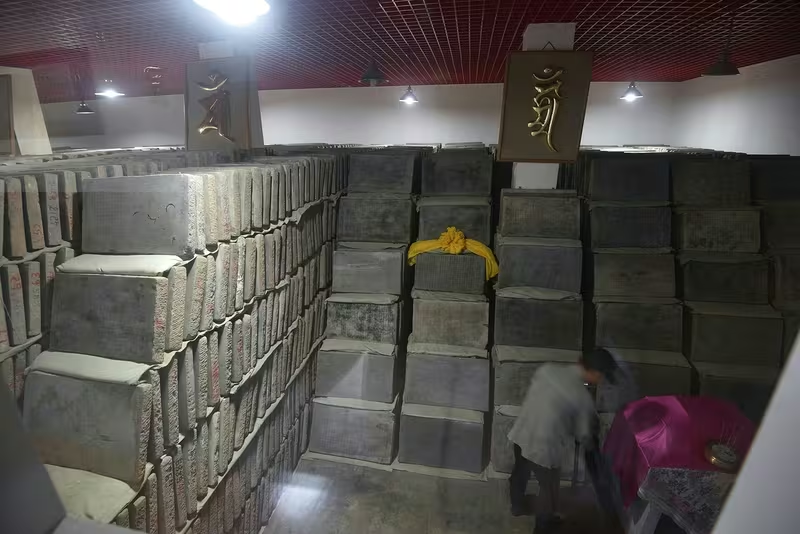
Siddham Script: The Buddhist Writing System That Survived in Japan
The Bodhgaya inscription of Mahanaman, dated 588/89 CE, is among the earliest specimens of Siddham, a medieval Indic script whose history connects northern India with the Buddhist cultures of East Asia. Also known as Kutila and, in its later evolved form, Siddhamātṛkā, the script developed from the Gupta script and was used in India from approximately the 6th century to the 13th century. It served as a vehicle for classical Sanskrit literature, royal land-grant charters, and religious texts, especially those associated with Mahāyāna and Vajrayāna Buddhism.
Siddham was particularly important in Buddhist monastic universities such as Nālandā and Vikramaśīla. Its use extended beyond India when Sanskrit Buddhist materials travelled to China during the Tang dynasty. In East Asia, the script became closely associated with Tantric Buddhism and was employed for mantras, dhāraṇīs, and bīja, or seed, syllables. China, Korea, and Japan developed their own Siddham calligraphic styles. Although the script was replaced in India and China, it remains in ritual and calligraphic use in Japan, especially within the Shingon and Tendai schools.
Origins and Classification
Linguistic Family
Siddham is a script rather than a spoken language. It is a medieval Brahmic abugida used principally to write Sanskrit and Buddhist religious material. In an abugida, each consonant character represents a syllable containing a consonant and, unless altered, an inherent vowel. Siddham belongs to the Indic script tradition and developed through the historical sequence of Early Brahmi, regional forms of Ashokan Brahmi, the Gupta script, and Siddhamātṛkā.
The script is ancestral to Nāgarī, Eastern Nagari, Tirhuta, Odia, and Nepalese scripts. Its historical importance therefore lies not only in its use for Buddhist and Sanskrit writing but also in its place within the evolution of several later South Asian scripts.
Origins
Siddham traces directly back to Early Brāhmī, the foundational script of South Asia used during the Mauryan period, around the 3rd century BCE. Between the 4th and 6th centuries CE, Ashokan Brāhmī diversified into distinct regional styles. In northern India, one of these developments produced the Gupta script, also called Late Brahmi or Early Nagari.
The Gupta script was the official administrative and literary hand of the Gupta Empire. During the late 6th century CE, it underwent structural and calligraphic changes that produced Siddhamātṛkā. The transition introduced sharply angled stroke terminations and solid triangular or wedge-shaped head-marks, known as śirorekhā.
The surviving early examples include the Bodhgaya inscription of Mahanaman, dated 588/89 CE, and the Lakhamandal inscription. These inscriptions place the formation of Siddham in the late 6th century and show the script at an important stage of development from Gupta writing.
Name Etymology
The word Siddhaṃ means “accomplished,” “completed,” or “perfected” in Sanskrit. The script received this name from the practice of writing Siddhaṃ or Siddhaṃ astu, meaning “may there be perfection,” at the beginning of documents.
The name Siddhamātṛkā is reported by the 11th-century scholar Al-Biruni. This name appears to correspond with the term Siddhaṃ preserved in Buddhist traditions in East Asia. Siddham is consequently one of the relatively few Indian scripts whose traditional name is known from historical sources.
In Chinese, the name is rendered xitan wenzi, meaning “Siddham script.” In Japanese it is known as shittan. Because the letterforms contain prominent bends and loops, some epigraphists and historians called the script Kuṭila, a Sanskrit word meaning “crooked” or “bent.” Another name used for it is bonji in Japanese and fànzì in Chinese.
Historical Development
Early Brahmi and Gupta Foundations (3rd century BCE–6th century CE)
The history of Siddham begins with Early Brahmi and the regional diversification of Ashokan Brahmi. During the Mauryan period, Brahmi provided a foundational writing system for South Asia. By the centuries between the 4th and 6th centuries CE, regional styles had emerged.
In northern India, the Gupta script became the principal administrative and literary form under the Gupta Empire. Its position in government and literary culture created the immediate setting for Siddham’s formation. Siddham was therefore not an isolated invention but a stage in a longer development within the Brahmic writing tradition.
Siddhamātṛkā Formation (Late 6th–7th century CE)
The late 6th century saw the Gupta script acquire new structural and calligraphic features. Sharply angled endings and solid triangular or wedge-shaped head-marks became characteristic of the emerging Siddhamātṛkā style. The early inscriptions at Bodhgaya and Lakhamandal document this transition.
By the 7th century, Siddham had become a primary script across northern India for classical Sanskrit literature, royal land-grant charters called tāmra-paṭṭa, and religious texts. Its use was especially prominent in Mahāyāna and Vajrayāna Buddhist communities.
Northern Indian Literary and Religious Use (7th–10th century CE)
Siddham was used in northern and eastern India and also spread westward, where it displaced southern-style scripts that had previously predominated. It appeared occasionally in the Deccan and even the far south, including in the Pattadakal bilingual inscription.
Its broad use for Sanskrit anticipated the later role of Devanāgarī. Like Devanāgarī in a later period, Siddhamātṛkā could be preferred for writing Sanskrit beyond the region where it had originated. Buddhist monasteries and universities, including Nālandā and Vikramaśīla, were important settings for its use and transmission.
East Asian Buddhist Transmission (7th–13th century CE)
Most Buddhist texts and Sanskrit materials transmitted from India and Central Asia to China during the Tang dynasty were written in Siddham. The script became particularly associated with Tantric Buddhism. Mantras, dhāraṇīs, and bīja syllables were among its most characteristic uses.
Around 800, a Chinese monk prepared the Hsi-t’an-tzu-chi, a primer designed to train Tantric monks to pronounce mantras correctly. It became a standard textbook for Sanskrit study in China and the Far East, although it dealt with Siddham letters rather than Sanskrit grammar. Chinese scholars gave special attention to the visual form of the characters, and Siddham developed a distinctive Chinese calligraphic tradition.
The script was carried to Korea, presumably during the 7th century. It may also have influenced the creation of Hangul, although the historical account presents this influence as uncertain.
In Japan, Kūkai introduced Siddham in 806 after returning from China. He had studied Sanskrit with monks trained at Nālandā, including one known as Prajñā. Saichō was another important propagator of Siddham in Japan and founded the Tendai school of Buddhism. During the Northern Song dynasty, from 960 to 1127, study of Siddham continued to prosper. East Asian traditions eventually developed separate Chinese, Japanese, and Korean calligraphic forms.
Disappearance in India and China (9th–20th centuries)
In India, Siddham began to transition into regional scripts during the 9th and 10th centuries. Nāgarī represented developments in the north and west, while Gauḍī became prominent in the east. By the 11th century, Devanāgarī had reached a more standard form and replaced Siddham for epigraphic and literary purposes.
The history of Siddham in China followed a different course. After the Mongol Yuan dynasty took control, Kublai Khan’s failed invasion of Japan in 1274 was followed by the absence of renewed contact between China and Japan. No new Buddhist material consequently reached Japan from China through that route.
By 1280, the Mongols had occupied all of China and introduced Lamaism as the state religion. Tantrism and Siddham studies declined, while the Lantsa script and other Indian scripts gained ground. Following the fall of the Yuan dynasty in 1368, Siddham use declined along with Chinese Buddhism. During the Ming period, Siddham was completely superseded for writing Sanskrit by Lantsa in the context of Tibetan Lamaism. Evidence indicates that the study of Sanskrit and Siddham was practically nonexistent in China from the 15th through the 20th centuries.
Scripts and Writing Systems
Siddham as an Abugida
Siddham is an abugida rather than an alphabet. Each consonant character indicates a syllable containing a consonant and, by default, the short vowel a. Thus, a consonant such as ⟨𑖎⟩ represents ka. Vowel diacritics modify the inherent vowel. The character sequence ⟨𑖎𑖿𑖧𑖺⟩ represents ko when the relevant vowel mark is added.
Independent vowel letters are used when a vowel occurs at the beginning of a word. Otherwise, vowels and vocalic elements appear as diacritics attached to consonants. Siddham includes five short vowels and five long vowels. The vocalic consonants ṛ and ḷ are treated as vowels and may occur in short or long forms. The script also includes the part-vowels anusvara, ⟨𑖽⟩ ṃ, and visarga, ⟨𑖾⟩ ḥ.
A virāma indicates that a consonant stands without its inherent vowel. For example, ⟨𑖎⟩ ka combined with the virāma ⟨𑖿⟩ produces ⟨𑖎𑖿⟩, an isolated consonant k. Conjunct consonants are an important part of Siddham writing, and two conjuncts are treated as part of the alphabet. Alternative forms also occur for conjuncts containing ṇ.
Direction and Additional Marks
Siddham texts were normally written from left to right and then from top to bottom, like other Brahmic scripts. Some texts, however, followed the traditional Chinese arrangement: top to bottom and then right to left. Bilingual Siddham-Japanese manuscripts could combine both systems. The manuscript might be turned 90 degrees clockwise, with Japanese written vertically, and then turned back so that Siddham continued from left to right.
Over time, scribes developed additional markings. These included punctuation marks, head marks, repetition marks, end marks, special ligatures for conjunct consonants, and occasionally ligatures combining syllables. Scribes also used ornaments of their own choice. The nuqta appears in some modern Siddham texts.
Writing Materials and Calligraphy
Siddham is commonly seen in brush writing, reflecting its transmission into East Asian calligraphic culture. It was also written with a bamboo pen. In Japan, formal Siddham calligraphy uses a special brush known as a bokuhitsu. An informal style is known as fude.
Japanese Buddhist scholars sometimes created multiple characters with the same phonological value. This practice combined aspects of Chinese writing with the Indian Siddham tradition and allowed Sanskrit texts to receive different interpretations during reading. Japanese Siddham consequently developed away from the original script used for sutras and is now somewhat different from the ancient form.
Geographic Distribution
Historical Spread
Siddham first flourished in northern India and spread across eastern and western regions. It was used in the Deccan and occasionally in the far south. Its presence at Pattadakal demonstrates that its range extended beyond the northern and eastern areas where it was most prominent.
Its greatest international spread occurred through Buddhist transmission. Sanskrit texts written in Siddham travelled from India and Central Asia to China during the Tang dynasty. From China, the script reached Korea and Japan. In each region it acquired particular calligraphic characteristics.
Centers of Learning
Buddhist monastic universities were central to Siddham’s use. Nālandā and Vikramaśīla are specifically associated with Mahāyāna and Vajrayāna texts written in the script. The transmission of Sanskrit knowledge through monks trained at Nālandā also helped connect Indian Siddham traditions with East Asian Buddhist learning.
In China, the Hsi-t’an-tzu-chi supported the education of Tantric monks by teaching them to pronounce mantras. In Japan, Siddham study continued through the Tendai and Shingon schools.
Modern Distribution
Siddham is no longer used for ordinary epigraphic or literary writing in India. It also fell into oblivion in China after centuries of decline. Japan is the only region where the script has persisted in active use into the present, especially within Shingon and Tendai Buddhism and the syncretic Shugendō tradition.
Literary Heritage
Classical Literature
Siddham was used for classical Sanskrit literature during its period of prominence in northern India. It was also employed in royal land-grant charters, or tāmra-paṭṭa. The script’s association with Sanskrit writing helped establish its importance beyond strictly Buddhist contexts.
Religious Texts
Religious writing was one of Siddham’s central functions. Mahāyāna and Vajrayāna Buddhist texts were written in the script, and Siddham was especially associated with Tantric Buddhism. Mantras, dhāraṇīs, and bīja syllables remain its best-known forms of use.
The Chinese Buddhist canon preserved Siddham characters for most mantras in the Taishō Tripiṭaka version. Korean Buddhists also continue to write bījas in a modified form of Siddham.
Poetry and Drama
The historical account identifies Siddham as a script for classical Sanskrit literature but does not specify individual Sanskrit poems, dramas, or authors written in it. Its literary role is therefore best understood through its function as a writing system for Sanskrit rather than through a distinct Siddham-language canon.
Scientific and Philosophical Works
The Hsi-t’an-tzu-chi was a primer for Siddham and Sanskrit pronunciation, prepared around 800 for Tantric monks in China. It focused on the Siddham letters and did not cover Sanskrit grammar. The script was also used for religious and scholarly materials transmitted through Buddhist learning networks.
Grammar and Phonology
Key Features
Siddham does not represent a separate spoken language with its own grammar. Its structure is orthographic. Consonants carry an inherent a, and vowel diacritics modify that vowel. Independent vowel signs are used for word-initial vowels, while anusvara, visarga, and vocalic consonants have their own written treatment.
Consonant clusters are represented through conjuncts. A virāma suppresses the inherent vowel and produces an isolated consonant. These features allow Siddham to represent the syllabic structure of Sanskrit.
Sound System
The source material describes Siddham’s treatment of vowels and syllables rather than a complete phonological inventory. The script contains five short vowels, five long vowels, the vocalic consonants ṛ and ḷ in short and long forms, anusvara ṃ, and visarga ḥ. Its vowel system is expressed through independent letters and attached diacritics.
Influence and Legacy
Scripts Influenced
Siddham is described as ancestral to Nāgarī, Eastern Nagari, Tirhuta, Odia, and Nepalese scripts. Its transitional forms therefore occupy an important place in the history of writing in South Asia. The script also anticipated the later use of Devanāgarī as a preferred script for Sanskrit outside its original region.
Cultural Impact
Siddham’s most enduring cultural impact is visible in Buddhist ritual practice. In Japan, the writing of mantras and the copying, reading, and calligraphic presentation of sutras continue in Shingon and Tendai Buddhism, as well as in Shugendō. Siddham bīja syllables are valued not merely as phonetic signs but as visual elements of Buddhist ritual and calligraphy.
The East Asian history of Siddham also shows how a South Asian script could acquire new identities outside India. Chinese, Japanese, and Korean traditions developed their own calligraphic forms. Japanese Buddhist scholars further created variant characters with the same phonological values, producing a writing practice that combined Indian and Chinese traditions.
Royal and Religious Patronage
The Gupta Administrative Tradition
The Gupta script, which preceded Siddham, served as the official administrative and literary hand of the Gupta Empire. This institutional role provided the historical environment in which Siddhamātṛkā developed during the late 6th century. Siddham later continued the Gupta tradition of writing Sanskrit and formal documents.
Buddhist Monastic Institutions
Mahāyāna and Vajrayāna Buddhist monastic universities were among the principal environments in which Siddham flourished. Nālandā and Vikramaśīla supported the production and transmission of religious texts. The script was used for mantras, dhāraṇīs, bījas, and Sanskrit Buddhist materials that later travelled to China and other parts of East Asia.
In Japan, Saichō helped propagate Siddham through the Tendai school, while Kūkai introduced it through the traditions associated with Shingon Buddhism. These institutions preserved the script after it had disappeared from ordinary use in India and China.
Modern Status
Current Use
Siddham is not a spoken language and has no modern community of native speakers. Its active survival is liturgical and calligraphic. Japan remains the principal setting where Siddham continues to be used, especially for Sanskrit bīja syllables and mantras in Shingon and Tendai Buddhism.
A recent use involves writing Japanese-language slogans on T-shirts in bonji, showing that the script can also appear beyond strictly traditional religious manuscripts. Nevertheless, its primary modern role remains ritual and artistic.
Official Recognition
Siddham has no stated official language or governmental status. Its continued significance comes from Buddhist institutions, manuscript practice, calligraphy, and digital encoding rather than from administrative use.
Preservation Efforts
Siddham was added to the Unicode Standard in June 2014 with the release of version 7.0. The Unicode block for Siddham occupies U+11580–U+115FF. Digital resources include Noto Sans Siddham, Muktamsiddham, ApDevaSiddham, and other specialist fonts.
Computer representation remains incomplete. Siddham is still largely handwritten, and existing fonts do not reproduce all possible conjunct consonants. The Chinese Buddhist Electronic Texts Association created a Siddham font for its electronic Taishō Tripiṭaka, although it does not include every conjunct. The Mojikyo software also contains Siddham fonts but divides the script across different blocks and requires multiple fonts for a single document. A Siddham input system based on the CBETA Siddhamkey 3.0 font has also been produced.
Learning and Study
Academic Study
Siddham is studied through inscriptions, Buddhist manuscripts, Sanskrit materials, and the history of Indic writing systems. Its early development can be examined through the Bodhgaya inscription of Mahanaman and the Lakhamandal inscription. Its international history is documented through Chinese, Korean, and Japanese Buddhist traditions.
The Hsi-t’an-tzu-chi offers evidence for the way Siddham was taught in China. It was designed to train Tantric monks in the pronunciation of mantras and became a standard textbook for Sanskrit in China and the Far East, though it focused on letters rather than grammar.
Resources
Modern learners can consult Unicode Siddham fonts and digital input tools, including Noto Sans Siddham, Muktamsiddham, ApDevaSiddham, Mojikyo, and Siddhamkey 3.0. Online resources include Siddham alphabet and pronunciation materials, collections of Siddham mantras and sutras, and Buddhist electronic-text projects preserving Siddham characters.
Traditional study also continues through Japanese Shingon and Tendai communities, where the script is written with brushes in formal and informal calligraphic styles.
Conclusion
Siddham preserves a crucial chapter in the history of Indic writing. Emerging from the Gupta script in the late 6th century, it became a major vehicle for Sanskrit literature, royal documents, and Mahāyāna and Vajrayāna Buddhist texts across northern India. Its use at Buddhist universities such as Nālandā connected script, language, and religious learning.
Siddham’s history did not end when Nāgarī and Gauḍī replaced it in India or when Lantsa displaced it in China. Through Buddhist transmission, it reached Korea and Japan, where it developed distinctive calligraphic traditions. Japan continues to use Siddham for mantras, bīja syllables, sutras, and ritual writing. Its Unicode encoding and modern fonts now extend that legacy into digital scholarship, ensuring that this historically mobile script remains available for study and practice.