Sylheti Nagri: The Puthi Script of Sylhet
The earliest known work written in Sylheti Nagri is Talib Husan, dated 1549, but the script’s history reaches beyond any single manuscript. Historically used in Bengal and Assam east of the Padma, Sylheti Nagri was especially associated with the eastern part of the Sylhet region, where it recorded poetry and other works known as puthis. It developed a distinctive literary culture connected with Middle Bengali, the Dobhashi literary dialect, and the phonological influence of Sylheti. Its simplified glyphs made it easier to learn than the Bengali script prevalent at the time, helping it reach ordinary readers despite never becoming part of formal education.
During the twentieth century, Sylheti Nagri lost ground to the standardised Eastern Nagari script. Printing presses continued operating as late as the 1970s, but several were destroyed or abandoned during the Bangladesh War of Independence and the Indo-Pakistani War of 1971. Since the late twentieth century, however, research, Unicode encoding, new fonts, digital keyboards, publications, and public cultural projects have contributed to a revival. For many people today, the script is a marker of Sylheti identity and cultural heritage.
Origins and Classification
Linguistic Family
Sylheti Nagri is an Indic script rather than a separate spoken language. It was historically used to write forms of Middle Bengali and literary language shaped by Sylheti phonology. The script also shared characteristics with the Dobhashi literary dialect, a popular literary form of its historical environment.
Its use was concentrated among communities in the Sylhet region, especially Muslims, although the script’s proposed origins are more diverse than its later social distribution. Because the script was used to record Sylheti-influenced literary works, it became closely associated with the cultural history of Sylhet.
Origins
The specific origin of Sylheti Nagri remains debated. Qadir and Professor Clifford Wright identify its descent from Kaithi, a script predominantly used in Bihar. Another historical comparison identifies Baitali Kaithi, formerly used for Hindustani, as identical to Sylhet Nagri except that Sylhet Nagri possessed a matra, or upper horizontal line used in Brahmic scripts.
Suniti Kumar Chatterjee attributed the use of Nagri in East Bengal to early Muslim colonies from upper India. Ahmad Hasan Dani proposed that Afghans invented the script during their rule of Bengal, observing that its letters resemble Afghan coin symbols and noting the presence of many Afghans in Sylhet at the time. Other theories place its development in the seventeenth or eighteenth century, when it may have been created to facilitate communication among Muslim sepoys from Bihar and other immigrant Muslims.
A further theory connects the script with Nagar Brahmins, a travelling Hindu caste known for retaining a Nagri variety of Kaithi while adopting the local language of the places where they settled. According to this account, some Brahmins later converted to Islam but continued using the script for poetry. Similar traditions are described for Sindh, Multan, and Varanasi. Other proposals connect the script with immigrant Bhikkhus from neighbouring countries such as Nepal.
These explanations cannot all be combined into one certain origin story. They instead show that Sylheti Nagri developed in a multilingual and mobile region, where writing practices, religious communities, and literary traditions crossed regional boundaries.
Name Etymology
The name Sylhet Nagri combines “Sylhet,” the region in which the script was primarily used and from which it is said to have originated, with nāgrī, meaning “of or pertaining to an abode” or nagar. The name can therefore be understood as “the Nagri of Sylhet” or “the script of the abode or city of Sylhet.”
The form Sylheti Nagri is common today, but it was not the name used in classical manuscripts such as Pohela Kitab by Muhammad Abdul Latif. The script has also been called Sylhet Nagri, Jalalabadi Nagri, Phul Nagri, Jangli Nagri, and Kat Nagri. Jalalabadi Nagri refers to Jalalabad, another name associated with Sylhet. Another widespread term is Musalmani Nagri, reflecting the script’s prevalence among the Muslims of Sylhet.
Nagendranath Basu argued that “Nagri” referred to the Nagar Brahmins, who were known for preserving their Nagri scripts while adopting the local languages of the places to which they migrated.
Historical Development
Early Manuscript Tradition (Sixteenth Century)
Manuscripts provide the clearest early evidence for the script. The earliest known work is Talib Husan, written by Ghulam Husan in 1549. Other surviving works include Rag Namah by Fazil Nasim Muhammad and Shonabhaner Puthi by Abdul Karim.
The script was used chiefly for puthis, a broad manuscript tradition in which poetry and narrative works circulated among readers. Although it was never part of formal education, its relative simplicity allowed it to reach common people with apparent ease. At one stage in the Sylhet region, literary works in Sylheti Nagri became more popular in practical use than works written in the Bengali script.
Puthi Literature and Popular Use
Sylheti Nagri literature was especially abundant in poetry, even though some manuscripts were described as prosaic in quality. The script was also used for medicine and magical manuscripts, showing that its range extended beyond literary entertainment. It even appeared in poems about the Second World War.
The script was largely associated with Muslims. Nevertheless, its history includes theories involving Buddhists, Hindus who later converted to Islam, Nagar Brahmins, Afghans, and immigrant communities. By the 1930s, Nagendranath Basu observed that Bengali Muslims in Bishnupur, Bankura, used the Bengali alphabet for general purposes but used Nagri for puthis. George Grierson’s Linguistic Survey of India similarly described the script as rarely used for formal documentation compared with the Bengali script. It was mainly used for puthi reading, although some people also signed their names in it.
The Munshi Sadeq Ali is considered the greatest and most popular writer associated with the script. His literary reputation reflects the importance of individual writers in a tradition that was sustained through manuscripts and community reading rather than through official institutions.
Printing and Standardisation (1869–1971)
A major change came through the work of Abdul Karim. A munshi who had studied and completed his education in London, Karim spent several years there learning the printing trade. After returning home around 1869, he designed a woodblock type for Sylheti Nagri and founded the Islamia Printing Press in Bandar Bazar, Sylhet.
Padmanath Bhattacharjee Vidyabinod, who wrote the first scholarly article on the script, regarded Abdul Karim’s standardisation as the beginning of its reawakening, or nobojonmo, period. The press made it possible to reproduce works beyond the limitations of handwritten manuscripts and helped establish a more regular printed form.
Other presses later operated in Sylhet, Sunamganj, Shillong, and Kolkata. They included the Sarada Printing and Publishing house in Naiyorpul, Sylhet; Calcutta’s General Printing Works at 16 Gardner Lane, Taltala; and the Hamidi Press in Sealdah. Scholarly writings have asserted that the script was used as far as Bankura, Barisal, Chittagong, and Noakhali. It also spread to Tripura, Mymensingh, and Dhaka, while its movement to Chittagong and Barisal is thought to have taken place by river.
Decline During the Twentieth Century
During the twentieth century, Sylheti Nagri lost substantial ground to the standardised Eastern Nagari script. Its decline was also connected with the loss of its printing infrastructure. Several presses fell out of use during the Bangladesh War of Independence and the Indo-Pakistani War of 1971. The Islamia Press in Sylhet town was destroyed by fire.
Printing presses for Sylheti Nagri nevertheless existed as late as the 1970s. The survival of printing into that decade demonstrates that the script did not disappear immediately, even as the Bengali writing system became increasingly dominant in education and public life.
Scripts and Writing Systems
Sylheti Nagri
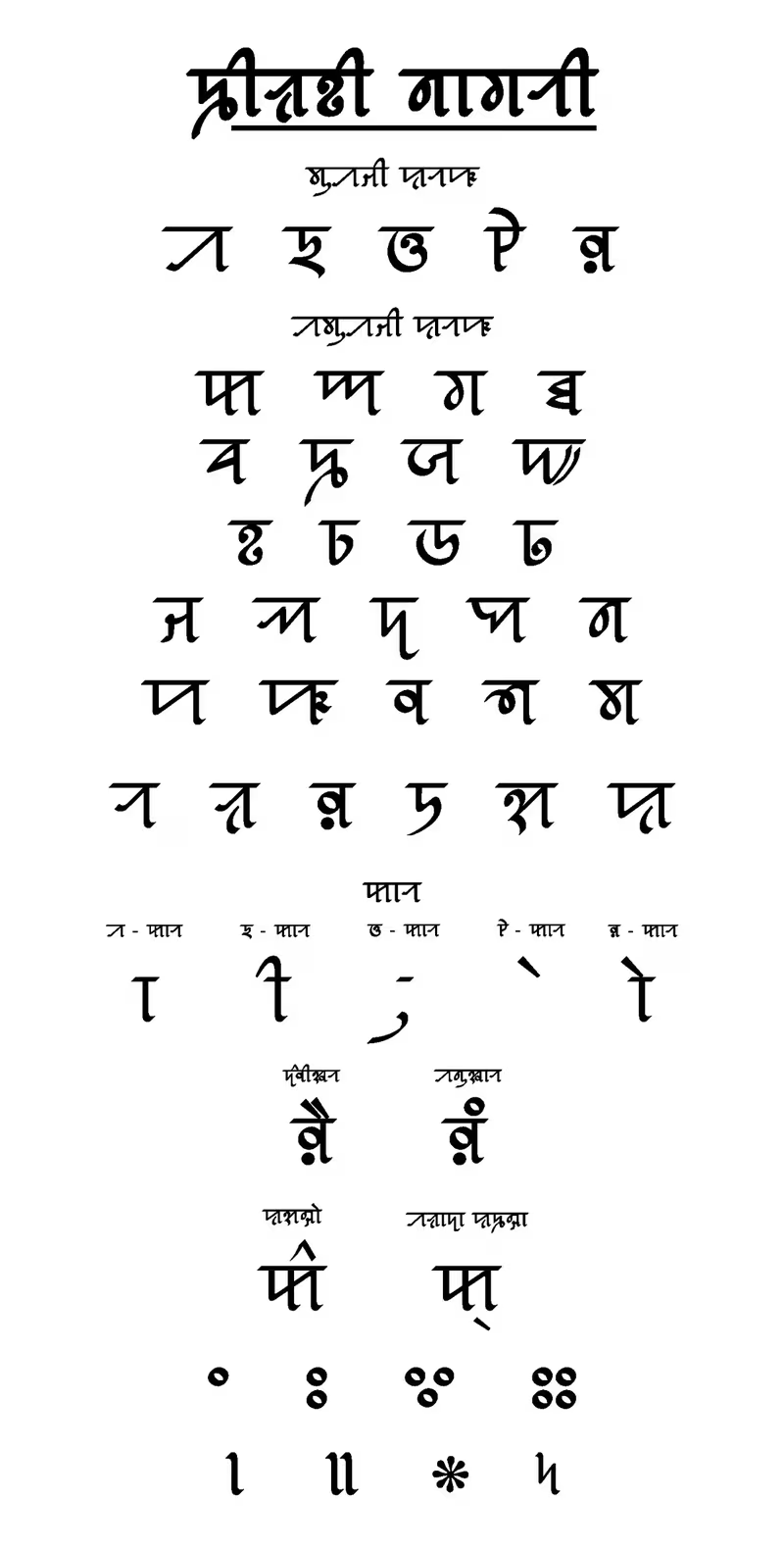
Sylheti Nagri is characterised by comparatively simple glyphs and fewer letters than the Bengali script. The alphabet is described as containing 32 letters: 5 vowels and 28 consonants. The script includes vowels, vowel diacritics or marks, consonants, consonant conjuncts, diacritical marks, and punctuation.
The vowels do not follow the sequence of the Bengali alphabet. Every vowel has a corresponding diacritic known as a xar. When a vowel occurs at the beginning of a syllable, or follows another vowel, it is written with an independent vowel letter. When it follows a consonant or consonant cluster, it is written using a diacritic that may appear above, below, before, or after the consonant.
The letter ꠅ represents the default inherent vowel /ɔ/ throughout the script. Unlike the other vowels, /ɔ/ has no separate vowel mark because it is understood to accompany each consonant. To remove the inherent vowel after a consonant, writers may use the hośonto, written as ◌꠆.
The script has one dedicated diphthong, ◌ꠂ oi /oi/, although the phonetic system contains many diphthongs. Most other diphthongs are represented by placing together the graphemes of their constituent vowels. The first element takes the form of a diacritic and the second remains an independent vowel glyph, as in ꠇꠦꠃ /xeu/.
There are 27 consonants. Letter names generally consist of the consonant sound with the inherent vowel ꠅ /ɔ/. Since the inherent vowel is not separately written, a letter’s name may look identical to the letter itself. The letter ꠊ, for example, is named ghô.
Historical sound changes have affected the relationship between spelling and pronunciation. The so-called aspirated consonants cause a higher or rising tone on the following vowel, but they are pronounced like the corresponding unaspirated consonants. The script also distinguishes ꠞ rô and ꠠ ṛô, although ordinary speech pronounces both as /ɾɔ/.
Consonant clusters can be represented by conjuncts. For instance, ꠞ꠆ꠟ rlô combines ꠞ rô and ꠟ lô. The number of commonly used conjuncts is lower than in many other Indic scripts. As of 2024, many fonts, browsers, and word processors still do not support Sylheti Nagri conjuncts fully.
Digital Encoding
Sylheti Nagri entered the Unicode Standard in March 2005 with version 4.1. Its Unicode block occupies U+A800–U+A82F. This encoding made it possible to represent the script in contemporary digital systems and contributed to its renewed visibility.
Sue Lloyd-Williams of STAR produced the first computer font for the script in 1997. The New Surma is a proprietary font, while Noto fonts provide an open-source option. Other fonts include Mukter Ahmed’s Fonty 18.ttf, which was developed from manuscripts and includes traditional Sylheti numbers.
Geographic Distribution
Historical Spread
The primary historical area of Sylheti Nagri was the eastern part of the Sylhet region. More broadly, the script was used in Bengal and Assam east of the Padma. Its historical range also included parts of present-day Bangladesh and northeastern India.
Scholarly accounts have reported its use in Bankura, Barisal, Chittagong, Noakhali, Tripura, Mymensingh, and Dhaka. Its presence in Chittagong and Barisal is thought to have resulted from riverine movement. Presses in Shillong and Kolkata provide further evidence of the script’s geographical reach.
Centers of Learning and Production
Sylhet was the principal centre of manuscript and printing activity. Bandar Bazar was the location of Abdul Karim’s Islamia Printing Press, while Naiyorpul was home to Sarada Printing and Publishing. Sunamganj and Shillong also had presses, as did Kolkata through General Printing Works and the Hamidi Press.
The tradition did not depend on formal schools. Instead, it circulated through manuscript reading, individual study, puthi performance, printing, and community use. This informal system helped the script reach people who had no institutional instruction in it.
Modern Distribution
Contemporary activity is concentrated in Bangladesh and among Sylheti communities in the diaspora. The revival is tied to efforts to preserve Sylheti as a cultural heritage in contrast to the dominance of Standard Bengali. SOAS University of London has supported initiatives such as the “Sylheti Project.”
Literary Heritage
Puthi Literature
The heart of Sylheti Nagri’s literary heritage is the puthi tradition. Early works include Talib Husan, Rag Namah, and Shonabhaner Puthi. The script’s simple visual structure encouraged poets and readers, while its association with Sylheti phonology gave the literature a distinctive regional character.
Religious Texts
Works such as Halat-un-Nabi, Mahabbatnama, and Noor Noshihot form part of the religious and devotional literature associated with the script. The New Testament was translated into Sylheti using Sylheti Nagri by James Lloyd-Williams and others in the United Kingdom. Published in 2014, it is titled Pobitro Injil Shorif.
Poetry and Other Works
The script was used for poetry, narratives, medicine, magical manuscripts, and poems about the Second World War. This range shows that Sylheti Nagri was not confined to one literary genre. It functioned as a flexible medium for religious, popular, practical, and historical writing.
Grammar and Phonology
Key Features
The historical literary language written in Sylheti Nagri was connected with Middle Bengali and the Dobhashi literary dialect, but it also reflected Sylheti phonology. The script therefore represented a regional literary culture rather than simply reproducing the conventions of the more prevalent Bengali script.
Sound System
The script’s inherent vowel is /ɔ/, represented by ꠅ and normally assumed after consonants. Vowel marks, or xar, attach to consonants and can occur in several positions around them. The dedicated diphthong is /oi/, while other diphthongs are created through combinations of vowel signs and independent vowel letters.
Aspirated consonants are associated with a higher or rising tone on the following vowel but are pronounced like unaspirated consonants. The distinction between ꠞ rô and ꠠ ṛô is maintained in the writing system, even though ordinary speech pronounces them alike.
Influence and Legacy
Cultural Impact
Sylheti Nagri gave the Sylhet region a distinctive literary identity. Its use for puthis enabled poetry and religious works to circulate among readers outside formal educational structures. The script’s relative simplicity also contributed to its popularity among particular communities, especially Muslims of Sylhet.
In the contemporary period, it has become a key identity marker for some people of Sylheti heritage, including members of the diaspora. The revival is closely linked with the preservation of the Sylheti language and regional cultural memory.
Research and Revival
Research expanded substantially in post-colonial Pakistan and independent Bangladesh. Munshi Ashraf Hussain, a researcher of Bengali folk literature, made a major contribution to Sylheti Nagri studies.
Publication resumed in Bangladesh in 2009 through Mostafa Selim, who founded Utsho Prokashon in Dhaka, and Anwar Rashid’s New Nation Library in Puran Lane, Sylhet. By 2014, Utsho Prokashon had published Nagri Grantha Sambhar, a collection of 25 manuscripts, prepared by Muhammad Abdul Mannan and Selim.
The revival attracted national attention through newspapers, television, and radio. The government enabled free circulation of books about Nagri to schools and colleges in Sylhet. Sarwar Tamizuddin directed the documentary Nagri Lipir Nabajatra, which was broadcast across Bangladesh. The Bangla Academy began hosting Nagri bookstalls at the Ekushey Book Fair.
Public cultural projects have also reinforced the script’s visibility. In 2018, the Sylhet City Corporation and Sylhet District Council funded a £20,000 circular mural at Surma Point called Nagri Chattar, designed by Shubhajit Chowdhury. The official building of the Sylhet District Deputy Commissioner also installed Nagri signboards.
Learning and Study
Academic Study
Sylheti Nagri is studied through manuscripts, literary works, historical research, and script scholarship. Padmanath Bhattacharjee Vidyabinod wrote the first scholarly article on the script, while later research by Munshi Ashraf Hussain and others expanded knowledge of its literary and folk traditions.
Archives associated with the British Library and Jadavpur University preserve materials related to the script. Research also considers the script’s debated origins, its relationship with Kaithi, its regional spread, its printing history, and its role in Sylheti identity.
Digital Resources
Unicode support allows Sylheti Nagri to be used in digital text. Google’s Gboard has offered Sylheti, identified as Syloti Nagri, as an input option since April 2019. The Syloti Nagri Keyboard, developed by Sabbir Ahmed Shawon and Muhammad Nurul Islam of CapsuleStudio as a routine project of Metropolitan University, Sylhet, was launched for Google Play on 9 December 2017.
Other digital resources include Sylheti Nagri Notes by the UK-based Sureware Ltd and the Multiling O Keyboard with its Sylheti Keyboard plugin by Honso. Fonts such as Noto and New Surma provide additional ways to read and write the script.
Conclusion
Sylheti Nagri developed as a regional literary script in the eastern areas of Bengal and Assam, with its strongest historical association with Sylhet. Its manuscripts preserve poetry, religious writing, medical and magical texts, and other forms of popular literature. Although its origins remain debated, proposed connections with Kaithi, Muslim colonies, Afghans, Nagar Brahmins, Buddhists, and immigrant communities reflect the complex movement of people and scripts across South Asia.
The script’s decline before the standardised Eastern Nagari system did not erase its cultural importance. Manuscript collections, scholarly research, surviving presses, Unicode encoding, fonts, keyboards, new publications, and public monuments have all supported its revival. Today Sylheti Nagri serves not only as a means of writing Sylheti but also as a visible emblem of Sylhet’s literary history and cultural identity.