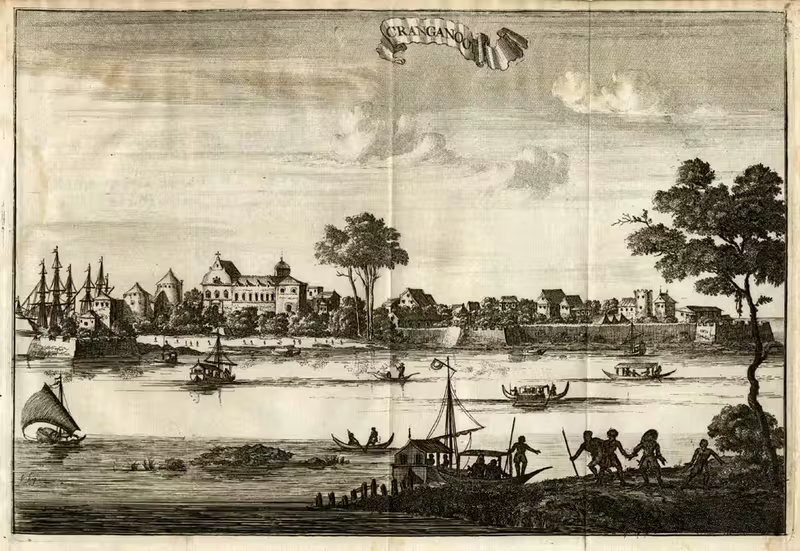
Overview
On the banks of the Periyar, where river channels meet the Kerala backwaters, lies Kodungallur: a town known by many names and shaped by centuries of maritime exchange. Modern Kodungallur is in Thrissur district, about 36 kilometres north of Kochi and 38 kilometres from Thrissur. Its position at the northern end of the Kerala lagoons made it a natural entry point for naval fleets moving into the backwaters.
Scholars identify the ancient harbour of Muziris with modern Kodungallur, although the identification remains a scholarly conclusion rather than an uncontested fact. In early historic times, the harbour connected central Kerala with navigators from the Mediterranean world. Pepper, pearls, muslin, ivory, diamonds, silk and perfumes were among the commodities associated with this trade.
Kodungallur also occupies a special place in the religious history of India. It is connected by tradition with the arrival of Saint Thomas, the establishment of an early mosque during the time of Malik Dinar, the presence of Jewish communities and an early Buddhist presence in South India. These traditions existed alongside long-established Shaiva, Vaishnava and Shakta practices. Later, the town became a contested military and commercial space for the Portuguese, Dutch, Cochin, Calicut and Travancore.
Etymology and Names
During the medieval period, Kodungallur formed part of the city known as Makothai Vanchi. Its Sanskrit name was Mahodaya Pura, or Mahodayapuram. For roughly three centuries, it served as the seat of the Kerala branch of the Chera clan known as the Chera Perumals.
European and regional names for the town reflect its connections with the surrounding waterways and its importance to overseas visitors. Cranganore is the best-known anglicised form, while the Portuguese used Cranganor. The town was also called Shingly, Vanchi, Muziris, Muchiri and Muyirikkode.
Several names—including Jangli, Gingaleh, Cyngilin, Shinkali, Chinkli, Jinkali, Shenkala and Cynkali—are linked to the River Changala. The name is explained through the idea of a “chain river,” associated with the Sanskrit word Shrinkhala. The changing names of Kodungallur therefore preserve several layers of its history: its Chera political identity, its riverine geography and its role in maritime commerce.
Geography and Location
Kodungallur lies on the Periyar near the northern end of the Kerala lagoon system. The town’s location provided access to inland waterways while also connecting it to the Malabar Coast. This combination gave Kodungallur both commercial and military value. Naval fleets could use the coastal waterways as an approach to the Kerala backwaters, and goods moving between the interior and the sea could pass through the harbour.
The River Changala, described as a tributary or branch of the Periyar, was especially important in the historical geography of the area. A major environmental change is associated with the year 1341. It is suggested that a flood or earthquake split the left branch of the Periyar into two. The right branch, known as the Changala, may have been silted along with the natural harbour at the river mouth. If so, large vessels could no longer navigate the port easily.
This possible transformation of the river system helps explain why commercial activity later shifted toward other Malabar ports, particularly Cochin and Calicut. The history of Kodungallur shows how waterways could create a port’s importance—and how changes in those waterways could weaken it.
Ancient History
The Harbour of Muziris
The ancient harbour of Muziris is believed by scholars to have stood at or near modern Kodungallur. Early historic central Kerala and western Tamil Nadu were ruled by the Chera line of kings, and the harbour formed part of a wider maritime world.
Navigators from the Mediterranean visited the coast, and the Roman Empire maintained continuous trading connections with western India. Black pepper was a particularly important commodity. Other products associated with the trade included pearls, muslin, ivory, diamonds, silk and perfumes. These exchanges placed the Periyar region within a commercial network that reached far beyond South India.
The identification of Kodungallur with Muziris is important but should be treated carefully. The historical record presents it as a scholarly belief, while the precise location and changing form of the ancient harbour continue to be investigated. The later silting and alteration of the waterways may also have changed the landscape substantially.
Christian Tradition
Saint Thomas Christians in Kerala traditionally hold that Thomas the Apostle landed in or around Kodungallur during the middle of the first century CE. According to this tradition, he founded seven churches: Kodungallur, Niranam, Nilackal or Chayal, Kokkamangalam, Kottakkavu, Palayoor and Kollam.
This tradition gives Kodungallur a foundational place in the history of Christianity in India. It also reflects the town’s position as a port open to movement from the western Indian Ocean. The historical account does not establish the landing as an independently confirmed event, but the tradition has remained central to the identity of Saint Thomas Christians in Kerala.
A later migration is associated with the Knanaya community. Sometime between the fourth and eighth centuries, the community is believed to have arrived from the Middle East under the leadership of the Syrian merchant Thomas of Cana. It settled on the southern side of Cranganore and established churches dedicated to Saint Thomas, Saint Kuriakose and Saint Mary. The community eventually left after its settlement was destroyed during a sixteenth-century conflict between the Kingdom of Cochin and the Zamorin of Calicut.
Muslim and Jewish Traditions
Kerala Muslim tradition identifies Kodungallur as the home of the oldest mosque in the Indian subcontinent. According to the legend of the Cheraman Perumals, the first Indian mosque was built at Kodungallur in 624 CE. The story connects its foundation with the last Chera ruler, who is said to have travelled from Dharmadom to Mecca and converted to Islam during the lifetime of Muhammad.
Another tradition links the mosque’s establishment with Malik Dinar. The same tradition associates him with a group of early mosques across the Malabar Coast, including those at Kollam, Madayi, Barkur, Mangalore, Kasaragod, Kannur, Dharmadam, Panthalayini and Chaliyam. These accounts belong to Kerala’s rich religious traditions and are presented as traditions rather than as uniformly established historical facts.
Jewish presence is also associated with the town and its region. One tradition holds that a Jewish colony on the Malabar Coast, perhaps established before the sixth century BCE, attracted the Apostle Thomas to the area. The port’s connections with overseas merchants provide the broader setting for these traditions of Jewish, Christian and Muslim settlement.
Historical Timeline
Chera and Medieval Kodungallur
Kodungallur’s political importance continued beyond the early historic period. From approximately the ninth century, it was part of Mahodayapuram and served as the seat of the Chera Perumals for about three centuries. The medieval harbour retained its economic and political prestige.
Sulaiman, a West Asian visitor to India, described the prosperity of the region and noted the presence of Chinese traders in the city. These traders purchased pepper, cinnamon, ivory, pearls, cotton fabrics and teak wood. The account indicates that Kodungallur was connected not only to western maritime networks but also to commercial movement across the Indian Ocean.
The port was sacked by Chola rulers in the eleventh century. Following the dissolution of Chera Perumal rule in the early twelfth century, Kodungallur became the principality of Padinjattedathu Swaroopam, controlled by the royal family of Kodungallur Kovilakam. The city-state was aligned at different times with either Cochin or Calicut.
The Transformation of the Harbour
The possible flood or earthquake of 1341 marked a major turning point. The associated silting of the Changala branch and the harbour may have made the port difficult for large vessels. Commercial traffic is consequently thought to have moved toward Cochin and Calicut.
The environmental change did not immediately erase Kodungallur’s political value. Its position between rival kingdoms continued to make it strategically important. Control of the town meant access to waterways, coastal routes and the northern approach to the Kerala backwaters.
Portuguese Intervention
Portuguese navigators began operating in South India in the early sixteenth century. At this time Kodungallur was a tributary state of Calicut, ruled by the Zamorin, but its location between Calicut and Cochin made it a frequent object of dispute. The local chieftain sometimes changed allegiance between the two powers.
The Portuguese attacked allied coastal cities as part of their struggle against Calicut’s control of the spice trade. On 1 September 1504, a Portuguese force under the command of Suarez de Menezes almost completely destroyed the port.
The attack intensified in October, when the Zamorin sent troops to fortify Kodungallur. The Portuguese interpreted the movement as preparation for another attack on Cochin. Lopo Soares therefore ordered a pre-emptive strike. A fleet of about ten fighting ships, accompanied by numerous boats from Cochin, moved toward Kodungallur. Larger vessels anchored at Palliport because they could not enter the shallow channels, while smaller frigates continued toward the town.
The Portuguese-Cochin force dispersed the Calicut troops on the beach with cannon fire. Around 1,000 Portuguese soldiers and 1,000 soldiers from Cochin then attacked the remaining defenders. The city was captured, sacked and burned by forces led by Duarte Pacheco Pereira and Diogo Fernandes Correa.
Some accounts state that Portuguese forces spared the Saint Thomas Christian quarters. The community was already navigating a difficult political environment, caught between the rulers of Calicut, Cochin and other regional states. Its role in the pepper trade also gave the Portuguese a reason to cultivate an alliance with it.
A Calicut fleet of approximately five ships and eighty paraus attempted to save the city but was defeated near Palliport. The ruler of Tanur, whose territory lay between Calicut and Kodungallur, then offered submission to the Portuguese. These events weakened the Zamorin and enabled Portuguese authority to expand along a substantial section of the Malabar Coast.
Dutch and Travancore
In 1662, the Dutch entered the contest for control of Kodungallur. With the assistance of the Zamorin, they defeated the Portuguese in a war lasting a fortnight and occupied the town. The Dutch took control of Kodungallur Fort in 1663.
The fort later served as part of the defensive system protecting southern Kerala, particularly Travancore, from Mysorean expansion. Mysorean troops reached northern Kerala in 1776 but did not advance beyond Kodungallur. They returned in 1786, again without progressing beyond the town.
On 31 July 1789, the Dutch transferred their establishments at Kodungallur and Azhikode to the Kingdom of Travancore for 300,000 Surat silver rupees.
Political and Military Significance
Kodungallur’s political history was closely tied to geography. The town was both a port and a gateway. Whoever controlled it could influence movement between the coast and the backwaters, as well as trade through the northern part of the lagoon system.
Under the Chera Perumals, it was a royal centre. After the Chera polity dissolved, it became a smaller principality but remained strategically valuable. Its location between Calicut and Cochin repeatedly drew it into regional competition. During the Portuguese period, control of Kodungallur was part of a wider attempt to dominate the Malabar spice trade.
Fort Cranganore, also known locally as Kottappuram Fort, embodied this strategic importance. Built by the Portuguese in 1523 and enlarged in 1565, it was captured by the Dutch in 1663. Its later role in the defence of Travancore shows how the former port continued to matter even after its commercial strength had diminished.
Religious and Cultural Importance
Kodungallur’s religious landscape includes major Hindu institutions and traditions associated with Christianity, Islam, Judaism and Buddhism.
Thiruvanchikulam Mahadeva Temple is dedicated to Shiva and is described as one of the major Shiva temples in South India. Shiva at Thiruvanchikulam was the patron deity of the Chera Perumals and remains the family deity of the Cochin Royal Family.
Kodungallur Bhagavathy Temple is dedicated to Bhadrakali, a form of Mahakali, Durga or Aadi Parashakthi. The goddess is also called Sri Kurumba, “the Mother of Kodungallur.” The temple is regarded as the head of sixty-four Bhadrakali temples in Kerala and is described as one of the oldest functioning temples in India.
These institutions exist within a town remembered for its religious diversity. The traditions connected with Saint Thomas, the Cheraman Perumal mosque and Jewish settlement do not represent a single uniform historical narrative, but together they demonstrate Kodungallur’s long association with travel, migration and exchange across the Indian Ocean.
Economic Role
Kodungallur’s earliest recorded importance was maritime. Pepper and cinnamon attracted Chinese traders, while Mediterranean commerce brought navigators to the Periyar region. Ivory, pearls, cotton cloth, teak, muslin, silk, perfumes and diamonds were also associated with the harbour’s trade.
The port’s economic life depended on its connection with navigable water. When the river channels and harbour were altered, its capacity to receive large vessels declined. Cochin and Calicut subsequently became more prominent commercial centres. Even after this change, Kodungallur remained a strategic location because its waterways and fortifications had military value.
Monuments and Heritage
The principal historic sites associated with Kodungallur include Kottappuram Fort, Thiruvanchikulam Mahadeva Temple and Kodungallur Bhagavathy Temple. Together, they represent the town’s military, royal and religious histories.
The Government of Kerala launched the Muziris Heritage Project in 2006 through the Department of Cultural Affairs. Its stated purpose is to scientifically retrieve and preserve the historical heritage of the region extending from North Paravur to Kodungallur. The Kerala Council for Historical Research serves as the project’s nodal agency, providing academic guidance and conducting archaeological and historical research.
Modern City
According to the 2011 Census of India, Kodungallur Municipality had a population of 33,935 and an average literacy rate of 95.10 percent. Approximately 64 percent of the population followed Hinduism, 32 percent Islam and 4 percent Christianity. Scheduled Castes made up 7.8 percent of the population, while Scheduled Tribes accounted for 0.1 percent.
Kodungallur is the headquarters of the Kodungallur sub-district in Thrissur district. It is connected by road to other towns in Kerala, including Kochi and Thrissur. Aluva Railway Station, 28 kilometres away in Ernakulam district, is the nearest major railway station identified in the historical account.
Today, Kodungallur’s importance rests not only in surviving temples and fort remains but also in the historical landscape around the Periyar. Its heritage combines an ancient port tradition, Chera political history, religious memory and the remains of European colonial competition.
Timeline
Traditional arrival of Saint Thomas
Saint Thomas is traditionally believed to have landed in or around Kodungallur during the first century CE.
Traditional foundation of the first mosque
Kerala Muslim tradition places the construction of an early mosque at Kodungallur in this year.
Mahodayapuram and the Chera Perumals
Kodungallur formed part of Mahodayapuram and served as the seat of the Kerala branch of the Chera Perumals.
Post-Chera principality
After the dissolution of Chera Perumal rule, Kodungallur emerged as Padinjattedathu Swaroopam under the Kodungallur Kovilakam.
Possible harbour catastrophe
A flood or earthquake is thought to have altered the Periyar channels and weakened the navigability of the harbour.
Portuguese attack
Portuguese and Cochin forces captured, sacked and burned Kodungallur during the conflict with Calicut.
Fort Cranganore constructed
The Portuguese built Fort Cranganore, later known as Kottappuram Fort.
Dutch occupation
The Dutch captured Kodungallur Fort after defeating the Portuguese with assistance from the Zamorin.
Transfer to Travancore
The Dutch handed over their establishments at Kodungallur and Azhikode to Travancore.
Muziris Heritage Project
The Government of Kerala launched a project to research and preserve the heritage of the Muziris region.