Overview
Around 200 BCE, Demetrius I of Bactria crossed south of the Hindu Kush and began the Greek expansion that created the Indo-Greek kingdoms. The resulting political world was not a single, continuously unified empire. It was a changing group of Hellenistic states whose rulers governed from regional centres such as Taxila, Sagala, Pushkalavati, and Bagram. At different times, their territories included parts of modern Afghanistan, Pakistan, and northwestern India.
The term “Indo-Greek Kingdom” therefore describes a political tradition rather than one uninterrupted state. Some rulers were connected to the Euthydemid dynasty of the Greco-Bactrian Kingdom; others controlled only a portion of the former realm. Civil wars, competing royal houses, and pressure from Indian, Saka, Scythian, Yuezhi, and Parthian powers repeatedly altered the political map.
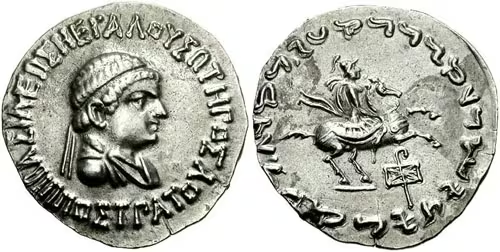
What united many of these kingdoms was their ability to combine Hellenistic and Indian practices. Their coins carried Greek inscriptions and royal portraits on one side and Indian scripts, symbols, and religious imagery on the other. Their rulers used Greek titles while addressing Indian subjects through Kharoshthi or, in a few cases, Brahmi. Their religious environment included Greek deities, Buddhism, Hindu traditions, Vaishnavism, and Zoroastrianism.
The most celebrated ruler was Menander I, known in Buddhist literature as Milinda. His reign, generally placed between approximately 165 and 130 BCE, brought Indo-Greek control to its greatest extent or close to it. Menander’s memory survived not only through his coins but also through the Milinda Panha, a Buddhist dialogue in which he questions the monk Nagasena.
The Indo-Greek political presence ended in stages rather than in a single collapse. The western territories were lost to Saka and other Central Asian powers, while Indian communities and kingdoms recovered regions to the east. The last known Indo-Greek rulers held part of the Punjab until approximately 10 CE. Greek populations, however, probably remained in the subcontinent for centuries under Indo-Scythian, Indo-Parthian, Kushan, and Western Satrap rule.
Historical Background
Greek communities before the Indo-Greek kingdoms
Greek involvement in the northwestern Indian subcontinent began before the Indo-Greek kingdoms. Under the Achaemenid Persian Empire, Greek communities were moved to eastern parts of the imperial world, including regions around present-day Afghanistan. These settlements became politically influential over time.
Alexander the Great’s conquest of the Persian Empire brought the northwestern Indian subcontinent into the wider Hellenistic world. In 326 BCE, Alexander reached the Hyphasis River, generally identified with the Beas. His soldiers refused to march farther east, and he turned back after establishing satrapies and cities, including Bucephala.
The territories in the Punjab were placed under local rulers such as Porus and Taxiles, while Greek commanders remained in authority over parts of the former Achaemenid and Macedonian possessions. Eudemus, one of Alexander’s generals, operated in the region until leaving India in 316 BCE. To the south, Peithon, son of Agenor, governed Greek colonies along the Indus before departing for Babylon.
Alexander’s conquest did not create a lasting Macedonian empire in India. After his death, power shifted among his generals and local rulers. Yet the conquest established networks of cities, military settlements, and political relationships that connected the northwest of the Indian subcontinent with Bactria, the Iranian plateau, and the eastern Mediterranean.
The Mauryan–Greek relationship
The rise of Chandragupta Maurya transformed the political situation. Around 322 BCE, Greek groups described in Indian texts as Yonas or Yavanas may have joined Chandragupta’s rebellion against the Nanda dynasty. The Mudrarakshasa and a Jain text, the Parisishtaparvan, describe an alliance involving Greeks, Kambojas, Shakas, Kiratas, Persians, and Bactrians. These accounts portray Chandragupta’s army as ethnically diverse.
The details are difficult to verify, but the broader relationship between the Mauryas and the Hellenistic world is well attested. In 305 BCE, Seleucus I Nicator led an army toward the Indus and encountered Chandragupta. The conflict ended in a treaty under which Seleucus ceded eastern territories to the Mauryan ruler, possibly extending as far as Arachosia. In return, Seleucus received 500 war elephants.
Ancient accounts refer to an epigamia, which could mean a dynastic marriage or an agreement permitting intermarriage between Indians and Greeks. The exact arrangement is uncertain. Greek writers do not clearly record an Indian princess entering the Seleucid royal family, while a later Indian text describes Chandragupta marrying a daughter of a Greek king. The episode illustrates the political and cultural connections that linked the Mauryan and Hellenistic courts, even though its precise details remain disputed.
Greek envoys and historians visited the Mauryan court. Megasthenes resided there, followed by Deimachus and Dionysius. A Mauryan department dealing with Greek and Persian foreigners is also associated with this period. Hellenistic pottery found across northern India provides further evidence for sustained contact.
Ashoka, Chandragupta’s grandson, continued the relationship with the Greek world. After adopting Buddhism, he issued edicts describing the spread of Dharma among Greek communities and other peoples within his realm. One edict names the Greeks among groups following the king’s instructions. Another states that Ashoka sent missions toward the territories of Hellenistic rulers, including Antiochus, Ptolemy, Antigonus, Magas, and Alexander.
Pali sources also describe Greek Buddhist monks. Dhammarakkhita, called a Greek or Yona, was sent to Aparantaka, the western region corresponding broadly to Gujarat and Sindh. Mahadharmaraksita was sent to the country of the Yonas. These reports cannot establish the scale of Greek conversion, but they point to religious exchange before the rise of the Indo-Greek kingdoms.
The rise of the Greco-Bactrian Kingdom
Bactria had been incorporated into the Hellenistic world after Alexander’s conquest. Seleucus I controlled it at first, but around 250 BCE the satrap Diodotus I declared independence and established the Greco-Bactrian Kingdom. The exact date is debated. A higher chronology places the breakaway around 255 BCE, while a lower chronology places it around 246 BCE.
The new kingdom was urbanised and wealthy. Ancient writers described Bactria as a land of many cities, with Bactra, Darapsa, and Eucratidia among its centres. Its rulers expanded in several directions. Under Euthydemus I, who overthrew Diodotus II around 230 BCE, Greco-Bactrian power extended into Sogdiana and the region beyond the Oxus.
Euthydemus faced an invasion by Antiochus III around 210 BCE. He lost an initial battle on the Arius but resisted a three-year siege at Bactra. Antiochus eventually recognised him as king and arranged a marriage between his daughter and Euthydemus’s son, Demetrius. Euthydemus argued that he had removed a rebel dynasty and was protecting Central Asia from nomadic peoples. The settlement allowed the Greco-Bactrian Kingdom to remain independent and strengthened its royal legitimacy.
Demetrius I inherited this kingdom and became the figure associated with the Greek expansion into India. The Indo-Greek kingdoms emerged when the eastern territories of the Greco-Bactrian world developed into separate or semi-independent states.
Rise to Power
Demetrius I and the southern expansion
Demetrius I is generally considered the founder of the Indo-Greek realm. He was the son of Euthydemus I and therefore belonged to a Greek ruling family connected to Magnesia in Asia Minor through his father. His mother’s identity is not established in the surviving evidence.
Demetrius’s expansion probably began after the decline of Mauryan power. Around 185 BCE, Pushyamitra Shunga, the Mauryan commander-in-chief, killed the last Mauryan emperor Brihadratha and founded the Shunga Empire. The political change may have weakened Mauryan authority in the northwest and created an opportunity for Greek intervention.
The exact motives of Demetrius are unknown. He may have sought to expand the Greco-Bactrian Kingdom, secure routes south of the Hindu Kush, protect Greek populations, or exploit the political fragmentation that followed the end of Mauryan imperial rule. It is also possible that several objectives operated together.
His coins have been found in Arachosia and the Kabul Valley. These finds suggest that Demetrius controlled important territories south of the Hindu Kush. On his coins, he wears an elephant-scalp helmet associated with Alexander’s Indian conquests. The image may have signalled victory in India, although it cannot by itself define the exact territory he conquered.
Demetrius may have occupied the Kabul Valley, Arachosia, and Gandhara. It is less certain whether he ruled deep inside the Punjab. He did not issue the Indian-standard coins later associated with Indo-Greek kings, which may indicate that his direct control did not extend far into the Indian plains or that his reign ended before he consolidated those territories.
Some scholars have connected Demetrius with a Yavana era beginning in 186 or 185 BCE. This identification remains part of the wider debate surrounding Indo-Greek chronology.
Fragmentation after Demetrius
After Demetrius’s death, the Greek political world divided. The Bactrian kings Pantaleon and Agathocles issued bilingual coins with Indian inscriptions. Their coins have been discovered as far east as Taxila, suggesting that Gandhara was included in their political sphere around 185–170 BCE.
The first bilingual issues are especially important because they used Brahmi or Kharoshthi alongside Greek. They also included Indian symbols and religious figures. Agathocles issued a small but remarkable group of silver coins displaying Balarama-Sankarshana and Vasudeva-Krishna. These are among the earliest known royal coins to incorporate imagery associated with Vaishnava traditions.
The relationship between Bactrian and Indian territories was not stable. Civil wars among the Greco-Bactrian rulers may have enabled Apollodotus I to establish himself as an independent Indo-Greek king. He appears to have ruled in Gandhara and the western Punjab. His coinage, along with that of Menander I, uses the title “Saviour King” in Greek and a corresponding title in an Indian language on the reverse.
This title had a strong Hellenistic background. Ptolemy I and Antiochus I had used the title Soter in the Greek world. In the Indo-Greek context, it may have addressed Greek populations, Indian subjects, or both. The title may have referred to military victory, political protection, or the ruler’s claim to restore order.
Golden Age
Menander I and Sagala
Menander I was the most successful and best-known Indo-Greek ruler. His reign is generally placed between approximately 165 and 130 BCE, although the chronology of the Indo-Greek kings remains subject to revision. His capital was Sagala in the Punjab, identified with modern Sialkot.
Menander’s coins are more numerous and geographically widespread than those of any other Indo-Greek ruler. They have been found across a large area, including eastern Punjab and regions far from Sagala. This distribution suggests a broad political and economic network.
Menander appears to have launched or completed a second wave of Indo-Greek expansion. His power extended through Punjab, and literary, epigraphic, and numismatic evidence connects him with Mathura. Ptolemy later associated Menander’s rule with Mathura, while the Yavanarajya inscription refers to a period of Yavana rule in the region.
Menander’s political structure should not be imagined as a uniformly administered empire. The Indo-Greek realm was a collection of territories linked by royal authority, military control, cities, and coin circulation. Some areas may have been directly governed, while others were controlled through important urban centres or subordinate rulers.
The eastern campaigns
Several Indian and Greek accounts refer to Indo-Greek campaigns beyond Punjab. Patanjali, writing around 150 BCE, used examples describing the Yavanas besieging Saketa and Madhyamika. Because he used the imperfect tense, these events may have been recent or ongoing when he wrote.
The Yuga Purana describes a Yavana advance through Saketa, the Panchala country, and Mathura toward Kusumadhvaja, another name for Pataliputra. The text speaks of the city’s mud fortifications and a resulting conflict. However, the Yuga Purana presents the account as a prophecy, and the historical interpretation of the passage is disputed.
There is no secure evidence that the Indo-Greeks permanently occupied Pataliputra. Some historians associate the campaign with Menander, while others have connected it with Demetrius or with a raid carried out alongside Indian allies. The lack of supporting coinage and inscriptions makes it difficult to establish the expedition’s scale or outcome.
The Hathigumpha inscription of Kharavela, ruler of Kalinga, offers another account. It describes a Yavana king whose name is commonly reconstructed as Dimi or Dimita. After Kharavela’s army advanced toward Rajagaha, the Yavana ruler retreated to Mathura with a demoralised army. The name has been identified with Demetrius by some scholars, but this interpretation creates chronological problems and is disputed. Menander remains a possible candidate, although the inscription does not provide a secure identification.
The evidence therefore supports Greek military activity in northern India but does not establish a continuous Indo-Greek empire reaching the Gangetic capital.
Mathura and Haryana
Indo-Greek influence in Mathura is supported by several kinds of evidence. Coins and inscriptions indicate that Greek rulers controlled or influenced the city during parts of the period between approximately 185 and 85 BCE, especially during the reign of Menander.
The Yavanarajya inscription, discovered near Mathura, records the last day of the 116th year of Yavana rule. If this refers to a Yavana era beginning around 186 BCE, the inscription would date to approximately 70 BCE. The interpretation is not certain, but it suggests that Indo-Greek authority or political memory persisted in Mathura after Menander’s death.
Large numbers of Indo-Greek coins have also been found at Khokrakot, modern Rohtak. They represent as many as fourteen Indo-Greek kings. Coin moulds from Naurangabad suggest activity in Haryana during the second and first centuries BCE.
Mathura’s political status later became contested. The Mitra and Datta dynasties issued coins there, but it is unclear whether they were independent rulers, local dynasties, or officials operating under a larger power. By the first century CE, Mathura was under the Indo-Scythian Northern Satraps.
The northwestern frontier and Eucratides
Indo-Greek power was also challenged from the north. Eucratides I, a major Greco-Bactrian ruler, attacked the Indo-Greek territories around the middle of the second century BCE. A king named Demetrius, described as “king of the Indians,” reportedly besieged Eucratides for four months. The identity of this Demetrius is uncertain. Some scholars identify him with Demetrius I, while others reject the identification on chronological grounds.
Eucratides eventually occupied territory as far as the Indus, probably between approximately 170 and 150 BCE. Menander later recovered these territories. The conflict shows that the Indo-Greek and Greco-Bactrian kingdoms were not always allies. They were related political formations competing for control of routes, cities, and the former eastern territories of the Hellenistic world.
Menander in Buddhist tradition
Menander’s memory was preserved in Buddhist literature under the name Milinda. The Milinda Panha presents a dialogue between King Milinda and the monk Nagasena. The king asks questions about the self, morality, knowledge, and Buddhist doctrine. Nagasena responds through logical arguments and analogies.
The text portrays Menander as intellectually engaged and eventually converted to Buddhism. It states that he became an arhat and gave up royal life in favour of religious practice. The historical Menander’s personal religious beliefs cannot be established with certainty from this literary work, which was composed and transmitted in a Buddhist setting. Nevertheless, the text demonstrates how later Buddhist communities remembered him.
Menander is also associated with Buddhist relic traditions. Plutarch stated that when a king named Menander died, cities contested the possession of his remains. They eventually divided the relics and built monuments. The account parallels traditions about the Buddha’s relics, although it does not independently establish the details of Menander’s death or burial.
A coin type introduced by Menander depicts Athena Alkidemos, “Athena the Protector of the People.” The type was adopted by many later Indo-Greek rulers in the eastern territories. Menander also issued coins bearing a wheel, commonly interpreted as a Buddhist dharmachakra, although symbols on coins may have had several layers of meaning.
Administration and Governance
A group of regional monarchies
The Indo-Greek kingdoms did not possess a single, uniform administrative system. The ancient evidence is limited, and most later rulers are known primarily through coins. Their political organisation must therefore be reconstructed from coin distributions, inscriptions, city sites, literary references, and patterns of overstriking.
The kingdoms were Hellenistic monarchies. Kings used Greek royal titles, placed their portraits on coins, and associated themselves with gods and heroic figures such as Zeus, Herakles, Athena, and Apollo. At the same time, they adapted their public presentation to Indian political and religious expectations.
Important regional centres included Taxila, Sagala, Pushkalavati, Bagram, and possibly Theophilus in the south of the Indo-Greek sphere. The geography of these centres indicates a political system organised around cities, fortified settlements, routes, and strategic valleys rather than a single capital controlling every region directly.
Languages and scripts
Greek remained an important language of royal authority. Coins commonly carried Greek legends, titles, and names. The reverse often used Kharoshthi, a script derived from Aramaic and widely used in the northwest.
The use of bilingual coinage was a major political innovation in the Indian context. It allowed the same royal issue to communicate with communities familiar with Greek traditions and with local populations using Indian languages and scripts. The inscriptions did not merely translate one another mechanically; they reflected different cultural settings.
Apollodotus I and later rulers generally issued coins in Greek and Kharoshthi. Agathocles is especially notable for the use of Brahmi on some coins, showing that Greek rulers could engage with the writing systems of regions farther east.
Indo-Greek coins played an important role in the modern decipherment of Kharoshthi. The presence of Greek legends alongside Kharoshthi allowed scholars to compare names and titles. The script later disappeared around the third century CE.
Royal titles and political identity
The rulers presented themselves through a mixture of Greek, Indian, and universalising titles. The Greek title Soter, meaning “Saviour,” appeared on the coins of Menander and Apollodotus. Several later kings used the Indian title Dharmikasa, translated into Greek as Dikaios, “the Just” or “righteous.”
The title Dharmikasa appears on coins associated with rulers such as Zoilos I, Strato I, Heliokles II, Theophilos, Menander II, Archebios, and Peukolaos. The title connected kingship with the Indian concept of Dharma, especially in a political culture shaped by the memory of Ashoka.
This does not mean that every ruler was Buddhist. The Indo-Greek religious environment was plural. Greek gods remained prominent on coins, while Indian religious figures, animals, symbols, and Buddhist motifs also appeared. The Heliodorus pillar demonstrates that at least some members of the Greek political world participated in Vaishnava devotion.
Local participation
By the late second and first centuries BCE, local technicians and communities were increasingly visible in Indo-Greek monetary production. Kharoshthi letters began to appear as mint marks alongside Greek monograms. This suggests the participation of local officials or craftsmen in the operation of the mints.
The coinage also shows changing regional practices. The Indo-Greeks issued round coins in the Greek or Attic standard and square coins in Indian standards. Later issues often became more Indian in shape, imagery, and script. These changes reflect adaptation to local circulation rather than a complete abandonment of Hellenistic identity.
Military Campaigns
Armies and equipment
The Indo-Greek armies combined traditions from the Hellenistic world, the Indian subcontinent, and Central Asian frontier societies. Coins show kings and soldiers wearing Greek or Greco-Bactrian helmets, including rounded helmets and the Macedonian kausia. They also depict cavalry, spears, swords, bows, and arrows.
The fourfold army described in the Milinda Panha included elephants, cavalry, bowmen, and infantry. This arrangement corresponds to the established Indian military model of elephants, horses, chariots, and foot soldiers, although the text’s precise description reflects a later literary context.
The coins of Agathocleia depict a long bow. Later coins, especially those of Zoilos I and Hermaeus, show a Central Asian recurve bow with a bow case or gorytos. The appearance of this equipment around 130 BCE indicates contact with steppe peoples, including the Scythians or Yuezhi.
Greek and Central Asian military traditions were therefore not separate systems. The armies adapted as political alliances shifted and new nomadic groups entered the region.
Demetrius’s campaigns
Demetrius I’s campaigns created the Indo-Greek political sphere. His control of Arachosia and the Kabul Valley gave him access to the routes connecting Bactria with Gandhara and the Punjab. His elephant-scalp helmet proclaimed an association with the conquest of India.
The surviving evidence does not establish the full sequence of his campaigns. It is possible that he founded or strengthened cities such as Sirkap at Taxila, although the political and chronological details of the site remain part of a broader archaeological debate. The urban environment associated with Taxila shows Greek and Indian influences without a clear division between separate communities.
Menander’s expansion
Menander expanded Indo-Greek power across Punjab and probably into Mathura. His widespread coin finds indicate that his influence reached far beyond his capital at Sagala. Literary references to campaigns against Saketa, Madhyamika, and perhaps Pataliputra may relate to his reign, but none can be accepted without qualification.
Menander’s eastern advance may have been a direct royal conquest, a series of raids, or an alliance with Indian forces opposed to the Shungas. The available accounts do not provide enough detail to distinguish among these possibilities.
Kharavela and the Yavana retreat
The Hathigumpha inscription records a conflict between Kharavela of Kalinga and a Yavana king. Kharavela’s army advanced toward Rajagaha, and the Yavana ruler retreated to Mathura. The inscription presents the event as a royal victory.
The Yavana king’s name is fragmentary. It has been read as Dimi or Dimita and associated with Demetrius, but the reading and identification are uncertain. Menander or another Indo-Greek ruler may be involved. The account nevertheless indicates that Indo-Greek forces operated far to the east of their core territories, even if their presence there was temporary.
Conflicts with Central Asian powers
From the middle of the second century BCE, movements of Scythians and Yuezhi altered the balance of power north of the Hindu Kush. The Yuezhi were migrating from the regions near China, and their movement pushed other groups toward Bactria and the Indian northwest.
Around 130 BCE, Heliocles, the last major Greco-Bactrian king, was probably killed during the invasion of Bactria. The Greco-Bactrian Kingdom then ceased to exist as an independent power. The Parthians may also have contributed to its fall.
The collapse of Bactria isolated the Indo-Greek kingdoms from their northern political base. Some Indo-Greek rulers continued to issue Greek-standard coins that may have been intended for tribute, payments to mercenaries, or trade with the Central Asian groups now controlling Bactria. The precise purpose of these coins remains unknown.
Cultural Contributions
A bilingual political culture
The most visible cultural achievement of the Indo-Greek kingdoms is their bilingual coinage. Royal portraits and Greek legends appeared with Kharoshthi or Brahmi inscriptions, Indian animals, local symbols, and religious imagery.
This was not merely a practical translation system. It created a new visual language of authority. Greek rulers could appear as Hellenistic kings while also presenting themselves as legitimate participants in the political and religious world of South Asia.
The coinage included:
- Greek portraits and titles.
- Zeus, Athena, Herakles, Apollo, and other Greek deities.
- Elephants, bulls, lions, and zebu cattle.
- Buddhist wheels and other symbols.
- Indian deities such as Balarama-Sankarshana and Vasudeva-Krishna.
- Indian scripts and legends.
- Blessing gestures resembling the Buddhist vitarka mudra.
The imagery changed over time and varied between regions. Greek religious figures remained common, but local symbols became more prominent in Indian-standard issues.
Buddhism
Buddhism flourished in the territories associated with the Indo-Greeks, although the relationship between rulers and Buddhist institutions varied. Menander’s association with Buddhism is the best known, but Buddhist connections extended beyond his reign.
The Buddhist Milinda Panha presents Menander as a patron and convert. It may preserve memories of actual exchanges between Greek rulers and Buddhist communities, but it should also be read as a religious text designed to present Buddhist doctrine through a royal dialogue.
Archaeological evidence shows Indo-Greek-period activity at Buddhist sites. The Butkara stupa in the Swat region received additional construction and Hellenistic architectural decoration in the second century BCE. A coin of Menander was found in a relevant archaeological layer, linking the site to the wider period of Indo-Greek influence.
Greek and northern craftsmen also contributed to the early decorative programmes at Sanchi and Bharhut. These craftsmen used Kharoshthi mason’s marks, indicating connections with Gandhara and the northwest.
Sanchi and Bharhut
At Sanchi, decorative reliefs were introduced around 115 BCE, with more extensive pillar carvings dating to approximately 80 BCE. Some of the earliest extensive stupa decoration in India is associated with this period.
The presence of northern craftsmen does not mean that Sanchi became a Greek monument. Local artists and patrons remained central to the site. Rather, the evidence shows the movement of people, technical skills, and artistic motifs across political boundaries.
Bharhut also preserves evidence of Indo-Greek participation. A warrior figure known as the Bharhut Yavana appears on a relief dated approximately to 100 BCE. He wears a headband, a northern tunic with Hellenistic folds, and carries a sword marked with a Buddhist triratna symbol. He has been interpreted as a Greek or as a figure representing a Greek-style warrior.
Craftsmen from Gandhara may have helped construct the Bharhut gateways between approximately 100 and 75 BCE. Kharoshthi mason’s marks on architectural elements support this interpretation. The railings, however, carry Indian markings and appear to have involved local artisans.
Greeks at Sanchi in the later period
A frieze at Sanchi, dated to the period of Satavahana rule around 50–1 BCE, depicts foreigners in Greek-style clothing worshipping the Great Stupa. The men have short curly hair, headbands, tunics, cloaks, and sandals. Some carry musical instruments resembling the Greek aulos and carnyx-like horns.
Three inscriptions identify Yavana donors at Sanchi. One records a gift by a Yona of Setapatha, a place whose exact location is uncertain. The inscriptions show that Greek-speaking or Greek-identified individuals continued to participate in Buddhist religious life after Indo-Greek political power had weakened.
The Heliodorus pillar
Around 113 BCE, Heliodorus, an ambassador sent by the Indo-Greek king Antialcidas, visited the court of the Shunga ruler Bhagabhadra at Vidisha. He erected a pillar dedicated to Vasudeva, “the God of Gods,” and identified himself as a devotee of that deity.
The pillar is one of the earliest known inscriptions associated with the Bhagavata or Vaishnava tradition. It is also a powerful illustration of the cultural mobility of the period. A man serving an Indo-Greek ruler could travel to a Shunga court and publicly identify himself with an Indian devotional tradition.
The pillar does not prove that all Indo-Greek rulers were Vaishnava or that the kingdoms had adopted Hinduism as a state religion. It does show that Greek identity and Indian religious participation were not mutually exclusive.
Indo-Greek art and Greco-Buddhist traditions
The relationship between the Indo-Greeks and Greco-Buddhist art is complex. Gandharan sculpture is generally difficult to date precisely, and many works traditionally attributed to later Indo-Scythian, Indo-Parthian, or Kushan periods may belong to earlier centuries.
Some scholars have argued that strongly Hellenistic figures from Gandhara and Hadda should be dated to the Indo-Greek period. Other interpretations place them between the first and third centuries CE, when Greek artistic traditions continued under later rulers.
The artistic vocabulary includes:
- Realistic human figures.
- Classical clothing such as the chiton and himation.
- Greek hairstyles and bodily proportions.
- Herakles-like figures associated with Vajrapani.
- Tyche-like figures associated with Hariti.
- Amphoras and Greek drinking vessels.
- Bacchanalian or festive scenes.
- Hellenistic architectural ornament.
The evidence does not permit every Hellenistic-looking sculpture to be labelled Indo-Greek. Greek communities and itinerant craftsmen remained active under later political powers. The safest conclusion is that Indo-Greek rule helped establish conditions in which Greek and Indian artistic traditions interacted, while the full development of Greco-Buddhist sculpture continued over several centuries.
Religion and Society
Greek religious traditions
Indo-Greek coins continued to display the classical Greek pantheon. Zeus, Herakles, Athena, and Apollo appear regularly. Some kings associated themselves with Herakles through titles such as Aniketos, “Invincible.”
The presence of Greek gods did not imply that local populations abandoned their own religious practices. Coin imagery served political and cultural purposes, and rulers could use multiple religious languages at the same time.
Hindu and Vaishnava traditions
Agathocles issued coins depicting Balarama-Sankarshana and Vasudeva-Krishna. These coins are especially important because they show a Hellenistic ruler using imagery linked to an Indian religious tradition.
The Heliodorus pillar provides epigraphic evidence for Vaishnava devotion among a Greek official. It demonstrates that individuals identified as Yavanas could participate in Indian religious movements and that Indo-Greek diplomacy included religious as well as political exchange.
Buddhist symbols and titles
The Buddhist wheel appears on the coins of Menander I and Menander II. Later kings used the title Dharmikasa, “Follower of the Dharma.” Royal figures and deities on some coins make gestures that resemble Buddhist blessing gestures.
These features suggest a close relationship with Buddhist communities, but they should not be treated as proof that every Indo-Greek king was Buddhist. The kingdoms were religiously plural, and the evidence comes mainly from coins, inscriptions, Buddhist literature, and archaeological contexts.
Greek communities in India
Greek populations had lived in the northwest since the Achaemenid, Macedonian, Seleucid, and Mauryan periods. The establishment of Indo-Greek kingdoms strengthened their political position, but they did not disappear when Indo-Greek rule ended.
Later inscriptions record Yavana donors at Buddhist caves in western India. At Karla, Yavana donors funded six structural pillars in the Great Buddhist Chaitya, built and dedicated under the Western Satrap ruler Nahapana around 120 CE. At the Pandavleni caves near Nashik, an inscription identifies Indragnidatta as the son of the Yavana Dharmadeva, a northerner from Dattamittri, probably Demetrias in Arachosia.
The Shivneri and Manmodi caves also preserve inscriptions by Yavana donors. These donors used Buddhist names or participated in Buddhist institutions, showing that Greek identity could continue even after the political disappearance of the Indo-Greek kingdoms.
Economy and Trade
Coinage and monetary circulation
The abundance and variety of Indo-Greek coins suggest a monetised and commercially active economy. The rulers issued silver and bronze pieces in both Greek and Indian formats.
Greek-standard coins were generally round and followed Hellenistic conventions. Indian-standard issues were often square and circulated in regions where local monetary practices favoured that shape. The combination of round and square coins indicates that rulers adapted their currency to different markets.
The use of Greek and Indian standards also reveals the geographical breadth of the kingdoms. Coins were produced for Greek-speaking communities, Indian cities, soldiers, merchants, and cross-border trade.
Neighbouring powers adopted Indo-Greek monetary conventions. The Kunindas to the east and the Satavahanas to the south issued coins that recalled Indo-Greek types. This imitation suggests that Indo-Greek coinage was familiar beyond the borders of the kingdoms.
Cupro-nickel coinage
The Greco-Bactrian and Indo-Greek kings Euthydemus II, Pantaleon, Agathocles, and possibly others issued cupro-nickel coins around 170 BCE. The alloy contained approximately 75 percent copper and 25 percent nickel.
At the time, this technology was also known in China as “white copper.” Because the alloy ratios are similar, the use of cupro-nickel has been interpreted as evidence of contact between the Chinese and Bactrian worlds. An alternative explanation is that the metal came from naturally nickel-bearing copper ores in the region around Anarak.
Cupro-nickel coinage was not used widely again until the nineteenth century. Its appearance in the Indo-Greek world demonstrates the technical experimentation associated with Hellenistic and Central Asian exchange.
Trade with Central Asia and China
The Greco-Bactrian and Indo-Greek territories occupied a central position in overland exchange. Zhang Qian, the Han envoy who visited Bactria around 126 BCE, reported Chinese bamboo products and cloth in Bactrian markets. The merchants he questioned said that these goods had been obtained in the markets of northwestern India.
Zhang Qian’s report contributed to the development of Chinese interest in Central Asia. Chinese missions followed, helping establish the networks later known as the Silk Road.
Greek accounts also claim that the Greco-Bactrians extended their power toward the Seres, generally associated with the Chinese world, and the Phryni. The extent of these expeditions is uncertain, but Greek soldiers and Hellenistic-style objects have been found north of the Tien Shan.
Maritime trade
The western coast of India was connected to the Red Sea and the eastern Mediterranean. Ptolemaic Egypt developed ports such as Myos Hormos and Berenike, from which ships sailed toward the Indian Ocean.
By approximately 130 BCE, Eudoxus of Cyzicus was said to have sailed to India and returned with perfumes and precious stones. Greek and Roman accounts describe maritime links with the Indus delta, the Kathiawar peninsula, and ports such as Barygaza.
The Periplus of the Erythraean Sea, written later, states that ancient Indo-Greek drachmae continued to circulate at Barygaza. It names Apollodotus and Menander among the rulers whose coins remained current. The account has been treated cautiously by some historians, who note that coin circulation does not necessarily prove direct political occupation.
Nevertheless, the coin evidence and maritime accounts point to a commercial environment in which Indo-Greek currency, merchants, and political connections moved beyond the core territories.
Decline and Fall
Fragmentation after Menander
Menander’s death around 130 BCE marked a major turning point. His empire broke apart, and Indo-Greek influence declined in many eastern areas. New republics and local kingdoms began to issue their own coins.
The Yaudheyas and Arjunayanas were especially prominent. Their coins proclaimed military victories, including “Victory by the sword.” These communities may have been military confederations that had earlier been incorporated into the Mauryan Empire and later recovered their independence.
The Audumbaras, Kunindas, Trigartas, Mitras, and Dattas also issued coinage in styles influenced by Indo-Greek practice. This development did not represent the simple replacement of Greek culture by Indian culture. Instead, it shows that Indo-Greek monetary and political conventions had been absorbed by neighbouring communities.
Loss of Bactria
The fall of the Greco-Bactrian Kingdom deprived the Indo-Greeks of their northern base. Scythian and Yuezhi movements destabilised Bactria from the mid-second century BCE. Around 130 BCE, Heliocles was probably killed during the invasions, and Greco-Bactrian rule ended.
The Indo-Greek rulers who remained in the Indian territories had to negotiate with the new powers. Some issued coins in Greek standards that may have been intended for tribute or payment to Central Asian groups. Others adopted steppe military symbols, including the recurve bow and bow case.
The Indo-Scythians and Yuezhi
The Sakas and Scythians entered the northwestern Indian political world from Central Asia. Maues controlled parts of the region around 80 BCE, although Indo-Greek rulers later regained some territory. Hippostratus appears to have been among the more successful later kings before losing to Azes I around 48 or 47 BCE.
Relations between Indo-Greeks and Indo-Scythians were not always purely antagonistic. Some evidence suggests alliances and intermarriage. Artemidoros has been interpreted as presenting himself as the son of Maues, although the reading and meaning remain disputed.
Indo-Scythian rulers also retained Greek and Kharoshthi inscriptions, used Greek deities on their coins, and adopted aspects of Indian religious culture. The Mathura lion capital and later coin images indicate Buddhist connections. This continuity suggests cultural fusion and political adaptation rather than the complete destruction of Greek communities.
Loss of the eastern territories
The eastern territories were progressively lost during the first century BCE. The Yaudheyas and Arjunayanas became independent, while Mathura passed to the Mitra or Datta dynasties before coming under the Northern Satraps.
The Maghera inscription near Mathura records a well dedicated in the 116th year of Yavana rule, probably around 70 BCE if the Yavana era began in 186 BCE. By this time, Indo-Greek authority was likely restricted or contested.
The Indo-Greeks may have ruled Mathura from the time of Menander until the middle of the first century BCE, but their control was not continuous or uniform. The political landscape included local dynasties, republics, Shunga influence, and Indo-Scythian power.
The final rulers
About twenty Indo-Greek rulers are known for the first century BCE and later period, largely through coinage. The western rulers included Hermaeus, whose authority in the Paropamisadae ended around 80 BCE. The Yuezhi or Sakas then took control of his territory and issued large numbers of posthumous coins in his name until approximately 40 CE.
The last known Indo-Greek rulers were Strato II and Strato III, who retained territory in the Punjab until approximately 10 CE. The Northern Satrap Saka ruler Rajuvula then conquered their remaining kingdom.
Another possible late Indo-Greek ruler was Theodamas, known from a first-century CE signet ring found in the Bajaur region. The inscription uses Kharoshthi and includes the Greek name Theodamas, but no coins of this ruler are known.
The disappearance of the Indo-Greek kingdoms was therefore gradual. Political power passed to Indo-Scythians, Indo-Parthians, and Kushans, but Greek communities, names, artistic traditions, and religious affiliations persisted.
Legacy
A bridge between Hellenistic and Indian worlds
The Indo-Greek kingdoms connected the Hellenistic world with northern and northwestern South Asia. Their political history began in Bactria but developed through interaction with the Punjab, Gandhara, Mathura, and regions farther west and south.
Their rulers were not simply Greeks ruling Indians, nor were they fully assimilated Indian kings. They operated in a multilingual, multi-religious society and created forms of rule that drew from both traditions.
Their coins provide the clearest evidence. A royal portrait in Hellenistic style could appear beside a Kharoshthi legend. A Greek deity could share a coin series with an elephant, Buddhist wheel, or Indian religious figure. A ruler could claim to be a Soter, a Dikaios, or a follower of Dharma.
Buddhism and Greco-Buddhist culture
The Indo-Greek period formed part of the wider environment in which Greco-Buddhist art developed. The exact chronology of Gandharan sculpture remains debated, and many works may belong to later Indo-Scythian, Indo-Parthian, or Kushan periods. Yet the earlier Indo-Greek presence helped sustain Greek artistic traditions, urban networks, and communities that later contributed to the artistic culture of Gandhara.
The memory of Menander as Milinda also gave the Indo-Greek world an enduring place in Buddhist intellectual history. The Milinda Panha transformed a historical king into a model of philosophical inquiry and religious conversion.
Religious pluralism
Indo-Greek history demonstrates that political identity and religious identity did not follow simple ethnic boundaries. Greek rulers used Greek gods, supported or interacted with Buddhist communities, and incorporated Indian imagery into their coinage. Greek ambassadors could become devotees of Vasudeva. Yavana donors could fund Buddhist monuments in western India generations after Indo-Greek rule had ended.
This pluralism should not be idealised as modern religious tolerance. The kingdoms were monarchies shaped by warfare and political competition. However, the surviving evidence clearly reveals overlapping religious and cultural identities.
Influence on later coinage
Later Indian and Central Asian powers copied Indo-Greek designs, titles, scripts, and imagery. The Kunindas, Yaudheyas, Satavahanas, Indo-Scythians, Indo-Parthians, and Kushans all operated within a monetary world influenced by Indo-Greek conventions.
Even when Greek political authority had disappeared, Greek legends and royal portraits remained useful. Kushan rulers continued to use Greek script on coins, while the artistic vocabulary of the northwest preserved Hellenistic forms.
Greek communities after the kingdoms
Greek groups probably remained in the Indian subcontinent for several centuries. Isidore of Charax, writing in the first century CE, described Alexandropolis in Arachosia as a Greek city under Parthian control. Later inscriptions from Buddhist caves identify Yavana donors in Maharashtra.
These communities were not necessarily politically independent. They lived under Indo-Scythian, Indo-Parthian, Kushan, or Western Satrap rule. Their continued presence nevertheless explains how Greek names, artistic forms, and religious associations survived beyond the last Indo-Greek kings.
Historical memory
The Indo-Greek kingdoms have often been studied primarily through coins because narrative histories are scarce. Justin preserves only a few passages derived from earlier Greek accounts. Strabo provides geographical information but sometimes questions the claims of his sources. Indian texts preserve memories of Yavana invasions and rulers, while Buddhist literature presents Menander through a religious dialogue.
This makes Indo-Greek history especially dependent on interdisciplinary research. Coins, inscriptions, archaeological layers, scripts, artistic styles, and literary traditions must be considered together. New coin finds and revised readings can change the proposed sequence of rulers.
The uncertainty is not a weakness of the history. It is one of its defining features. The Indo-Greek kingdoms were politically fragmented, geographically mobile, and culturally diverse. Their history survives in many partial records rather than one continuous royal chronicle.
Timeline
Alexander reaches the northwestern Indian subcontinent
Alexander’s campaign reaches the Hyphasis River after conquering parts of the former Achaemenid territories.
Chandragupta Maurya rises
Greek groups may participate in Chandragupta Maurya’s struggle against the Nandas, according to later Indian accounts.
Seleucid–Mauryan settlement
Seleucus I and Chandragupta Maurya conclude a treaty involving territorial transfers, war elephants, and an agreement connected with intermarriage.
Greco-Bactrian independence
Diodotus I establishes the independent Greco-Bactrian Kingdom; the exact date remains debated.
Euthydemus establishes a dynasty
Euthydemus overthrows Diodotus II and begins the dynasty associated with Demetrius I.
Antiochus III recognises Euthydemus
After a prolonged siege at Bactra, Antiochus III recognises Euthydemus and arranges a marriage alliance with his son Demetrius.
Demetrius expands into India
Demetrius I crosses into the Indian sphere from Bactria, beginning the Indo-Greek political tradition.
Fall of the Mauryas
Pushyamitra Shunga overthrows the last Mauryan emperor, creating a new political environment for Greek expansion.
Early bilingual coinage
Pantaleon and Agathocles issue coins combining Greek and Indian inscriptions and imagery.
Menander I begins his reign
Menander establishes Sagala as his capital and expands Indo-Greek authority across Punjab and possibly toward Mathura.
Heliodorus pillar at Vidisha
Heliodorus, an ambassador of Antialcidas, dedicates a pillar to Vasudeva at the Shunga court.
Northern craftsmen at Bharhut
Kharoshthi mason’s marks and a Greek-style warrior figure appear in the artistic context of the Bharhut stupa.
Indo-Scythian pressure increases
Saka and other Central Asian powers take territories in the Hindu Kush and challenge Indo-Greek rulers.
Azes I establishes Indo-Scythian power
Azes I defeats or replaces Indo-Greek authority in important central territories, though alliances and overlapping rule continue.
End of the last Indo-Greek kingdom
The Northern Satrap Rajuvula conquers the remaining Punjab territory of Strato II and Strato III.
Yavana donors at Karla
Yavana donors fund pillars at the Great Buddhist Chaitya under the Western Satrap ruler Nahapana.
Greek traditions continue under later rulers
Greek communities and Hellenistic artistic traditions remain part of the cultural world of the Kushan and related states.