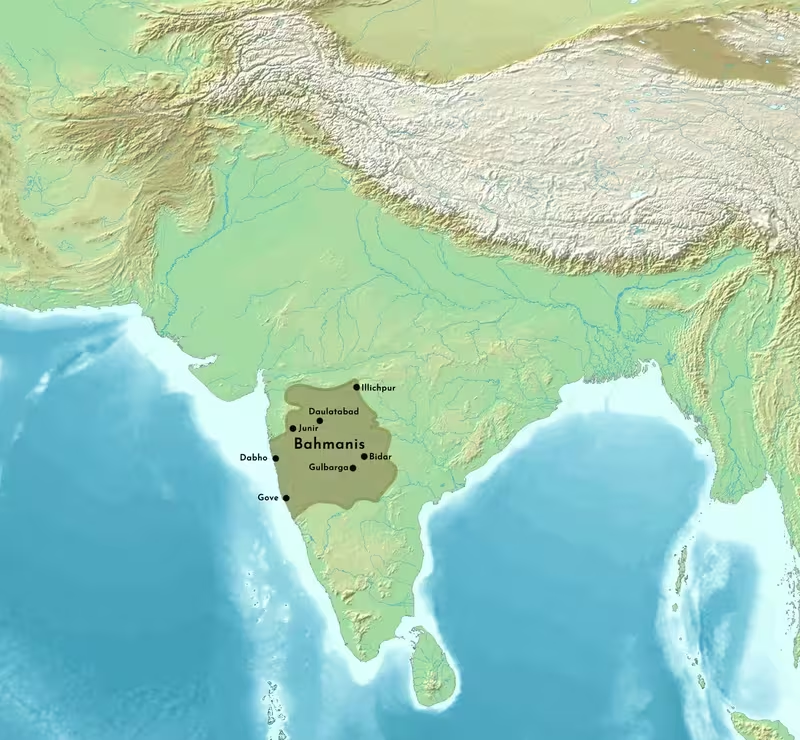
Overview
On 3 August 1347, a rebellion at Daulatabad produced a new power on the Deccan Plateau. Zafar Khan, also known as Hasan Gangu, was accepted as ruler after Ismail Mukh, the earlier leader of the rebellion, abdicated in his favour. Crowned as Alauddin Bahman Shah, he established the Bahmani Kingdom, the first independent Muslim sultanate of the Deccan.
The Bahmani state emerged from the weakening authority of Muhammad bin Tughlaq, the Sultan of Delhi. Its rulers governed a territory that was repeatedly contested by the Delhi Sultanate, Vijayanagara, Warangal, Malwa, Gujarat, and the Gajapatis. War was a persistent feature of its political life, particularly along the Godavari basin, the Tungabhadra Doab, and the Marathwada country.
The kingdom also created a distinctive political and cultural environment. Persian became an important language of court and literature, while Dakhni developed as a language used across Muslim communities of the Deccan. Bahmani rulers patronized forts, mosques, tombs, and madrasas at Gulbarga and Bidar. At the same time, the court was marked by conflict between local Deccani nobles and foreign Afaqi nobles, a rivalry that eventually helped break the sultanate apart.
Rise to Power
Hasan Gangu and the Deccan
The early career of Hasan Gangu illustrates the opportunities and uncertainties of fourteenth-century Muslim India. The court chronicler Ziauddin Barani described him as having been born in very humble circumstances and as having worked as a field labourer during the first thirty years of his life. Muhammad bin Tughlaq later appointed him commander of one hundred horsemen, reportedly because the sultan valued his honesty.
Hasan Gangu belonged to the large movement of people drawn from Delhi and North India into the Deccan. Muhammad bin Tughlaq had required inhabitants of Delhi to migrate southward in order to strengthen the Muslim settlement at Daulatabad. Hasan Gangu viewed the Deccan as a region of opportunity and had hoped to use his cavalry there. He received an iqta after participating in the conquest of Kampili and eventually rose to become a governor and military commander under the Tughlaqs.
The political situation changed sharply in the 1340s. Ismail Mukh had led a rebellion by the amirs of the Deccan and had been placed on the throne of Daulatabad in 1345. Muhammad bin Tughlaq besieged the rebels at the citadel, but another rebellion in Gujarat compelled him to leave the area. He placed several nobles, including Shaikh Burhan-ud-din Bilgrami and Malik Jauhar, in charge of the siege.
During this crisis, Hasan Gangu was being pursued by Imad-ul-Mulk, the governor of Berar and the leader against whom the Deccani amirs had regrouped. Hasan Gangu attacked and killed Imad-ul-Mulk, then marched toward Daulatabad. He and the Deccani amirs defeated the imperial forces left behind by the Delhi Sultanate. The rebels recognized that Hasan Gangu possessed the military authority needed to lead them, and they accepted his elevation without dissent.
On 3 August 1347, he was crowned Alauddin Bahman Shah Sultan. The new kingdom established its headquarters at Hasanabad, identified with Gulbarga, where its coins were minted. The rebellion therefore did more than replace one governor with another: it created an independent state in the southern provinces of the Delhi Sultanate.
Legitimacy and political authority
The new ruler received support from influential Chishti Sufis. They gave him a robe believed to have been worn by the Prophet Muhammad and invested his rule with religious legitimacy. His title, Alauddin Bahman Shah, became associated with the foundation of the Bahmani dynasty.
This ceremony reflected the wider role of Sufi networks in the establishment of Indo-Muslim political authority. The Sufis presented the new regime as a legitimate protector of the land, people, and produce of the Deccan. In this political-religious understanding, the territory of the Bahmanids could be recognized as Dar ul-Islam, rather than remaining a region open to plunder without consequence.
The origins of Hasan Gangu himself remain uncertain. Abd-al-Malek Esami, a contemporary historian, stated that Bahman Shah was born in Ghazni. Other accounts described him as Afghan or Turkic. The historian Ferishta connected him with Bahram Gur, but also considered this descent implausible and attributed it to later poets seeking to flatter the dynasty. Encyclopedia Iranica described him as a Khorasani adventurer who claimed descent from Bahram Gur, while Andre Wink identified him as Afghan. The precise background of the founder is therefore debated, even though medieval accounts broadly associate him with Afghanistan, northern India, or the wider Persianate world.
Golden Age
The Bahmani state did not have a single undisputed golden age. Its power expanded in phases, and its most influential political and cultural developments occurred under several rulers and ministers.
Alauddin Bahman Shah was succeeded by his son Mohammed Shah I in 1358. Under the early sultans, the kingdom consolidated itself through warfare and administration. Mohammed Shah I and his successors confronted Vijayanagara and the remaining powers of the southern Deccan. During the reign of Mohammed Shah I, the conflicts with Vijayanagara were described as exceptionally severe. The wars caused extensive loss of life, and one medieval account claimed that parts of the Carnatic took generations to recover.
The Bahmani state reached a particularly active phase under Firuz Shah, Ahmad Shah I Wali, and Mahmud Gawan. Firuz Shah combined military ambition with efforts to broaden the political elite. Ahmad Shah relocated the capital to Bidar and continued expansionist campaigns. Mahmud Gawan, who served as vizier and regent from 1466 until his execution in 1481, oversaw the kingdom during a period of territorial expansion and administrative reorganization.
Mahmud Gawan's campaigns against Malwa, Vijayanagara, and the Gajapatis helped extend Bahmani power to its maximum extent. His career also reveals the central tension within the state. Although he was a foreign newcomer, he became one of its most capable administrators and commanders. His reforms challenged the privileges of powerful nobles and intensified the opposition that eventually led to his death.
Administration and Governance
The Bahmani Kingdom was a sultanate ruled through a court, military commanders, provincial governors, and an aristocracy divided by origin, language, and religious affiliation. Its political structure developed as the kingdom expanded beyond the capacity of its original arrangements.
Mahmud Gawan increased the number of administrative divisions from four to eight. This change was intended to reduce the burden of governing a larger state. The provincial governors were known as tarafdars. Their authority could be substantial, particularly when the central court was weakened by succession disputes or factional conflict. The later revolt of five provincial governors demonstrated how easily provincial power could become independent political authority.
The ruling elite included people from several backgrounds. North Indian immigrants and their descendants formed an early part of the Bahmani political establishment. Over time, the court recruited foreign nobles from the west, including Persians, Afghans, and Turks. Iranian influence was especially visible in the court's language, literary culture, religious affiliations, and ceremonial practices.
The two broad political groupings were called the Dakhanis and the Afaqis. The Dakhanis were the established local Muslim elite, including descendants of Sunni immigrants from northern India. The Afaqis were foreign newcomers from the western Islamic world. Mahmud Gawan was among the Afaqis, and many members of this group were Shi'a or had significant Shi'a inclinations.
The rivalry was not purely a dispute over ethnicity. It also involved access to office, patronage, and state resources. The Dakhanis believed that positions and privileges should be reserved for those established in the Deccan. The Afaqis, meanwhile, brought connections to Persianate courts and wider networks of scholars, administrators, soldiers, and Sufis.
Religious and linguistic differences intensified the conflict. The Dakhanis were predominantly Sunni, while the Afaqis included many Shi'a. The Dakhanis spoke Dakhni, whereas the Afaqis favoured Persian. These divisions did not prevent cooperation, but they made court politics increasingly unstable.
The court also interacted with powerful Sufi figures. During Firuz Shah's reign, Gesudaraz, a Chishti saint who had migrated from Delhi to Daulatabad, was prominent in court and public life. Sufi communities helped connect rulers, urban populations, scholars, and religious institutions across the Deccan.
Military Campaigns
Conflict with Vijayanagara
The most persistent military rivalry of the Bahmani period was with the Vijayanagara Empire. The two states competed for the Godavari basin, the Tungabhadra Doab, and the Marathwada country. Their wars did not always require a specific immediate cause; military conflict became a regular feature of relations between the kingdoms.
Mohammed Shah I fought Vijayanagara in wars remembered for their severity. The Bahmanids also confronted Warangal, another important power in the southern Deccan. Their campaigns against these Hindu kingdoms helped establish the Bahmani sultans as warriors of the faith in the eyes of some Muslim chroniclers.
Firuz Shah fought Vijayanagara repeatedly. His reign included Bahmani victories in 1398 and 1406, followed by a defeat in 1417. One victory resulted in his marriage to the daughter of Deva Raya, the Vijayanagara emperor. The marriage illustrates the mixture of warfare, diplomacy, and dynastic politics that characterized relations between the two states.
Ahmad Shah I Wali continued the struggle. His campaigns included attacks on Vijayanagara and the destruction of territory associated with the southern empire. The conflict remained central to Bahmani political identity even when the kingdom faced other enemies.
The Chand Minar at Daulatabad was constructed under Alauddin Ahmad II and commemorated his victory over Deva Raya II of Vijayanagara in 1443. That conflict was described as the last major war between the two powers during the period of their direct rivalry.
Other fronts
Bahmani rulers also fought the sultanates of Malwa and Gujarat, as well as the Gajapatis to the east. Ahmad Shah I led campaigns against Malwa and Gujarat, while Mahmud Gawan later directed campaigns against Malwa, Vijayanagara, and the Gajapatis.
Warangal remained an important target in the eastern Deccan. Ahmad Shah's reign included campaigns that finally captured the remnants of Warangal. These operations helped push Bahmani influence across a broader section of the plateau.
The military system also incorporated enslaved people captured during wars. Captives from Vijayanagara could be converted to Islam and integrated into Bahmani society, where some began military careers. This practice formed part of the wider military and social systems of medieval Muslim states, but it also reveals the human cost of the prolonged Deccan wars.
Gunpowder and artillery
The Bahmani army is associated with some of the earliest recorded military uses of gunpowder-derived weapons in South Asia. In 1368, Mohammed Shah I is said to have used a train of artillery at the Battle of Adoni against the Vijayanagara forces led by Harihara II. After this period, firearms and artillery became an important part of Bahmani military power.
The exact historical interpretation is debated. Iqtidar Alam Khan argued that a different translation of Ferishta's account suggests that the Delhi Sultanate and non-Muslim Indian states may already have possessed gunpowder weapons. On this interpretation, the Bahmanis may have acquired such weapons from Delhi rather than invented them independently. The Battle of Adoni would then represent the first recorded military use of gunpowder-derived objects in the subcontinent, rather than the first appearance of gunpowder technology itself.
Klaus Rötzer suggested that early pyrotechnic weapons were initially used mainly to frighten enemy cavalry and elephants. The Bahmani use of cannons during the siege of Machal in 1470 or January 1471 represents a later development: it is identified as the first known use of gunpowder in siege weaponry on the Deccan Plateau.
Cultural Contributions
Persianate court culture
The Bahmani court patronized Persian language, literature, and culture. The establishment of the kingdom brought Turkish and Indo-Turkish soldiers, explorers, saints, and scholars from Delhi and northern India into the Deccan. Other figures arrived from Persia and Khorasan. The exact proportion of Shi'a among these groups is unclear, but several nobles at court identified as Shi'a or showed strong Shi'a affiliations.
Persian became the language of high culture and administration, while Dakhni developed across the Muslim communities of the Deccan. Firuz Shah was the first author identified with writing in the Dakhni dialect of Urdu. Under his reign, Dakhni was used by different social and religious groups, from courtly circles to Sufi communities. It became more than the language of an urban elite: it also expressed a regional Muslim identity.
The court celebrated Nowruz, and musicians came from Lahore, Delhi, Persia, and Khorasan. The presence of these performers and scholars reflects the cultural circulation linking the Deccan to northern India and the wider Persianate world.
Education and Mahmud Gawan Madrasa
Mahmud Gawan founded the Mahmud Gawan Madrasa at Bidar. It served as a centre of both religious and secular education and became one of the clearest expressions of the Bahmani court's Persianate intellectual culture.
The madrasa was established during Mahmud Gawan's period as vizier and regent. His patronage of education complemented his administrative and military work. The building is also important because it connects the Bahmani state to the wider movement of Persianate scholarship, in which educational institutions brought together religious learning, literary culture, and practical knowledge.
Architecture
The Bahmani rulers patronized major works at both Gulbarga and Bidar. Among the principal monuments associated with the dynasty are Gulbarga Fort, the Jama Masjid at Gulbarga, Bidar Fort, the Mahmud Gawan Madrasa, and the Chand Minar at Daulatabad.
Bidar became the capital after Ahmad Shah I relocated the court there in 1429. The city's fort and religious institutions reflected its new political importance. Gulbarga, the earlier capital, retained major monuments from the formative phase of the kingdom.
The Bahmani sultans also built mosques, tombs, madrasas, and forts at Daulatabad, Golconda, and Raichur. Their architecture was strongly influenced by Persian models, and architects were invited from Persia, Turkey, and Arabia. The resulting Persianate Indo-Islamic style influenced the later Deccan Sultanates.
A Sasanian emblem, showing two open wings beneath a crescent and sometimes a circle, appears on several early Bahmani constructions in Gulbarga. It may have been intended to strengthen claims of Sasanian lineage, although such claims should be understood as part of royal representation rather than accepted as proof of dynastic descent.
The later sultans were buried in a necropolis known as the Bahmani Tombs. One tomb has an exterior decorated with coloured tiles, while Arabic, Persian, and Urdu inscriptions appear inside the tombs. These monuments preserve the dynasty's political memory even after its state disappeared.
Bidriware
Bidriware is a metal handicraft associated with Bidar and developed during Bahmani rule. The craft uses white brass that is blackened and then inlaid with silver. The quality of the inlay work made Bidar's craftworkers famous, and the name “Bidri” came to be associated with the town.
Bidriware demonstrates how courtly and urban culture could produce enduring regional traditions. Although the craft developed in a royal and urban setting, its identity became attached to the city itself. Bidriware received a geographical indication registration on 3 January 2006, confirming its continuing association with Bidar.
Economy and Trade
The surviving accounts offer limited detail about Bahmani taxation and commercial institutions, but they reveal sharp differences in wealth and social condition. Afanasy Nikitin, a Russian merchant and traveller who passed through the sultanate, contrasted the enormous wealth of the nobility with the misery of the peasantry and the frugality of the Hindus.
The state depended on the land and produce of the Deccan, which its rulers claimed to protect through their political authority. Expansion brought new agricultural regions and strategic routes into the sphere of Bahmani power, but warfare also placed heavy burdens on rural communities.
The Deccan's political economy was tied to military service. Cavalry commanders, provincial governors, foreign nobles, local elites, and enslaved soldiers all formed part of the system through which the sultanate gathered and redistributed resources. The assignment of an iqta to Hasan Gangu after his participation in the conquest of Kampili illustrates the connection between military achievement and access to revenue-bearing authority.
The circulation of musicians, scholars, soldiers, and administrators from Delhi, Persia, and Khorasan indicates that the Bahmani kingdom participated in networks extending well beyond the Deccan. Bidar and Gulbarga served as political centres within these wider cultural and economic connections.
Decline and Fall
The Bahmani decline became visible under Mahmood Shah Bahmani II, the last ruler to exercise substantial power. The underlying weakness was not simply military defeat. It resulted from the interaction of factional rivalry, provincial autonomy, disputed succession, and the inability of the central court to reconcile competing elites.
The conflict between Dakhanis and Afaqis became especially destructive. Mahmud Gawan had attempted to bring the factions together during his fifteen years as prime minister, but neither side fully trusted him. His reforms reduced the power of sections of the nobility, giving his opponents a strong motive to remove him.
Nizam-ul-Mulk Bahri and other Afaqi opponents were angered by Mahmud Gawan's reforms. They fabricated a treasonous letter, supposedly written by Mahmud Gawan to Purushottama Deva of Orissa. Muhammad Shah III accepted the letter as evidence and ordered the execution of his vizier in 1481.
The sultan later regretted the decision until his death. The execution removed one of the kingdom's most capable administrators and damaged the authority of the central government. Nizam-ul-Mulk Bahri became regent and prime minister, but the factional conflict did not end.
The sultanate's provincial governors then moved toward independence. In 1490, Yusuf Adil Shah, Malik Ahmad Nizam Shah I, and Fathullah Imad-ul-Mulk asserted control over Bijapur, Ahmednagar, and Berar. They maintained a formal loyalty to the Bahmani sultan, but the practical power of the central state had ended in these provinces. Qasim Barid I followed in 1492, establishing the political basis of the Bidar Sultanate. Golconda also became effectively independent.
Mahmood Shah attempted to preserve unity by bringing his amirs and wazirs together in 1501 and securing an agreement for annual jihad against Vijayanagara. These expeditions were financially ruinous. Rather than restoring central authority, they placed additional pressure on an already divided state.
After 1518, the last Bahmani sultans were puppet monarchs under the Barid Shahi prime ministers, who exercised actual power. The last independent Bahmani authority ended in 1518 when Golconda, the final state to break away, became independent. The kingdom formally dissolved in 1527.
Legacy
The Bahmani Sultanate transformed the political map of the Deccan. It established an independent Muslim state after the southern territories of the Delhi Sultanate broke away and created a durable centre of power at Gulbarga and later Bidar.
Its rivalry with Vijayanagara shaped the military and diplomatic history of the southern Deccan. The conflicts over the Tungabhadra Doab, the Godavari basin, Marathwada, and other frontier regions continued beyond the Bahmani period and influenced the later Deccan Sultanates.
The kingdom's cultural legacy was equally important. Persianate court culture, Dakhni literary expression, Sufi networks, educational institutions, and Indo-Islamic architecture all developed through the movement of people and ideas into the Deccan. Bidriware remains a visible continuation of a craft tradition associated with Bahmani Bidar.
The successor states—Ahmednagar, Berar, Bidar, Bijapur, and Golconda—continued many of the political and cultural patterns established under Bahmani rule. They inherited the former kingdom's military traditions, elite divisions, architectural vocabulary, and engagement with Persianate culture.
The Bahmani story also demonstrates the limits of a state built on a coalition of military commanders and competing aristocratic groups. Territorial expansion could increase the resources of the sultanate, but it could also strengthen provincial governors and intensify competition at court. The execution of Mahmud Gawan symbolized this contradiction: the kingdom reached a high point of expansion, yet its political centre was becoming less capable of controlling the forces that sustained it.