Overview
In 624 CE, the Badami Chalukya ruler Pulakeshin II placed his brother Kubja Vishnuvardhana in charge of the newly conquered Vengi region in the eastern Deccan. That appointment created the political foundation of the Eastern Chalukyas, also called the Chalukyas of Vengi. What began as a provincial governorship gradually developed into a hereditary kingdom whose history stretched across several centuries.
The dynasty controlled the Vengi country, broadly associated with parts of present-day Andhra Pradesh. Its capital first stood at Pishtapura, identified with modern Pitapuram. It later moved to Vengi, near present-day Pedavegi and Eluru, and then to Rajamahendravaram, now Rajahmundry. These changes reflect the changing political geography of the kingdom, although the surviving summary does not give exact dates for each transfer.
The Eastern Chalukyas faced repeated challenges from rival dynasties, ambitious nobles, and competing branches of their own ruling family. Their political history therefore includes long periods of instability as well as strong reigns. At the same time, their rule helped consolidate Vengi as a regional political and cultural unit. During the later centuries, the court became associated with the growth of Telugu literature, poetry, temple architecture, and artistic traditions. Marital relationships with the Cholas further connected Vengi to the wider politics of southern India.
Rise to Power
The Eastern Chalukyas branched from the Chalukyas of Badami, a dynasty based in the Deccan. Pulakeshin II conquered Vengi after defeating the remaining power of the Vishnukundinas. He then appointed Kubja Vishnuvardhana as governor in 624 CE. The new governor was not an outsider without political connections: he was Pulakeshin's brother and belonged to the same Chalukya ruling family.
The exact moment when the Vengi governorship became an independent monarchy is not fixed with certainty. One historical reconstruction places the change after Pulakeshin II died fighting the Pallavas at the Battle of Vatapi. As the authority of Badami weakened, Vishnuvardhana's eastern province may have acquired greater autonomy. In this sense, the Eastern Chalukyas emerged through the gradual transformation of a frontier governorship into a regional kingdom.
The dynasty's early identity was connected to its Kannada Chalukya origins. The Timmapuram plates of Kubja Vishnuvardhana describe the family as belonging to the Manavya gotra and as Haritputras, or sons of Hariti, a claim also associated with the Kadambas and Western Chalukyas. From the 11th century, however, the dynasty promoted a more elaborate legendary ancestry. This account traced the rulers through the lunar dynasty, Budha, Pururava, the Pandavas, Satanika, and Udayana. It then connected the family to Vijayaditya and his son Vishnuvardhana.
The legendary account should be distinguished from the earlier genealogical claims in the inscriptions. It tells of Vijayaditya's death in a campaign in the Deccan against Trilochana Pallava, the refuge given to his pregnant widow by Vishnubhatta Somayaji of Mudivemu, and the naming of her son Vishnuvardhana after her protector. When the child matured, the story says, he became ruler of the Deccan through the favour of the goddess Nanda Bhagavati.
Golden Age
The first generations after Kubja Vishnuvardhana were unsettled. Between 641 and 705 CE, several rulers—including Jayasimha I and Mangi Yuvaraja—held the throne for longer periods, but other reigns were extremely brief. Indra Bhattaraka is listed as ruling for only seven days, while Kokkili ruled for six months. Family feuds and weak accessions made it difficult for the Vengi monarchy to exercise consistent authority.
The political situation became more difficult when the Rashtrakutas of Malkhed displaced the Western Chalukyas of Badami. The Eastern Chalukyas were then exposed to the power of a major Deccan dynasty. Rashtrakuta forces overran Vengi more than once, and for a long period no Eastern Chalukya ruler was able to prevent these interventions.
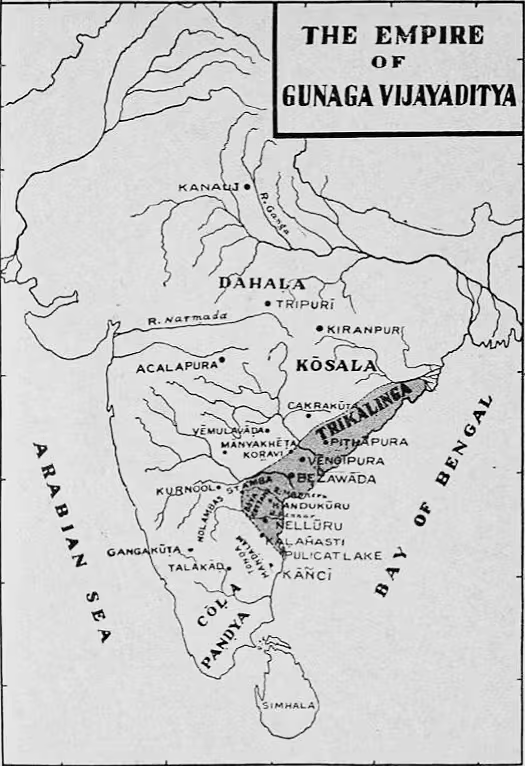
A major change came with the accession of Gunaga Vijayaditya III in 849 CE. The Rashtrakuta ruler Amoghavarsha treated him as an ally. After Amoghavarsha's death, Vijayaditya proclaimed independence. His reign marks the recovery of a stronger Vengi monarchy after generations of political pressure. He was assisted by his brothers Yuvaraja Vikramaditya I and Yuddhamalla I, and the period also produced some of the earliest known examples of Telugu poetry in inscriptions.
The reign of Bhima I, who ruled from 892 to 921, was another important period in the development of the kingdom's religious architecture. He is associated with the construction of the famous temples at Draksharama and Chalukya Bhimavaram, now Samalkot. These buildings formed part of a wider programme of temple construction sponsored by Eastern Chalukya rulers.
The later 10th and 11th centuries brought renewed dynastic conflict. Danarnava ruled from 970 to 973, followed by Jata Choda Bhima, identified in the ruler list as a usurper, from 973 to 999. Shaktivarman I restored the Chalukya line in 999. He was followed by Vimaladitya and then by Rajaraja Narendra, whose reign from 1022 to 1061 is especially important for the history of Telugu literature.
The chronology in the surviving records is not entirely uniform. The general historical description places the end of Eastern Chalukya rule around 1001, while the ruler list continues through the 11th century to Virachola Vishnuvardhana IX, whose reign is given as 1079–1102. This difference reflects the complexity of defining when the dynasty ceased to function as an independent political house, particularly during its close relationship with the Cholas.
Administration and Governance
The Eastern Chalukya state was a monarchy shaped by Hindu political ideas. Inscriptions refer to the traditional seven components of the state, known as the Saptanga, and to eighteen offices or Tirthas. These included the Mantri, or minister; the Purohita, or chaplain; the Senapati, or military commander; the Yuvaraja, or heir apparent; the Dauvarika, or doorkeeper; the Pradhana, or chief; and the Adhyaksha, or departmental head.
The names of these offices reveal the structure expected of a royal court, but the surviving evidence does not explain in detail how each office functioned in practice. Royal charters recording gifts of villages or land were addressed to the Naiyogi Kavallabhas, a general term whose precise duties are not clear, and to the Grameyakas, the residents of the village receiving the grant. Inscriptions also mention Manneyas, who held assignments of land or revenue in different villages.
The kingdom was divided into territorial units such as the Vishaya and Kottam. Karmarashtra and Boya-Kottams are examples of subdivisions mentioned in records. Administration was therefore not confined to the royal centre. It depended on local authorities, landed beneficiaries, village communities, subordinate chiefs, and members of collateral branches of the ruling family.
Political power was particularly fragmented during periods of royal weakness. Estates were held by ruling-house branches based at places such as Elamanchili, Pithapuram, and Mudigonda. Other important families included the Kona Haihayas, Kalachuris, Kolanu Saronathas, Chagis, Parichedas, Kota Vamsas, Velanadus, and Kondapadamatis. Marriage ties connected many of these groups to the Eastern Chalukya house.
When the Vengi ruler was strong, these nobles paid allegiance and tribute. When the throne was contested or the monarch appeared weak, they could cooperate with external enemies or support rival claimants. Fratricidal wars and foreign invasions thus reinforced one another, making the stability of the kingdom dependent on the personal authority of its ruler.
Military Campaigns
The first major military event in the dynasty's history was Pulakeshin II's conquest of Vengi after the defeat of the Vishnukundinas. The appointment of Kubja Vishnuvardhana turned the conquered territory into a Chalukya-ruled province.
The Eastern Chalukyas later faced the Pallavas, the Rashtrakutas, the Cholas, and the Chalukyas of Kalyani. These relationships were alternately hostile and cooperative. The death of Pulakeshin II while fighting the Pallavas created the political circumstances in which Vengi may have moved toward independence.
Rashtrakuta pressure was the most persistent challenge during the early and middle phases of the dynasty. Rashtrakuta forces overran the Vengi kingdom repeatedly. Gunaga Vijayaditya III was the first Eastern Chalukya ruler identified in the historical summary as capable of checking this pressure. His alliance with Amoghavarsha and his subsequent declaration of independence marked a significant change in the balance of power.
Military power also depended on the support of subordinate families and provincial elites. The army provided a career for many members of the Shudra population, and some rose to the status of Samanta Raju and Mandalika. This indicates that military service could create new political ranks, even within a society otherwise strongly shaped by hereditary status.
Cultural Contributions
Religion and Society
Hinduism was the principal religious tradition of the Eastern Chalukya kingdom, and Shaivism was more prominent than Vaishnavism. Some rulers described themselves as Parama Maheswaras. The Mahasena temple at Chebrolu became known for an annual festival during which the deity's image was carried in procession to Vijayawada and back.
Temple establishments included dancers and musicians, showing that temples functioned not only as places of worship but also as centres for the cultivation of the fine arts. Rulers such as Vijayaditya II, Yuddhamalla I, Vijayaditya III, and Bhima I took an active interest in temple construction.
Buddhism, which had been influential during the Satavahana period, was declining. Many Buddhist monasteries had become deserted, although some communities may have survived. Xuanzang recorded more than twenty Buddhist monasteries in the region, with over three thousand monks. Jainism retained stronger support. Jain temples received land grants from rulers and private patrons, and Jain centres included Vijayawada, Jenupadu, Penugonda in West Godavari, and Munugodu. Kubja Vishnuvardhana, Vishnuvardhana III, and Amma II are associated with Jain patronage, while Vimaladitya is described as a declared follower of Mahavira's doctrine.
Vengi society was heterogeneous but organised through a hereditary caste system. Brahmins received land and money and served as councillors, ministers, civil officials, and military commanders. Kshatriyas formed the ruling and warrior class. The Komatis were an important trading community whose guild, the Nakaram, had its headquarters at Penugonda and branches in seventeen other centres. The population also included Boyas and Savaras, identified as tribal groups.
Literature and Language
The Eastern Chalukya period was central to the early development of Telugu literary culture. The Vipparla inscription of Jayasimha I and the Lakshmipuram inscription of Mangi Yuvaraja are identified as the earliest Telugu inscriptions of the dynasty, dating to the 7th century. The Aladankaram plates combine Sanskrit and Telugu, demonstrating the coexistence of the two languages in royal records.
Telugu poetry appears clearly in the Addanki, Kandukur, and Dharmavaram inscriptions of Pandaranga, the army chief of Vijayaditya III, during the later 9th century. Literary works from before the 11th century are not clearly known, but the development visible in inscriptions prepared the ground for the court literature of the next century.
At the court of Rajaraja Narendra, the poet Nannaya began translating the Mahabharata into Telugu. Nannaya was trained in the Vedas, Shastras, and ancient epics. His work remained incomplete but became recognised as a masterpiece of Telugu literature. Narayana Bhatta, proficient in eight languages, assisted him and was granted a village by Rajaraja Narendra in 1053 for his contribution.
The dynasty's Kannada and Telugu connections were closely related to its origin. Because Kubja Vishnuvardhana was Pulakeshin II's brother, the Chalukyas governed both Karnataka and Andhra territories and supported Telugu alongside their Kannada inheritance. Nannaya's Bharata uses the Akkara metre, associated with Kannada literature. Narayana Bhatta was also a Kannada poet, and the Kannada poets Adikavi Pampa and Nagavarma I came from families originally connected with Vengi.
Architecture
Eastern Chalukya architecture developed from Pallava and Chalukya traditions while acquiring a distinct regional character. Vijayaditya II is credited with constructing 108 temples. Yuddhamalla I erected a temple dedicated to Kartikeya at Vijayawada. Bhima I sponsored the Draksharama and Chalukya Bhimavaram temples, while Rajaraja Narendra built three memorial shrines at Kalidindi in West Godavari.
The Pancharama shrines, especially Draksharama, and the temples at Biccavolu demonstrate the dynasty's architectural style. The Golingesvara temple at Biccavolu contains richly carved images of Ardhanarisvara, Shiva, Vishnu, Agni, Chamundi, and Surya. Jain cave temples were also constructed at Ambapuram and the Adavinekkalam hills during the 7th and 8th centuries. Five Jain caves in these locations are associated with Eastern Chalukya patronage.
Economy and Trade
The evidence available for the Eastern Chalukya economy comes mainly from land grants, village records, administrative terms, and references to merchant organisation. Royal charters frequently recorded gifts of land or villages. Some officials and subordinate elites held assignments of land or revenue in different villages, linking political authority to control over agrarian resources.
Trade was represented by the Komati community and its guild, the Nakaram. Its headquarters at Penugonda in West Godavari and branches in seventeen other centres indicate an organised commercial network within the region. The records do not provide enough information to describe particular commodities, taxes, or long-distance routes in detail, but the existence of this guild shows that commerce had an institutional presence in Vengi society.
Decline and Fall
The Eastern Chalukya kingdom was repeatedly weakened by succession disputes. The list of rulers includes several very short reigns, contested accessions, and periods in which rival branches of the ruling family competed for authority. Nobles who supported the monarchy during strong reigns could become independent-minded during crises.
External pressure added to these internal divisions. The Rashtrakutas intervened repeatedly before Gunaga Vijayaditya III restored greater independence. Later, the Eastern Chalukyas maintained close relations, including marital connections, with the Cholas. These relationships brought Vengi into the political orbit of another powerful southern dynasty.
After the decline of Rashtrakuta power, the Kakatiyas—formerly subordinate to the Western Chalukyas—rose to sovereignty by suppressing other Chalukya subordinates in Telangana. This changing political environment further reduced the space in which the Eastern Chalukya monarchy could operate independently.
The exact endpoint of the dynasty requires caution. The general account places Eastern Chalukya rule in Vengi until approximately 1001 CE, while the supplied ruler chronology continues with Shaktivarman I, Vimaladitya, Rajaraja Narendra, and later rulers through Virachola Vishnuvardhana IX, dated to 1079–1102. The available account does not identify one final battle, deposition, or administrative act that definitively ended the dynasty. It is therefore more accurate to describe the 11th century as a period of transformation and close Chola connection rather than assign an entirely certain single date of collapse.
Legacy
The Eastern Chalukyas left a lasting mark on the history of the eastern Deccan. Their rule helped consolidate Vengi as a recognisable political region and connected it to the wider worlds of the Badami Chalukyas, Pallavas, Rashtrakutas, Chalukyas of Kalyani, and Cholas.
Their most enduring cultural legacy lies in the development of Telugu literary expression. Inscriptions preserve the early appearance of Telugu, while the court of Rajaraja Narendra gave Nannaya the setting in which the Telugu Mahabharata was begun. The dynasty also encouraged interaction between Kannada and Telugu literary traditions.
Its temples and Jain caves preserve another dimension of its history. Draksharama, Samalkot, Biccavolu, Vijayawada, and Ambapuram reflect the religious diversity and artistic patronage of the period. These monuments show how royal devotion, local communities, musicians, dancers, sculptors, and administrators contributed to the cultural life of Vengi.