Overview
Around the first centuries of the Common Era, rulers who called themselves kshatrapas governed a broad and changing zone of western and central India. Modern historians call them the Western Satraps, or Western Kshatrapas, to distinguish them from the Northern Satraps who ruled around eastern Punjab and Mathura. In Indian usage they were also known as Sakas, while the second-century geographer Ptolemy described them as Indo-Scythians.
Their political history extends approximately from 35 to 415 CE. At various moments, their authority reached across Saurashtra, Gujarat, Malwa, Sindh, Rajasthan, Maharashtra, Madhya Pradesh, northern Konkan, and parts of Vidarbha. Their territories were not equally stable throughout this period. The kingdom expanded under rulers such as Nahapana, contracted after defeat by the Satavahana king Gautamiputra Satakarni, revived under the Kardamaka line, and eventually disappeared under pressure from the Gupta emperor Chandragupta II.
The Western Satraps are especially important because several kinds of evidence survive from their rule. Their silver coins preserve royal portraits, names, paternal affiliations, titles, and, in later reigns, dates. Inscriptions at Nasik, Karla, Junnar, Junagadh, Sanchi, Eran, Kanheri, and other places describe donations, military victories, political claims, and religious patronage. Buddhist caves and stupas reveal the movement of wealth into religious institutions, while the Periplus of the Erythraean Sea presents Barigaza—usually identified with Bharuch—as a major port in an international trading system connecting India with the Red Sea and the Mediterranean.
The Western Satraps were neither isolated foreign rulers nor a simple continuation of a single, unchanging dynasty. They were Saka rulers who operated within the political and cultural worlds of India. They used titles of Iranian origin, inherited coin forms from the Indo-Greek tradition, issued legends in Brahmi and Prakrit, adopted Sanskrit for major royal inscriptions, supported Buddhist institutions, and entered matrimonial relationships with Indian ruling houses. Their history demonstrates how political authority, commercial wealth, religious patronage, and cultural adaptation interacted in ancient western India.
Rise to Power
The meaning of “Satrap”
The term kshatrapa is related to satrap. Both ultimately derive from the Median term xšaθrapāvan, meaning a governor or viceroy of a province. The title could therefore imply authority exercised on behalf of a higher king. The ruler who held the senior title mahakshatrapa, or “Great Satrap,” stood above the kshatrapa, who could be an heir apparent or subordinate ruler.
This terminology has encouraged debate about the political position of the Western Satraps. Their continued use of the word “satrap” on coins may indicate recognition of a superior authority, perhaps the Kushan emperor. A statue found at Mathura bearing the name “Shastana,” generally associated with Castana, was discovered alongside statues of the Kushan rulers Vima Taktu and Kanishka. The Rabatak inscription also claims Kushan authority over Ujjain during Kanishka's reign. These details have been interpreted as evidence for an alliance or even Kushan overlordship.
The question is not settled. The Western Satraps may have been Kushan dependants in an early phase, but the evidence does not establish that their entire history was one of continuous vassalage. By the time of Rudradaman I, their rulers were clearly able to conduct major wars, claim extensive territories, and present themselves as powerful sovereigns.
The Kshaharata line
The earliest phase of Western Satrap history is associated with the Kshaharata dynasty, also called the Chaharada, Khaharata, or Khakharata line. The name appears in a Taxila copper-plate inscription dated to 6 CE, where it qualifies the Indo-Scythian ruler Liaka Kusulaka. A Nasik inscription from the nineteenth year of the Satavahana ruler Sri Pulumavi refers to the Khakharatavasa, or Kshaharata race.
The earliest Kshaharata ruler for whom coins are known is Abhiraka. His coinage is rare, and little else is recorded about him. He was followed by Bhumaka, whose coins use the title “Satrap” rather than “king” or raño. Bhumaka was the father of Nahapana, the most powerful ruler of the early Kshaharata period.
Nahapana's dates remain uncertain. His reign has been placed variously between 24 and 70 CE, 66 and 71 CE, or 119 and 124 CE. The uncertainty results from the differing interpretations of his coins, inscriptions, and the chronological systems used by later numismatists. His coinage carries Buddhist symbols, including the eight-spoked wheel or dharmachakra, and the lion seated on a capital, recalling the pillar imagery associated with Ashoka.
Nahapana's expansion
Nahapana transformed the Kshaharata authority into a substantial power. He controlled parts of the Satavahana Empire in western and central India, including Malwa, southern Gujarat, northern Konkan, and the districts around Nasik and Poona. His territory extended from Bharuch to Sopara and included important inland routes leading towards Ujjain and the Deccan.
This expansion placed Nahapana in a region of intense political competition. To the northwest, the Paratarajas ruled in Baluchistan, while the Kushans were extending their power across northern India. To the east and south, the Satavahanas were major rivals. The Western Satrap kingdom therefore occupied a strategic position between several expanding states.
Nahapana relied on members of his family and court to administer these territories. His son-in-law Ushavadata, the son of Dinika and husband of Nahapana's daughter Dakshamitra, served as a viceroy. Inscriptions at Nasik, Karla, and Junnar record Ushavadata's donations, public works, and military activity. These inscriptions show that authority was exercised not only through a central ruler but also through powerful relatives and officials operating in regional centres.
One inscription records an alliance with the Uttamabhadras against the Malavas. According to the text, the Uttamabhadra chief had been besieged during the rainy season by the Malavas. Ushavadata went to release him, and the Malavas fled at the mere sound of his approach before being captured. The account is a royal or official statement and presents the campaign in triumphant terms, but it confirms that the Western Satraps were active in the political struggles of Malwa and adjacent regions.
Golden Age
Castana and the Kardamaka dynasty
After the Kshaharata phase, a new ruling house emerged. It is often called the Kardamaka dynasty or the Bhadramukha line. Its founder was Castana, also known in some records as Chastana. The precise date of his accession is uncertain, but many historians place the beginning of his reign in 78 CE. This date has led to the suggestion that Castana founded the Saka Era used by later Western Satrap rulers.
Castana was associated with Ujjain, which became the principal political centre of the Western Satraps. Ptolemy's Geographia, composed in the second century, describes Ujjain as “Ozene-Regia Tiastani”—Ujjain, the royal city of Chastana. The same account places the territory of the Indo-Scythians from Patalene in the west to Ujjain in the east and beyond Barigaza in the south.
Castana's relationship with the Kushans remains debated. The Mathura statue bearing the name “Shastana” may represent Castana himself and may indicate that he was a Kushan feudatory. The Rabatak inscription's claim over Ujjain supports the possibility of Kushan authority in the region during Kanishka's reign. On the other hand, the later political and military record of the Western Satraps shows a high degree of independent action. The safest conclusion is that Western Satrap relations with the Kushans changed over time and cannot be reduced to a single arrangement.
Rudradaman I
Rudradaman I, Castana's grandson, was the most celebrated ruler of the Kardamaka line. He assumed the title mahakshatrapa around 130 CE and restored Western Satrap power after the upheavals that followed Nahapana's defeat.
His reign is particularly well documented by the Junagadh rock inscription, dated approximately to 150 CE. The inscription describes Rudradaman as ruler of a large territory, including eastern and western Malwa, Anupa, Anarta, Saurashtra, northern Gujarat, Marwar, Kachchha, Sindh-Sauvira, eastern Rajasthan, northern Konkan, and areas associated with Malwa and central India. The text emphasizes that these lands were free from robbers, snakes, wild animals, diseases, and other troubles, presenting the king as a protector whose power enabled religion, wealth, and pleasure to flourish.
The geographical claims should be read as a royal statement of authority rather than a modern administrative map. Even so, the inscription indicates the scale of the Western Satrap kingdom at its height. Rudradaman had recovered much of the territory previously associated with Nahapana, although the southern areas around Poona and Nasik may have remained under Satavahana control.
War and marriage with the Satavahanas
Rudradaman's most important rival was the Satavahana king Vashishtiputra Satakarni, ruler of the southern and central Deccan. The conflict between the two kingdoms was prolonged and destructive. Rudradaman's Junagadh inscription states that he defeated Satakarni twice in battle but did not destroy him because of their close family relationship.
That relationship arose through marriage. Rudradaman's daughter was married to Vashishtiputra Satakarni. A Kanheri inscription refers to the queen descended from the Kardamaka royal family and daughter of the Mahakshatrapa Rudra—an incomplete name generally understood as Rudradaman. The marriage did not end the political rivalry. Instead, it appears to have created a limit to the violence between two related royal houses.
The episode illustrates the flexibility of ancient political alliances. Matrimonial ties could coexist with warfare, and kinship could provide a reason for sparing a defeated ruler without preventing the victor from reclaiming territory or demanding political advantage.
Victory over the Yaudheyas
Rudradaman also fought the Yaudheyas. His Junagadh inscription praises their military reputation, noting that they were proud of their title as heroes among the Kshatriyas and reluctant to submit. It then claims that he destroyed them by force.
The Yaudheyas were a powerful political community, and their defeat strengthened Rudradaman's position in northwestern and central India. The inscription's wording is again royal self-presentation, but it indicates that the Western Satraps were contesting power not merely with neighbouring monarchies but also with organized warrior communities.
The eastern frontier
The reach of Western Satrap authority extended at times into regions farther east than traditionally assumed. A recently identified inscription at Setkhedi in the Shajapur district, dated to 107 in the Saka Era—approximately 185 CE—belongs to Rudrasimha I and confirms Saka expansion into eastern Malwa at that date.
A memorial pillar found at Pauni in Vidarbha bears an inscription naming “Mahakshatrapa Kumara Rupiamma.” It is dated to the second century CE. The pillar may mark the southern extent of Western Satrap conquest, although the interpretation of the title is uncertain. The word kumara may indicate that Rupiamma was the son of a Great Satrap rather than an independent ruler who himself held that title.
These records show that the borders of the Western Satrap kingdom could reach beyond the Narmada region. They also warn against treating the Narmada as a permanent frontier. Political control shifted repeatedly between the Satraps and the Satavahanas.
Administration and Governance
A satrapal monarchy
The Western Satrap political system was a hereditary monarchy expressed through satrapal titles. The senior ruler was the mahakshatrapa, while a kshatrapa could be a subordinate, regional governor, or heir apparent. The evidence does not provide a complete administrative manual or a detailed list of offices, but inscriptions reveal a structure in which royal relatives, ministers, and military officials played important roles.
Ushavadata's career illustrates this arrangement. As Nahapana's son-in-law and viceroy, he conducted military operations, organized donations, built public facilities, and distributed resources to religious communities. His inscriptions associate him with Bharukachchha, Dashapura, Govardhana near Nasik, and Shorparaga or Sopara. The range of these activities suggests that regional administration depended on trusted members of the royal household and court.
A Junnar inscription records a gift by Ayama, a minister of Nahapana, in the forty-sixth year. The text calls Nahapana “the King Mahakshatrapa,” a formulation that may indicate that he had become an independent ruler rather than remaining a subordinate satrap. The inscription is especially valuable because it links a named minister to a dated royal administration.
Royal titles and political legitimacy
The Western Satraps used titles with foreign linguistic origins but deployed them within Indian political contexts. The word kshatrapa connected them to the wider Indo-Iranian and Indo-Scythian political vocabulary, while inscriptions and coin legends presented them as rulers of Indian cities, territories, and religious institutions.
Their political legitimacy was expressed through several overlapping languages. Coins used royal portraits and inscriptions. Prakrit connected the court to established inscriptional practice in western India. Sanskrit, especially under Rudradaman I, allowed the monarchy to present itself in the elevated literary language associated with learned Brahmanical culture.
This was not simply a replacement of one language by another. Prakrit continued to be used on coins and in inscriptions, while Sanskrit became increasingly prominent in royal self-representation. The Western Satraps thus participated in the gradual expansion of Sanskrit epigraphy without abandoning older regional and administrative conventions.
Public works and donations
Western Satrap officials supported both religious and public infrastructure. Ushavadata's inscriptions describe rest-houses, gardens, tanks, and other facilities at Bharuch, Mandasor, Nasik, and Sopara. These places were connected by routes of pilgrimage, commerce, and administration.
A major donation recorded at Karla granted the village of Karajika for the support of ascetics living in the caves at Valuraka. The gift was intended for the Buddhist community without distinction of sect or origin, and its income supported those who observed the rainy-season retreat. The inscription also describes donations to gods and Brahmanas, the giving of cows and gold, the creation of a sacred crossing on the Banasa River, and the feeding of large numbers of Brahmanas.
The record presents Ushavadata as a patron of multiple religious communities. It should not be read as a neutral survey of social policy, since the inscription was designed to celebrate the donor's merit. Nevertheless, it demonstrates that the Western Satrap court could direct wealth towards Buddhist establishments while also making offerings within Brahmanical religious frameworks.
Military Campaigns
Conflict with the Satavahanas
The Satavahanas were the most persistent military rivals of the Western Satraps. Nahapana's expansion had taken important western and central territories from them. Gautamiputra Satakarni later reversed much of that advance, and Rudradaman I restored Satrap power in many areas.
Gautamiputra's victory over Nahapana is known from both coinage and inscription. He restruck large numbers of Nahapana's silver coins, including coins found in the Jogalthambi hoard in the Nasik district. By placing his own marks on the coinage of a defeated enemy, Gautamiputra asserted that the Kshaharata ruler's political authority had been extinguished.
An inscription in Cave 3 of the Nasik Caves presents Gautamiputra as the destroyer of the Sakas, Yavanas, and Pahlavas, and as the ruler who uprooted the Kshaharata family and restored the glory of the Satavahana race. The language is deliberately expansive and triumphal. It confirms the seriousness of the conflict, while the precise extent and duration of Gautamiputra's conquest remain matters of historical reconstruction.
The Satavahana king Yajna Sri Satakarni later defeated the Western Satraps in the late second century. His inscriptions at Nasik, Kanheri, and Guntur testify to the renewed extension of Satavahana authority. Two inscriptions at Kanheri and one in the Nasik Caves record his presence. This victory brought the southern territories of the Western Satraps back under Satavahana control and contributed to a decline in Satrap power.
There is uncertainty about some of the territorial changes. Poona and Nasik may have remained in Satavahana hands from Gautamiputra's victory over Nahapana, because no Kardamaka inscriptions are known from those areas during the relevant period. The evidence therefore suggests a complicated frontier rather than a single decisive transfer of the entire region.
Rudradaman's campaigns
Rudradaman I's military career marked a revival of Western Satrap strength. He defeated the Satavahanas twice, while sparing Vashishtiputra Satakarni because of their family relationship. He also defeated the Yaudheyas, whose military reputation made the victory especially useful in royal propaganda.
The Junagadh inscription lists numerous territories acquired through Rudradaman's own valour. The catalogue includes Malwa, Saurashtra, Gujarat, Sindh, eastern Rajasthan, northern Konkan, and other regions. Some of these may have been inherited or recovered rather than conquered for the first time, but the inscription presents them as the product of the ruler's power.
Later expansion and contraction
During the third century, the Western Satraps retained influence in central India. Rudrasena II, who ruled from approximately 256 to 278 CE, governed during a period described as one of high prosperity for the Kshatrapa dynasty. His coins have been found in the Sanchi-Vidisha region, demonstrating that the Satraps had regained territory from the Satavahanas there.
A possible marriage alliance connected Rudrasena II with the Andhra Ikshvakus. The Ikshvaku ruler Māṭharīputra Vīrapuruṣadatta appears to have married Rudradhara-bhattarika, daughter of the ruler of Ujjain, probably Rudrasena II. The identification is not absolutely certain, but the Nagarjunakonda inscription indicates a political relationship between the two ruling houses.
By the fourth century, Saka authority was still visible at Sanchi, Vidisha, and Eran. The Kanakerha inscription, dated to 319 CE, records the construction of a well by the Saka chief and “righteous conqueror” Sridharavarman. Another inscription associated with Sridharavarman and his military commander is known from Eran. These records reveal a Saka military and administrative presence even as new powers were rising across northern India.
Cultural Contributions
Buddhist caves and religious patronage
The Western Satraps and their officials were major patrons of Buddhist cave institutions in western India. Their support is especially visible in Maharashtra and Gujarat, where caves served as monastic residences, spaces for ritual, and landmarks along routes used by merchants and travellers.
The Great Chaitya at Karla, the largest chaitya hall in South Asia according to the historical account preserved here, was constructed and dedicated in 120 CE during Nahapana's rule. The hall's association with the Western Satraps reflects the resources available to the court and its officials. Karla's location also connected religious patronage with movement through the western Deccan.
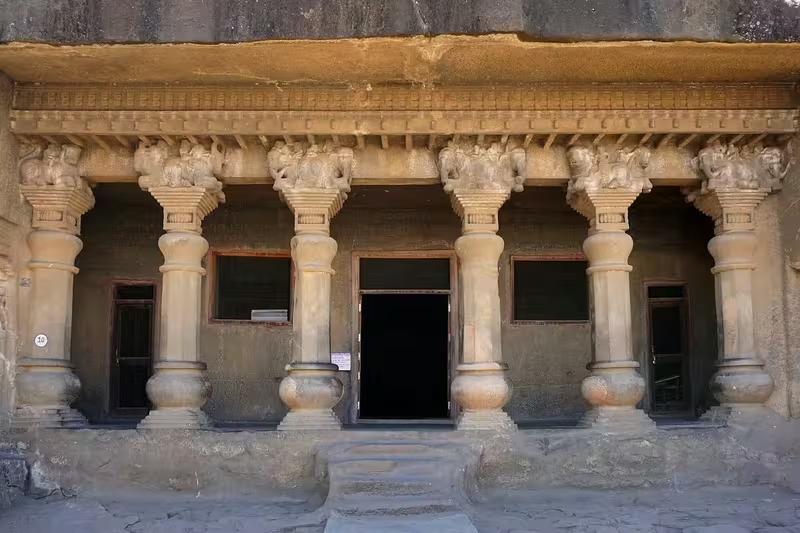
The Nasik Caves, also known as the Pandavleni Caves, contain inscriptions associated with Nahapana's family. Cave 10, called the Nahapana Vihara, is spacious and contains sixteen rooms. Ushavadata's inscriptions state that he caused the cave to be made and bestowed it on the Buddhist community. His donation included funds for food and clothing for monks. Dakshamitra, Nahapana's daughter and Ushavadata's wife, also donated a cave for Buddhist monks.
The Junnar cave complexes preserve another record of Satrap patronage. Ayama, Nahapana's prime minister, made a donation in the forty-sixth year of the ruler's reign. Inscriptions at Karla, Junnar, Nasik, Lenyadri, and nearby sites also include donations by individuals described as Yavanas, a term that could refer to Greeks or Indo-Greeks. These donations show that religious institutions attracted support from a diverse population connected by trade, migration, and political authority.
Devnimori and western Indian Buddhist art
Buddhist monuments at Devnimori in Gujarat belong to the later period of Western Satrap rule. The site included viharas and a stupa, and coins of Rudrasimha were found inside the stupa. The Buddha images display the influence of the Greco-Buddhist art of Gandhara and have been described as examples of a Western Indian artistic tradition associated with the Western Satraps.
The artistic significance of Devnimori extends beyond the site itself. One interpretation holds that the Devnimori tradition preceded the rise of Gupta art and may have influenced artistic developments at Ajanta, Sarnath, and other centres from the fifth century onward. More broadly, the Western Satraps may have helped transmit artistic forms from Gandhara towards the western Deccan.
This proposed influence should be treated as a historical interpretation rather than a settled chain of direct transmission. The evidence does, however, show that western India was not culturally isolated. Artistic forms, religious institutions, and material objects moved across political boundaries.
Sanskrit epigraphy
The Western Satrap period marks a major stage in the development of Sanskrit inscriptions. Prakrit had been favoured for centuries, especially after the influence of Ashoka's edicts. Most early inscriptions in western India were therefore composed in Prakrit or related forms. The Western Satraps helped establish Sanskrit as a language of public royal representation.
The inscription of Ushavadata at Nasik, dating to the early second century, contains hybrid features and is among the earliest known Sanskrit-related inscriptions in western India. The Junagadh rock inscription of Rudradaman I, approximately dated to 150 CE, is more significant. It is the earliest surviving long inscription in fairly standard Sanskrit and is written in Brahmi.
The Junagadh inscription is not merely a list of victories. It presents the ruler as a patron of order, prosperity, learning, and refinement. Rudradaman is described as skilled in poetry and as using Sanskrit at court. The inscription's language approaches high classical Sanskrit, although it contains a small number of epic or vernacular features.
The political importance of this development was considerable. By adopting Sanskrit for a major royal record, the Western Satrap court could present itself as fully engaged with Indian literary and Brahmanical culture. Later Gupta inscriptions used Sanskrit extensively, and the Western Satrap example may have helped establish a model for this practice.
Astronomy and translation
Rudradaman's court was associated with Yavanesvara, whose name means “Lord of the Greeks.” Yavanesvara translated the Yavanajataka, an astrological treatise, from Greek into Sanskrit for readers who did not speak Greek. The work became authoritative for later astrological writing in India.
This episode illustrates the intellectual networks of the Western Satrap period. The court's use of Sanskrit did not exclude knowledge from outside the subcontinent. Instead, Greek learning could be translated into Sanskrit and incorporated into an Indian literary and scholarly setting.
The Western Satraps' political world therefore connected several cultural traditions: Saka titulature, Indo-Greek coin forms, Greek astronomical knowledge, Prakrit inscriptional practice, Sanskrit court literature, and Buddhist religious art.
Economy and Trade
Barigaza and the Indian Ocean
The port of Barigaza, generally identified with Bharuch, was one of the most important commercial centres in the Western Satrap territories. The Periplus of the Erythraean Sea, a second-century account of maritime routes and markets, describes the region as a fertile country producing wheat, rice, sesame oil, clarified butter, cotton, and Indian textiles.
The text calls the inland territory adjoining Scythia Abiria and the coastal region Syrastrene, a name connected with Saurashtra. It identifies Minnagara as the metropolitan city and describes Barigaza as the main market town. Ujjain, called Ozene, lay inland and supplied goods needed in the country around Barigaza as well as commodities intended for export.
The Periplus names Nahapana under the form Nambanus as ruler of the area around Barigaza. The identification is not based on a direct statement in the text using the name Nahapana, but the geographical and chronological correspondence has led to the association.
Barigaza's trade depended on the relationship between port and inland routes. Goods moved down from Ujjain and other market towns, while imports arrived from Egypt and the western Indian Ocean. Ships were fitted out from Ariaca and Barigaza, carrying Indian products to ports across the sea.
Imports and exports
The imported goods listed for Barigaza included Italian, Laodicean, and Arabian wine; copper, tin, and lead; coral and topaz; glass; storax; sweet clover; realgar; antimony; gold and silver coin; and perfumes. Fine textiles, expensive vessels, singers, young women, and luxury goods were described as being brought for the king or elite consumers.
The exports included spikenard, costus, bdellium, ivory, agate, carnelian, lycium, cotton cloth, silk cloth, mallow cloth, yarn, long pepper, and other goods brought from inland markets. The variety of products reveals a trade system based on agricultural produce, textiles, minerals, precious materials, aromatics, and manufactured goods.
The account also notes that ships travelling from Egypt made the voyage under favourable conditions around July. This reference connects Barigaza to the seasonal rhythm of Indian Ocean navigation and to the broader maritime system linking the western coast of India with the Red Sea.
Ujjain and inland commerce
Ujjain was not simply a royal centre. It was also an inland market and distribution point. According to the Periplus, agate and carnelian, Indian muslins, mallow cloth, and ordinary textiles were brought from Ozene to the Barigaza region.
The association between Ujjain and trade helps explain the city's importance to the Western Satraps. Its position connected Malwa with Gujarat, the western coast, and routes leading towards the Deccan and northern India. Control of Ujjain allowed the Satraps to link political authority with the movement of goods and revenue.
Coinage
Western Satrap coinage is among the most useful bodies of evidence for ancient Indian political history. The coins were based on the currency of earlier Indo-Greek rulers. Their obverse commonly shows a stylized royal bust accompanied by a Greek or pseudo-Greek legend. The reverse uses symbols such as a thunderbolt and arrow, or, in later forms, a chaitya hill or three-arched hill with a river symbol, crescent, and sun. Brahmi legends identify the ruler and his ancestry.
The coins of Nahapana use a Greek-script legend that transliterates a Prakrit formula meaning “in the reign of Kshaharata Nahapana.” Castana's coins similarly identify him as the Satrap Castana. Over time, the Greek script became increasingly corrupted and eventually lost much of its linguistic meaning, although it retained a visual and traditional role on the coin.
From the reigns of Jivadaman and Rudrasimha I, the coins generally record the minting date in the Saka Era using Brahmi numerals behind the king's head. Jivadaman, who ruled twice—approximately 178–181 CE and 197–198 CE—is the first Western Satrap ruler known to have placed the date on his coins. This practice makes it possible to reconstruct the sequence and overlapping reigns of later rulers with unusual precision.
The reverse legends also name the father of each ruler. This genealogical information helps establish succession even when literary and inscriptional records are incomplete. Some numismatists have questioned whether the dates correspond to the Saka Era or to the earlier Azes Era, but the dated coins remain central to the chronology of the dynasty.
Trade and cultural movement
Commercial networks also carried religious and artistic objects. The Pompeii Lakshmi, an Indian statuette found in the ruins of Pompeii, is considered a possible result of Indo-Roman trade. One interpretation proposes that it may have originated in the Bhokardan area, moved west through the port of Barigaza, and reached Rome during the period of Nahapana.
The object's exact route cannot be established with certainty, but its presence illustrates the wider significance of western Indian ports. Trade did not move only bulk commodities and coins. It could also carry images, artistic ideas, luxury objects, and religious forms across the Indian Ocean.
Decline and Fall
The third and fourth centuries
The Western Satraps remained politically active long after the defeat of Nahapana. Their authority fluctuated between western India and central India, and the Kardamaka rulers continued to issue coins and sponsor religious institutions.
Rudrasena II's reign, approximately 256–278 CE, appears to have been a prosperous phase. His coins are found in the Sanchi-Vidisha region, showing that the Western Satraps had recovered territory there. The dynasty also established or maintained political relationships with the Andhra Ikshvakus through marriage.
The Chastana family ended with Visvasena, who ruled approximately from 293 to 304 CE. He was the brother and successor of Bhartrdaman and the son of Rudrasena II. A coin of Visvasena was found during excavations at Ajanta in a brick monastery near the Waghora River, another indication of the circulation of Western Satrap currency in western India.
A new family began with Rudrasimha II, who ruled approximately from 304 to 348 CE. His coins describe him as the son of a Lord Jivadaman. His reign overlapped with those of Yasodaman II and Rudradaman II, who appear to have been sons and possibly sub-kings. The existence of overlapping rulers suggests a complex dynastic structure in which members of the royal family governed different territories or exercised authority simultaneously.
Saka rule at Sanchi and Eran
The Saka presence in central India continued under Rudrasimha II and his contemporaries. The Kanakerha inscription at Sanchi, dated to 319 CE, records the construction of a well by Sridharavarman, a Saka chief described as a righteous conqueror and great military officer. Another inscription associated with Sridharavarman and his military commander is known from Eran.
These records are important because they demonstrate that the Western Satrap political world persisted at a time when new powers were consolidating in northern India. They also show that Saka rule was not limited to the western coast or Gujarat. Central Indian religious and administrative centres remained connected to Satrap authority.
Kushan decline and Sasanian expansion
The political environment around the Western Satraps changed as Kushan power declined. The Sasanian Empire expanded into the northwest of the subcontinent, particularly Gandhara and Punjab, from the time of Shapur II around 350 CE. Sasanian influence or control may also have extended towards the mouth of the Indus, as suggested by Sasanian coinage in Sindh.
This expansion probably affected the remnants of Kushan authority and may also have reduced Western Satrap influence in the northwest. The exact relationship between Sasanian expansion and the later decline of the Western Satraps is not fully documented, but it formed part of the wider transformation of power across the region.
Gupta conquest
Central India was conquered by the Gupta emperor Samudragupta, who ruled approximately from 336 to 380 CE. At Eran, an inscription of Sridharavarman appears to have been followed by a Gupta monument and inscription established to increase Samudragupta's fame. This sequence suggests that Samudragupta displaced Saka authority in the region or compelled its submission.
The Allahabad pillar inscription of Samudragupta may refer to Sridharavarman as a Saka ruler who paid homage, offered daughters in marriage, and requested permission to administer his own districts and provinces. The identification is probable but not completely certain. The inscription nevertheless reflects the expansion of Gupta influence over Saka and other regional rulers.
The final stage of Western Satrap history is associated with the Gupta emperor Chandragupta II, who ruled approximately from 380 to 415 CE. A later literary account tells a dramatic story in which the Gupta king Ramagupta attacked the Western Satraps, was trapped, and agreed to surrender his wife Dhruvadevi to the Saka ruler Rudrasimha III. Chandragupta allegedly substituted himself for the queen, entered the Saka camp in disguise, killed Rudrasimha, and later succeeded his brother.
This account comes from a fragment of the Natya-darpana and has the character of a political and literary tale. It should not be treated as an independently confirmed narrative of events. The broader Gupta conquest, however, is supported by inscriptions and coinage.
Inscriptions of Chandragupta II at Sanchi, dated to 412–413 CE, celebrate his victories and the banners of triumph he acquired in many battles. These records show Gupta control in a region previously associated with the Western Satraps. The long inscription of the later Gupta ruler Skandagupta at Junagadh, beside the earlier records of Ashoka and Rudradaman, confirms Gupta control of Gujarat.
Chandragupta II's conquest ended nearly four centuries of Saka rule in the subcontinent. The Guptas then adopted the Western Satrap silver coin design. Chandragupta II and his son Kumaragupta I issued coins showing the ruler's bust and a pseudo-Greek inscription on the obverse. On the reverse, however, the Gupta royal eagle, or Garuda, replaced the chaitya hill with its crescent and star. The adoption of the design was a visible acknowledgment of the monetary traditions established by the conquered dynasty.
Legacy
The Western Satraps left an unusually broad legacy because their political history can be reconstructed from several different types of evidence. Their coins are especially valuable. They preserve royal names, family relationships, titles, dates, and changing political affiliations. The practice of adding Saka Era dates to coins from the late second century made it possible to clarify succession and identify overlapping reigns.
Their inscriptions also mark a transition in the public use of Sanskrit. The Junagadh record of Rudradaman I stands at the beginning of the long Sanskrit royal inscription tradition that became prominent under the Guptas. The Western Satrap court did not create Sanskrit epigraphy by itself, but its use of polished Sanskrit for a major statement of kingship helped establish a model for later rulers.
The dynasty's religious legacy is visible in the cave complexes of western India. Karla, Nasik, Junnar, Lenyadri, and other sites preserve evidence of royal, ministerial, familial, mercantile, and Yavana patronage. The inscriptions show that Buddhist institutions were integrated into networks of wealth and authority. They also reveal the participation of donors from different cultural backgrounds.
The Western Satraps were equally important to the history of Indian Ocean commerce. Barigaza connected western India to Egypt, Arabia, and the Mediterranean. Ujjain and other inland centres supplied textiles, stones, aromatics, and agricultural products. The trade described by the Periplus helps place the Western Satrap kingdom within a world of seasonal navigation, port markets, and long-distance exchange.
Their coin designs continued to influence later dynasties. The Guptas adopted the royal bust and pseudo-Greek legend, modifying the reverse to display the Garuda. The Traikutakas and the rulers of Valabhi also used designs derived from Western Satrap coinage. This continuation shows that the Satrap monetary system remained useful and prestigious after the dynasty itself disappeared.
The Western Satraps also demonstrate the difficulty of drawing a strict line between “foreign” and “Indian” in ancient history. Their ancestors and political vocabulary were connected with Saka and Indo-Scythian movements. Yet the rulers governed Indian territories, patronized Buddhist caves, supported Brahmanical donations, used Prakrit and Sanskrit, formed marriages with Indian dynasties, and participated in commercial and intellectual networks across the subcontinent. Their history is therefore best understood as one of political adaptation and cultural integration.