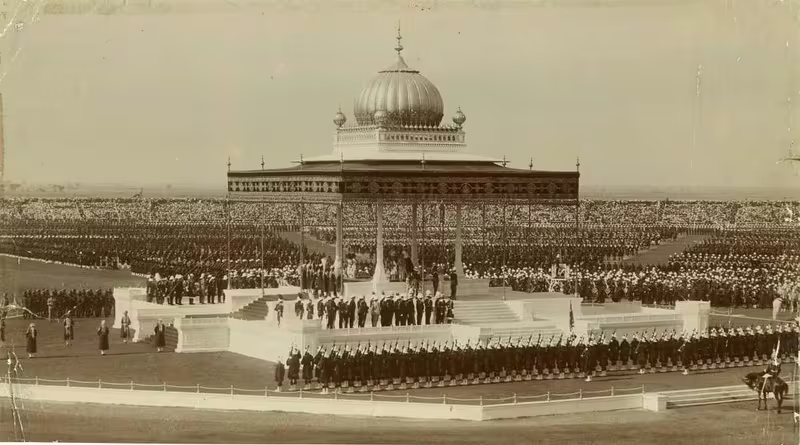
Overview
On 1 January 1877, Delhi became the setting for an imperial ceremony proclaiming Queen Victoria Empress of India. The assembly inaugurated a pattern that would be repeated in 1903 and 1911: a vast public performance in which the British monarchy, the Viceroy, Indian princes, military forces and colonial officials were brought together to display the structure of the British Empire in India.
The term Durbar came from the Persian word for a royal court. The Delhi Durbar was also called the Imperial Durbar. These assemblies were organised by the British Raj at Coronation Park, Delhi, to mark the accession or coronation of a British monarch as Emperor or Empress of India. Although the ceremonies presented imperial rule as stable and widely supported, they also became occasions for political statements, disagreement and the public demonstration of Indian aspirations.
Three Durbars were held, in 1877, 1903 and 1911. The first was associated with Queen Victoria, the second with King Edward VII and the third with King George V and Queen Mary. George V was the only reigning British sovereign to attend one in person. At the earlier ceremonies, the monarch was represented by the Viceroy or another member of the royal family.
The Durbars combined ceremony with administration and entertainment. Their programmes included proclamations, homage from Indian rulers, military reviews, banquets, balls, exhibitions and public appearances. The 1911 gathering also announced two major political decisions: the transfer of India's capital from Calcutta to Delhi and the annulment of the partition of Bengal. Yet the imperial system represented by the Durbars could not survive the growth of Indian nationalism and the eventual independence of India and Pakistan after the Second World War.
Background
The Delhi Durbar belonged to the political world of the British Raj, in which the British Crown ruled India through the Viceroy, the colonial administration and relationships with the princely states. The ceremony was intended to make imperial authority visible. Indian maharajas and nawabs attended alongside British officials, military leaders and other dignitaries, creating a carefully ordered image of loyalty and hierarchy.
The first Durbar followed the British decision to proclaim Queen Victoria Empress of India. It began on 1 January 1877 and was organised under the direction of Thomas Henry Thornton. Lord Lytton, the Viceroy of India, presided over the event. Maharajas, nawabs and intellectuals were present, but the gathering was primarily official rather than a mass popular occasion.
The political message of the first Durbar was expressed in the language of imperial benevolence. Queen Victoria's message spoke of close affection between the Crown and the people of India and promised that liberty, equity and justice would be secured under British rule. It presented the empire as an institution committed to prosperity and welfare.
The occasion also exposed a different political reality. Ganesh Vasudeo Joshi, speaking on behalf of the Poona Sarvajanik Sabha, appeared in homespun white khadi and read a carefully worded demand that India should receive “the same political and social status as is enjoyed by her British subjects.” The request was respectful in form, but its implications were substantial. It placed equality and political rights within an imperial ceremony designed to affirm British supremacy.
The 1877 Durbar was later criticised because funds were directed towards the event during the Great Famine of 1876–78. The contrast between imperial spectacle and widespread suffering contributed to the controversy surrounding the assembly.
Prelude
The second Durbar was planned for the coronation of King Edward VII and Queen Alexandra. It began on 1 January 1903, during the viceroyalty of Lord Curzon. Curzon designed the proceedings in meticulous detail and turned the gathering into a much larger and more elaborate spectacle than the official assembly of 1877.
Preparations transformed a deserted plain outside Delhi into a temporary city. The grounds contained an extensive tented settlement, a light railway for spectators, a post office with its own stamps, telephone and telegraph facilities, shops, a hospital, a magistrate's court and a police force with specially designed uniforms. Sanitation, drainage and electric lighting were also installed. Maps of the camping ground and souvenir guidebooks were distributed, while special medals and postal issues were created for the event.
Edward VII did not travel to India. To represent him, his brother, the Duke of Connaught and Strathearn, arrived by train from Bombay with other dignitaries. Curzon and his government travelled from Calcutta in the opposite direction. The arrangement illustrated the central role of the Viceroy in representing the Crown in India before a reigning monarch attended in person.
The third Durbar followed a royal proclamation of 22 March 1911. It was arranged to commemorate the coronation of King George V and Queen Mary and to allow them to be proclaimed personally as Emperor and Empress of India. Governors and the rulers of the princely states were summoned to attend and pay homage.
George V and Queen Mary left Portsmouth on 11 November aboard the RMS Medina. They reached Delhi on 7 December, where a grand State Entry took place through the city gates. Fifty thousand troops participated, led by Sir O'Moore Creagh, the Commander-in-Chief of India. The King rode an Australian charger in military uniform and a plumed pith helmet. The crowd had expected an elephant and a crown, and the actual appearance therefore disappointed some spectators. Queen Mary followed in an open carriage.
The Event
The 1877 Durbar
The Proclamation Durbar began on New Year's Day, 1877. Lord Lytton presided over the gathering, which included Indian princes, nobles and intellectuals. A medal commemorating Queen Victoria's proclamation as Empress of India was struck and distributed to honoured guests. Ramanath Tagore, described as elderly at the time, was raised to the status of honorary Raja by Lytton.
The ceremony was presented as a bond between the British monarch and the people of India. Queen Victoria's message emphasised affection, justice and the improvement of Indian welfare. The promise of equal political and social status voiced by Ganesh Vasudeo Joshi, however, gave the event another meaning. In the middle of an imperial celebration, an Indian political organisation had publicly articulated a demand that anticipated the later rise of the Indian National Congress and the independence movement.
Unlike the later Durbars, the 1877 assembly was not a mass popular celebration. Its main participants were official representatives, rulers and invited dignitaries. Its importance lay less in the scale of its public entertainment than in the establishment of the imperial format and the political language surrounding it.
The 1903 Durbar
The 1903 Durbar began on 1 January and continued through two weeks of festivities. It was designed to display imperial order on an enormous scale. The temporary city included systems of transport, communication, policing, commerce, public health and entertainment. The arrangements made the Durbar a carefully managed urban and technological display as well as a court ceremony.
Indian princes arrived with retinues from across the country. Many of them met one another for the first time at the gathering. They appeared in jewels drawn from family collections accumulated over centuries. The Indian armies, assembled under Commander-in-Chief Lord Kitchener, paraded and played their bands while controlling the large crowds.
On the first day, Curzon and the maharajas entered the ceremonial area on elephants. Some elephants carried enormous gold candelabra fixed to their tusks. The procession gave visual form to the connection between imperial authority and the Indian princely order.
The central ceremony was followed by polo and other sports, dinners, balls, military reviews, concerts, bands and exhibitions. Newspapers, artists and photographers from around the world covered the event. Film footage was shown in temporary cinemas across India, and the popularity of these screenings is often associated with the beginnings of the country's early film industry.
The event also created new forms of commercial and commemorative culture. India Post issued two commemorative souvenir sheets with a special cancellation at noon on 1 January 1903. The final celebration was a grand coronation ball, attended only by the highest-ranking guests and presided over by Lord and Lady Curzon. Lady Curzon was noted for her jewels and peacock gown.
The 1911 Durbar
The 1911 Durbar was held on Tuesday, 12 December at Coronation Park. A semi-circular grandstand accommodated 10,000 government officials and dignitaries. Behind it, an artificial mound provided seating for 50,000 local people.
George V and Queen Mary arrived wearing their Coronation robes. The King-Emperor wore the Imperial Crown of India, a crown containing 6,100 diamonds as well as sapphires, emeralds and rubies. It had eight arches, a velvet and miniver cap, and weighed 34 ounces, or 965 grams.
The Delhi Herald Extraordinary, Brigadier-General William Peyton, read the royal proclamation in English. Captain Malik Umar Hayat Khan, the Assistant Herald, followed with a reading in Urdu. The royal couple then received homage from the Indian princes. Among those who paid homage was the Begum of Bhopal, one of the few women rulers identified in the ceremony's account.
A moment involving the Gaekwar of Baroda, Maharajah Sayajirao III, attracted controversy. He approached the royal couple without his jewellery, made a simple bow and turned his back as he left. At the time, his conduct was interpreted as a sign of dissent towards British rule. The episode showed how a ritual of homage could also provide an opportunity for political symbolism.
After the homage, George V and Queen Mary moved to the domed royal pavilion. The King-Emperor announced that India's capital would be transferred from Calcutta to Delhi. The annulment of the partition of Bengal was also announced. When the royal couple departed, the enthusiastic crowd surged into the arena.
Key Phases
The Durbars followed a recurring sequence:
- Imperial proclamation: The British monarch's accession, coronation or imperial title was publicly marked.
- Royal or viceregal arrival: The representative of the Crown entered through an elaborate procession.
- Princely homage: Indian rulers paid respect to the monarch or the royal representative.
- Military display: Troops, cavalry, bands and regimental colours demonstrated the strength and organisation of the Raj.
- Public festivities: Sports, exhibitions, dinners, balls, films and public appearances extended the ceremony beyond the official audience.
- Political messaging: Imperial promises, administrative announcements and signs of Indian disagreement appeared within the proceedings.
Turning Points
The most important political turning point of the 1911 ceremony was the announcement of the capital's transfer from Calcutta to Delhi. The declaration connected the British administration with a city strongly associated with earlier imperial and royal traditions.
A second turning point came from the announcement that the partition of Bengal would be annulled. Both decisions gave the 1911 Durbar consequences beyond the celebration of George V's coronation.
The 1877 speech by Ganesh Vasudeo Joshi was another important moment. It inserted a demand for political and social equality into a ceremony created to affirm imperial authority. In 1911, Sayajirao III's conduct was interpreted as dissent, demonstrating that princely participation did not always mean complete political agreement.
Participants
The British Crown and Colonial Administration
Queen Victoria was proclaimed Empress of India at the 1877 Durbar, though she did not attend. Lord Lytton represented the imperial government as Viceroy.
At the 1903 Durbar, King Edward VII was represented by the Duke of Connaught and Strathearn. Lord Curzon, the Viceroy, was the principal organiser and presiding figure. His administration created the temporary city and the detailed programme of ceremonies.
George V and Queen Mary attended the 1911 Durbar in person. Their presence gave the ceremony a status the earlier gatherings had not possessed. George V was the only reigning British monarch to attend a Delhi Durbar.
Indian Princes and Rulers
The maharajas and nawabs were central to the Durbars. Their attendance allowed the British to present the princely states as participants in a broad imperial order. They appeared in processions, paid homage, joined ceremonial gatherings and brought large retinues.
At the 1903 Durbar, the princes' jewels and public splendour became part of the spectacle. At the 1911 Durbar, rulers were formally received by the King and Queen. The Begum of Bhopal's participation was especially notable because she was a woman ruler. The Gaekwar of Baroda, meanwhile, became associated with a gesture understood at the time as dissent.
Indian Political Voices
Ganesh Vasudeo Joshi represented the Poona Sarvajanik Sabha in 1877. His use of homespun white khadi and his demand for equality connected the formal ceremony to emerging Indian political organisation.
The later independence movement made it increasingly difficult for the Raj to stage an imperial celebration without confronting opposition. By the proposed Durbar of 1937 or 1938, the Indian National Congress had become a major political force and had already demonstrated its willingness to boycott the event.
Aftermath
The 1911 Durbar continued beyond the central ceremony. On 13 December, George V and Queen Mary appeared at a balcony of the Red Fort in a Jharokha Darshan, a public appearance associated with Mughal emperors. Half a million or more ordinary people came to greet them.
On 14 December, the King-Emperor presided over a military review involving 40,000 troops. The proceedings culminated in a major cavalry charge. An investiture followed at Delhi Park, where Queen Mary was the first recipient of the Order of the Star of India. A total of 26,800 silver Delhi Durbar Medals were awarded to British and Indian Army personnel who participated in the event. Two hundred gold medals were also struck, with one hundred intended for Indian princely rulers and the highest-ranking government officers.
The royal couple then spent ten days in Nepal, where George V went tiger hunting. After travelling through India by train to Bombay, they left on 10 January aboard the RMS Medina.
The event also had a cinematic afterlife. With Our King and Queen Through India, released in 1912 and also known as The Durbar in Delhi, recorded the journey and ceremony using the early colour process Kinemacolor.
The Proposed Durbar of 1937 or 1938
A fourth Durbar was considered after the accession of Edward VIII in January 1936. In his first and only speech from the throne at the State Opening of Parliament in November that year, Edward announced that he intended to attend a Durbar in Delhi during the winter after his coronation.
Edward abdicated in December 1936. It was initially suggested that his brother, George VI, might continue with the plan. Lord Zetland, the Secretary of State for India, and Lord Linlithgow, the Viceroy, supported the idea. George VI's doctors and Prime Minister Stanley Baldwin, however, believed that travel to India after his coronation would place too great a strain on his health. On 9 February 1937, the visit was postponed until “a later date.”
The political situation in India also changed rapidly. The Government of India Act 1935 had introduced limited steps towards self-government. In the 1937 provincial elections, the Indian National Congress won control in seven of eleven provinces. Congress made clear that it would boycott the Durbar and refuse to vote funds for it.
Linlithgow warned Zetland that the King should be told to expect “unpleasantness” if he visited India. Jawaharlal Nehru told the Indian press that if the British Government wished to protect the King from an “untoward incident”, it should keep him in England.
Financial arguments became the official basis for further delay. The proposed visit was estimated to cost £1 million, a cost that would fall on the central government of India. In February 1938, George VI was formally advised to postpone the visit until the international situation was more settled and the financial outlook clearer. The Second World War and the movement towards Indian independence ultimately made a royal Durbar nearly impossible.
Historical Significance
The Durbars were designed to strengthen British rule by displaying the Crown's authority and the loyalty of India's princely rulers. The 1911 ceremony generally achieved this immediate purpose, as the princes pledged their fealty and later supported the British during the First World War.
Their political meaning, however, extended beyond imperial success. The assemblies created a stage on which Indian political aspirations could be voiced. Joshi's demand in 1877 demonstrated that the imperial language of justice and equality could be turned against colonial inequality. The controversies surrounding the 1877 famine, Sayajirao III's conduct in 1911 and the Congress opposition to the later proposed Durbar all reveal the limits of imperial spectacle.
The Durbars also linked political power with modern systems of communication and mass culture. The 1903 event used railways, telephones, telegraphs, electric lighting, printed maps, postal souvenirs and film. The 1911 Durbar was recorded in colour film and presented the monarchy to audiences far beyond those physically present in Delhi.
The transfer of the capital from Calcutta to Delhi was the most enduring administrative decision announced at a Durbar. It placed Delhi at the centre of the colonial state and connected British rule with the city's earlier imperial associations.
Legacy
Today, Coronation Park is sometimes used for major religious festivals and municipal conventions. The thrones used by George V and Queen Mary in 1911 are displayed at the Marble Hall Gallery and Museum in Rashtrapati Bhavan.
The Durbars remain important for understanding how the British Raj represented itself. Their processions, uniforms, jewels, military reviews and temporary architecture expressed a hierarchy in which the British Crown stood at the centre and Indian princes occupied carefully defined positions around it.
They are also remembered as spaces of contradiction. The 1877 ceremony celebrated imperial sovereignty during the Great Famine. The 1903 spectacle displayed administrative efficiency and extraordinary wealth. The 1911 gathering presented princely loyalty while also producing a controversial gesture of dissent and announcing major political changes. The proposed 1937–38 Durbar showed how quickly the imperial ritual had become politically difficult once mass nationalist politics had expanded.
The emergence of independent India and Pakistan after the Second World War ended the political world that had made the Durbars possible. The imperial court in Delhi was therefore not merely discontinued; it was rendered obsolete by the collapse of the colonial framework it had been created to celebrate.
Historiography
The Durbars can be interpreted in two connected ways. From the perspective of the British Raj, they were carefully organised instruments of imperial legitimacy. The ceremonies brought together the Crown, the Viceroy, the army and the princely states, and the 1911 gathering appeared to confirm continued support for British rule.
From an Indian political perspective, the same ceremonies exposed the gap between imperial promises and colonial realities. Queen Victoria's language of liberty, equity and justice stood beside Joshi's demand that Indians should enjoy the political and social status of British subjects. The famine controversy further challenged the image of an empire devoted to Indian welfare.
Historians and commentators have also examined the Durbars as spectacles of representation. The 1903 temporary city, the ceremonial elephants, the royal jewels, military parades, postal souvenirs and early films transformed political authority into something that could be seen, bought, photographed and screened. The public performance was therefore central to the imperial message.
The proposed Durbar of 1937 or 1938 adds a final dimension. Its postponement was initially explained through health and finance, but the political strength of the Congress and the prospect of nationalist opposition made a royal visit increasingly difficult. The episode illustrates how the ritual of imperial unity lost its force as the independence movement grew.