Overview
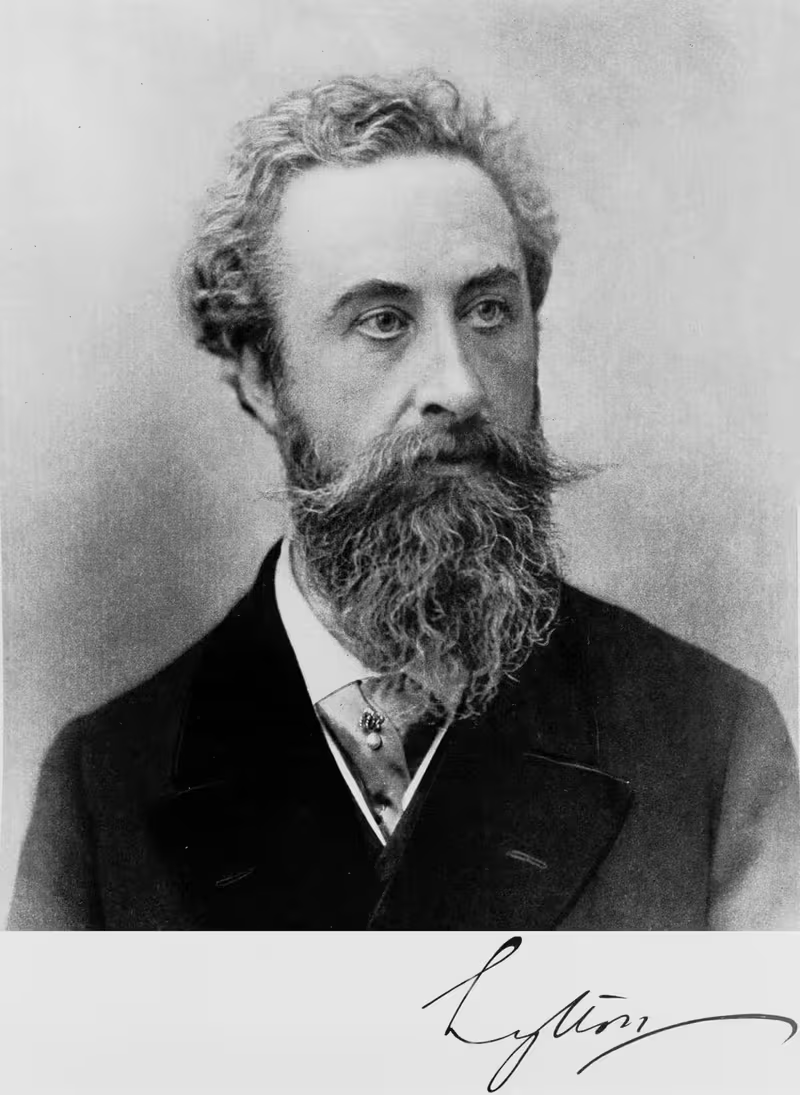
On 14 March 1878, the Viceroy's Council unanimously passed the Vernacular Press Act in British India. Proposed by Viceroy Lord Lytton, the measure was designed to restrict criticism of colonial policies in newspapers published in Indian languages. Because English-language publications were excluded, the law treated the vernacular press differently from the English press and became a clear expression of colonial discrimination.
The Act was introduced during a period of growing political tension. Opposition had intensified with the beginning of the Second Anglo-Afghan War, while public criticism also focused on Lytton's policies, including the Delhi Durbar of 1877, held when India was suffering severe famine. The legislation was soon known as “The Gagging Act.”
Background
The revolt of 1857 had already made the colonial government suspicious of the press. After the revolt, demands arose in England for tighter control over published criticism. As Indian-language newspapers became more assertively nationalist, colonial officials increasingly discussed ways to regulate what they described as seditious writing and the creation of unhappiness among the people.
The Act was modelled on Irish press laws. Its purpose was not simply to regulate printing in general, but to control publications in “Oriental languages.” English-language newspapers were left outside its main operation. The measure applied across much of British India, though the extract describing the law identifies an exception for the South.
Prelude
The government moved quickly to pass the bill, limiting the opportunity for public reaction. It was not published in the usual papers in Calcutta, and newspapers in the North-Western Provinces were slow to learn its exact provisions. Even two weeks after the Act came into force, some northern papers were still uncertain about what it contained.
The lack of advance publicity did not prevent resistance. Once publishers and political associations understood the law, criticism spread among newspapers and across social and religious communities.
The Event
The Act gave the government extensive powers over the vernacular press. Officials were to keep regular watch over Indian-language newspapers. If a report was judged seditious, the newspaper could be warned.
A district magistrate could require the printer and publisher of a vernacular newspaper to enter into a bond promising not to provoke disaffection against the government or hostility between people of different religions, castes, or races. Printers and publishers could also be ordered to provide a security deposit. If the rules were broken, that deposit could be forfeited; a repeated violation could lead to the confiscation of printing equipment.
The magistrate's decision was final, with no appeal to a court of law. Publications could receive exemption by submitting proofs to a government censor. This precensorship power was later opposed, and the government appointed a press commissioner to provide what it considered authentic and accurate news to the press.
Key Phases
The first phase was enactment on 14 March 1878. The second consisted of the law's implementation and the rapid response of newspapers and public associations. In October 1878, the Act was modified in a minor respect: publishers were no longer required to submit proofs before publication, although the bail-bond requirement remained.
Turning Points
A major turning point was the decision of the Amrita Bazar Patrika in Calcutta to become an all-English weekly within a week of the Act's passage. This allowed it to avoid the law's discrimination against Indian-language publications. Meanwhile, several Bengali journals appeared and disappeared in quick succession, often failing to gain support because of their weakness of language and thought.
Participants
Colonial Government
Lord Lytton and the Viceroy's Council initiated and passed the measure. District magistrates received the central enforcement powers, including the authority to demand bonds, require security, and act against newspapers judged to have violated the law.
Indian Press and Public Associations
The Indian-language press became the principal target and one of the most persistent centres of opposition. Proceedings were instituted against Som Prakash, Bharat Mihir, Dacca Prakash, and Samachar. Native associations of different religions, castes, and creeds denounced the Act, while prominent leaders in Bengal and India called it unwarranted and unjustified.
The Indian Association was among the Act's strongest critics. It demanded that an editor accused of sedition should receive a judicial trial, but the colonial government never conceded this crucial demand.
Aftermath
Newspapers continued criticising the Act, and protests remained active. The succeeding administration of Lord Ripon reviewed the developments produced by the measure and finally withdrew it in 1881. The repeal ended the law, but not the resentment it had created.
Historical Significance
The Vernacular Press Act revealed the unequal political status of English and Indian-language journalism under colonial rule. By exempting English publications while imposing extensive controls on vernacular newspapers, it connected press freedom with the broader struggle against racial and political discrimination.
Its enforcement also encouraged cooperation among associations and leaders across religious and social divisions. Although the Act was repealed, the opposition surrounding it helped strengthen India's growing independence movement.
Legacy
The law is remembered both for its censorship provisions and for the resistance it provoked. Its nickname, “The Gagging Act,” captured the widespread view that the colonial government was attempting to silence public debate. The episode also demonstrated how newspapers could respond creatively to restrictive legislation, as shown by the transformation of the Amrita Bazar Patrika.
Historiography
The Act is generally interpreted as a colonial attempt to manage criticism at a moment of political anxiety. Its stated concern with seditious writing and social tension stood alongside a structure that singled out Indian-language publications. The demand for judicial trial in sedition cases, which the government rejected, remains central to understanding why the measure was regarded by its opponents as unjustified.