Gondi Language: A South-Central Dravidian Tradition
In 1928, Munshi Mangal Singh Masaram designed a native writing system for Gondi based on Brahmi characters and arranged in the format of an Indian alphasyllabary. His work forms part of a broader history of Gondi writing that also includes Devanagari, Telugu, and the Gunjala Gondi Lipi. The latter is associated with manuscripts dating up to 1750 and was identified by researchers from the University of Hyderabad.
Gondi, natively known as Koitur, Kōītōr, or Koi, is a South-Central Dravidian language spoken chiefly in Madhya Pradesh, Maharashtra, Chhattisgarh, Andhra Pradesh, and Telangana, with smaller communities in neighbouring states. About three million people speak it, but the language is highly endangered: only about one fifth of Gonds speak Gondi. Its cultural record includes rich folk literature, especially wedding songs and narrations. At the same time, language shift, education, employment, and sustained contact with dominant regional languages have placed considerable pressure on its continued use.
Origins and Classification
Linguistic Family
Gondi belongs to the South-Central Dravidian branch of the Dravidian language family. It is the largest minor Dravidian language by number of speakers. Gondi people are ethnically related to the Telugus, and Gondi has long existed in multilingual regions where Dravidian and Indo-Aryan languages come into contact.
The language has developed features that distinguish it from its Proto-Dravidian ancestor. One notable development is the presence of aspirated stops. Gondi dialects also preserve differences in the treatment of consonants and in the development of particular sounds.
Origins
The precise date and place at which Gondi emerged are not established in the available historical record. Its classification connects it with Proto-Dravidian, while its present distribution is concentrated across central and southern India. The language is spoken among Gondi communities spread across several states rather than within a single compact administrative region.
Name Etymology
The name Gond, used by outsiders, has an uncertain origin. One proposal connects it with the Dravidian word kond, meaning “hill,” and compares it with the Khonds of Odisha. Another theory, recorded in the Worldmark Encyclopedia of Cultures and Daily Life, holds that the Mughal dynasty used the term Gond, meaning “hill people,” for the group during the sixteenth to eighteenth centuries.
Gondi speakers call themselves Koitur or Koi. The origin of these names is also uncertain.
Historical Development
Early Dravidian Inheritance
Gondi developed within the South-Central Dravidian language group and retains features associated with its Dravidian history. The Hill-Maṛia dialect has a uvular sound /ʁ/ that corresponds to a sound represented as r̠ in other Dravidian languages or to Proto-Dravidian t̠. This uvular sound contrasts with an alveolar r that corresponds to Proto-Dravidian r.
Regional Diversification
Gondi has several important dialects, including Dorla, Koya, Madiya, Muria, and Raj Gond. Most dialects remain inadequately recorded and described. Differences between northwestern and southeastern varieties include the treatment of the original initial s. Northern and western Gondi generally preserve it, while varieties farther south and east change it to h or lose it altogether.
Other dialectal differences include the alteration of initial r to initial l and changes in which e and o become a. In 2015, the ISO 639 code for “Southern Gondi,” ggo, was deprecated and divided into Aheri Gondi and Adilabad Gondi.
Modern Period
Language shift has strongly affected Gondi. By the 1920s, half of Gonds had stopped speaking the language entirely. In the 1970s, Gondi youth in areas with increasing contact with wider society had also stopped speaking it, regarding it as a relic of earlier times.
Hindi, Chhattisgarhi, Marathi, and Odia exert particular pressure through their use in education and employment. Gond households may adopt a more prestigious regional language, after which children become monolingual in that language. Continued contact with Indo-Aryan languages has produced extensive borrowing in Gondi vocabulary, grammar, and syntax.
Scripts and Writing Systems
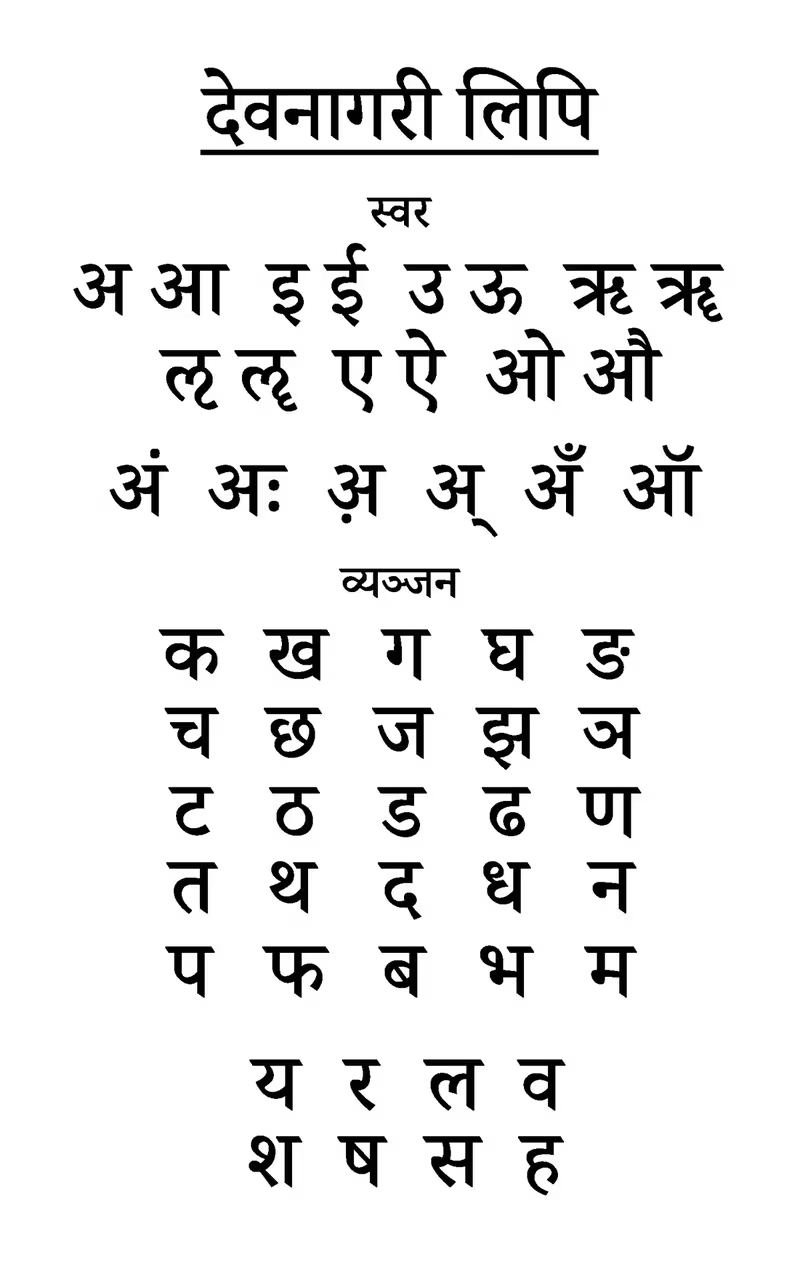
Devanagari and Telugu
Because no native script has achieved widespread use, Gondi is often written in Devanagari and Telugu scripts. The Gondi version of Article 1 of the Universal Declaration of Human Rights is presented in Devanagari, together with a Romanised form using ISO 15919.
The beginning of the Northern Gondi text is:
सब् माने कुन् गौरव् अरु अधिकार् ना मांला ते जनंजात् सुतन्तर्ता अरु बराबर् ता हक् पुट्ताल।
Its Romanisation begins:
Sab māne kun gaurav aru adhikār nā māmlā tē janamjāt sutantartā aru barābar tā hak puṭtāla.
Masaram Gondi Script
In 1928, Munshi Mangal Singh Masaram designed a native script based on Brahmi characters. It follows the format of an Indian alphasyllabary. The script did not become widely used, although it is being encoded in Unicode. The continued fact that most Gonds remain illiterate has also limited the spread of written Gondi.
Gunjala Gondi Lipi
A separate native writing system, generally called Gunjala Gondi Lipi, is associated with manuscripts dating up to 1750. A group of researchers from the University of Hyderabad discovered the writing tradition. According to the Maharashtra Oriental Manuscripts Library and Research Centre of India, a dozen manuscripts were found in the script.
Awareness and promotion programs are in development. Gunjala Gondi Lipi has gained prominence, and efforts are being undertaken in villages of northern Andhra Pradesh to widen its use.
Geographic Distribution
Historical Spread
Gondi is distributed across the central Indian region associated with Gondi communities. It is chiefly spoken in Madhya Pradesh, Maharashtra, Chhattisgarh, Andhra Pradesh, and Telangana, with small minorities in neighbouring states.
Modern Distribution
Large communities of Gondi speakers are found in southeastern Madhya Pradesh, including Betul, Chhindwara, Seoni, Balaghat, Mandla, Dindori, and Jabalpur districts. In eastern Maharashtra, important areas include Amravati, Nagpur, Yavatmal, Chandrapur, Gadchiroli, and Gondia.
In Telangana, communities are concentrated in the northern districts of Adilabad, Komaram Bheem, and Bhadradi Kothagudem. Gondi is also spoken in the Bastar division of Chhattisgarh and Nabarangpur district of Odisha.
Literary Heritage
Folk Literature
Gondi has a rich folk literature. Wedding songs and narrations are specifically noted examples. This oral and performance-based heritage provides an important setting for the language even though most Gondi dialects have not yet been adequately recorded or described.
The bibliography associated with Gondi includes studies of its grammar, vocabulary, folk tales, stories, songs, and folk poetry. A 1917 audio recording of the Parable of the Prodigal Son in Gondi is also associated with the language.
Documentary and Educational Materials
The Universal Declaration of Human Rights provides a published sample of Northern Gondi. Other resources include a Gondi-English-Hindi-Marathi-Telugu dictionary and descriptions of Gondi varieties. Children’s books and online videos have been created as part of more recent revitalisation efforts.
Grammar and Phonology
Key Features
Gondi has a two-gender system. Nouns, or substantives, are classified as masculine or nonmasculine. Certain special words use derivative suffixes to mark gender: -a:l and -o:r for masculine forms, and -a:r for feminine forms.
Plural suffixes are divided according to gender and noun form. -r is used with most masculine nouns, -ir with masculine nouns ending in -e, and -ur with nouns ending in -o or -or. Examples include:
- kānḍī “boy,” kānḍīr “boys”
- kallē “thief,” kallīr “thieves”
- tottōr “ancestor,” tottūr “ancestors”
Nonmasculine nouns use several other suffixes, including -n, -ik, -k, and a null suffix.
Before case markers are added, nouns take an oblique marker. The oblique markers are -d-, -t-, -n-, -ṭ-, and a null marker. For example, kay-d-e means “in the hand.” Genitive markers include -na, -va, and -a. The choice depends on the noun or pronoun: -na follows na:r “village,” -va follows personal and reflexive pronouns, and -a is used elsewhere.
Sound System
Several consonants show context-sensitive pronunciation. The sounds /tʃ tʃʰ dʒ dʒʱ/ may be pronounced as alveo-palatal sounds before non-front vowels in some dialects. /s/ becomes a retroflex sibilant before a retroflex stop.
An alveolar tap /ɾ/ may vary freely with a trill [r]. The pronunciation of /n/ changes according to the following consonant: it is dental before a dental stop, palatal before a palatal affricate, and retroflex before a retroflex stop. Elsewhere, it is alveolar.
The sound /v/ becomes an approximant [w] before rounded vowels. All consonants except /ɽ, ɾ, s, h/ may occur singly or doubled in medial position. In southern and southeastern dialects, initial s is changing into h or disappearing in some varieties.
Influence and Legacy
Contact with Regional Languages
The dominant regional languages affecting Gondi include Hindi, Chhattisgarhi, Marathi, and Odia. Their influence is especially strong in education and employment, and sustained contact has resulted in substantial Indo-Aryan borrowing in Gondi vocabulary, grammar, and syntax.
A survey in Anuppur district found that the local variety known as dehati bhasha, or “rural language,” was in practice a mixture of Hindi and Chhattisgarhi rather than Gondi. This example illustrates the extent of language shift and structural contact in some areas.
Cultural Impact
Gondi remains closely connected with Gondi identity, even though only about one fifth of Gonds speak it. Its wedding songs, narrations, dialects, and writing systems form part of a broader cultural heritage. The development of children’s books, online videos, and programs promoting Gunjala Gondi Lipi reflects continuing efforts to strengthen that heritage.
Royal and Religious Patronage
Mughal Usage of the Name
The Mughal dynasty is associated with one explanation for the outsider name Gond. According to this theory, Mughal usage during the sixteenth to eighteenth centuries applied the term “hill people” to the group. The available account does not describe a broader program of Mughal patronage for the Gondi language.
Written and Oral Preservation
Gondi’s preservation has depended on several forms of cultural transmission. Oral literature includes songs and narrations, while written documentation includes grammatical descriptions, dictionaries, manuscripts, script studies, and recorded texts. These materials complement community-based revitalisation efforts.
Modern Status
Current Speakers
Almost 13 million people identified themselves as Gonds in the 2011 census, but only 2.98 million recorded themselves as speakers of Gondi. The language is therefore highly endangered. Large speaker communities remain in parts of Madhya Pradesh, Maharashtra, Telangana, Chhattisgarh, and Odisha.
Official Recognition
The available record does not identify a state or national official status for Gondi. It does document its use in Devanagari and Telugu, as well as continuing efforts to promote native scripts.
Preservation Efforts
Revitalisation efforts include children’s books and online videos. Programs promoting Gunjala Gondi Lipi are in development, with village-level initiatives in northern Andhra Pradesh seeking to widen its use. Surveys have also found encouraging attitudes among some younger Gonds: one survey reported that younger people had a positive attitude toward speaking Gondi and saving it from extinction, while another found large numbers willing to help develop the language.
Learning and Study
Academic Study
Gondi has been examined through sociolinguistic surveys, grammars, dialect studies, and collections of folk literature. Important grammatical studies include works on Gondi as spoken in the Betul district, an introduction to Gondi grammar, and a descriptive grammar of Gondi.
Resources
Available resources include:
- a Gondi-English-Hindi-Marathi-Telugu dictionary;
- grammatical descriptions and vocabulary collections;
- folk tales, stories, wedding songs, and songs of the Gonds;
- a 1917 audio recording of the Parable of the Prodigal Son;
- children’s books and online videos;
- research on Masaram and Gunjala Gondi writing systems.
Conclusion
Gondi is a major South-Central Dravidian language with a wide distribution across central and southern India, a complex dialect landscape, and a substantial folk tradition. Its grammar includes a two-gender system, distinctive noun morphology, and case marking, while its sound system displays both Dravidian inheritance and developments such as aspirated stops. Gondi is also notable for its varied writing history: it is commonly written in Devanagari and Telugu, while Masaram and Gunjala Gondi Lipi represent native script traditions.
The language faces severe pressure from Hindi, Chhattisgarhi, Marathi, Odia, and other dominant languages. Yet surveys, community initiatives, children’s materials, online videos, and renewed interest in Gunjala Gondi Lipi demonstrate that preservation remains possible. Gondi’s songs, narrations, linguistic diversity, and writing systems continue to express the cultural identity of its speakers.