Overview
Around modern Ramnagar village in Bareilly district, the remains of Ahichchhatra preserve the history of a northern Indian city that endured for more than a millennium. The settlement was the ancient capital of Northern Panchala, a kingdom remembered in the Mahabharata, and later became an important centre of Jain religious activity, pottery production, sculpture, and terracotta art.
The archaeological site includes the remains of a large urban settlement and a mound popularly called the fort. Most of the ancient city lay about half a mile north-east of the modern village, while the fort mound stood about two miles to its west. Excavations have revealed nine strata, extending from a level earlier than the 3rd century BCE to the 11th century CE. Other archaeological work places the beginnings of habitation much earlier, in the middle of the second millennium BCE.
Ahichchhatra is especially valuable because its history is visible through several kinds of evidence: fortifications, pottery, inscriptions, coins, Jain āyāgapaṭas, stupas, pillars, stone sculpture, and exceptionally large terracotta reliefs. The city appears to have reached its greatest prosperity during the Gupta period.
Etymology and Names
The name appears in several forms, including Ahichchhatra, Ahikshetra, Ahikṣetra, and Ahikhet. In Sanskrit, ahi means snake or Nāga, while kṣetra means a region or territory. The name has therefore been interpreted as “the region of the Nāgas,” referring to ancient communities associated with serpent worship.
A local legend connects the name with the story of Adi Raja, described as a Nāga descendant of Vasuki. According to this tradition, Drona found Adi Raja sleeping beneath the protection of a serpent whose expanded hood formed a canopy over him. The future ruler’s sovereignty was supposedly foretold at that moment. The fort is consequently also called Adikot.
The 14th-century Jain text Vividha Tirtha Kalpa, composed by Jain Acharya Jinaprabha Suri, gives Samkhyāvati as an earlier name of Ahichchhatra. In another form, the place is mentioned as Shankavai Samkhyavati. These names reflect the site’s continuing place in Jain sacred geography long after its early political prominence.
Geography and Location
Ancient Ahichchhatra lies near present-day Ramnagar village in Aonla tehsil of Bareilly district, Uttar Pradesh. The remains are spread across an archaeological landscape rather than a single surviving monument. The principal urban area was north-east of the modern village, and the large fort mound was located to its west.
Remote-sensing imagery from Indian Remote Sensing satellites has identified the ruins as triangular in shape. Excavations also uncovered brick fortifications, showing that the settlement was planned and defended at an early stage. Around 1000 BCE, the city covered at least 40 hectares, making it one of the largest known sites associated with the Painted Gray Ware culture.
A large pond lies about two kilometres west of Ahichchhatra, in Jagannathpur village. Local tradition connects it with the Pandavas and their forest dwelling, or vanvas, and places its origin in the time of the Mahabharata. This association belongs to the site’s traditional memory rather than to the securely dated archaeological sequence.
Ancient History
Archaeological evidence suggests that the area was first inhabited in the middle of the second millennium BCE by people associated with the Ochre Coloured Pottery culture. They were followed by communities using Black and Red Ware. By approximately 1000 BCE, Ahichchhatra had become a large settlement associated with the Painted Gray Ware culture.
Evidence of early fortifications from around 1000 BCE indicates that urban development had already begun by this period. The city’s association with Panchala reaches back to late Vedic times, when it served as the capital of Northern Panchala. It is also described as one of the sixteen Mahajanapadas, the major states of ancient India.
The site’s later history is particularly rich in Jain material. Several ancient Jain āyāgapaṭas—ritual or devotional tablets—have been found at Ahichchhatra. The famous Nāṃdighoṣa āyāgapaṭa is dated to the early first century CE, around 15 CE. Twenty-seven Jain inscriptions discovered at the site bear dates earlier than 100 CE, demonstrating the strength of Jain religious activity during the early centuries of the Common Era.
Ahichchhatra also produced coins associated with Achyuta Naga, its last independent ruler. These coins carry the legend “Achyu” on the obverse and an eight-spoked wheel on the reverse.
Historical Timeline
Panchala and Early Urban Development
Ahichchhatra’s earliest urban history is connected with Northern Panchala. Its fortifications and large area around 1000 BCE show that it was already an important settlement during the Painted Gray Ware period. The city’s political role as a Panchala capital endured into the early historic period.
Kushan and Early Common Era Activity
During the early centuries CE, Ahichchhatra supported Jain institutions and developed a distinctive sculptural tradition. Jain temples, images, inscriptions, stupas, and pillars have been attributed to the Kushan and Gupta periods. A Jain temple excavated by Alois Anton Führer was constructed during the rule of an Indo-Scythian dynasty and contained idols dated between 96 and 152 CE.
Gupta Period
The city appears to have reached its height under the Gupta Empire. This period saw intense artistic and industrial activity. Ahichchhatra’s region lacked good-quality stone, so artisans made especially extensive use of terracotta. Temples were decorated with unusually large terracotta relief panels and sculptures, many of them of high quality.
The city also had a specialised pottery area. In the early Gupta period, excavators found very large firing pits, approximately 10 or 12 feet deep. Their scale suggests organised craft production rather than only household manufacture.
The last independent ruler of Ahichchhatra was Achyuta Naga. Samudragupta defeated him, after which Panchala was annexed into the Gupta Empire. This political change connected Ahichchhatra more directly with the expanding Gupta state.
Later History
Occupation continued after the Gupta period. The excavated sequence extends to the 11th century CE, while later Jain literary works preserve memories of the site as a sacred place. The 8th-century Jain text Kaivalyamala, written by Śvetāmbara Acharya Udyotansuri around 778 CE, states that Harigupta of the Gupta Empire took initiation at Ahichchhatra.
The 14th-century Vividha Tirtha Kalpa describes two Jain temples dedicated to Parshvanatha in the area. These references show that the site’s religious importance continued even as its earlier political and urban prominence had faded.
Political Significance
Ahichchhatra’s primary political importance came from its role as the capital of Northern Panchala. Its large size, fortifications, and long occupation reflect the significance of the city within the northern Indian political landscape.
The fortifications are among the clearest signs of its strategic character. The traditional name Adikot preserves the memory of a fortified centre, although the legend of Adi Raja belongs to the realm of local tradition. The discovery of Achyuta Naga’s coins provides more direct evidence of a historical ruling authority at the site.
Samudragupta’s defeat of Achyuta Naga marked the end of Ahichchhatra’s independent political rule and the incorporation of Panchala into the Gupta Empire.
Religious and Cultural Importance
Ahichchhatra is a major Jain pilgrimage site because Jain tradition identifies it as the place where Parshvanatha, the 23rd Tirthankara, attained Kevala Jnana, or omniscience. Jain tradition also holds that all 24 Tirthankaras visited the site and connects its sacred history with Rishabhanatha, the first Tirthankara.
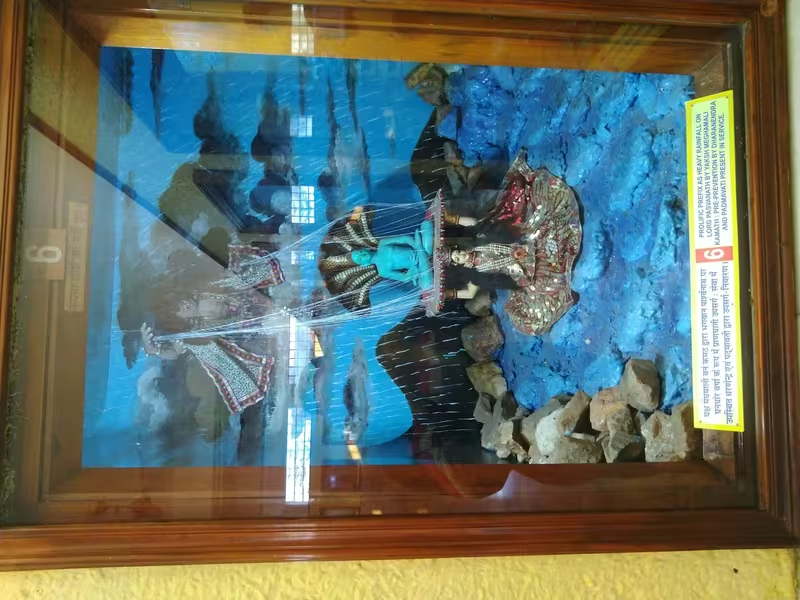
The story of Parshvanatha’s enlightenment at Ahichchhatra includes the intervention of the serpent god Dharanendra and the goddess Padmavati. When Kamath caused continuous rain in an attempt to obstruct Parshvanatha, Dharanendra is said to have formed a canopy of a thousand hoods over him, while Padmavati coiled around his body. Jain temples at Ahichchhatra commemorate this Kevalajñāna kalyāṇaka.
The site’s religious history is also documented through inscriptions and āyāgapaṭas. These objects, along with temple remains and images, reveal a well-established Jain community during the early centuries CE.
Economic Role
Pottery was one of Ahichchhatra’s most important economic activities. The area’s shortage of suitable stone encouraged the development of ceramic and terracotta traditions. In the early Gupta period, a dedicated pottery section contained firing pits as deep as 10 or 12 feet.
Terracotta was not merely a utilitarian material at Ahichchhatra. Artisans used it for large architectural relief panels and sculptures, including temple decoration. The quality and scale of these works make the site important for the study of early Indian terracotta art.
Monuments and Architecture
The principal visible feature of the archaeological landscape is the large mound popularly called the fort. Excavations have identified brick fortifications and urban remains, while the triangular plan of the city has been traced through remote sensing.
The site has also yielded Jain temples, stupas, pillars, images, and āyāgapaṭas. Some discoveries belong to the Indo-Scythian and Kushan periods, while others date from the Gupta era. Many sculptures are now held in different museums.
The modern Ahichchhatra Jain Temple commemorates Parshvanatha’s attainment of omniscience and remains the centre of pilgrimage at the site. The annual Ahichchhatra Jain Mela is held in March.
Archaeological Exploration
Sir Alexander Cunningham briefly explored Ahichchhatra in 1871. The Archaeological Survey of India carried out excavations beginning in 1940, continuing for about five years. The 1940–44 excavations identified Painted Gray Ware at the earliest level then investigated and established a long sequence of occupation.
More recent excavations have pushed the history of the settlement further back, identifying Ochre Coloured Pottery and Black and Red Ware phases before the Painted Gray Ware levels. Together, these discoveries show that Ahichchhatra was not a city created suddenly in the historic period but the result of long-term settlement and urban development.
Modern Status and Access
Ahichchhatra lies near Ramnagar in Bareilly district, approximately 55 kilometres from Bareilly. Rail access is available through Revati Bahoda Khera Station on the Chandausi–Bareilly line, from where vehicles can be taken to Ramnagar and the archaeological area. Buses and other road connections are available from Delhi, Meerut, Aligarh, Lucknow, Kasganj, and Badaun.
The site combines archaeological remains with an active Jain pilgrimage tradition. Its fortifications, ancient settlement layers, terracotta art, inscriptions, and temples make it important both for historical research and for visitors interested in India’s early urban and religious heritage.