Overview
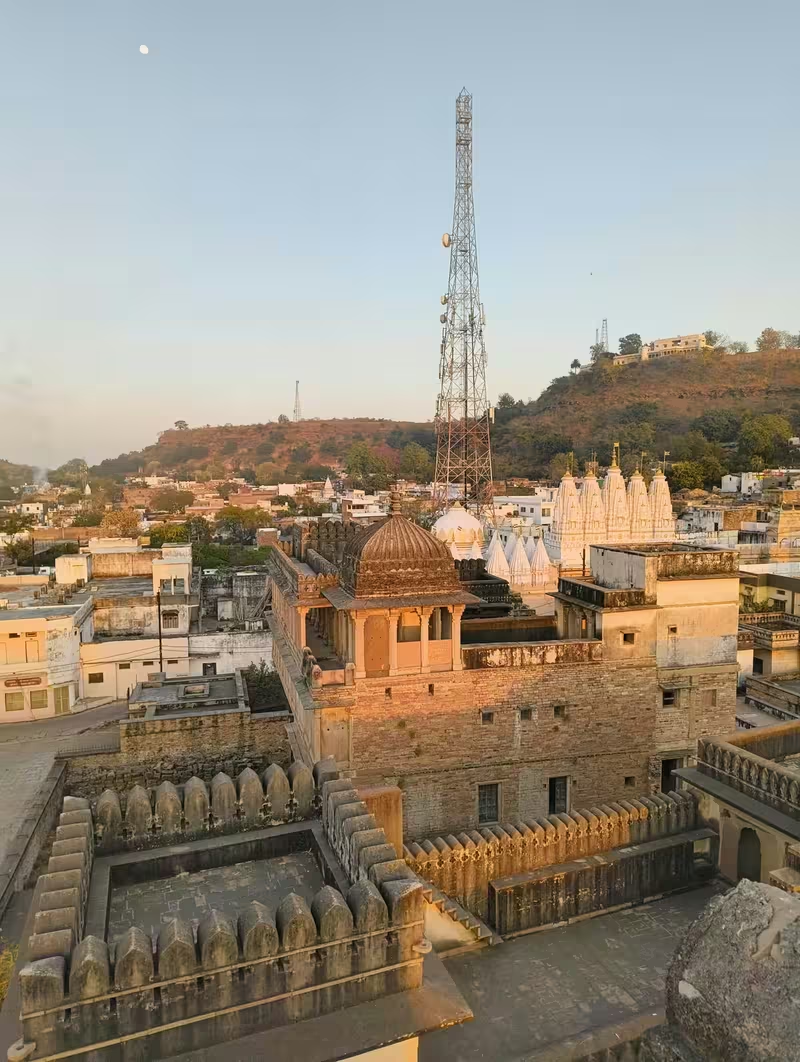
Set among hills southwest of the Betwa River, Chanderi developed as a fortified and contested town in the historical region of Malwa. Its landscape combines hills, lakes, and forests with monuments associated with the Malwa Sultanate and the Bundela Rajputs. Jain temples and pilgrimage sites in and around the town add another long-lasting dimension to its history.
Chanderi’s political story is marked by repeated changes of power. The later Pratīhāra rulers, the Delhi Sultanate, the Malwa Sultanate, Rana Sanga and Medini Rai, the Mughals, Sher Shah Suri, the Bundelas, the Scindias of Gwalior, and the British all became connected with the town. The fort was not merely a monument: it was the focus of several struggles over control of the surrounding region.
The town also preserves important Jain and Sufi traditions. Jain sites nearby include Khandargiri, Thuvanji, Gurilagiri, Bhamon, Bithala, Bhiyadant, and Aamanachar. Within Chanderi, the dargah of Makhdoom Shah-i Wilayat represents a Chishti Sufi lineage established there in the fourteenth century.
Etymology and Names
The historical record presented here does not establish the origin of the name “Chanderi” or list a sequence of earlier names for the town. It is consistently identified as Chanderi in accounts of its medieval, early modern, colonial, and modern history.
Geography and Location
Chanderi lies at approximately 24.72° north and 78.13° east, at an average elevation of 456 metres. It is located in present-day Ashoknagar district in Madhya Pradesh. The town stands 127 kilometres from Shivpuri, 38 kilometres from Lalitpur, 57 kilometres from Ashoknagar, 348 kilometres from Jhansi, and 46 kilometres from Isagarh.
Its setting helped give Chanderi both defensive and cultural importance. Hills surround the town, while lakes and forests form part of its wider environment. The Betwa River lies to the northeast of this hill country. The combination of elevated terrain and access through the surrounding region contributed to Chanderi’s role as a fort city and made it valuable to rulers competing for influence in Malwa.
Ancient and Early Medieval History
The available historical account begins with Chanderi’s prominence in the early second millennium. During the eleventh and twelfth centuries, the town came under the sway of the later Pratīhāra kings. Its existence and regional importance are also reflected in the writings of the Persian scholar Alberuni, who mentioned Chanderi in 1030.
Jain traditions in the area reach further back in material form. The Purana Mandir, a Digambar Jain temple, contains idols of Parshvanatha said to date to the seventh century. The Chandraprabha Digambar Jain Temple has an inscription whose earliest date is 967 CE. These remains indicate that Chanderi and its surrounding area had become part of an established Jain religious landscape well before the town’s major medieval military contests.
Historical Timeline
Delhi Sultanate
In 1251, Ghiyas ud din Balban captured Chanderi for Nasiruddin Mahmud, the Sultan of Delhi. This event placed the town within the expanding political sphere of the Delhi Sultanate and confirms its value as a strategic settlement in central India.
Malwa Sultanate and Medini Rai
Sultan Mahmud I Khilji of Malwa captured Chanderi in 1438 after a siege lasting several months. The prolonged siege reflects the strength or strategic value of the position. Later, Rana Sanga of Mewar conquered much of Malwa, including Chanderi, and appointed Medini Rai as ruler under his authority.
Medini Rai had been a rebellious minister of Sultan Mahmud II of Malwa. Under Rana Sanga’s lordship, he made Chanderi the capital of his kingdom. The town therefore became more than a defended outpost: for a period, it served as the political centre of Medini Rai’s territory.
Mughal and Sur Afghan Rule
Chanderi entered Mughal history during the Battle of Chanderi, when Emperor Babur captured the fort from Medini Rai. The account of the battle is also associated with the Rajput practices of jauhar and saka. According to the historical description, women and children entered a prepared fire during the night, while the men subsequently prepared for a final battle. The men wore saffron garments, chewed tulsi leaves, and fought with the expectation of death. These practices should be understood within the specific martial and social values attributed to the episode, while the human cost of the event remains central to its memory.
Chanderi did not remain permanently under Babur’s control. In 1529, Puran Mal defeated Mughal forces and captured the town. In 1542, Sher Shah Suri took Chanderi and added it to the governorship of Shujaat Khan. Later, Emperor Akbar made the city a sarkar, or administrative division, within the subah of Malwa.
Bundela Rule
The Bundela Rajputs captured Chanderi in 1586. The town was held by Ram Sab, identified as a son of Raja Madhukar of Orchha. In 1646, Devi Singh Bundela was made ruler of Chanderi. The city then remained in the hands of Devi Singh’s family until 1811.
This long Bundela phase forms an important part of Chanderi’s architectural identity. The town is described as being dotted with monuments associated with both the Malwa Sultanate and the Bundela Rajputs, showing how successive ruling traditions remain visible in its built environment.
Scindias, British Rule, and the Revolt of 1857
In 1811, Jean Baptiste Filose annexed Chanderi for Daulat Rao Sindhia, the Maratha ruler of Gwalior. The city was transferred to the British in 1844.
During the Revolt of 1857, the British lost control of Chanderi. British forces recaptured it on 14 March 1858 under Hugh Rose. Richard Harte Keatinge led the assault and received the Victoria Cross for his role. In 1861, Chanderi was transferred back to the Scindias of Gwalior and became part of Isagarh District in Gwalior State.
After Indian independence in 1947, Gwalior became the capital of Madhya Bharat. Madhya Bharat was later merged into Madhya Pradesh on 1 November 1956, placing Chanderi within the modern state’s administrative framework.
Political and Military Significance
Chanderi’s political importance arose from its location, fortifications, and relationship to Malwa. The town was repeatedly targeted by rulers seeking to control central Indian routes and territories. Its history includes a siege by the Malwa Sultanate, a decisive Mughal assault, a short-lived recovery by Puran Mal, and later transfers among the Bundelas, Scindias, and British.
Its role changed according to the ruler who controlled it. Under Medini Rai, Chanderi became a capital. Under Akbar, it was organised as a sarkar in the Malwa subah. Under the Gwalior State, it became part of Isagarh District. These changes show how the town was repeatedly incorporated into larger political systems while retaining its local identity.
Religious and Cultural Importance
Jainism is central to Chanderi’s heritage. The town was a major centre of Jain culture and an important centre of the Parwar Jain community. The Jain Bhattarakas of Mula Sangh, Balatkara Gana, maintained a centre at Chanderi that flourished for several centuries. A lineage of Jain teachers is recorded from Devendrakirti through figures including Tribhuvanakirti, Padmanandi, Yashahkirti, Lalitkirti, Dharmakirti, Padmakirti, Sakalakirti, and Surendrakirti. One branch continued at Sironj.
The dargah of Makhdoom Shah-i Wilayat preserves another important religious tradition. From the fourteenth century, Chanderi was associated with the Chishti Sufi saint Mawlānā Wajīh al-Dīn Yūsuf, who died in 1329. He was a disciple of Shaykh Nizam al-Din Awliya of Delhi and studied with Kamal al-Din of Dhar and Mughith al-Din of Ujjain. In 1325, Nizam al-Din gave Yūsuf a tunic and cap as symbols of spiritual succession.
The saint is locally revered as Makhdoom Shah-i Wilayat. His annual Urs, held from 27 to 29 March, draws devotees to the dargah to offer chaadars and pray. The complex includes the saint’s tomb, a mosque, a khanqah, and inscribed cenotaphs. One cenotaph commemorates Shaykh Barakat, who died on 25 January 1518.
Monuments and Architecture
The Choubeesee Bara Mandir has two sections: the front is known as Bara Mandir and the rear as Choubeesee Mandir. An inscription associates its construction with 1293 CE, or Vikram Samvat 1350. The temple was renovated between the thirteenth and eighteenth centuries. It contains 24 images representing the 24 Tirthankaras. The idols are made from stones corresponding to the traditional colours of the Tirthankaras and are described as having uniform dimensions.
At Khandargiri, a 45-foot carved image of Rishabhnatha dominates the site. Inscriptions indicate that the statue is more than 700 years old. Six caves were cut into the hillside, with carvings of Jain saints and other religious decoration. Cave 6 is identified as the oldest and dates to 1236.
The Thuvanji Jain temple belongs to the ninth century. Its principal image is a light-blue colossal image of Adinath, measuring 36 feet 8 inches. Other large images include two of Parshvanatha, measuring 13 feet 4 inches and 12 feet 6 inches.
The Purana Mandir contains images of Parshvanatha associated with the seventh century, while the Chandraprabha Digambar Jain Temple is dedicated to Chandraprabha, the eighth Tirthankara. Its oldest inscription dates to 967 CE.
Economic Role and Modern City
Chanderi has a good roadway network and lies on State Highway 20 and National Highway 376, with connections to Ashoknagar, Isagarh, Lalitpur, and other towns. It has no railway service in or near the town. Administrative measures were adopted in 2014 for a proposed Northern Railways line on the Pipraigaon–Chanderi–Lalitpur route.
The town is also associated with Chanderi weaving and the Chanderi sari. This textile identity appears in popular culture as well: parts of Sui Dhaaga were filmed in Chanderi, with the film presenting a weaving setup connected with Chanderiyaan Chanderi.
Chanderi had a population of 28,313 in 2001 and 33,190 in 2011. Its historical monuments, Jain sites, Sufi shrine, surrounding landscape, and connections with film have made it a destination where political, religious, and cultural histories meet.
Chanderi in Popular Culture
The 2018 horror-comedy film Stree, starring Rajkummar Rao and Shraddha Kapoor, is set and was filmed in Chanderi. Parts of Sui Dhaaga were also shot there. The television serial Gudiya Humari Sabhi Pe Bhari used locations including the Chanderi bus stand and the area around Kila Kothi. Janhit Mein Jaari is set in Chanderi and was filmed there in major portions. The sequel Stree 2: Sarkate ka Aatank continues the connection between the fictional world of the films and the town.